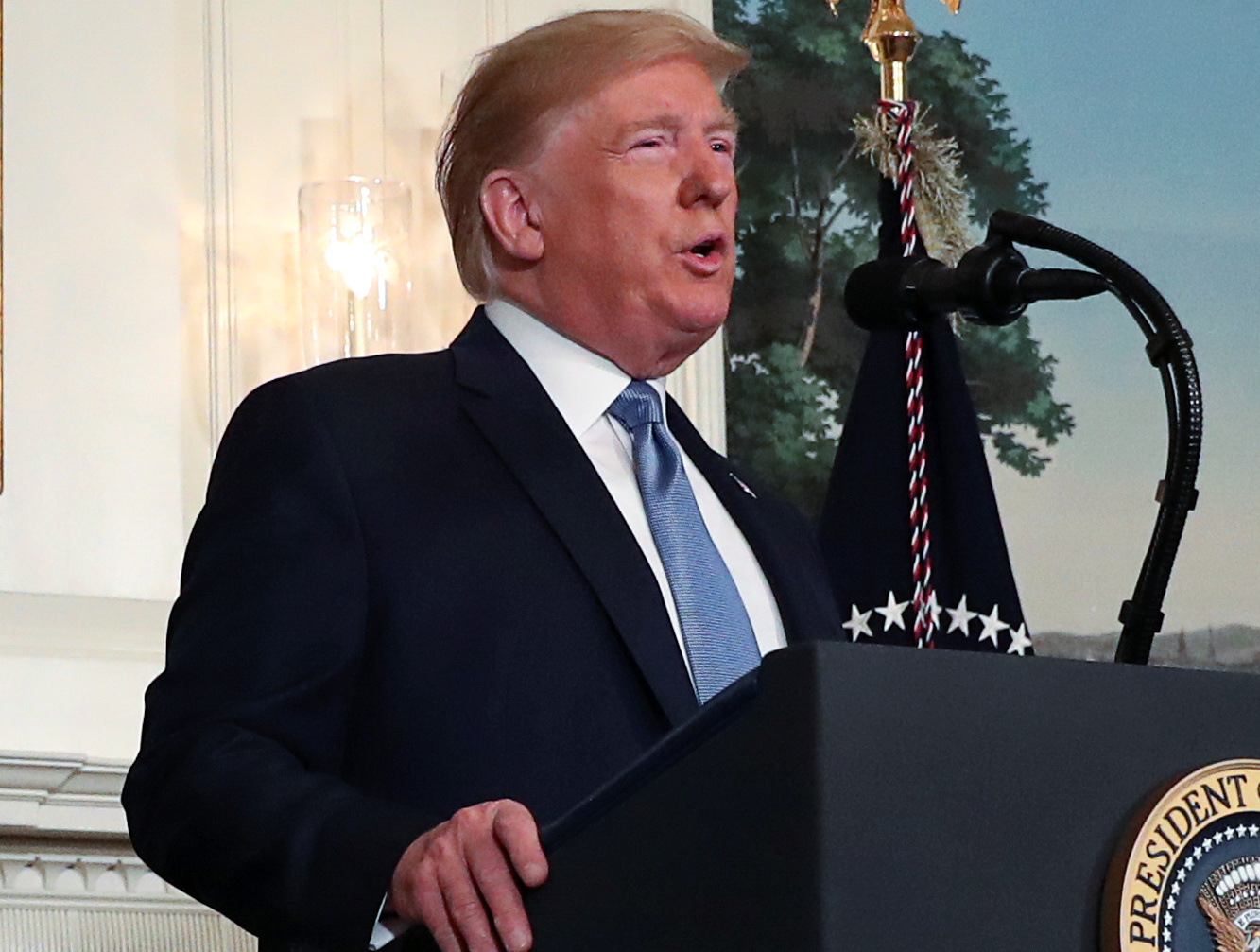
Trump visits mass shooting victims; protesters shout ‘Do something!’

U.S. President Donald Trump deplanes with first lady Melania Trump arriving aboard Air Force One at El Paso International Airport for a visit with victims and first responders in the wake of last weekend's mass shootings in El Paso, Texas, U.S., August 7, 2019. REUTERS/Leah Millis

By Jeff Mason

EL PASO, Texas (Reuters) – U.S. President Donald Trump met victims and first responders from last weekend’s deadly shootings in Texas and Ohio on Wednesday, as chanting protesters accused him of inflaming tensions with anti-immigrant and racially charged rhetoric.

Trump visited hospitals where victims were treated in El Paso, Texas, on the border with Mexico, and in Dayton, Ohio, after massacres 13 hours apart that shocked the country and reopened a national debate on gun safety.

In both cities, crowds of protesters gathered to confront Trump and condemn his visit. Some held signs reading “Trump is racist,” “Love over hate” and “Send him back!”

Chanting crowds in Dayton urged Trump: “Do something!”

The president and first lady Melania Trump avoided the press on both hospital visits and stayed out of public view.

They visited survivors in their hospital rooms at the University Medical Center in El Paso and Miami Valley Hospital in Dayton, and thanked the medical staff and first responders, White House spokeswoman Stephanie Grisham said.

“It was a warm and wonderful visit,” Trump said on Twitter after leaving Dayton. “Tremendous enthusiasm & even Love.”

A pro-Trump demonstrator holds a placard outside the University Medical Center, where U.S. President Donald Trump holds a meeting with first responders in the wake of last weekend's mass shootings at a Walmart store, in El Paso, Texas, U.S., August 7, 2019. REUTERS/Jose Luis Gonzalez

A pro-Trump demonstrator holds a placard outside the University Medical Center, where U.S. President Donald Trump holds a meeting with first responders in the wake of last weekend’s mass shootings at a Walmart store, in El Paso, Texas, U.S., August 7, 2019. REUTERS/Jose Luis Gonzalez

Trump also visited law enforcement personnel at an emergency operations center in El Paso to thank them for their response on Saturday, when a man killed 22 people at a Walmart store, apparently after posting an anti-immigrant manifesto online.

In Dayton, nine people and the suspect were killed in a rampage early on Sunday.

“The job you have done is incredible,” Trump told gathered officers and staff. “I wanted to come and thank you.”

Before leaving Washington, Trump said that in the wake of the shootings he wanted to strengthen background checks for gun purchases and make sure mentally ill people did not carry guns. He predicted congressional support for those two measures but not for Democratic efforts to ban assault rifles.

“I can tell you that there is no political appetite for that at this moment,” Trump told reporters at the White House. “But I will certainly bring that up … There is a great appetite, and I mean a very strong appetite, for background checks.”

Dayton Mayor Nan Whaley and U.S. Senator Sherrod Brown of Ohio, both Democrats, accompanied Trump in Dayton and told reporters they urged him to call on Senate Republican leader Mitch McConnell to bring the Senate back from its summer recess to work on a House-passed bill that expands background checks on gun buyers.

Brown said he asked Trump to promise he would sign that bill. “He only said that we will get things done,” Brown said, adding the president had been “comforting” to the victims.

Whaley said she agreed with Trump’s decision not to visit the district where the shooting occurred given the high emotions in the community.

‘NOT INTERESTED’

“A lot of people that own businesses in that district are not interested in the president being there,” she said. “A lot of the time his talk can be very divisive and that’s the last thing we need in Dayton.”

Trump later criticized the two Democrats for their comments, saying on Twitter the news conference they held was “a fraud. It bore no resemblance to what took place.”

Trump told reporters at the El Paso operations center the two Democrats “should not be politicking today.”

Democrats say Trump’s anti-immigrant, racially charged language at rallies and on Twitter has fanned racist, white nationalist sentiments, creating a political climate that is conducive to hate-based violence.

The massacre in the predominantly Hispanic city of El Paso is being investigated as a hate crime and act of domestic terrorism, authorities said. The FBI said the Dayton shooter also explored violent ideologies.

An open letter to Trump on Wednesday in the El Paso Times described the border city as having “a deep tradition of racial harmony” whose people came together after the tragedy. It admonished Trump for calling El Paso one of the country’s most dangerous cities in his February State of the Union address.

“He’s going to make war between us. Racism is starting to pop up more and more. Mexican people are fed up. He’s going to create chaos around here,” said Fernando Montoya, 45, who joined the protesters at a park in El Paso.

On Monday, Trump gave a speech focusing on mental health reforms, tighter internet regulation and wider use of the death penalty. Democrats accused Trump of hiding behind talk of mental illness and the influence of social media rather than committing to laws to restrict gun ownership.

In Iowa, Democratic presidential front-runner Joe Biden said Trump had “fanned the flames” of white supremacy.

“We have a president with a toxic tongue who has publicly and unapologetically embraced a political strategy of hate, racism, and division,” the former vice president said.

Former Texas congressman and El Paso native Beto O’Rourke, another 2020 presidential contender, said Trump “helped create the hatred that made Saturday’s tragedy possible” and thus “has no place here.”

Asked on MSNBC on Wednesday if Trump is a white supremacist, O’Rourke said: “He is. He’s also made that very clear.”

U.S. Representative Veronica Escobar, a Democrat whose congressional district includes El Paso, declined a White House invitation to join Trump in the city and said that the president “is not welcome here.”

“Members of our community, Hispanics and Mexicans and immigrants, have been dehumanized. That’s the bottom line: we’ve been dehumanized by the president and by his words,” she told the protest rally in El Paso.

Not everyone agreed that Trump should stay away.

“This is not a political visit,” El Paso Mayor Dee Margo told reporters. “He is president of the United States. So in that capacity, I will fulfill my obligations as mayor of El Paso to meet with the president and discuss whatever our needs are in this community.”

(Additional reporting by Nandita Bose, Rich McKay, Susan Heavey and Doina Chiacu in Washington, Barbara Goldberg in New York, Daniel Trotta in El Paso; Writing by John Whitesides; Editing by Howard Goller, Alistair Bell and Sonya Hepinstall)

Heading to El Paso, Trump nixes assault weapons ban, supports stronger background checks

A woman kneels at a memorial three days after a mass shooting at a Walmart store in El Paso, Texas, U.S. August 6, 2019. REUTERS/Callaghan O'Hare

By Nandita Bose and Jeff Mason

WASHINGTON (Reuters) – U.S. President Donald Trump dismissed legislation to ban assault rifles as politically unfeasible on Wednesday as he prepared to visit the sites of two deadly mass shootings that shocked the country and drew criticism of his anti-immigrant rhetoric.

As he left the White House, Trump said he wanted to strengthen background checks for gun purchases and make sure mentally ill people did not carry guns. He predicted congressional support for those two measures but not for banning assault rifles.

“I can tell you that there is no political appetite for that at this moment,” Trump told reporters at the White House. “But I will certainly bring that up … There is a great appetite, and I mean a very strong appetite, for background checks.”

U.S. President Donald Trump speaks to reporters as he departs on travel to Dayton, Ohio and El Paso, Texas following back-to-back mass shootings in the cities, on the South Lawn of the White House in Washington, U.S., August 7, 2019. REUTERS/Kevin Lamarque

U.S. President Donald Trump speaks to reporters as he departs on travel to Dayton, Ohio and El Paso, Texas following back-to-back mass shootings in the cities, on the South Lawn of the White House in Washington, U.S., August 7, 2019. REUTERS/Kevin Lamarque

The president faced an uncertain welcome on Wednesday in Dayton, Ohio, where nine people and the suspect were killed in a rampage early on Sunday and in El Paso, Texas, where 22 people were killed at a Walmart store on Saturday before the gunman was taken alive.

The back-to-back massacres, occurring 13 hours apart, have reopened the national debate over gun safety and led protesters in Dayton to heckle Ohio’s Republican governor, Mike DeWine, at a vigil for the shooting victims with chants of “Do something!”

Dayton Mayor Nan Whaley, a Democrat, said on Tuesday she would welcome the Republican president, who has said he wants to meet law enforcement, first responders and survivors.

But Whaley said she planned to tell Trump “how unhelpful he’s been” on the issue of gun violence, referring to the speech he gave on Monday focusing on mental health reform, tighter internet regulation and wider use of the death penalty.

Critics have said Trump stokes violence with racially incendiary rhetoric. The El Paso massacre is being investigated as a hate crime and the FBI said the Dayton shooter had explored violent ideologies.

Democrats accuse Trump of hiding behind talk of mental illness and the influence of social media rather than committing to laws they insist are needed to restrict gun ownership and the types of weapons that are legal.

In Iowa, Democratic presidential front-runner Joe Biden planned to say, “We have a president with a toxic tongue who has publicly and unapologetically embraced a political strategy of hate, racism, and division.”

In a sign of higher tensions after the shootings, a motorcycle backfiring on Tuesday night in New York’s Times Square sent crowds running for fear of another gun attack. “People are obviously very frightened,” New York Governor Andrew Cuomo told CNN.

Authorities in Texas have said they are investigating Saturday’s shooting spree in the predominantly Hispanic west Texas border city of El Paso as a hate crime and an act of domestic terrorism. They cited a racist manifesto posted online shortly before the shooting, which they attributed to the suspect.

An open letter to Trump on Wednesday in the El Paso Times described the border city as having “a deep tradition of racial harmony” whose people came together after the tragedy. It admonished Trump for calling El Paso one of the country’s most dangerous cities in his February State of the Union address.

“The violence that pierced El Paso, drawing you here today, is not of our own community,” wrote editor Tim Archuleta. “An outsider came here to shatter our city, to murder our neighbors. A white man from another Texas city came to target the more than 80% of us who share Hispanic roots.”

‘SINISTER IDEOLOGIES’

Trump, in his televised White House speech on Monday, condemned “sinister ideologies” and hate. His supporters say Democrats unfairly blame him for the behavior of criminals.

Democrats say Trump’s own anti-immigrant, racially charged language at rallies and on Twitter has done much to fan racist, white nationalist sentiments, creating a political climate more conducive to hate-based violence.

U.S. Representative Veronica Escobar, a Democrat whose congressional district includes El Paso, declared that Trump “is not welcome here.”

Trump staged his first political rally of 2019 in El Paso in February.

She said on Twitter on Tuesday she declined a White House invitation to join Trump in El Paso after being told he was too busy to speak with her by phone in advance. “I refuse to be an accessory to his visit,” Escobar later told CNN.

Former Texas congressman and El Paso native Beto O’Rourke, who is seeking the 2020 Democratic nomination for president, said Trump “helped create the hatred that made Saturday’s tragedy possible” and thus “has no place here.”

In an apparent answer to his criticism, Trump said on Twitter late on Tuesday O’Rourke “should respect the victims & law enforcement – & be quiet!”

Not everyone agreed that Trump should stay away.

“This is not a political visit,” El Paso Mayor Dee Margo told reporters. “He is president of the United States. So in that capacity, I will fulfill my obligations as mayor of El Paso to meet with the president and discuss whatever our needs are in this community.”

(Reporting by Steve Gorman; Additional reporting by Rich McKay, Susan Heavey and Doina Chiacu in Washingon, Barbara Goldberg in New York; Editing by Paul Tait and Howard Goller)

Trump freezes all Venezuelan government assets in bid to pressure Maduro

FILE PHOTO: Venezuela's President Nicolas Maduro speaks during a ceremony to commemorate the Bicentennial of the Battle in the Vargas Swamp at the National Pantheon in Caracas, Venezuela July 25, 2019. Miraflores Palace/Handout via REUTERS

By Matt Spetalnick and Roberta Rampton

WASHINGTON (Reuters) – U.S. President Donald Trump imposed a freeze on all Venezuelan government assets in the United States on Monday, sharply escalating an economic and diplomatic pressure campaign aimed at removing socialist President Nicolas Maduro from power.

The executive order signed by Trump goes well beyond the sanctions imposed in recent months against Venezuela’s state-run oil company PDVSA and the country’s financial sector, as well as measures against dozens of Venezuelan officials and entities.

Trump’s action, the toughest yet against Maduro, not only bans U.S. companies from dealings with the Venezuela government but also appears to open the door to possible sanctions against foreign firms or individuals that assist it.

Russian and Chinese companies are among those still doing significant business in the South American OPEC nation.

“All property and interests in property of the Government of Venezuela that are in the United States … are blocked and may not be transferred, paid, exported, withdrawn, or otherwise dealt in,” according to the executive order released by the White House.

The scope of the announcement came as a surprise even to some Trump administration allies. “This is big,” said Ana Quintana, senior policy analyst with the Heritage Foundation, a conservative Washington think tank.

Quintana said it appeared the order would be a sweeping embargo on doing business with Venezuela, although she was awaiting further details.

Venezuela’s Information Ministry did not respond immediately to a request to comment.

The United States and most Western nations have called for Maduro to step down and have recognized Venezuelan opposition leader Juan Guaido as the country’s legitimate president.

Guaido, accused by Maduro of mounting a U.S.-directed coup attempt, appointed a board for Citgo Petroleum, Venezuela’s most important foreign asset, earlier this year.

DRAMATIC ACTION

Trump said on Thursday he was considering a quarantine or blockade of Venezuela, although he did not elaborate at the time on when or how such a blockade would be imposed.

He is taking more dramatic action after numerous rounds of sanctions failed to turn Venezuela’s military against Maduro or make significant progress in dislodging him.

U.S. officials have long said they had other weapons in their economic arsenal, even as they privately expressed frustration that European partners and others had not taken stronger steps and that the months-long pressure campaign had not made more headway.

Trump said in a letter to Congress the freezing of assets was necessary “in light of the continued usurpation of power by the illegitimate Nicolas Maduro regime, as well as the regime’s human rights abuses, arbitrary arrest and detention of Venezuelan citizens, curtailment of free press, and ongoing attempts to undermine Interim President Juan Guaido.”

His executive order also threatened sanctions against anyone assisting Maduro or his loyalists, suggesting that Washington could resort to so-called secondary sanctions against third-country companies and individuals.

Fernando Cutz, a former top Trump adviser on Latin America, said the executive order could be applied to non-U.S. firms and entities, limiting their ability to do business with Venezuela if they wanted to continue to deal with U.S. companies or banks.

China and Russia continue to trade oil with Venezuela. The move could escalate tensions with China, already inflamed by a tit-for-tat trade war, said Cutz, now a senior associate with the Cohen Group, a consulting firm.

China and Russia – together with Cuba – have continued to back Maduro, prompting U.S. national security adviser John Bolton to warn Beijing and Moscow on Monday against doubling down in their support for him.

Bolton is slated to give a speech on Tuesday morning at a gathering of more than 50 countries in Lima, Peru, that would outline a planned U.S. initiative to lead to a peaceful transfer of power in Venezuela.

Moscow and Beijing turned down invitations to attend.

A White House official declined to comment on the implications of the order for foreign companies doing business in Venezuela, where an economic crisis has driven more than 3 million people to emigrate, fleeing hyperinflation and shortages of food and medicine.

Trump’s order allows exceptions for the delivery of food, medicine and clothing “intended to be used to relieve human suffering.”

(Reporting by Makini Brice, Eric Beech, Matt Spetalnick, Roberta Rampton and Lesley Wroughton; Additional reporting by Angus Berwick in CARACAS; Editing by Sandra Maler and Paul Tait)

Trump denounces white supremacy after shootings, cites video games and internet

U.S. President Donald Trump speaks about the shootings in El Paso and Daytonin the Diplomatic Room of the White House in Washington, U.S., August 5, 2019. REUTERS/Leah Millis

WASHINGTON (Reuters) – President Donald Trump on Monday called for urgent action to prevent gun violence and said all Americans must “condemn racism, bigotry and white supremacy” after mass shootings in Texas and Ohio killed 29 people and wounded dozens.

Trump, whose rhetoric has frequently been condemned as stoking racial divisions, laid out a number of policy options but did not mention his own past remarks.

“These sinister ideologies must be defeated,” Trump said in remarks at the White House. “Hate has no place in America. Hatred warps the mind, ravages the heart and devours the soul.”

On Saturday, a gunman killed 20 people at a Walmart store in El Paso, Texas, in what authorities said appeared to be a racially motivated hate crime. Just 13 hours later, another gunman in downtown Dayton, Ohio, killed nine people.

Trump said mental health laws should be reformed to better identify mentally disturbed individuals and he called for capital punishment for those who commit mass murder and hate crimes.

He said he had directed the Justice Department to work with local authorities and social media companies to detect mass shooters before they strike. He said the Internet, social media and violent video games had helped radicalize people.

Earlier on Monday, Trump had urged lawmakers in a tweet to put strong checks in place on potential gun buyers, suggesting action could be tied with immigration reform. In his remarks at the White House, however, he did not mention immigration.

(Reporting by Roberta Rammpton and Susan Heavey; Writing by Tim Ahmann; Editing by Bill Trott)

Mueller says he did not exonerate Trump, U.S. policy precluded charges

Former Special Counsel Robert Mueller testifies before a House Judiciary Committee hearing on the Office of Special Counsel's investigation into Russian Interference in the 2016 Presidential Election" on Capitol Hill in Washington, U.S., July 24, 2019. REUTERS/Jonathan Ernst

By David Morgan and Jan Wolfe

WASHINGTON (Reuters) – Former Special Counsel Robert Mueller on Wednesday told a dramatic U.S. congressional hearing he had not exonerated President Donald Trump of obstruction of justice and indicated he would have sought his indictment were it not for a Justice Department policy against bringing charges against a sitting president.

Mueller, answering questions publicly for the first time on his inquiry, also defended the integrity of his investigation as he appeared for eagerly anticipated testimony at the first of two back-to-back televised congressional hearings that carry high stakes for Trump and Democrats who are split between impeaching him or moving on to the 2020 election.

(https://www.reuters.com/live/mueller-report)

The former FBI director, who spent 22 months investigating what he concluded was Russian interference in a “sweeping and systematic fashion” in the 2016 U.S. election to help Trump and the president’s conduct, appeared first before the House of Representatives Judiciary Committee.

The committee’s Democratic chairman, Jerrold Nadler, praised Mueller and said no one, including Trump, is “above the law.”

But Trump’s Republican allies on the committee tried to paint Mueller’s investigation as unfair to the president, with Louie Gohmert heatedly telling him “you perpetuated injustice” and conservative congressman Guy Reschenthaler calling the manner in which the inquiry was conducted “un-American.”

Mueller’s 448-page report, released in redacted form on April 18, did not reach a conclusion on whether Trump committed the crime of obstruction of justice in a series of actions aimed at impeding the inquiry, but did not exonerate him.

Democratic Representative Ted Lieu asked Mueller if the reason he did not bring a criminal indictment against Trump was the Justice Department’s longstanding policy crafted by its Office of Legal Counsel against bringing criminal charges against a sitting president.

“That is correct,” Mueller said.

Trump has claimed that the Mueller inquiry resulted in the president’s “complete and total exoneration.”

“Did you actually totally exonerate the president?” Nadler asked Mueller.

“No,” Mueller replied.

Mueller’s then-spokesman Peter Carr and Justice Department spokeswoman Kerri Kupec issued a joint statement on May 29 saying that Attorney General William Barr had previously stated that Mueller “repeatedly affirmed that he was not saying that, but for the OLC (Justice Department Office of Legal Counsel) opinion, he would have found the President obstructed justice.”

Asked at the hearing whether he stood by that May 29 statement, Mueller said, “I would have to look at it more closely.”

Mueller, accused by Trump of heading a “witch hunt” and trying to orchestrate a “coup” against the Republican president, said his inquiry was conducted in “a fair and independent manner” and that members of the special counsel’s team “were of the highest integrity.”

Trump has accused Mueller of having conflicts of interest, including saying Mueller wanted the president to appoint him as FBI director after firing James Comey. Mueller disputed Trump’s account, saying he had not sought the FBI job from Trump. Mueller noted that Justice Department ethics officials confirmed he had no such conflicts.

“Let me say one more thing,” Mueller said. “Over the course of my career, I have seen a number of challenges to our democracy. The Russian government’s effort to interfere with our election is among the most serious.”

The interrogation of Mueller, a reluctant witness who appeared only after being subpoenaed, afforded an opportunity for Americans, who may not have pored over the lengthy and sometimes dense report, to hear his conclusions in a highly charged hearing scheduled by Democrats, with Trump running for re-election in 2020.

‘A LITTLE FAST’

Mueller, 74, was surrounded by news photographers as he took his place in the packed hearing room, showing little apparent emotion as he scanned the scene. Mueller faced a series of rapid-fire questions from lawmakers in both parties, several times asking them to repeat their questions and often referring them to the text of the report itself. Some Republicans interrupted Mueller as he was trying to answer questions.

“That went a little fast for me,” Mueller told Doug Collins, the committee’s top Republican, at one point.

Mueller avoided being drawn into arguments with Republicans who hammered away at his inquiry, often frustrating lawmakers with responses such as “I am not going to get into that.”

“And if I can finish,” Mueller told Republican Matt Gaetz after the congressman interrupted him.

In a comment sure to disappoint Republicans, Mueller said he would not answer questions about the origins of the Russia probe in the FBI before he was named to take over the inquiry in 2017 or about a controversial dossier compiled by a former British intelligence agent. Republicans have tried to portray the investigation as a politically motivated attack on Trump cooked up by Democrats and various enemies.

Mueller was set to testify later in the day before the House Intelligence Committee. Democrats control the House, while Trump’s fellow Republicans control the Senate.

Democrats entered the hearings hoping his testimony would rally public support behind their own ongoing investigations of the president and his administration. Democrats are deeply divided over whether to launch the impeachment process set out in the U.S. Constitution for removing a president from office for “high crimes and misdemeanors.”

Mueller’s inquiry detailed numerous contacts between Trump’s 2016 presidential campaign and Russia at a time when the Kremlin was interfering in the 2016 U.S. election with a scheme of hacking and propaganda to sow discord among Americans and boost Trump’s candidacy.

Mueller’s investigative report said the inquiry found insufficient evidence to establish that Trump and his campaign engaged in a criminal conspiracy with Russia.

‘NOT EXCULPATED’

Democrats focused on five actions by Trump that Mueller had investigated as potential obstruction of justice, including at one point telling his White House counsel to remove the special counsel.

“Obstruction of justice strikes at the core of the government’s efforts to find the truth and to hold wrongdoers accountable,” Mueller testified.

Under questioning by Nadler, Mueller acknowledged that the report detailed “multiple acts by the president that were capable of exerting undue influence over law enforcement investigations, including the Russian interference and obstruction investigations.”

“Well, the finding indicates … that the president was not exculpated for the acts that he allegedly committed,” Mueller told Nadler.

Attorney General William Barr, a Trump appointee, subsequently cleared the president of obstruction of justice after receiving Mueller’s report.

In his opening statement, Mueller reiterated that his team had decided not to make a determination on the question of obstruction. “Based on Justice Department policy and principles of fairness, we decided we would not make a determination as to whether the president committed a crime. That was our decision then and remains our decision today,” Mueller said.

Nadler said in his opening statement that Mueller conducted the inquiry with “remarkable integrity” and was “subjected to repeated and grossly unfair personal attacks.”

“Although department policy barred you from indicting the president for this conduct, you made clear that he is not exonerated. Any other person who acted in this way would have been charged with crimes. And in this nation, not even the president is above the law,” Nadler said.

Republican congressman John Ratcliffe accused Mueller of exceeding his authority in the report’s extensive discussion of potential obstruction of justice by Trump after the special counsel made the decision not to draw a conclusion on whether Trump committed a crime. Ratcliffe agreed that Trump was not above the law, but said the president should not be “below the law” either.

Republican Collins said the facts of the Mueller report are that “Russia meddled in the 2016 election. The president did not conspire with Russians. Nothing we hear today will change those facts.”

“The president watched the public narrative surrounding the investigation assume his guilt while he knew the extent of his innocence,” Collins said. “The president’s attitude towards the investigation was understandably negative, yet the president did not use his authority to close the investigation.”

Republican Representative Steve Chabot said Wednesday’s hearing was the “last, best hope” by Democrats “to build up some sort of groundswell across America to impeach President Trump. That’s what this is really all about today.” Chabot also told Mueller some people thought his report was “a pretty one-sided attack on the president.”

Republican Representative James Sensenbrenner noted that Mueller’s report never referred to actions by Trump as potentially impeachable conduct.

Before the hearing, Trump complained on Twitter that Mueller had not investigated various of the president’s foes including 2016 Democratic presidential candidate Hillary Clinton and, referring to the former special counsel, “HIMSELF.” During the hearing, Trump posted a tweet that quoted a Fox News anchor as calling the hearing a “disaster” for Democrats and Mueller’s reputation.

Mueller’s investigation led to criminal charges against 34 people and three Russian entities. People who were convicted at trial or pleaded guilty included Trump’s former campaign chairman and other aides.

With a no-nonsense reputation, Mueller is a Marine Corps combat veteran from the Vietnam War who later served as a federal prosecutor and became the architect of the modern FBI after the Sept. 11, 2001, attacks on the United States. Mueller served as FBI director from 2001 to 2013 under presidents in both parties.

(Reporting by David Morgan and Jan Wolfe; Additional reporting by Doina Chiacu, Sarah N. Lynch, Makini Brice, Susan Cornwell, Richard Cowanl Patricia Zengerle; Writing by Will Dunham; Editing by Jonathan Oatis)

As new U.S. law frees inmates, prosecutors seek to lock some back up

Monae Davis plays with a grandchild, Dayrone Ferguson Jr., 2, after an interview at a halfway house in Buffalo, New York, U.S., July 16, 2019. Picture taken July 16, 2019. REUTERS/Lindsay DeDario

By Andy Sullivan

BUFFALO, N.Y. (Reuters) – Monae Davis walked out of prison on March 7, thanks to a new law that eased some of the harshest aspects of the United States’ war on drugs.

Now the U.S. Justice Department is trying to lock him back up.

As Davis, 44, looks for work and re-connects with his family, U.S. prosecutors are working to undo a federal judge’s decision that shaved six years off his 20-year prison sentence under the First Step Act, a sweeping criminal-justice reform signed into law by President Donald Trump last December.

“They’re prosecutors and it’s their job to make it hard on people,” he said. “Do I think it is right? No, it’s not fair.”

Even as thousands of prison inmates have been released by judges under the new law, federal prosecutors have fought scores of petitions for reduced sentences and are threatening to put more than a dozen inmates already released back behind bars, Reuters found in an analysis of these cases.

The reason: the Justice Department says the amount of drugs they handled was too large to qualify for a reduced sentence.

Davis, for example, reached a deal in 2009 with U.S. attorneys in western New York to plead guilty to selling 50 grams or more of crack, resulting in his 20-year sentence. Under First Step guidelines, that carries a minimum sentence of five years, less than half the time he has already served.

But prosecutors say Davis should not get a break, because in his plea deal he admitted to handling between 1.5 kilograms and 4.5 kilograms, which even under current guidelines is too high to qualify for a sentence reduction.

In a statement, the Justice Department said it is trying to ensure that prisoners seeking relief under the First Step Act aren’t treated more leniently than defendants now facing prosecution.

The department said prosecutors now have a greater incentive than previously to bring charges that more closely reflect the total amount of drugs they believe to be involved.

“This is a fairness issue,” the department said.

A TOUTED ACHIEVEMENT

Passed by overwhelming majorities in Congress, the First Step Act stands out as a rare bipartisan achievement in an era of sharp political divisions. Trump has invited ex-offenders to the White House and his State of the Union speech.

The law allows inmates who are serving time for selling crack cocaine to ask a judge to reduce their prison sentences. It’s a belated recognition, supporters say, that tough-on-crime policies that required lengthy prison terms for crack dealers were too punitive and fell most heavily on African-Americans.

More than 1,100 inmates have been released so far under this provision in the new law, according to the Justice Department.

In most of the 1,100 sentence-reduction cases, U.S. prosecutors did not oppose the inmate’s release. But in at least 81 cases, Reuters found, Justice Department lawyers have tried – largely unsuccessfully so far – to keep offenders behind bars. They argue that judges should base their decision on the total amount of drugs that were found to be involved during the investigation, rather than the often smaller or more vague amount laid out in the law they violated years ago.

The difference between the two amounts in these cases is often significant – and, depending on whether a judge agrees with prosecutors’ objections, can mean years of continued incarceration rather than immediate release.

Regional prosecutors’ offices, though they often enjoy great autonomy, have made it clear that they are operating on instructions from Washington.

One prosecutor in western Virginia in April objected to nine sentence reductions she had previously not opposed, citing Justice Department guidelines.

The federal government has lost 73 of 81 cases in which the issue has arisen so far, according to the Reuters analysis.

Prosecutors have appealed at least three of those decisions and indicated they intend to appeal 12 more.

If they succeed, men like Davis would return to prison.

First Step Act advocates say the Justice Department is undercutting the intent of the law.

“Many of these people have served in prison for five, 10, 15, 20 years and more. It’s time for them to be able to get on with their lives, and the notion the Department of Justice is just going to keep nagging at them and appealing these cases is not what we ever had in mind,” Democratic Senator Dick Durbin, one of the law’s authors, told Reuters.

Florida resident Gregory Allen, freed in March, appeared with Trump at a ceremony celebrating the new law in April. Federal prosecutors in Tampa, meanwhile, had filed paperwork to appeal that decision and force him back to prison. They dropped the appeal three weeks later, without explanation.

Legal experts say they are aware of few other cases in which the federal government has tried to re-incarcerate someone who has been freed due to a sentence reduction.

“It’s particularly cruel,” said Mary Price, an attorney with Families Against Mandatory Minimums, a nonpartisan group. “The whole point of the First Step Act was to give some relief to people who were sentenced to unduly long sentences.”

A TURBULENT LIFE

According to court documents and his own account, Davis has led a turbulent life. The son of a prostitute who entered the witness protection program when testifying in a criminal case, Davis was given a new name and moved to New Orleans when he was seven years old.

By the time he was fifteen, back in Buffalo, both parents and a younger brother were dead and he was selling drugs. He dropped out of high school.

He killed a woman accidentally when he was nineteen, he said, and records show he eventually pleaded guilty to state manslaughter charges.

By the time he was 30, federal agents say, Davis oversaw a network that sold crack and cocaine across western New York and Pennsylvania.

“Your life has been a disaster, and maybe not all of it your fault,” U.S. Judge William Skretny told him in 2009 as he sentenced him.

In March, the same judge ruled that Davis should be freed under the First Step Act.

“I fell off the chair,” Davis recalled. “I couldn’t believe it.”

Prosecutors told the court they intend to appeal. The U.S. Attorney for the Western District of New York, James P. Kennedy Jr., declined to comment on Davis’s case, but said in a prepared statement that asking for appellate review ” is consistent with our mission of seeing to it that justice is done in each case.”

Meanwhile, Davis is learning to use a smartphone and planning to start welding classes in September. Eventually, he says, he aims to run a cleaning service or auto shop and set aside money for his six grandchildren so they can have a better life than he did.

“I know God has a plan for me,” he said. “I know I’m not finished yet.”

(Editing by Kevin Drawbaugh and Julie Marquis)

Mexico anxiously awaits U.S. response on immigration deal as deadline arrives

Members of the Mexican National Guard keep watch at the border between Mexico and U.S., as seen from Ciudad Juarez, Mexico, July 20, 2019. Picture taken July 20, 2019. REUTERS/Jose Luis Gonzalez

MEXICO CITY (Reuters) – Mexico is on tenterhooks as a Monday deadline on a U.S. migration deal that removed tariff threats on Mexican exports arrived, and despite progress made in reducing migrant flows it was unclear what President Donald Trump’s next move would be.

The agreement reached in June laid out that if the United States deems that Mexico has not done enough to thwart migrants by the July 22 deadline, the two countries would begin talks over changing rules to make most asylum seekers apply for refuge in Mexico, not the United States.

U.S Secretary of State Mike Pompeo speaks with Mexican Foreign Minister Marcelo Ebrard during a private meeting at the Foreign Ministry Building (SRE) in Mexico City, Mexico July 21, 2019. Mexico's Foreign Ministry /Handout via REUTERS

U.S Secretary of State Mike Pompeo speaks with Mexican Foreign Minister Marcelo Ebrard during a private meeting at the Foreign Ministry Building (SRE) in Mexico City, Mexico July 21, 2019. Mexico’s Foreign Ministry /Handout via REUTERS

Mexico said on Sunday it had averted the so-called “safe third country” negotiations with the United States that it desperately wants to avoid after Secretary of State Mike Pompeo praised Mexican efforts in reducing U.S.-bound migrant flows.

But while Pompeo praised the progress made by Mexico in helping cut apprehensions on the U.S. southern border by a almost a third in June to some 100,000, he also said there was still “more work to do” and that he would consult with Trump, who has been uncharacteristically hush on the topic.

“As for the next set of actions. I’ll talk with the president and the teams back in Washington and we’ll decide exactly which tools and exactly how to proceed,” said Pompeo.

Mexico’s foreign minister Marcelo Ebrard, who met with Pompeo in Mexico City on Sunday, was scheduled to attend Mexican President Andres Manuel Lopez Obrador’s daily presser Monday morning.

Following the meeting with Pompeo, Ebrard said considering the advances Mexico had made, it was not necessary to initiate negotiations on a safe third country agreement between Mexico and the United States.

Eager to avoid being cornered into those talks, Mexico has deployed some 21,000 militarized National Guard police to decrease the flow of people across the U.S-Mexico border.

Mexico has long resisted U.S. pressure to formally accept the safe third country status.

(Reporting by Anthony Esposito; editing by Richard Pullin)

Trump defiant as lawmakers blast his ‘racist’ attacks on four congresswomen

U.S. Reps Rashida Tlaib (D-MI), Ilhan Omar (D-MN), Alexandria Ocasio-Cortez (D-NY) and Ayanna Pressley (D-MA) hold a news conference after Democrats in the U.S. Congress moved to formally condemn President Donald Trump's attacks on the four minority congresswomen on Capitol Hill in Washington, U.S., July 15, 2019. REUTERS/Erin Scott

By Jeff Mason and Susan Cornwell

WASHINGTON (Reuters) – President Donald Trump doubled down on his attacks against four minority U.S. congresswomen on Monday and dismissed concerns that his comments were racist, prompting outrage from Democrats, who moved to condemn him in the House of Representatives.

Speaking at the White House, Trump said people he described as critical of the United States should leave the country.

Those remarks followed his Twitter messages on Sunday that said the four left-wing lawmakers, known in Congress as “the squad,” should go back to “the totally broken and crime-infested places from which they came.”

All four of the first-term House members are U.S. citizens and all but one were born in the United States.

“If you’re not happy in the U.S., if you’re complaining all the time, very simply: You can leave,” he said, drawing scattered applause from a crowd of businesspeople.

Asked if he was concerned that some viewed his remarks as racist and that white supremacists found common cause with him, Trump said he was not. “It doesn’t concern me because many people agree with me,” Trump said.

The president’s remarks were widely derided and some, though not many, of his fellow Republicans spoke out against them.

Trump did not identify the lawmakers by name in his Sunday tweets, but he appeared to refer to representatives Alexandria Ocasio-Cortez of New York, Ilhan Omar of Minnesota, Ayanna Pressley of Massachusetts and Rashida Tlaib of Michigan.

All four have been critical of Trump, as well as of the current Democratic leaders of the House, straining party unity in that chamber.

At a press conference on Capitol Hill, the four lawmakers said Trump was trying to sow division and distract attention from what they characterized as failed policies on immigration, healthcare and taxation.

“Weak minds and leaders challenge loyalty to our country in order to avoid challenging and debating the policy,” Ocasio-Cortez said.

Tlaib and Omar repeated their calls for Trump to be impeached.

House Speaker Nancy Pelosi, who has been criticized by members of “the squad,” said her party would introduce a resolution condemning Trump’s “xenophobic tweets.”

A draft of the resolution, seen by Reuters late on Monday, said the House “strongly condemns President Donald Trump’s racist comments that have legitimized and increased fear and hatred of new Americans and people of color …”

Representative Steny Hoyer, the No. 2 Democrat in the House, told reporters the resolution could be on the House floor for debate as soon as Tuesday.

Such a resolution could put Trump’s fellow Republicans in Congress in an awkward position, forcing them either to vote against their party’s leader, who has strong support among conservatives, or effectively to defend his statements.

Trump’s attacks elevated the profiles of the four progressive Democrats, who have helped push the party’s agenda to the left, causing concern among Democratic moderates who are eager to hold onto their seats in the 2020 election.

A FEW REPUBLICANS SPEAK OUT

Trump has a history of what critics consider race-baiting. He led a movement that falsely claimed former President Barack Obama was not born in the United States, and he said after a deadly, white supremacist-led rally in Charlottesville, Virginia, that “both sides” were to blame for violence there.

“This is the agenda of white nationalists, whether it is happening in chat rooms, or it’s happening on national TV, and now it’s reached the White House garden,” Omar said.

Although most Republicans stayed silent on Trump’s divisive rhetoric, several began expressing concern late on Monday.

Texas Representative Will Hurd, the only African-American Republican in the House, called the attacks “racist” on CNN.

Tim Scott, the Senate’s only black Republican, called them “racially offensive” on Twitter.

Others did not go that far. Senator Mitt Romney, the party’s 2012 presidential nominee, and Senator Marco Rubio, who ran in 2016, both condemned the remarks but declined to characterize them as racist.

House Republican Leader Kevin McCarthy said the four lawmakers belonged in the United States, but did not criticize Trump. “The president is not a racist,” he told reporters.

Senate Republican Leader Mitch McConnell did not comment on the controversy.

Trump regularly used racially charged language during his campaign and continued in his presidency. His latest remarks came as some of his efforts to deal with immigration – a major issue for his conservative base – have faltered.

Trump promised as a candidate to build a wall along the U.S.-Mexico border and that Mexico would pay for it. As president, very little has happened on wall construction and Mexico has resolutely refused to pay for a wall.

‘RACISM, DIVISION’

In his Sunday tweets, Trump said of the four congresswomen, “Why don’t they go back and help fix the totally broken and crime-infested places from which they came … Then come back and show us how … it is done.”

Ocasio-Cortez, Pressley and Tlaib were born in the United States while Omar, a Somali refugee, arrived in 1992.

Republican Senator Lindsey Graham, a sometime Trump golf partner and adviser, called the four congresswomen “communist” and “anti-Semitic” on Fox News on Monday, but he also called on Trump to stop making such personal attacks.

“Aim higher … Take on their policies. The bottom line here is this is a diverse country,” he said, adding that he had spoken to Trump.

(Additional reporting by Makini Brice, Eric Beech, Richard Cowan, Mohammad Zargham and Roberta Rampton; Writing by Andy Sullivan and Jeff Mason; Editing by Kevin Drawbaugh, Bill Trott, Dan Grebler and Cynthia Osterman)

Trump drops census citizenship question, vows to get data from government

U.S. President Donald Trump stands with Commerce Secretary Wilbur Ross and Attorney General Bill Barr to announce his administration's effort to add a citizenship question to the 2020 census during an event in the Rose Garden of the White House in Washington, U.S., July 11, 2019. REUTERS/Carlos Barria

By Jeff Mason and David Shepardson

WASHINGTON (Reuters) – U.S. President Donald Trump retreated on Thursday from adding a contentious question on citizenship to the 2020 census, but insisted he was not giving up his fight to count how many non-citizens are in the country and ordered government agencies to mine their databases.

Trump’s plan to add the question to the census hit a roadblock two weeks ago when the U.S. Supreme Court ruled against his administration, which had said new data on citizenship would help to better enforce the Voting Rights Act, which protects minority rights.

The court ruled, in considering the litigation by challengers, that the rationale was “contrived.” Critics of the effort said asking about citizenship in the census would discriminate against racial minorities and was aimed at giving Republicans an unfair advantage in elections by lowering the number of responses from people in areas more likely to vote Democratic.

Trump, a Republican, and his supporters say it makes sense to know how many non-citizens are living in the country.

“We will utilize these vast federal databases to gain a full, complete and accurate count of the non-citizen population, including databases maintained by the Department of Homeland Security and the Social Security Administration. We have great knowledge in many of our agencies,” Trump said in remarks in the White House Rose Garden on Thursday. “We will leave no stone unturned,” he said.

Trump said he was not reversing course.

“We are not backing down on our effort to determine the citizenship status of the United States population,” he said.

But there could be more legal challenges ahead for the administration because the U.S. Constitution states that every person living in the country should be counted to determine state-by-state representation in Congress and that is done every 10 years in the Census, not by other means.

“We will vigorously challenge any attempt to leverage census data for unconstitutional redistricting methods,” said Michael Waldman, president of the Brennan Center for Justice, a law and policy institute at the NYU School of Law.

Waldman said his group would also challenge “any administration move to violate the clear and strong rules protecting the privacy of everyone’s responses, including the rules barring the use of personal census data to conduct law or immigration enforcement activities.”

IMMIGRATION POLICIES

Trump, who has made hard-line policies on immigration a feature of his presidency and his campaign for re-election in 2020, said he was ordering every government agency to provide the Department of Commerce with all requested records regarding the number of citizens and non-citizens. The U.S. Census Bureau is part of the Commerce Department.

“That information will be useful for countless purposes, as the president explained in his remarks today,” U.S. Attorney General William Barr said in a statement.

Barr cited a legal dispute on whether illegal immigrants can be included for determining apportionment of congressional districts. “Depending on the resolution of that dispute, this data may possibly prove relevant. We will be studying the issue.”

The approach announced by Trump on Thursday was similar to the one proposed by a Census Bureau official to Commerce Secretary Wilbur Ross, according to a memorandum made public by congressional Democrats in 2018. It said the costs of adding a citizenship question to the Census would be high, but using existing administrative records would not.

Opponents called Thursday’s decision a defeat for the administration, but promised they would look closely to determine the legality of Trump’s new plan to compile and use citizenship data outside of the census.

Rights groups in citizenship-question lawsuits in federal courts in New York and Maryland have no plans to abandon the litigation, Sarah Brannon of the American Civil Liberties Union Voting Rights Project, and John Yang, president of Asian Americans Advancing Justice, said on a conference call with reporters.

They also see potential for future litigation over the Trump administration’s collection of data, as well as how those data are used in state redistricting.

“We will sue as necessary,” Brannon said.

The Census is also used to distribute some $800 billion in federal services, including public schools, Medicaid benefits, law enforcement and highway repairs.

(Reporting by Jeff Mason and David Shepardson; additional reporting by Roberta Rampton, Doina Chiacu, Makini Brice and Eric Beech in Washington and Andrew Chung and Lauren LaCapra in New York; Writing by Patricia Zengerle; Editing by Grant McCool and Leslie Adler)

Kudlow says U.S. expects China to start purchasing crops very soon

FILE PHOTO: White House chief economic advisor Larry Kudlow speaks with reporters on the driveway outside the West Wing of the White House in Washington, U.S. June 27, 2019. REUTERS/Yuri Gripas

WASHINGTON (Reuters) – White House economic adviser Larry Kudlow said on Thursday the United States expects China to start purchasing crops and U.S. agricultural products soon and noted that trade talks between the two countries are ongoing.

The United States and China agreed last month to restart trade talks that stalled in May. President Donald Trump agreed not to impose new tariffs and U.S. officials said China agreed to make agricultural purchases, but those have not yet materialized.

(Reporting by Jeff Mason; Editing by Chizu Nomiyama)