Trump will not block ex-FBI chief Comey’s testimony: White House

A combination photo shows U.S. President Donald Trump (L) in the House of Representatives in Washington, U.S., on February 28, 2017 and FBI Director James Comey in Washington U.S

WASHINGTON (Reuters) – U.S. President Donald Trump will not invoke executive privilege to block former FBI Director James Comey’s scheduled testimony before Congress this week, the White House said on Monday.

“In order to facilitate a swift and thorough examination of the facts sought by the Senate Intelligence Committee, President Trump will not assert executive privilege regarding James Comey’s scheduled testimony,” White House spokeswoman Sarah Sanders told reporters.

Comey was leading a Federal Bureau of Investigation probe into alleged Russian meddling in last year’s U.S. presidential election and possible collusion by Trump’s campaign when the president fired him last month.

Presidents can assert executive privilege to prevent government employees from sharing information.

If Trump had asserted executive privilege over Comey, it would have likely created the perception that the administration was seeking to hide information about the FBI’s Russia investigation.

It has been reported that Comey plans to talk about conversations in which Trump pressured him to drop his investigation into former national security advisor Mike Flynn, who was fired for failing to disclose conversations with Russian officials.

Comey is scheduled to testify for the first time since his firing before the Senate Intelligence Committee as part of the committee’s Russia-related investigation.

(Reporting by Steve Holland and Julia Edwards Ainsley; Editing by James Dalgleish and Lisa Shumaker)

Trump administration approves tougher visa vetting, including social media checks

A U.S. Customs and Border Protection arm patch and badge

By Yeganeh Torbati

WASHINGTON (Reuters) – The Trump administration has rolled out a new questionnaire for U.S. visa applicants worldwide that asks for social media handles for the last five years and biographical information going back 15 years.

The new questions, part of an effort to tighten vetting of would-be visitors to the United States, was approved on May 23 by the Office of Management and Budget despite criticism from a range of education officials and academic groups during a public comment period.

Critics argued that the new questions would be overly burdensome, lead to long delays in processing and discourage international students and scientists from coming to the United States.

Under the new procedures, consular officials can request all prior passport numbers, five years’ worth of social media handles, email addresses and phone numbers and 15 years of biographical information including addresses, employment and travel history.

Officials will request the additional information when they determine “that such information is required to confirm identity or conduct more rigorous national security vetting,” a State Department official said on Wednesday.

The State Department said earlier the tighter vetting would apply to visa applicants “who have been determined to warrant additional scrutiny in connection with terrorism or other national security-related visa ineligibilities.”

President Donald Trump has vowed to increase national security and border protections, proposing to give more money to the military and make Mexico pay to build a wall along the southern U.S. border.

He has tried to implement a temporary travel ban on people from six Muslim-majority nations that a U.S. appeals court refused to reinstate, calling it discriminatory and setting the stage for a showdown in the Supreme Court.

The Office of Management and Budget granted emergency approval for the new questions for six months, rather than the usual three years.

While the new questions are voluntary, the form says failure to provide the information may delay or prevent the processing of an individual visa application.

Immigration lawyers and advocates say the request for 15 years of detailed biographical information, as well as the expectation that applicants remember all their social media handles, is likely to catch applicants who make innocent mistakes or do not remember all the information requested.

The new questions grant “arbitrary power” to consular officials to determine who gets a visa with no effective check on their decisions, said Babak Yousefzadeh, a San Francisco-based attorney and president of the Iranian American Bar Association.

“The United States has one of the most stringent visa application processes in the world,” Yousefzadeh said. “The need for tightening the application process further is really unknown and unclear.”

(Editing by Sue Horton and Lisa Shumaker)

Trump says he has new reasons to hope for Middle East peace

By Steve Holland and Jeff Mason

JERUSALEM (Reuters) – U.S. President Donald Trump said on Monday that he had come to Israel from a weekend visit to Saudi Arabia with new reasons to hope that peace and stability could be achieved in the Middle East.

On the second leg of his first overseas trip as president, Trump was to hold talks separately with Israeli Prime Minister Benjamin Netanyahu and Palestinian President Mahmoud Abbas.

The U.S. leader visited the Church of the Holy Sepulchre in Jerusalem’s walled Old City and was due to pray at Judaism’s Western Wall. He travels on Tuesday to Bethlehem in the occupied West Bank at the end of a stopover lasting 28 hours.

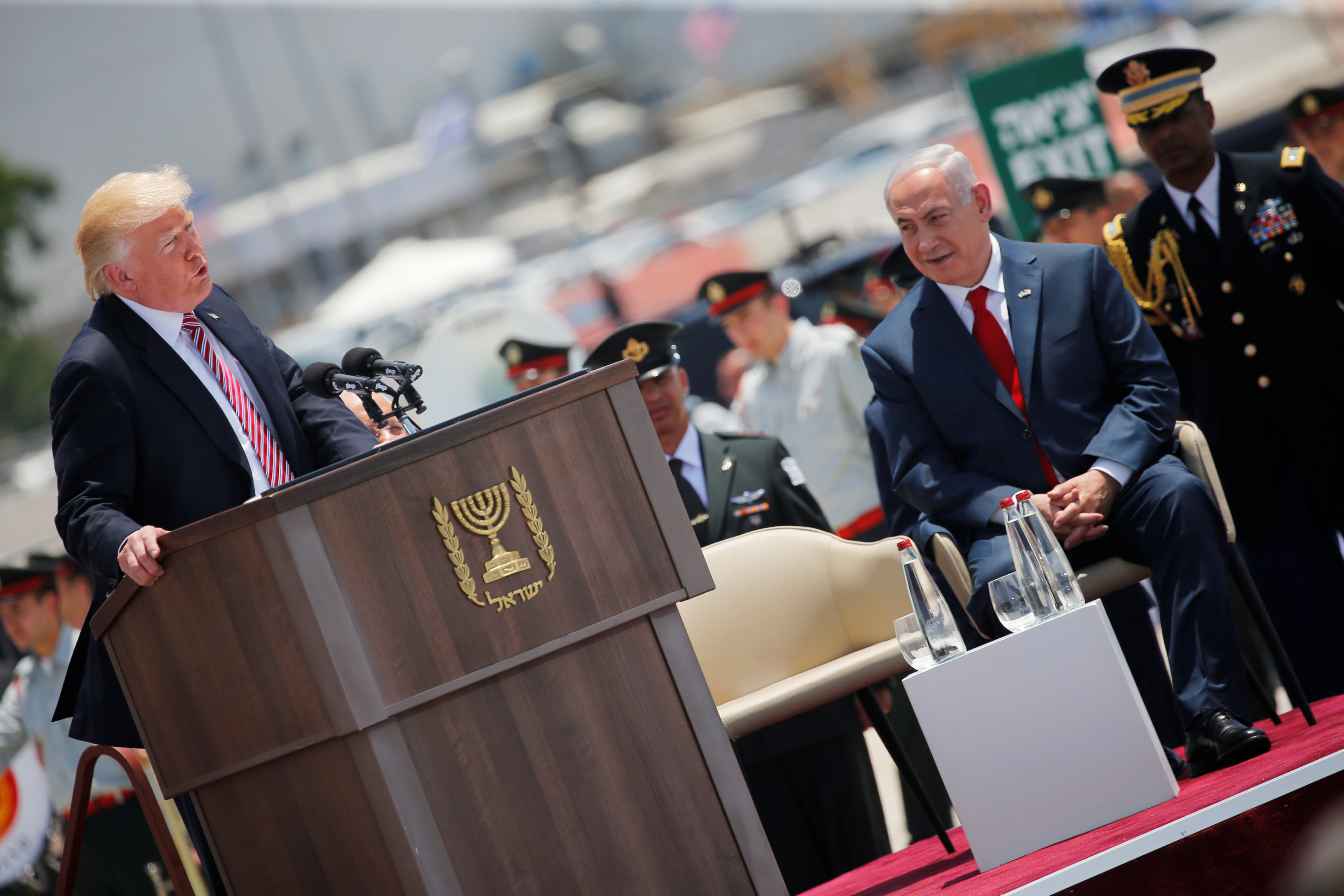
Netanyahu and his wife Sara, as well as President Reuven Rivlin and members of the Israeli cabinet, were at Tel Aviv’s Ben-Gurion airport to greet Trump and first lady Melania in a red carpet ceremony after what is believed to have been the first direct flight from Riyadh to Israel.

“During my travels in recent days, I have found new reasons for hope,” Trump said in a brief speech on arrival.

“We have before us a rare opportunity to bring security and stability and peace to this region and its people, defeating terrorism and creating a future of harmony, prosperity and peace, but we can only get there working together. There is no other way,” he said.

Trump’s tour comes in the shadow of difficulties at home, where he is struggling to contain a scandal after firing James Comey as FBI director nearly two weeks ago. The trip ends on Saturday after visits to the Vatican, Brussels and Sicily.

ARAB WELCOME

During his two days in Riyadh, Trump received a warm welcome from Arab leaders, who focused on his desire to restrain Iran’s influence in the region, a commitment they found wanting in the Republican president’s Democratic predecessor, Barack Obama. He also announced $110 billion in U.S. arms sales to Saudi Arabia.

Israel shares the antipathy that many Arab states have toward Iran, seeing the Islamic Republic as a threat to its very existence.

“What’s happened with Iran has brought many of the parts of the Middle East toward Israel,” Trump said in public remarks at a meeting in Jerusalem with Rivlin.

He also urged Iran to cease “its deadly funding, training and equipping of terrorists and militias”.

But Iran’s freshly re-elected pragmatist president, Hassan Rouhani, said regional stability could not be achieved without Iran’s help, and accused Washington of supporting terrorism with its backing for rebels in Syria.

He said the summit in Saudi Arabia “had no political value, and will bear no results”.

“Who can say the region will experience total stability without Iran? Who fought against the terrorists? It was Iran, Syria, Hezbollah and Syria. But who funded the terrorists?”

Rouhani also said Iran would continue a ballistic missile program that has already triggered U.S. sanctions, saying it was for defensive purposes only.

U.S. President Donald Trump (C) stands next to Western Wall Rabbi Shmuel Rabinowitz at the plaza in front of the Western Wall, Judaism’s holiest prayer site, in Jerusalem’s Old City May 22, 2017. REUTERS/Jonathan Ernst

“ULTIMATE DEAL”

Earlier, at the airport, Netanyahu said Israel hoped Trump’s visit would be a “milestone on the path towards reconciliation and peace”.

But he also repeated his right-wing government’s political and security demands of the Palestinians, including recognition of Israel as a Jewish state.

Trump has vowed to do whatever is necessary to broker peace between Israel and the Palestinians — something he has called “the ultimate deal” — but has given little indication of how he could revive negotiations that collapsed in 2014.

U.S. Secretary of State Rex Tillerson told reporters en route to Tel Aviv that any three-way meeting between Trump, Netanyahu and Abbas was for “a later date”.

When Trump met Abbas this month in Washington, he stopped shortly of explicitly recommitting his administration to a two-state solution to the decades-old conflict, a long-standing foundation of U.S. policy.

Trump has also opted against an immediate move of the U.S. Embassy in Tel Aviv to Jerusalem, a longtime demand of Israel.

A senior administration official told Reuters last week that Trump remained committed to the measure, which he pledged in his election campaign, but would not announce such a move during this trip.

Israel’s Prime Minister Benjamin Netanyahu (R) listens as U.S. President Donald Trump (L) speaks during a welcoming ceremony upon his arrival at Ben Gurion International Airport in Lod near Tel Aviv, Israel May 22, 2017. REUTERS/Jonathan Ernst

On Sunday, Israel authorized some economic concessions to the Palestinians that it said would improve civilian life in areas controlled by the Palestinian Authority and were intended to respond to Trump’s request for “confidence-building steps”.

The United States welcomed the move but the Palestinians said they had heard such promises before.

Trump will have visited significant centers of Islam, Judaism and Christianity by the end of his trip, a point that his aides say bolsters his argument that the fight against Islamist militancy is a battle between “good and evil”.

(Writing by Jeffrey Heller)

In U.S. presidential first, Trump prays at Jerusalem’s Western Wall

U.S. President Donald Trump places a note in the stones of the Western Wall, Judaism's holiest prayer site, in Jerusalem's Old City

By Luke Baker and Steve Holland

JERUSALEM (Reuters) – President Donald Trump made a historic visit to Jerusalem’s Western Wall on Monday, standing before the holiest place where Jews are permitted to pray and saying a few words before inserting a note between the monumental stones.

He was accompanied by the Rabbi of the Western Wall, Shmuel Rabinowitz, who said on Israel Radio that he recited two psalms with the U.S. leader. One of them, Psalm 122, speaks of Jerusalem as a “city that is united together”.

The ancient stones are in a part of Jerusalem that Israel captured in the 1967 Middle East war. It considers all of Jerusalem its indivisible capital, a status that is not recognized internationally.

“(Trump) said that he understands the significance of the Western Wall for the Jewish people and that’s why he decided to visit here during his first trip to Israel. He is certain he will come here again, perhaps many times. He was very moved,” Rabinowitz said.

“He asked about the size of the Western Wall. We presented the maps, what was in the past, what’s happening now, the excavations, the finds.”

The president was joined on the visit by his son-in-law, Jared Kushner, an Orthodox Jew who went to the wall shortly after Trump and said prayers. Both he and Trump wore black kippahs, the skull caps worn by religious Jews and by others as a mark of respect.

After a few moments standing silently before the limestone edifice, his right hand resting on the blocks, Trump withdrew and smiled briefly. He did not walk backwards from the wall as religious Jews do as a sign of devotion.

It is the first time a sitting U.S. president has visited and prayed at the site. Barack Obama visited in 2008, but it was during the campaign, before he became president.

The Wall, the visible portion of which stands more than 60 feet (20 meters) high, was a retaining structure for the second Jewish temple, which stood on an esplanade in the Old City before being destroyed by the Romans in 70 A.D.

The site is known to Jews as Temple Mount, the holiest place in Judaism, and to Muslims as The Noble Sanctuary, where al-Aqsa Mosque, the third holiest site in Islam, and the gold-topped Dome of the Rock, now stand.

Access to much of the walled Old City, which is divided into four ‘quarters’ — Muslim, Christian, Armenian and Jewish — was shut down on Monday ahead of Trump’s visit. The area has been the scene of multiple stabbing attacks by Palestinians targeting Jews over the past couple of years.

As Trump and Kushner visited the area of the wall set aside for men, Melania Trump and Ivanka, Kushner’s wife, visited a separate nearby section where women are allowed to pray.

Like her husband, Melania held her right hand up against the towering stones and inserted a note among the cracks, something Jews often do as a means of submitting prayers.

Ivanka, who converted to Judaism on marrying her husband, was dressed demurely in black and wore her hair partially covered by a small hat. Video footage showed her crying as she prayed at the wall.

Trump’s visit to the site sparked some controversy during the planning.

Prime Minister Benjamin Netanyahu had sought to accompany Trump to the Western Wall. But the State Department said that would not be permitted as officially the Wall is in East Jerusalem, which Israel occupied 50 years ago, and Palestinians seek as the capital of a future state.

(Writing by Luke Baker; Editing by Jeffrey Heller, Greg Mahlich)

Trump reassures farmers immigration crackdown not aimed at their workers

Migrant farmworkers with H-2A visas walk to take a break after harvesting romaine lettuce in King City, California, U.S

By Mica Rosenberg and Kristina Cooke

WASHINGTON/SAN FRANCISCO (Reuters) – President Donald Trump said he would seek to keep his tough immigration enforcement policies from harming the U.S. farm industry and its largely immigrant workforce, according to farmers and officials who met with him.

At a roundtable on farm labor at the White House last month, Trump said he did not want to create labor problems for farmers and would look into improving a program that brings in temporary agricultural workers on legal visas.

“He assured us we would have plenty of access to workers,” said Zippy Duvall, president of the American Farm Bureau Federation, one of 14 participants at the April 25 meeting with Trump and Agriculture Secretary Sonny Perdue.

During the roundtable conversation about agriculture, farmers and representatives of the sector brought up labor and immigration, the details of which have not been previously reported. Some farmers told Trump they often cannot find Americans willing to do the difficult farm jobs, according to interviews with nine of the 14 participants.

They said they were worried about stricter immigration enforcement and described frustrations with the H-2A visa program, the one legal way to bring in temporary seasonal agricultural workers.

The White House declined to comment on the specifics of the discussion, but described the meeting as “very productive.” The U.S. Department of Agriculture did not respond to a request for comment on the April meeting.

About half of U.S. crop workers are in the country illegally and more than two-thirds are foreign born, according to the most recent figures from the U.S. Department of Labor’s National Agriculture Workers’ Survey.

During the roundtable, Luke Brubaker, a dairy farmer from Pennsylvania, described how immigration agents had recently picked up half a dozen chicken catchers working for a poultry transportation company in his county.

The employer tried to replace them with local hires, but within three hours all but one had quit, Brubaker told the gathering at the White House.

Trump said he wanted to help and asked Secretary Perdue to look into the issues and come back with recommendations, according to the accounts.

While other issues such as trade, infrastructure and technology were also discussed, participants were more positive after the meeting about the conversation on foreign labor “than about anything else we talked about,”  said Bill Northey, a farmer and Iowa’s secretary of agriculture.

RED TAPE

Tom Demaline, president of Willoway Nurseries in Ohio, said he told the president about his struggles with the H-2A guestworker program, which he has used for 18 years.

He told Trump the program works in concept, but not in practice. “I brought up the bureaucracy and red tape,” he said. “If the guys show up a week or two late, it puts crops in jeopardy. You are on pins and needles all year to make sure you get the workers and do everything right.”

While use of the program has steadily increased over the past decade, it still accounts for only about 10 percent of the estimated 1.3 million farmworkers in the country, according to government data. In 2016, the government granted 134,000 H-2A visas

Employers who import workers with H-2A visas must provide free transportation to and from the United States as well as housing and food for workers once they arrive. Wage minimums are set by the government and are often higher than farmers are used to paying.

Steve Scaroni, whose company Fresh Harvest brings in thousands of foreign H-2A workers for growers in California’s Central valley, says, however, that he could find work for even more people if he had more places to house them.

Trump recently signed another executive order titled “Buy American, Hire American,” calling for changes to a program granting temporary visas for the tech industry, but not to visas used by farmers and other seasonal businesses, including Trump’s own resorts.

FARMER CONCERNS

Trump also signed two executive orders, just days after taking office, focused on border security that called for arresting more people in the United States illegally and speeding up deportations.

Roundtable participants said that many farmers have worried about the effect of the stepped up enforcement on their workforce, but Trump told them his administration was focused on deporting criminals, not farmworkers.

“He has a much better understanding about this than some of the rhetoric we have seen,” said meeting attendee Steve Troxler, North Carolina’s agriculture commissioner and a farmer himself.

The farmers at the meeting said they stressed to the president the need for both short-term and permanent workers. They said there should be a program to help long-time farmworkers without criminal records, but who are in the country illegally, to become legal residents.

Last Tuesday, Democrats in the House and Senate said they would introduce a bill to give farmworkers who have worked illegally in the country for two consecutive years a “blue card” to protect them from deportation.

Brubaker, the Pennsylvania farmer, said he liked what he had heard about the bill and hoped it would get the president’s support to make it a bipartisan effort.

“The administration has got something started here,” he said of the meeting with farm leaders. “It’s about time something happens.”

(Reporting by Kristina Cooke in San Francisco and Mica Rosenberg in Washington; Additional reporting by Julia Love in Salinas, California; Editing by Sue Horton and Mary Milliken)

President Trump signs Religious Liberty Executive Order on National Day of Prayer

U.S. President Donald Trump signs an Executive Order on Promoting Free Speech and Religious Liberty during the National Day of Prayer event at the Rose Garden of the White House in Washington D.C., U.S., May 4, 2017.

By Kami Klein

On the National Day of Prayer, President Donald Trump and Vice President Pence signed a new executive order focusing on Religious Liberty.  White House officials declared “it is the policy of the administration to protect and vigorously promote religious liberty.”  Today, President Trump made good on his promise to ease a ban on political activity by churches and other tax-exempt institutions.

Many friends of Morningside were already in Washington D.C. for the National Day of Prayer. Prophetic and influential leaders such as Paula White, Jentezen Franklin, Samuel Rodriguez, Pastor Ramiro Pena, Franklin Graham and Anne Graham were there for this historic moment.  Also in attendance were Alveda King, Ravi Zachariah, Rev. Maldonado, Dr. David Jeremiah, Dr. Jim Garlow and Pastor Frank Amedia.

In a signing ceremony at the White House, President Trump said: “We will not allow people of faith to be targeted, bullied or silenced any more.”  The President continued by saying, “ No one should be censoring sermons or targeting pastors.”

This executive order will allow non-profit organizations, hospitals, educational institutions and businesses to deny certain health coverage for religious reasons.  An example of this would be Christian Groups like Little Sisters of the Poor from being forced to pay for abortion or contraception services.

Under the Johnson Amendment, a 1954 law sponsored by Lyndon Johnson, organizations that are non-profit, tax exempt status are not allowed to participate in political campaigning or supporting any one candidate for elective office.   Trump’s order guides the IRS to “alleviate the burden of the Johnson Amendment.”

A White House official told Fox News, “I think how the President feels about the Johnson amendment is that politicians and unelected bureaucrats shouldn’t have the power to shut up their critics just because they are church leaders or charities.”

“We don’t have any plans to discriminate, we’re about not discriminating against religious organizations!”

The following is the full text of Trump’s Executive Order :  


PROMOTING FREE SPEECH AND RELIGIOUS LIBERTY

By the authority vested in me as President by the Constitution and the laws of the United States of America, in order to guide the executive branch in formulating and implementing policies with implications for the religious liberty of persons and organizations in America, and to further compliance with the Constitution and with applicable statutes and Presidential Directives, it is hereby ordered as follows:

Section 1. Policy. It shall be the policy of the executive branch to vigorously enforce Federal law’s robust protections for religious freedom. The Founders envisioned a Nation in which religious voices and views were integral to a vibrant public square, and in which religious people and institutions were free to practice their faith without fear of discrimination or retaliation by the Federal Government. For that reason, the United States Constitution enshrines and protects the fundamental right to religious liberty as Americans’ first freedom. Federal law protects the freedom of Americans and their organizations to exercise religion and participate fully in civic life without undue interference by the Federal Government. The executive branch will honor and enforce those protections.

Sec. 2. Respecting Religious and Political Speech. All executive departments and agencies (agencies) shall, to the greatest extent practicable and to the extent permitted by law, respect and protect the freedom of persons and organizations to engage in religious and political speech. In particular, the Secretary of the Treasury shall ensure, to the extent permitted by law, that the Department of the Treasury does not take any adverse action against any individual, house of worship, or other religious organization on the basis that such individual or organization speaks or has spoken about moral or political issues from a religious perspective, where speech of similar character has, consistent with law, not ordinarily been treated as participation or intervention in a political campaign on behalf of (or in opposition to) a candidate for public office by the Department of the Treasury. As used in this section, the term “adverse action” means the imposition of any tax or tax penalty; the delay or denial of tax-exempt status; the disallowance of tax deductions for contributions made to entities exempted from taxation under section 501(c)(3) of title 26, United States Code; or any other action that makes unavailable or denies any tax deduction, exemption, credit, or benefit.

Sec. 3. Conscience Protections with Respect to Preventive-Care Mandate. The Secretary of the Treasury, the Secretary of Labor, and the Secretary of Health and Human Services shall consider issuing amended regulations, consistent with applicable law, to address conscience-based objections to the preventive-care mandate promulgated under section 300gg-13(a)(4) of title 42, United States Code.

Sec. 4. Religious Liberty Guidance. In order to guide all agencies in complying with relevant Federal law, the Attorney General shall, as appropriate, issue guidance interpreting religious liberty protections in Federal law.

Sec. 5. Severability. If any provision of this order, or the application of any provision to any individual or circumstance, is held to be invalid, the remainder of this order and the application of its other provisions to any other individuals or circumstances shall not be affected thereby.

Sec. 6. General Provisions. (a) Nothing in this order shall be construed to impair or otherwise affect:

(i) the authority granted by law to an executive department or agency, or the head thereof; or

(ii) the functions of the Director of the Office of Management and Budget relating to budgetary, administrative, or legislative proposals.

(b) This order shall be implemented consistent with applicable law and subject to the availability of appropriations.

(c) This order is not intended to, and does not, create any right or benefit, substantive or procedural, enforceable at law or in equity by any party against the United States, its departments, agencies, or entities, its officers, employees, or agents, or any other person.


Sources:  Fox news, Reuters, CNN, CNBC, Washington Examiner

Putin says trust erodes under Trump, Moscow icily receives Tillerson

U.S. Secretary of State Rex Tillerson attends a meeting with Russian Foreign Minister Sergei Lavrov in Moscow, Russia

By Yeganeh Torbati and Vladimir Soldatkin

MOSCOW (Reuters) – Vladimir Putin said on Wednesday trust had eroded between the United States and Russia under President Donald Trump, as Moscow delivered an unusually hostile reception to Secretary of State Rex Tillerson in a face-off over Syria.

Any hope in Russia that the Trump administration would herald less confrontational relations has been dashed in the past week after the new U.S. leader fired missiles at Syria to punish Moscow’s ally for its suspected use of poison gas.

Just as Tillerson sat down for talks, a senior Russian official assailed the “primitiveness and loutishness” of U.S. rhetoric, part of a volley of statements that appeared timed to maximize the awkwardness during the first visit by a member of Trump’s cabinet.

“One could say that the level of trust on a working level, especially on the military level, has not improved but has rather deteriorated,” Putin said in an interview broadcast on Russian television moments after Tillerson sat down with Russian Foreign Minister Sergei Lavrov in an ornate hall.

Putin doubled down on Russia’s support for Syrian President Bashar al-Assad, repeating denials that Assad’s government was to blame for the gas attack last week and adding a new theory that the attack may have been faked by Assad’s enemies.

Moments earlier, Lavrov greeted Tillerson with unusually icy remarks, denouncing the missile strike on Syria as illegal and accusing Washington of behaving unpredictably.

“I won’t hide the fact that we have a lot of questions, taking into account the extremely ambiguous and sometimes contradictory ideas which have been expressed in Washington across the whole spectrum of bilateral and multilateral affairs,” Lavrov said.

“And of course, that’s not to mention that apart from the statements, we observed very recently the extremely worrying actions, when an illegal attack against Syria was undertaken.”

Lavrov also noted that many key State Department posts remain vacant since the new administration took office — a point of sensitivity in Washington.

One of Lavrov’s deputies was even more undiplomatic.

“In general, primitiveness and loutishness are very characteristic of the current rhetoric coming out of Washington. We’ll hope that this doesn’t become the substance of American policy,” Deputy Foreign Minister Sergei Ryabkov told Russia’s state-owned RIA news agency.

“As a whole, the administration’s stance with regards to Syria remains a mystery. Inconsistency is what comes to mind first of all.”

Tillerson kept to more calibrated remarks, saying his aim was “to further clarify areas of sharp difference so that we can better understand why these differences exist and what the prospects for narrowing those differences may be.”

“I look forward to a very open, candid, frank exchange so that we can better define the U.S.-Russian relationship from this point forward,” he told Lavrov.

After journalists were ushered out of the room, Lavrov’s spokeswoman, Maria Zakharova, wrote on her Facebook page that U.S. journalists traveling with Tillerson had behaved as if they were in a “bazaar” by shouting questions to Lavrov.

Kremlin spokesman Dmitry Peskov said Tillerson might meet Putin later on Wednesday if the two top diplomats decided it would be useful to brief the Russian president on their talks. But Peskov too did not hold back his criticism, saying calls from Western powers for Russia to cut support for Assad amounted to giving terrorists a free hand.

Moscow’s hostility to Trump administration figures is a sharp change from last year, when Putin hailed Trump as a strong figure and Russian state television was consistently full of effusive praise for him.

Russian Foreign Minister Sergei Lavrov and U.S. Secretary of State Rex Tillerson enter a hall during their meeting in Moscow, Russia

Russian Foreign Minister Sergei Lavrov and U.S. Secretary of State Rex Tillerson enter a hall during their meeting in Moscow, Russia, April 12, 2017. REUTERS/Maxim Shemetov

COVER-UP

The White House has accused Moscow of trying to cover up Assad’s use of chemical weapons after the attack on a town killed 87 people last week.

Trump responded to the gas attack by firing 59 cruise missiles at a Syrian air base on Friday. Washington warned Moscow, and Russian troops at the base were not hit.

Moscow has stood by Assad, saying the poison gas belonged to rebels, an explanation Washington dismisses as beyond credible. Putin said that either gas belonging to the rebels was released when it was hit by a Syrian strike on a rebel arms dump, or the rebels faked the incident to discredit Assad.

Trump came to the presidency promising to seek closer ties with Russia and greater cooperation fighting against their common enemy in Syria, Islamic State. Tillerson is a former oil executive who was awarded Russia’s Order of Friendship by Putin.

Last week’s poison gas attack and the U.S. retaliation upended what many in Moscow hoped would be a transformation in relations between the two countries, which reached a post-Cold War low under Trump’s predecessor Barack Obama.

The United States and its European allies imposed financial sanctions on Russia in 2014 after Putin seized territory from neighboring Ukraine.

Washington is leading a campaign of air strikes in Syria against Islamic State fighters and has backed rebels fighting against Assad during a six-year civil war, but until last week the United States had avoided directly targeting the Syrian government.

Russia, meanwhile, intervened in the civil war on Assad’s side in 2015 and has troops on the ground, which it says are advising government forces. Both Washington and Moscow say their main enemy is Islamic State, although they back opposing sides in the wider civil war which has killed more than 400,000 people and spawned the world’s worst refugee crisis.

In an interview with the Fox Business Network, Trump said he was not planning to order U.S. forces into Syria, but that he had to respond to the images of dead children poisoned in the gas attack.

“We’re not going into Syria,” he said in excerpts of the interview on the station’s website. “But when I see people using horrible, horrible chemical weapons … and see these beautiful kids that are dead in their father’s arms, or you see kids gasping for life … when you see that, I immediately called (Defense Secretary) General Mattis.”

Tillerson traveled to Moscow with a joint message from Western powers that Russia should withdraw its support for Assad after a meeting of the Group of Seven industrialized economies also attended by Middle East allies.

Some of Washington’s allies had been wary of Trump, who spoke during his election campaign of seeking closer ties with Moscow and questioned the value of U.S. support for its traditional friends. Tillerson’s mission sees the Trump administration taking on the traditional U.S. role as spokesman for a unified Western position.

Trump’s relations with Russia are also a domestic issue, as U.S. intelligence agencies have accused Moscow of using computer hacking to intervene in the election to help Trump win. The FBI is investigating whether any Trump campaign figures colluded with Moscow, which the White House denies.

(writing by Peter Graff; Editing by Sonya Hepintall)

Trump’s pick Gorsuch sworn in, restoring top court’s conservative tilt

Chief Justice of the United States John Roberts (C) looks on as Judge Neil Gorsuch (R) signs the constitutional oath during swearing-in ceremony at the Supreme Court in Washington, U.S.

By Lawrence Hurley

WASHINGTON (Reuters) – Neil Gorsuch, picked by President Donald Trump and confirmed by the Republican-led Senate, was sworn in as a U.S. Supreme Court justice at the White House on Monday and was poised to have an instant impact on a court once again dominated by conservatives.

Trump earned the biggest political victory of his presidency and fulfilled a major campaign promise when the Senate voted on Friday to confirm the conservative federal appeals court judge from Colorado to the lifetime job despite vehement Democratic opposition. With Gorsuch aboard, the court once again has five conservative justices and four liberals.

Gorsuch took his judicial oath in a White House Rose Garden ceremony with Trump watching on, filling a vacancy that lingered for nearly 14 months after the death of conservative Justice Antonin Scalia in February 2016. The oath was administered by Justice Anthony Kennedy, for whom Gorsuch worked as a clerk as a young lawyer. Gorsuch will become the first justice to serve alongside a former boss.

All the other members of the court were at the ceremony, including liberal Justice Ruth Bader Ginsburg, who called Trump “a faker” last year during the presidential campaign but later said she regretted the remark. Trump at the time called on her to resign and said her “mind is shot.”

Scalia’s widow, Maureen, also attended the ceremony.

Gorsuch earlier in the day took his separate constitutional oath, administered by Chief Justice John Roberts, in a private ceremony at the Supreme Court with the other justices.

Trump made Gorsuch, 49, the youngest Supreme Court nominee since Republican President George H.W. Bush in 1991 selected Clarence Thomas, who was then 43. Gorsuch could be expected to serve for decades, and Trump could make further appointments to the high court to make it even more solidly conservative, with three of the eight justices 78 or older: Ginsburg, 84; fellow liberal Stephen Breyer, 78; and conservative swing vote Kennedy, 80.

Gorsuch will take part in the court’s next round of oral arguments, starting on April 17. They include a closely watched religious rights case on April 19 in which a Missouri church is objecting to being frozen out of state funds for a playground project due to a state ban on providing public money to religious organizations.

He is expected to take part in oral arguments in 13 cases during the court’s current term, which ends in June.

Gorsuch can be expected to have have an immediate impact of the court. He takes part on Thursday in the justices’ private conference to decide which cases to take up. Appeals are pending before the justices on expanding gun rights to include carrying concealed firearms in public, state voting restrictions that critics say are aimed at reducing minority turnout, and letting Christian business owners object on religious grounds to providing gay couples certain services.

Gorsuch could also play a vital role in some cases on which his new colleagues may have been split 4-4 along ideological lines and therefore did not yet decide. Those cases potentially could be reargued in the court’s next term, which starts in October.

Gorsuch’s wife, Louise, and his two daughters were also present at the private constitutional oath ceremony at the court, said Supreme Court spokeswoman Kathy Arberg. Louise Gorsuch held a family Bible as her husband took the oath, Arberg said.

The Senate, which last year refused to consider Democratic former President Barack Obama’s nomination of Merrick Garland, voted 54-45 to confirm Gorsuch.

(Reporting by Lawrence Hurley; Editing by Will Dunham)

Oil prices jump 2 percent after U.S. launches missile strike in Syria

Crude oil storage tanks are seen from above at the Cushing oil hub, appearing to run out of space to contain a historic supply glut that hammered prices, in Cushing, Oklahoma,

By Henning Gloystein

SINGAPORE (Reuters) – Oil prices surged more than 2 percent on Friday after the United States launched dozens of cruise missiles at an airbase in Syria.

U.S President Donald Trump said he had ordered missile strikes against a Syrian airfield from which a deadly chemical weapons attack was launched earlier this week, declaring he acted in America’s “national security interest” against Syrian President Bashar al-Assad.

After tepid trading before the news, Brent crude futures, the international benchmark for oil, jumped to $56.08 per barrel before easing to be up 1.6 percent at $55.75 per barrel at 0310 GMT.

U.S. West Texas Intermediate (WTI) crude futures also climbed by over 2 percent, to a high of $52.94 a barrel before receding to be up 1.8 percent at $52.61.

Both benchmarks hit their highest levels since early March.

The strikes rattled global markets. While oil prices surged as traders priced in what has in the past been called a Middle East risk premium, and safe-haven products like gold jumped, stock markets and the U.S. dollar slumped.

“The U.S cruise missile strikes have seen crude oil jump over two percent in a straight line,” said Jeffrey Halley, senior market analyst at futures brokerage OANDA in Singapore.

Halley said the strikes had potentially big implications for oil markets.

“What will be the response of Iran and Russia, two of the world’s largest oil producers and staunch allies of the Assad regime?… We will have to wait for these answers as the day moves on,” he said.

U.S. officials said the military had fired 59 cruise missiles against a Syrian airbase controlled by Assad’s forces, in response to a poison gas attack on Tuesday in a rebel-held area.

Officials said the United States had informed Russia ahead of the strikes. The strikes did not target sections of the Syrian base where Russian forces were believed to be present.

(Reporting by Henning Gloystein; Editing by Kenneth Maxwell and Richard Pullin)

Trump’s son-in-law, Kushner, flies into Iraq with top U.S. general

U.S. President Donald Trump's son-in-law and senior advisor Jared Kushner (L) speaks with Marine Corps Gen. Joseph F. Dunford Jr., chairman of the Joint Chiefs of Staff, before departing for Iraq from Ramstein Air Base, Germany April 3, 2017. DoD/Navy Petty Officer 2nd Class Dominique A. Pineiro/Handout via REUTERS

By Phil Stewart

BAGHDAD (Reuters) – U.S. President Donald Trump’s son-in-law, Jared Kushner, flew into Iraq on Monday with the top U.S. military officer to get a first-hand assessment of the battle against Islamic State from U.S. commanders on the ground and to meet Iraqi officials.

For Kushner, who has not been to Iraq before, the trip comes at a critical time as Trump examines ways to accelerate a U.S.-led coalition campaign that U.S. and Iraqi officials say has so far been largely successful in uprooting Islamic State militants in Iraq and Syria.

The visit appears to demonstrate the far-reaching portfolio of Kushner, 36, who is part of Trump’s innermost circle and who has been given a wide range of domestic and foreign policy responsibilities, including working on a Middle East peace deal.

Marine General Joseph Dunford, the chairman of the U.S. military’s Joint Chiefs of Staff, said he invited Kushner and Tom Bossert, White House homeland security adviser, to accompany him so they could hear “first-hand and unfiltered” from military advisers about the situation on the ground and interact with U.S. forces.

“I said, ‘Hey, next time I go to Iraq, if you’re interested, come and it’d be good,” Dunford said, adding he extended the invitation weeks ago.

That kind of ground-level awareness of the war helps inform strategic decisions, Dunford said, adding it was the same reason he regularly leaves Washington to visit Iraq.

“The more appreciation you could have for what’s actually happening on the ground, the more informed you are when you start talking about the strategic issues,” Dunford said.

Kushner, who is married to Trump’s daughter Ivanka Trump, did not speak with reporters during the flight to Iraq.

Dunford’s spokesman, Navy Captain Greg Hicks, said Kushner was traveling on behalf of Trump to express the president’s support and commitment to Iraq’s government and U.S. personnel helping combat Islamic State.

Trump, who campaigned on defeating Islamic State, has yet to announce any dramatic shift in war strategy.

U.S. ROLE AFTER MOSUL FIGHT

The trip to Iraq comes as Iraqi security forces engage in fierce, house-to-house fighting to retake Mosul, Islamic State’s last major stronghold in Iraq and the city where leader Abu Bakr al-Baghdadi declared a caliphate nearly three years ago.

Nearly 290,000 people have fled the city to escape the fighting, according to the United Nations.

Although the loss of Mosul would deal a major defeat to Islamic State, U.S. and Iraqi officials are preparing for smaller battles even after the city is recaptured and expect the group to go underground to fight as a traditional insurgency.

What happens to the U.S. military role in Iraq after Mosul is recaptured remain unclear.

Influential Shi’ite cleric Moqtada al-Sadr has previously called on Iraq’s government to order the withdrawal of U.S. and allied forces after the battle of Mosul is over.

Dunford said Iraqi Prime Minister Haider al-Abadi understood the need for continued U.S. military support.

“It’s not our judgment that the Iraqis will be self sustaining and self sufficient in the wake of Mosul. More importantly, it’s not Prime Minister Abadi’s assessment,” Dunford said.

Across the border in Syria, a U.S.-backed campaign to isolate Islamic State’s de facto capital of Raqqa is advancing ahead of an eventual assault on the city.

U.S.-backed Syrian forces repelled a major counter-attack by Islamic State militants holding out at the country’s largest dam and in the nearby town of Tabqa, the group and activists said on Sunday. The dam is a strategic target in the military campaign, located about 40 km (25 miles) to the east of Raqqa.

(Reporting by Phil Stewart; Editing by Giles Elgood)