Trump signs revised travel ban order, leaves Iraq off

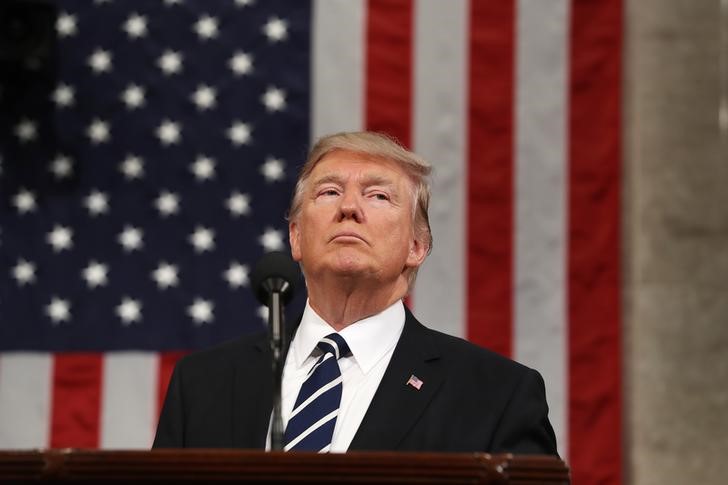
U.S. President Donald Trump delivers his first address to a joint session of Congress from the floor of the House of Representatives iin Washington, U.S.,

U.S. President Donald Trump delivers his first address to a joint session of Congress from the floor of the House of Representatives iin Washington, U.S., February 28, 2017. REUTERS/Jim Lo Scalzo/Pool

By Steve Holland and Julia Edwards Ainsley

WASHINGTON (Reuters) – President Donald Trump signed a revised executive order on Monday banning citizens from six Muslim-majority nations from traveling to the United States but removing Iraq from the list, after his controversial first attempt was blocked in the courts.

The new order, which the White House said Trump had signed, keeps a 90-day ban on travel to the United States by citizens of Iran, Libya, Syria, Somalia, Sudan and Yemen.

White House spokeswoman Sarah Huckabee Sanders said the new order would take effect on March 16. The delay aims to limit the disruption created by the original Jan. 27 order before a U.S. judge suspended it on Feb. 3.

Trump, who first proposed a temporary travel ban on Muslims during his presidential campaign last year, had said his original executive order was a national security measure meant to head off attacks by Islamist militants.

It came only a week after Trump was inaugurated, and it sparked chaos and protests at airports, as well as a wave of criticism from targeted countries, Western allies and some of America’s leading corporations.

“It is the president’s solemn duty to protect the American people,” Secretary of State Rex Tillerson told reporters after Trump signed the new order. “As threats to our security continue to evolve and change, common sense dictates that we continually re-evaluate and reassess the systems we rely upon to protect our country.”

The leader of the minority Democrats in the Senate, Chuck Schumer, said he expected the revised order to have the same uphill battle in the courts as the original version.

“A watered down ban is still a ban,” he said in a statement. “Despite the administration’s changes, this dangerous executive order makes us less safe, not more, it is mean-spirited, and un-American. It must be repealed.”

Trump’s original ban resulted in more than two dozen lawsuits in U.S. courts. Attorney General Bob Ferguson of Washington state, which succeeded in having the previous ban suspended, said he was “carefully reviewing” the new order.

IRAQ’S NEW VETTING

Iraq was taken off the banned list because the Iraqi government has imposed new vetting procedures, such as heightened visa screening and data sharing, and because of its work with the United States in countering Islamic State militants, a senior White House official said.

Defense Secretary Jim Mattis, who along with several other senior Cabinet members had lobbied for Iraq’s removal, was consulted on the new order and the updated version “does reflect his inputs,” Pentagon spokesman Captain Jeff Davis said.

Thousands of Iraqis have fought alongside U.S. troops for years or worked as translators since the U.S.-led invasion in 2003. Many have resettled in the United States after being threatened for working with U.S. troops.

The White House official said the new executive order also ensures that tens of thousands of legal permanent residents in the United States – or green card holders – from the listed countries would not be affected by the travel ban.

The original order barred travelers from the seven nations from entering for 90 days and all refugees for 120 days. Refugees from Syria were to be banned indefinitely but under the new order they are not given separate treatment.

Trump’s first order was seen by opponents as discrimination against Muslims. The White House official said the new order had nothing to do with religion and that the administration would reset the clock on the 90-day travel ban.

But House of Representatives Democratic leader Nancy Pelosi said “the Trump administration’s repackaging has done nothing to change the immoral, unconstitutional and dangerous goals of their Muslim and refugee ban.”

“NO ALLEGED CHAOS”

Trump publicly criticized judges who ruled against him and vowed to fight the case in the Supreme Court, but then decided to draw up a new order with changes aimed at making it easier to defend in the courts.

Refugees who are “in transit” and already have been approved would be able to travel to the United States.

“There’s going to be a very orderly process,” a senior official from the Department of Homeland Security said. “You should not see any chaos so to speak, or alleged chaos at airports. There aren’t going to be folks stopped tonight from coming into the country because of this executive order.”

The FBI is investigating 300 people admitted into the United States as refugees as part of 1,000 counter-terrorism probes involving Islamic State or individuals inspired by the militant group, congressional sources told Reuters on Monday, citing senior administration officials.

An FBI spokeswoman said the agency was consulting its data to confirm the information.

The White House official said U.S. government agencies would determine whether Syria or other nations had made sufficient security improvements to be taken back into the refugee admissions program.

The new order spells out detailed categories of people eligible to enter the United States, such as for business or medical travel, or people with family connections or who support the United States.

“There are a lot of explicit carve-outs for waivers and given on a case-by-case basis,” the official said.

(Additional reporting by Patricia Zengerle, Doina Chiacu, Mica Rosenberg, Tim Ahmann and Idrees Ali; Editing by Bill Trott and Nick Tattersall)

World stock markets and U.S. dollar retreat before key Trump speech

Men walk past an electronic board showing Japan's Nikkei average outside a brokerage in Tokyo, Japan,

By Sinead Carew

NEW YORK (Reuters) – World stock markets and the U.S. dollar fell on Monday while U.S. Treasury yields rose amid investor caution ahead of a key speech by U.S. President Donald Trump.

The dollar fell ahead of Trump’s State of the Union address, during which he is expected to unveil details on pro-growth policies including infrastructure spending.

“There is setting up for what people expect might be at least a focus on things like fiscal stimulus and infrastructure spending of some kind, that might actually boost risk and cause yields to rise,” said Aaron Kohli, an interest rate strategist at BMO Capital Markets in New York.

U.S. 10-year Treasury notes were last down 7/32 in price to yield 2.342 percent, from a yield of 2.317 percent late Friday. Two-year notes US2YT=RR were last down 1/32 in price to yield 1.169 percent, from a yield of 1.145 percent late Friday.

The dollar was down 0.3 percent against a basket of major currencies after Trump said Monday that tax reform details would not be revealed until after the administration’s proposal on health care.

Investors had hoped for “more clarity around tax reform sooner rather than later” said Bipan Rai, senior macroeconomic strategist at CIBC Capital Markets in Toronto.

At 11:25 a.m. ET, the Dow Jones Industrial Average was down 5.62 points, or 0.03 percent, at 20,816.14, the S&P 500 shed 0.2 points, or 0.01 percent, to 2,367.14, while the Nasdaq Composite added 1.63 points, or 0.03 percent, to 5,846.93.

Europe’s benchmark index of leading 300 shares fell 0.1 percent.

MSCI’s benchmark world stock index slipped 0.03 percent after it hit a record high Thursday.

A proposed 29 billion euro merger between the London Stock Exchange and Deutsche Boerse to create Europe’s biggest stock exchange looked dead in the water due to an inability to meet European antitrust demands. Shares in both companies fell. The London Stock Exchange fell as much as 3 percent while Deutsche Boerse fell as much as 4 percent.

“The regulatory hurdles were always a risk, and with Brexit, there are additional hurdles to clear that seem close to insurmountable now,” said Neil Wilson, senior market analyst at ETX Capital.

MSCI’s broadest index of Asia-Pacific shares outside Japan fell 0.24 percent, while Japan’s Nikkei fell 0.9 percent for its lowest close since Feb. 9 on concerns that a stronger yen would crimp corporate earnings.

The Dow Jones Industrial Average scaled its 11th consecutive record high on Friday, the longest such run since 1987, leading some to suggest it could be prone for a correction.

In Europe, the focus was on France, where the latest polls showed that centrist Emmanuel Macron would score a more convincing victory over far-right and anti-euro Marine Le Pen in the presidential election’s runoff vote.

France’s 10-year bond yield fell to a one-month low of 0.88 percent.

In commodities, Brent crude was up 0.3 percent at $56.14 per barrel while U.S. West Texas Intermediate was up 0.4 percent at $54.20 per barrel as a global supply glut appeared to ease.

(Additional Reporting by Jamie McGeever and Dhara Ranasinghe; Editing by Bernadette Baum)

China say North Korea’s nuclear plan is a problem between U.S. and North Korea

North Korean leader Kim Jong Un watches a performance given with splendor at the People's Theatre on Wednesday to mark the 70th anniversary of the founding of the State Merited Chorus in this photo released by North Korea's Korean Central News Agency (KCNA) in Pyongyang on February 23, 2017. KCNA/via REUTERS

BEIJING (Reuters) – China on Friday dismissed renewed pressure from U.S. President Donald Trump over its role in North Korea, saying the crux of the matter was a dispute between Washington and Pyongyang.

Trump told Reuters in an interview on Thursday that China could solve the national security challenge posed by North Korea “very easily if they want to”, turning up pressure on Beijing to exert more influence to rein in Pyongyang’s increasingly bellicose actions.

China has made clear that it opposes North Korea’s nuclear and missile programs and has repeatedly called for denuclearization of the Korean peninsula and a return to negotiations between Pyongyang and world powers.

It has also insisted it is dedicated to enforcing U.N. sanctions against North Korea.

“We have said many times already that the crux of the North Korean nuclear issue is the problem between the United States and North Korea,” Chinese Foreign Ministry spokesman Geng Shuang told a daily news briefing, responding to Trump’s remarks.

“We hope the relevant parties can shoulder their responsibilities, play the role the should, and together with China play a constructive role for peace and stability on the Korean peninsula and for its denuclearization,” he added.

The official Xinhua news agency said China’s influence on North Korea had been exaggerated.

“The Trump White House needs to make the first move and talk to Pyongyang. The United States stands to lose nothing for trying this,” it said in an English-language commentary.

China announced on Saturday last week it was banning imports of coal from North Korea, after it tested an intermediate-range ballistic missile.

North Korean state media issued a rare reproach of China on Thursday saying its main diplomatic backer was “dancing to the tune” of the United States for halting its coal imports because of its nuclear and missile programs.

The North’s state-run KCNA news agency did not refer directly to China by name but in an unmistakable censure it accused a “neighboring country” of going along with North Korea’s enemies to “bring down its social system”.

Asked about the report, Geng said the U.N. sanctions were a clear signal of opposition from the international community about North Korea’s nuclear and missile programs and that China would enforce them.

However, he also described China and North Korea as being friendly neighbors.

“We are willing to work with North Korea to promote the stable and healthy development of relations,” Geng said, adding North Korea was well aware of China’s position on its nuclear program.

(Reporting by Ben Blanchard; Editing by Robert Birsel)

Kremlin says Putin-Trump meeting possible before July

A billboard showing a pictures of US president-elect Donald Trump and Russian President Vladimir Putin is seen through pedestrians in Danilovgrad, Montenegro,

MOSCOW (Reuters) – The Kremlin said on Monday there was talk of a possible meeting between President Vladimir Putin and U.S. President Donald Trump taking place before a G20 summit in July, but there was nothing specific to report so far.

The two men have never met, but both have said they want to try to mend battered U.S.-Russia ties, which fell to their lowest level since the Cold War after Moscow’s 2014 annexation of Ukraine’s Crimea.

The new U.S. administration is under pressure over Russia however because Michael Flynn, Trump’s national security adviser, is struggling to get past a controversy over a call he had with the Russian ambassador to the United States Sergei Kislyak before Trump took office.

Top White House officials have been reviewing over the weekend Flynn’s contacts and whether he discussed the possibility of lifting U.S. sanctions on Russia once Trump took office, which could potentially be in violation of a law banning private citizens from engaging in foreign policy.

When asked about it on Monday, Kremlin spokesman Dmitry Peskov told a conference call with reporters that Flynn and Kislyak had not discussed lifting sanctions on Moscow.

“Obviously every ambassador informs the center (Moscow) about all the contacts he has so the information gets to us, but we are not willing to comment on internal discussions being held in Washington,” Peskov said.

Asked if there had been talks between any Russian and U.S. representatives on easing sanctions, Peskov said: “We have already said there have not been any (such talks)”.

(Reporting by Maria Tsvetkova; Writing by Denis Pinchuk; Editing by Andrew Osborn)