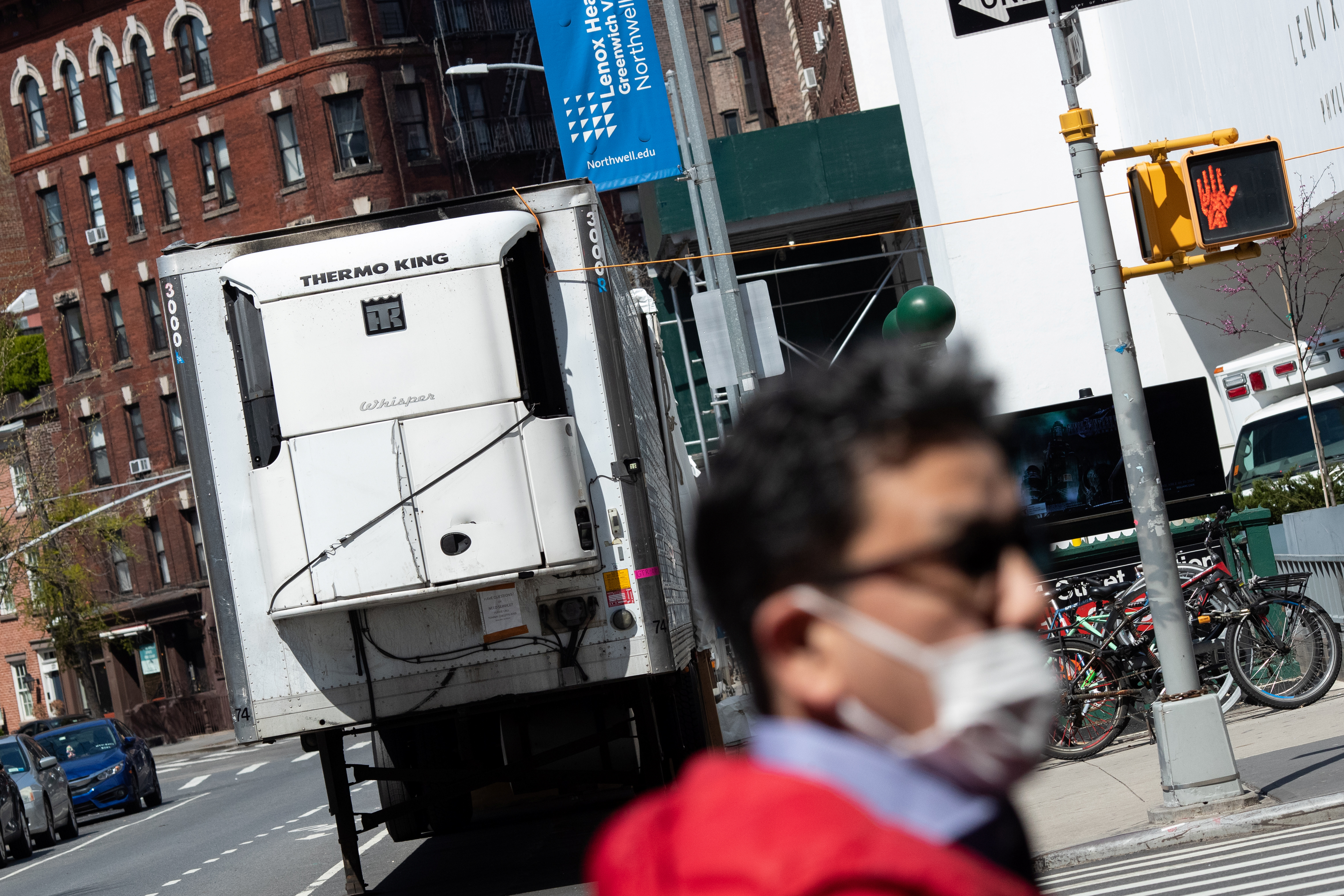
‘Schools are survival’: U.S. coronavirus closures put homeless students at risk

By Carey L. Biron

WASHINGTON (Thomson Reuters Foundation) – For U.S. student Samantha Kinney, high school is about more than education: It has also given her a support network, a sense of accomplishment — and, at times, even access to daily necessities like food and hygiene products.

Kinney, 18, has dealt with homelessness and housing instability for years, including a time when she lived out of a car with her parents and dropped out of school altogether.

She currently lives with relatives in Kansas City, Missouri – having not seen her parents in a few years – and has restarted school, where she has found a surprisingly nurturing community.

“There were even times when families would ‘adopt’ me for Christmas, when they would buy me gifts before break,” Kinney told the Thomson Reuters Foundation by phone.

Now, the coronavirus pandemic has thrown that support system into flux.

Like most schools across the country, Kinney’s school is closed, probably through the end of the school year in June, leaving students in unstable housing situations without the everyday help they rely on, warn homelessness groups.

For many students, those closures have removed a key source of stability, safety, access to food and other resources, as well as the opportunity to gain the skills or a job that could secure their future.

“Schools are survival for children experiencing homelessness,” said Barbara Duffield, executive director of SchoolHouse Connection, a nonprofit that works on the issue nationally.

“Now that schools aren’t there, and the organizations that schools referred (homeless students) to are closing down or short-staffed, a lot of the most vulnerable populations are more likely to fall through the cracks,” she said.

Kinney is one of at least 1.5 million homeless public school students across the country, according to federal statistics released in January for the 2017-2018 school year, the latest available.

That figure is a record high, according to SchoolHouse Connection, up 11% in just a year, and includes a doubling of the number of students in “unsheltered” situations, such as living in cars or on the street.

Those who work with homeless students worry that the pandemic will have an outsized impact on many of them, now and into the future.

More than 90% of schools in the United States have been affected by closures to some degree due to the pandemic, according to trade publication Education Week.

So far, Kinney said she is coping with the changes. She has a computer and stable internet connection at her relatives’ house, and has stayed on top of her studies.

Still, the high school senior said she feels the disruption even more starkly than her peers, including the possible cancellation of landmark events such as prom and a formal graduation.

“I really wanted the satisfaction of being able to walk across that stage and being handed my diploma,” she said.

SOURCE OF STABILITY

Schools have long played a critical, but poorly recognized, role in helping homeless students in the United States, said social workers and activists.

As well as providing homeless students with an education, many public schools “offer other basic supports, including showers, laundry, and even clothing,” said Matt Smith of Washington state’s Homeless Student Stability Program.

But Dana Bailey, chief operating officer at nonprofit Homeless Youth Connection in Avondale, Arizona, said that homeless youths are more likely to drop out of school – and that the coronavirus outbreak has “turned our organization upside-down”.

In Arizona, schools started closing on March 16 for what was going to be two weeks, but has been extended to the rest of the school year.

During the first few weeks of the closure, Bailey and her colleagues focused on the immediate needs of the nearly 290 students they work with.

For students who usually get food through schools, the group dropped off groceries or gift cards that can be used for food and other supplies.

Then, as the schools prepared to start remote learning, Homeless Youth Connection began trying to source essentials like computers and internet hotspots for students who didn’t have them.

“Our students come into our program with no stability,” said Kayla McCullough, a program manager at the non-profit.

“They don’t have what we think of as a home, housing is temporary, food is unreliable and family members are overburdened by trauma caused by homelessness.”

Students who face problems at home are often safer at school, McCullough said.

“If there’s any danger at home, they get to escape that by going to school … It’s a light at the end of the tunnel for many,” she said.

Some community advocates say the public fear surrounding the pandemic is exacerbating homelessness issues, sometimes resulting in people being kicked out of their living situation.

“We’re starting to hear from (homeless) parents that there’s fear on the part of their hosts, (who are) saying, ‘You’ve been here for six months, and I’m too scared to have you’,” said Debra Albo-Steiger, a director at the Project UP-START homeless programme in Miami’s public school system.

DORMS SHUTTERED

School closures don’t affect only younger students: As colleges and universities across the country have shut classrooms and dorms, many have been confronted with students who have nowhere else to go.

Nearly half of college students are housing insecure, and 16% are homeless, according to Marissa Meyers, a researcher with the Hope Center for College, Community and Justice at Temple University in Philadelphia.

Amid the pandemic, “colleges and universities don’t know what to do — they’re paralyzed,” she said, with most seeing major holes opening in their budgets.

Colleges and universities are projecting a $23 billion decline in revenue next school year due to the coronavirus-related drop in enrolment, according to the American Council on Education industry group.

The federal government recently allotted $14 billion to struggling colleges and universities, half of which must be used to help students pay for things like food, housing, school materials and health care.

Some schools have found a way to keep some of their dorms open for students, at least temporarily.

Middle Tennessee State University spokesman Jimmy Hart said the school has made exceptions for those who can’t go anywhere else, including international students and those without reliable internet connections at home.

Berea College in Kentucky, which caters solely to low-income students, is also maintaining housing for about 150 students who could not vacate, according to president Lyle Roelofs.

“No student who had no home to go to or another viable option was asked to leave campus,” he said in emailed comments.

Yet Roelofs expressed concern about the longer-term effects of coronavirus-related closures, particularly for poor students.

“My larger fear is that … the extra curveballs they are facing as a result of the pandemic may seriously degrade their already discouraging prospects,” he said

That’s a sentiment expressed by many, at all levels of schooling.

“We know (the pandemic) isn’t just affecting health, but also our economy,” said Dana Bailey of Homeless Youth Connection.

Ahead of the next school year, she said, “we’re already anticipating a greater number of students needing our services”.

(Reporting by Carey L. Biron, Editing by Jumana Farouky and Zoe Tabary. Please credit the Thomson Reuters Foundation, the charitable arm of Thomson Reuters, that covers the lives of people around the world who struggle to live freely or fairly. Visit http://news.trust.org)

Trump warns China could face consequences for virus outbreak

By Jeff Mason and Matt Spetalnick

WASHINGTON (Reuters) – U.S. President Donald Trump warned China on Saturday that it should face consequences if it was “knowingly responsible” for the coronavirus pandemic, as he ratcheted up criticism of Beijing over its handling of the outbreak.

“It could have been stopped in China before it started and it wasn’t, and the whole world is suffering because of it,” Trump told a daily White House briefing.

It was the latest U.S. volley in a war of words between the world’s two biggest economies, showing increased strains in relations at a time when experts say an unprecedented level of cooperation is needed to deal with the coronavirus crisis.

“If it was a mistake, a mistake is a mistake. But if they were knowingly responsible, yeah, I mean, then sure there should be consequences,” Trump said. He did not elaborate on what actions the United States might take.

Trump and senior aides have accused China of a lack of transparency after the coronavirus broke out late last year in its city of Wuhan. This week he suspended aid to the World Health Organization accusing it of being “China-centric.”

Washington and Beijing have repeatedly sparred in public over the virus. Trump initially lavished praise on China and his counterpart Xi Jinping for their response. But he and other senior officials have also referred to it as the “Chinese virus” and in recent days have ramped up their rhetoric.

They have also angrily rejected earlier attempts by some Chinese officials to blame the origin of the virus on the U.S. military.

Trump’s domestic critics say that while China performed badly at the outset and must still come clean on what happened, he is now seeking to use Beijing to help deflect from the shortcomings of his own response and take advantage of growing anti-China sentiment among some voters for his 2020 re-election bid.

At the same time, however, White House officials are mindful of the potential backlash if tensions get too heated. The United States is heavily reliant on China for personal protection equipment desperately needed by American medical workers, and Trump also wants to keep a hard-won trade deal on track.

Trump said that until recently the U.S.-China relationship had been good, citing a multi-billion agricultural agreement aimed at defusing a bitter trade war. “But then all of a sudden you hear about this,” he said.

He said the Chinese were “embarrassed” and the question now was whether what happened with the coronavirus was “a mistake that got out of control, or was it done deliberately?”

“There’s a big difference between those two,” he said.

WUHAN LAB

Trump also raised questions about a Wuhan virology laboratory that Fox News this week reported had likely developed the coronavirus as part of China’s effort to demonstrate its capacity to identify and combat viruses. Trump has said his government is seeking to determine whether the virus emanated from a Chinese lab.

As far back as February, the Chinese state-backed Wuhan Institute of Virology dismissed rumors that the virus may have been artificially synthesized at one of its labs or perhaps escaped from such a facility.

Wandering off the topic of the coronavirus, Trump also used the White House briefing to take a swipe at presumed Democratic presidential nominee Joe Biden and his long record on China as a senator and former vice president.

While stressing his own confrontational trade policies toward China, Trump, using his nickname “Sleepy Joe” for his rival, said if Biden wins the White House that China and other countries “will take our country.”

Trump also again cast doubt on China’s death toll, which was revised up on Friday. China said 1,300 people who died of the coronavirus in Wuhan – half the total – were not counted, but dismissed allegations of a cover-up.

The United States has by far the world’s largest number of confirmed coronavirus cases, with more than 720,000 infections and over 37,000 deaths.

Even Dr. Deborah Birx, coordinator of the White House coronavirus task force who has steered clear of political aspects of Trump’s contentions briefings, questioned China’s data.

Showing on a chart that China’s death rate per 100,000 people was far below major European countries and the United States, she called China’s numbers “unrealistic” and said it had a “moral obligation” to provide credible information.

(Reporting by Jeff Mason, Matt Spetalnick, Idrees Ali, Julia Harte and Makini Brice; writing by Matt Spetalnick; Editing by Sandra Maler and Daniel Wallis)

U.S. stay-at-home frustration spreads; coronavirus-battered New York says may be past the worst

By Maria Caspani and Nathan Layne

NEW YORK (Reuters) – Demonstrations to demand an end to stay-at-home measures that have pummelled the U.S. economy spread to Texas on Saturday as the governor at the epicentre of the U.S. coronavirus crisis said his state of New York may finally be past the worst.

New York, which has recorded nearly half the country’s deaths from COVID-19, the respiratory disease caused by the highly infectious virus, on Saturday reported 540 coronavirus-related deaths for April 17, down from 630 a day earlier and the lowest daily tally since April 1.

The number of patients in the state requiring intensive care and ventilators to help them breathe was also down.

“If you look at the past three days, you could argue that we are past the plateau and we’re starting to descend, which would be very good news,” New York Governor Andrew Cuomo said in his daily briefing.

Some 2,000 people were still being hospitalized with COVID-19 every day, Cuomo said, and he noted 36 of the latest New York deaths occurred at nursing homes, which have been ravaged by the pandemic nationwide.

In neighboring New Jersey, both the number of new hospitalizations and new coronavirus cases were also slightly down from the day before, Governor Phil Murphy said. But he added: “We are not out of the woods, we have not yet plateaued.”

Illinois reported 125 new coronavirus deaths and an additional 1,585 cases but said the growth rate was slowing.

Murphy said he had a “concerning” call with Senate minority leader and fellow Democrat Chuck Schumer, who told him there was no momentum in the U.S. Congress for direct aid to states whose economies were suffering from the stay-at-home orders aimed at curbing the spread of the virus.

Without federal aid, the state will see “historic” layoffs, he said.

More than 22 million Americans have filed for unemployment benefits in the past month as closures of businesses and schools and severe travel restrictions have hammered the economy.

But an influential research model said late on Friday the strict adherence to the orders imposed in 42 of the 50 U.S. states was a key factor behind an improved outlook for the country’s coronavirus death toll.

The University of Washington’s predictive model, regularly updated and often cited by state public health authorities and White House officials, projected the virus would take 60,308 U.S. lives by Aug. 4, down 12% from a forecast earlier in the week.

The model predicted some states may be able to begin safely easing restrictions as early as May 4.

PUSHBACK

Many have already started pushing back against the measures.

Governor Murphy chastised an official in Atlantic County, home to Atlantic City, for expressing frustration in a Facebook post over the effect of the closures on the casino-dependent local economy. County surrogate Jim Curcio said his comments were his personal opinion.

“I’ve lived here all my life and when we go into a recession here we seem to be the last to come out of it and people suffer terribly and the most vulnerable suffer the most,” Curcio told Reuters on Saturday. “What is happening to the private sector is my breaking my heart.”

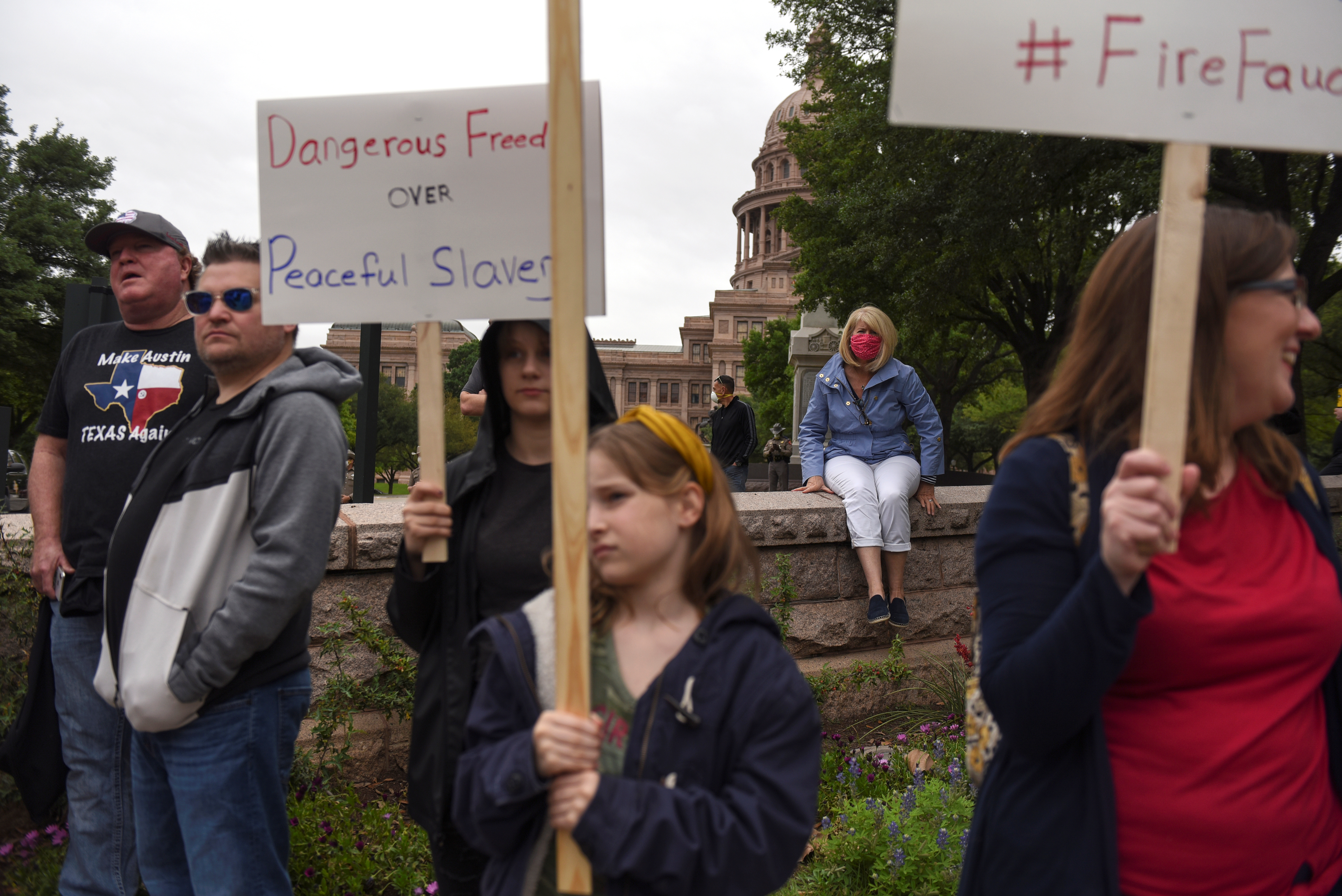
On Saturday, several dozen protesters gathered in the Texas capital of Austin chanting “USA! USA!” and “Let us work!”

In Brookfield, Wisconsin, hundreds of demonstrators cheered as they lined a main road and waved American flags to protest at the extension of that state’s “safer at home” order.

Earlier in the week, scattered protests erupted in the capitols of Ohio, Minnesota, Michigan and Virginia. The demonstrators mostly flouted the social-distancing rules and did not wear the face masks recommended by public health officials.

As of Friday night, New York has mandated the statewide wearing of masks for anyone out in public and unable to practice social distancing.

Republican President Donald Trump appeared to encourage protesters with a series of Twitter posts on Friday calling for them to “LIBERATE” Michigan, Minnesota and Virginia, all run by Democratic governors.

Trump had touted a thriving economy as the best case for his re-election in November.

Several states, including Ohio, Michigan, Texas and Florida, have said they aim to reopen parts of their economies, perhaps by May 1 or even sooner, but appeared to be staying cautious.

Florida’s Republican governor Ron DeSantis reopened some beaches with restrictions from Friday evening, but also said on Saturday that schools will remain closed and continue distance learning the rest of this school year.

Fellow Republican Governor Greg Abbott of Texas has also extended school closures to the end of the academic year.

Health experts say that to avoid a second wave of infections as people return to work, extensive testing must be available to track infections, as well as contact tracing and antibody testing to learn who had been previously infected and might have some immunity.

Vice President Mike Pence said on Friday the United States had the capacity to do a sufficient amount of testing for states to move into a phase one of reopening.

Governors and state health officials say there is nowhere near enough test kits and equipment available, however.

The United States has by far the world’s largest number of confirmed coronavirus cases, with more than 720,000 infections and over 37,000 deaths.

The handful of states that did not issue stay-at-home orders have all seen significant surges in new cases.

(Reporting by Nathan Layne in Wilton, Connecticut, Maria Caspani in New York, Jennifer Hiller in Houston and Idrees Ali in Washington; Writing by Bill Berkrot and Sonya Hepinstall; Editing by Daniel Wallis)

Trump says getting close to a deal with Democrats on U.S. coronavirus stimulus

WASHINGTON (Reuters) – U.S. President Donald Trump said Sunday that Republicans were “close” to getting a deal with Democrats on another legislative package to help alleviate economic damage done by the coronavirus pandemic.

At a White House briefing, the president suggested there could be a resolution by Monday.

(Reporting by Nandita Bose; Editing by Cynthia Osterman)

U.S. coronavirus death toll rises as cases hit 750,000: Reuters tally

By Lisa Shumaker

(Reuters) – The U.S. death toll from the novel coronavirus rose to more than 40,000 on Sunday, the highest in the world and almost double the number of deaths in the next highest country Italy, according to a Reuters tally.

It took the United States 38 days after recording its first fatality on Feb. 29 to reach 10,000 deaths on April 6, but only five more days to reach 20,000 dead, according to a Reuters tally. The United States’ toll increased to 40,000 from 30,000 in four days after including untested but probable COVID-19 deaths reported by New York City.

The United States has by far the world’s largest number of confirmed coronavirus cases, with more than 750,000 infections — a number that has doubled in 13 days. New cases on Saturday rose by nearly 29,000, the lowest increase in three days.

More than 22 million Americans have filed for unemployment benefits in the past month as closures of businesses and schools and severe travel restrictions have hammered the economy.

Governors in U.S. states hardest hit by the coronavirus sparred with President Donald Trump over his claims they have enough tests and should quickly reopen their economies as more protests are planned over the extension of stay-at-home orders.

The region of Maryland, Virginia and Washington D.C. is still seeing increasing cases. New Jersey reported on Sunday that its new cases rose by nearly 3,900, the most in more than two weeks. Boston and Chicago are also emerging hot spots with recent surges in cases and deaths.

Several states, including Ohio, Texas and Florida, have said they aim to reopen parts of their economies, perhaps by May 1 or even sooner, but appeared to be staying cautious.

(Writing by Lisa Shumaker; Editing by Daniel Wallis)

Latest on the spread of the coronavirus around the world – Sunday

(Reuters) – Reported cases of the coronavirus have crossed 2.33 million globally and 159,818 people have died, according to a Reuters tally as of 2000 GMT on Sunday.

DEATHS AND INFECTIONS

* For an interactive graphic tracking the global spread, open https://tmsnrt.rs/3aIRuz7in an external browser.

* For a U.S.-focused tracker with state-by-state and county map, open https://tmsnrt.rs/2w7hX9Tin an external browser.

AMERICAS

* Governors in U.S. states hardest hit by the novel coronavirus sparred with President Donald Trump over his claims they have enough tests and should quickly reopen their economies as more protests are planned over the extension of stay-at-home orders.

* The U.S. death toll from the novel coronavirus rose to more than 40,000 on Sunday, the highest in the world and almost double the number of deaths in the next highest country Italy, according to a Reuters tally.

* U.S. lawmakers are very close to an agreement on approving extra money to help small businesses hurt by the coronavirus pandemic and could seal a deal as early as Sunday, congressional and Trump administration officials said.

* The number of people with the new coronavirus in Canada is trending in the right direction but strict physical distancing will need to stay in place, Prime Minister Justin Trudeau said on Sunday.

* Chile reported on Sunday that there were more than 10,000 people in the country with the coronavirus, the third-highest tally in Latin America, as the disease ravages the economy of the world’s top copper producer.

* Peru reported over 15,000 cases of coronavirus on Sunday, the second-highest tally in Latin America, as the disease continues to ravage the economy of the world’s No. 2 copper producer.

EUROPE

* President Vladimir Putin said that Russian authorities had the coronavirus crisis under full control and that everything would work out with God’s help, even as the country on Sunday registered a record daily rise in cases of the new virus.

* Italy said on Sunday that deaths from the coronavirus pandemic rose by 433, the lowest daily tally in a week, and the number of new cases slowed to 3,047 from a previous 3,491.

* Ireland is highly unlikely to allow large gatherings this year and the “cocooning” of people over 70 years old in their homes may persist for quite a while, Health Minister Simon Harris said.

* A delivery of protective equipment for British health workers that was due on Sunday from Turkey has been delayed, a British government official said, as medics on the frontline of the coronavirus outbreak increasingly report shortages of gear.

* Britain is not considering lifting the lockdown imposed almost four weeks ago to control the coronavirus outbreak given “deeply worrying” increases in the death toll, a senior minister said

* Germany’s confirmed coronavirus cases have risen by 2,458 to 139,897, data from the Robert Koch Institute (RKI) for infectious diseases showed on Sunday. That was lower than a 3,609 increase reported on Saturday.

*Pope Francis called for an all-embracing vision of the world after the Covid-19 crisis, saying moving on without global solidarity or excluding sectors of society from the recovery would result in “an even worse virus”.

ASIA-PACIFIC

* China reported 16 new coronavirus cases but no deaths while authorities remained on guard against a major resurgence and monitored the spread of cases in Heilongjiang province.

* Australia added to growing pressure on China over its handling of the novel coronavirus, questioning its transparency and demanding an international investigation into the origins of the virus and how it spread.

* South Korea extended its social distancing policy for another 15 days but offered some relief for churches and sporting fixtures, as it reported just eight new coronavirus infections, the lowest in two months.

* Indonesia’s death toll from the new coronavirus has likely reached 1,000, nearly double the official figure of 535, Indonesian Doctors Association (IDI) chairman Daeng Faqih was quoted saying.

* Pakistan has lifted restrictions on congregational prayers at mosques, but put in place a host of safety conditions to avert the further spread of the coronavirus in the country, a statement said.

MIDDLE EAST AND AFRICA

* Health ministers from the Group of 20 major economies began a virtual meeting on Sunday to work on a joint response to the coronavirus pandemic, Saudi Arabian state television reported.

* Saudi Arabia’s highest religious body, the Council of Senior Scholars, urged Muslims worldwide to pray at home during Ramadan if their countries require social distancing to combat coronavirus, state news agency SPA reported.

* Turkey’s confirmed coronavirus cases have risen to 82,329, Health Minister Fahrettin Koca said, overtaking neighbouring Iran for the first time to register the highest total in the Middle East.

* Iran has extended furloughs for prisoners for another month, Iranian President Hassan Rouhani said on Sunday, as the Islamic Republic endeavours to stem the spread of the new coronavirus in its crowded jails.

ECONOMIC FALLOUT

* Neiman Marcus Group is preparing to seek bankruptcy protection as soon as this week, becoming the first major U.S. department store operator to succumb to the economic fallout from the coronavirus outbreak, people familiar with the matter said.

*Europe will need at least another 500 billion euros from European Union institutions to finance its economic recovery after the coronavirus pandemic, on top of the agreed half-a-trillion package, the head of the euro zone bailout fund said.

* Canada will invest C$2.5 billion ($1.8 billion) in measures to help the hard-hit oil and gas industry during the coronavirus outbreak, Prime Minister Justin Trudeau said.

* Global stocks rallied on President Donald Trump’s plans to revive the coronavirus-hit U.S. economy and a report about a clinical trial for a potential drug to treat COVID-19.

* China’s economy contracted for the first time on record in the first quarter as the coronavirus shut down factories and shopping malls and put millions out of work.

(Compiled by Sarah Morland and Devika Syamnath; Editing by William Maclean)

Some life insurers hit pause on older Americans during coronavirus crisis

By Suzanne Barlyn

(Reuters) – Some U.S. life insurers are deciding not to gamble on older Americans during the coronavirus crisis by temporarily suspending applications from certain age groups or imposing tougher requirements.

Prudential Financial Inc, Lincoln National Corp and Protective Insurance Corp are among the insurers that have made changes. Prudential and Protective are temporarily halting applications from individuals aged 80 or older, while Lincoln has postponed approving policies for that age group and others, the companies said.

Mutual of Omaha Insurance Co and Penn Mutual Life Insurance Co are temporarily suspending applications for individuals aged 70 or older. Securian Financial has stopped accepting new applications for those 71 and older until at least June 15, according to memos seen by Reuters.

Some insurers are also suspending applications for people in their 60s who previously may have been eligible for coverage despite common health problems such as diabetes or asthma.

Insuring older Americans can be a big risk for U.S. life insurers under the best of circumstances, but it brings in hefty premiums. A healthy 40-year-old woman pays about $180 annually for a $250,000 15-year term life policy, while a healthy 70-year-old woman pays $2,244, or 1,146% more, according to online brokerage Policygenius.

Many people buy life insurance when they are younger, concerned they could die and leave their families impoverished.

Life insurance may seem less critical for older people, but some see it as a path to a legacy, said Byron Udell, president and chief executive officer of insurance brokerage AccuQuote.

“Many people haven’t been able to accumulate much of anything and want to leave something behind beyond a bunch of socks and underwear,” Udell said.

The changes generally apply to life insurance that requires “full underwriting,” a process to determine risk and pricing, which includes reviewing health records and can require a medical exam. The review can facilitate qualifying for significantly higher coverage amounts than other types of life insurance.

Insurers said they are making the changes for their companies’ long-term financial health and ability to pay claims for existing policyholders. A Mutual of Omaha spokeswoman said the company acted on the advice of its reinsurers, companies that insure life insurers.

People aged 65 and older account for eight out of every 10 deaths from the novel coronavirus in the United States, according to the U.S. Centers for Disease Control and Prevention (CDC).

Policies for people in their 70s represent anywhere from 2% to 3.5% of sales, some of the insurers told Reuters.

(Reporting by Suzanne Barlyn; Editing by Paul Simao)

Factbox: Latest on the spread of the coronavirus around the world

(Reuters) – Reported cases of the coronavirus have crossed 2.18 million globally and 147,265 people have died, according to a Reuters tally as of 1400 GMT on Friday.

DEATHS AND INFECTIONS

– For an interactive graphic tracking the global spread, open https://tmsnrt.rs/3aIRuz7 in an external browser.

– For a U.S.-focused tracker with state-by-state and county map, open https://tmsnrt.rs/2w7hX9T in an external browser.

AMERICAS

– The U.S. Secretary of State said nations should rethink adopting Huawei’s 5G networks in their telecommunications infrastructure, due to China’s role in the pandemic.

– Some Venezuelan public health workers told Reuters the nation’s rickety health care system is ill-prepared to confront the pandemic, with a nationwide testing program dependent on a single, overstretched Caracas lab.

– Honduras’ health minister said that a Cuban medical brigade would join local medics to fight the coronavirus.

– Mexico’s deputy health minister, Hugo Lopez-Gatell, said the country might have as many as 55,951 people infected, twice the estimated number reported last week.

– Brazilian President Bolsonaro fired his health minister and again called for states to end stay-at-home orders. He also accused a house speaker of turning state governors against him and seeking to remove him from office.

EUROPE

– Britain was too slow to react on a number of fronts to the outbreak and 40,000 people could die, a leading public health professor told lawmakers on Friday, a day after the UK’s hospital death toll rose to 14,576.

– Switzerland urged residents against complacency as the country’s infection rate slows and lawmakers start relaxing restrictions.

– Germany’s health minister said the outbreak has become manageable again as the number of recovered patients has exceeded new infections every day this week.

– Moscow has more cases than state testing shows, private testing results among people without symptoms suggest.

ASIA-PACIFIC

– Nearly 1,300 people who died in the Chinese city of Wuhan, or half the total, were not counted in death tolls because of lapses, state media said on Friday, but Beijing dismissed claims that there had been any kind of cover-up.

– Singapore is assessing whether to place recovered migrant workers on cruise ships rather than back in dormitories that have become infection hotbeds, despite problems controlling onboard outbreaks encountered elsewhere.

– Japan said it hoped to start distributing relief payments next month, after extending a state of emergency nationwide.

– The number of infections in South Asia crossed 22,000 on Friday, driven by a rise in cases in India as the Maldives locked down its capital.

– Indonesia surpassed the Philippines on Friday as the country reporting the most infections in Southeast Asia.

MIDDLE EAST AND AFRICA

– The pandemic will likely kill at least 300,000 Africans and risks pushing 29 million into extreme poverty, the U.N. Economic Commission for Africa said, calling for a $100 billion safety net for the continent.

– Iran paraded medical gear to mark its national Army Day as the country’s death toll rose to 4,958. A parliamentary report released earlier this week said the death toll might be almost double the figures announced by the health ministry, and the number of infections eight to 10 times more.

– Saudi Arabia’s grand mufti said that Muslim prayers during Ramadan and the Eid al-Fitr feast should be performed at home if the outbreak continues.

– Israel is heading off shortages of disposable surgical masks by mass-producing washable versions sized to fit everyone from children to bearded men.

ECONOMIC FALLOUT

– World stock markets made a super-charged sprint towards a second straight week of gains on Friday after President Donald Trump laid out plans to gradually reopen the coronavirus-hit U.S. economy following similar moves elsewhere. [MKTS/GLOB]

– Oil prices were mixed on Friday as news of Trump’s plans was quickly overshadowed by China’s worst quarterly economic contraction on record.

– The International Monetary Fund said the economic fallout of the pandemic, combined with other problems, meant Latin America and the Caribbean would likely see “no growth” in the decade from 2015 to 2025.

– Chile´s export-driven economy will see a painfully slow recovery after being battered by mass protests and the coronavirus crisis, market watchers said.

– It is unclear whether measures designed to support the euro zone economy will be sufficient, Germany’s Bundesbank head told Bloomberg, adding that expansionary monetary and fiscal policies would remain necessary for some time.

– The outbreak will not affect China’s current account in the medium-to-long term, the foreign exchange regulator said on Friday.

– Saudi Arabia is facing the crisis with strong financial reserves and relatively low government debt, its finance minister said.

– Fourteen Japanese companies have scrapped plans for initial public offerings this month, more than in the aftermath of the Sept 2001 attacks on the United States.

– Britain’s financial watchdog has proposed a repayment freeze for millions of consumers with auto finance contracts, goods bought on high-cost credit, and pawned belongings.

(Compiled by Sarah Morland; Editing by Tomasz Janowski, Arun Koyyur and Nick Macfie)

Trump suggests U.S. states re-open economies in three phases in new guidelines

WASHINGTON (Reuters) – Parts of President Donald Trump’s guidelines for re-opening the U.S. economy amid the coronavirus pandemic trickled out on Thursday afternoon, revealing a three-phase plan that could allow some states to begin as early as this month lifting limits meant to contain the disease’s spread.

In the first phase of Trump’s guidelines, to be publicly unveiled on Thursday evening, larger venues like restaurants and movie theaters could operate again with strict social distancing, according to a copy seen by Reuters. Non-essential travel could resume and schools could open their doors again in phase two. In phase three medically vulnerable people could resume public interactions.

The New York Times reported that Trump told governors of states that some could re-open their states by May 1 or earlier. He was also expected to soon announce hiring plans for tracking the disease’s spread, according to the Times.

(Reporting by Jeff Mason, Eric Beech, Lisa Lambert and Tim Ahmann; Editing by Chris Reese)

Fed says backstop for small business loans fully operational

WASHINGTON (Reuters) – The Federal Reserve’s program to back emergency government loans to small businesses is “fully operational,” the U.S. central bank said on Thursday, a boost to banks as they await a possible expansion to the total amount of funds they will be allowed to disburse to help companies through the coronavirus crisis.

The Fed’s program is designed to make it easier for banks to offer loans under the $350 billion Paycheck Protection Program run by the Small Business Administration (SBA) by extending credit to financial institutions that make them, using the loans as collateral.

There are no fees for using the facility but the Fed said it will charge banks a 0.35% interest rate.

“Supplying financial institutions with additional liquidity will help increase their capacity to make PPP loans,” the Fed said.

The SBA has already allocated more than 1.6 million loans, which have the potential to be forgiven, to small businesses in all 50 states. These account for more than $338 billion of the initial $350 billion, since the initial program passed by Congress was launched less than two weeks ago.

With funds set to be exhausted shortly, U.S. Treasury Secretary Steven Mnuchin and SBA Administrator Jovita Carranza on Wednesday urged Congress to approve an additional $250 billion in funds. Democrats have said they are in favor, but only if there are additional safeguards to ensure that credit is reaching businesses in underserved communities that don’t have strong pre-existing relationships with banks.

Data released on Tuesday showed that the construction, professional services and manufacturing sectors so far are among those topping the list of recipients, although the program has been hampered by slow disbursement of the actual funds and criticism that it shows preference to those who are existing business customers of participating lenders.

The Fed’s own program does not expand the amount available but it does allow banks to move loans off their balance sheets more quickly, freeing up capital to lend further if Congress adds more to the pot.

(Reporting by Lindsay Dunsmuir and Ann Saphir; Editing by Chizu Nomiyama, Jonathan Oatis and Bernadette Baum)