Frost thaws in U.S.-China ties ahead of G20 meeting

FILE PHOTO: U.S. and Chinese flags are placed for a joint news conference by U.S. Secretary of State Mike Pompeo and Chinese Foreign Minister Wang Yi at the Great Hall of the People in Beijing, China June 14, 2018. REUTERS/Jason Lee/File Photo

By David Brunnstrom and John Geddie

WASHINGTON/SINGAPORE (Reuters) – The United States and China will hold a delayed top-level security dialogue on Friday, the latest sign of a thaw in relations, as China’s vice president said Beijing was willing to talk with Washington to resolve their bitter trade dispute.

The resumption of high-level dialogue, marked by a phone call last week between Presidents Donald Trump and Xi Jinping, comes ahead of an expected meeting between the two at the G20 summit in Argentina starting in late November.

It follows months of recriminations spanning trade, U.S. accusations of Chinese political interference, the disputed South China Sea and self-ruled Taiwan.

China and the United States have both described last week’s telephone call between Xi and Trump as positive. Trump predicted he’d be able to make a deal with China on trade.

In a concrete sign of the unfreezing, the U.S. State Department said Secretary of State Mike Pompeo, Defense Secretary Jim Mattis, Chinese politburo member Yang Jiechi and Defense Minister Wei Fenghe will take part in diplomatic and security talks later this week in Washington.

China said last month the two sides had initially agreed “in principle” to hold the second round of diplomatic security talks in October but they were postponed at Washington’s request amid rising tensions over trade, Taiwan and the South China Sea.

Mattis had been due to hold talks with Wei in Beijing in October, but those plans were upended after Washington imposed sanctions on China’s People’s Liberation Army for buying weapons from Russia.

Mattis did meet Wei in Singapore on Oct. 18 and told him that the world’s two largest economies needed to deepen high-level ties to reduce the risk of conflict.

Speaking in Singapore on Tuesday, Chinese Vice President Wang Qishan, who is close to Xi, reiterated China’s readiness to hold discussions and work with the United States to resolve trade disputes as the world’s two largest economies stand to lose from confrontation.

“Both China and the U.S. would love to see greater trade and economic cooperation,” Wang told the Bloomberg New Economy Forum in Singapore.

“The Chinese side is ready to have discussions with the U.S. on issues of mutual concern and work for a solution on trade acceptable to both sides,” he said.

“The world today faces many major problems that require close co-operation between China and the United States,” Wang said.

Wang echoed comments made by Xi on Monday at a major import fair in Shanghai that Beijing will embrace greater openness.

Trump has railed against China over intellectual property theft, entry barriers to U.S. business and a gaping trade deficit, which U.S. data showed reached a record $40.2 billion in September.

The trade war, which has seen both sides impose tariffs on billions of dollars worth of the other’s imports, is beginning to hurt China’s economy and has battered Chinese shares and the yuan currency.

It has also brought purchases of U.S. soybeans by China to a virtual standstill. Soybeans are the largest U.S. agricultural export to China.

Jim Sutter, CEO of the U.S. Soybean Export Council, told Reuters on the sidelines of the Shanghai import fair that both countries understood the need to maintain their relationship.

“I think both sides are optimistic … more optimistic after the call last week that took place, that some kind of a solution can be reached,” he said.

(Reporting by David Brunnstrom and John Geddie; Additional reporting by Tom Daly and Michael Martina in Shanghai; Writing by Ben Blanchard; Editing by Tony Munroe and Neil Fullick)

First wave of Central American migrants arrives in Mexico City

Migrants, part of a caravan traveling en route to the United States, queue to receive food as they stay in a sport center used as shelter in Arriaga, Mexico November 4, 2018. REUTERS/Carlos Garcia Rawlins

MEXICO CITY (Reuters) – The first Central American migrants from a caravan traveling through Mexico toward the United States in hopes of seeking asylum arrived in Mexico City on Sunday, taking up temporary shelter at a sports stadium.

More than 1,000 Central Americans, many fleeing gang violence and financial hardship in their home countries, bedded down at the stadium where the city government set up medical aid and food kitchens.

Ahead of U.S. congressional elections this Tuesday, President Donald Trump has warned repeatedly about the advance of the caravan and ordered thousands of troops to the Mexican border, where units strung up razor wire this weekend.

The migrants arrived in the capital, nearly 500 miles (805 kilometers) from the closest border crossings in Texas, four weeks after setting out from the Honduran city of San Pedro Sula.

“Our heads are set at getting to the United States, to fulfill the American dream,” said Mauricio Mancilla, who traveled with his six-year old son from San Pedro Sula. “We have faith in God that we will do this, whatever the circumstances.”

Thousands more Central Americans were moving in groups in the Gulf state of Veracruz, the central state of Puebla and in the southern state of Chiapas, local media reported.

“This is an exodus,” Alejandro Solalinde, a Catholic priest and migrant rights activist, told reporters. “It’s without precedent.”

The U.S. government has pressured Mexico to halt the advance of the migrants and President Enrique Pena Nieto has offered temporary identification papers and jobs if they register for asylum in the southern states of Chiapas and Oaxaca.

Mexico’s government said on Saturday it was processing nearly 2,800 asylum requests and that around 1,100 Central Americans had been deported.

At the capital’s famed shrine to the Virgin of Guadalupe, a group of Mexican volunteers called out on bullhorns, offering bus rides to migrants to the stadium.

Cesar Gomez, a 20-year old Guatemalan, said he jumped at joining the caravan to avoid the dangers of traveling alone and paying thousands of dollars to human smugglers.

“This was a good opportunity,” he said as he waited for a ride. “The first thing is to try for the United States. If not, maybe I will stay here.”

(Reporting by Josue Gonzalez, Stefanie Eschenbacher and Alberto Fajardo; Editing by Susan Thomas)

For Trump supporters, elections a battle for his vision of America

Supporters applaud U.S. President Donald Trump as he arrives to attend a campaign rally at Middle Georgia Regional Airport in Macon, Georgia, U.S., November 4, 2018. REUTERS/Jonathan Ernst/File Photo

By Maria Caspani, Julia Harte and Ned Parker

MACON, Ga. (Reuters) – For many Americans, Tuesday’s congressional midterm elections are a referendum on President Donald Trump’s divisive persona, hardline policies and pugnacious politics.

But at a Trump rally on Sunday in a crowded airport hangar in Macon, Georgia, and at other such events, the elections are a far different proposition: a vote to protect a leader supporters see as under siege, whose inflammatory rhetoric is a necessary price for a norm-shattering era of change.

“He is putting people back to work,” said Barbara Peacock, 58, a retired postal worker from Macon, Georgia, as she perused Trump 2020 merchandise. “He is telling it like it is.”

At rallies overflowing with red-hatted, mostly white supporters in conservative pockets of the country, she and many other Trump supporters credit the president with making the country – and their lives – better.

Rallying together, bedecked in Trump shirts and waving “Make America Great Again” and “Finish the Wall” signs, they hope to make Trump’s ideas the dominant force in American political life for decades to come.

They face strong headwinds. Nationally, about 52 percent of Americans disapprove of Trump’s performance. More people say they would vote for a Democratic candidate than a Republican in Tuesday’s congressional elections, Reuters/Ipsos polling shows.

But pro-Trump Republicans are eager to defy expectations, just as the president did with his 2016 victory.

In Grand Rapids, Michigan, pro-Trump activist Ben Hirschmann, 23, sees Tuesday’s elections as decisive for Trump’s vision of America.

“Trump’s not on the ballot, but he is on the ballot,” he said at a phone-bank event at the local Republican headquarters. “Everything we voted for in 2016 is on the line in 2018.”

Hirschmann is part of a group that organizes flash mobs at busy intersections in the Grand Rapids area, drawing 30 to 40 people about twice a week to hold campaign signs for Republican U.S. Senate candidate John James.

‘NOW WE’RE LIVING GOOD’

Trump has a clear strategy: drive Republican turnout by focusing on illegal immigration, as a caravan of migrants moves through Mexico toward the U.S. border, while playing up gains in the economy and casting his Democratic opponents as an angry, liberal and dangerous “mob.”

“The choice could not be more clear,” he told supporters at a rally in Missoula, Montana. “Democrats produce mobs, Republicans produce jobs.”

It is unclear if the strategy will work. Republicans are expected to keep control of the Senate. But Democrats are widely favored to win the 23 seats they need to assume control of the House of Representatives, where Republicans are defending dozens of seats in largely suburban districts where Trump’s popularity has languished and Democrats have performed well in presidential races.

Trump’s rallies have focused mostly on Senate and gubernatorial battles in states he won in the 2016 presidential race – from Florida and Missouri to West Virginia and Ohio. A Trump adviser, who asked not to be identified, told Reuters: “These are places where data and polling information tells us that the president is of best use.”

At a rally in Johnson City, Tennessee, in early October, Jessica Lotz, 33, and her fiance, Chad Lavery, said Trump’s immigration policies resonated with them. During the 2008 economic downturn, Lotz and Lavery said they saw construction, landscaping and house painting jobs go to illegal immigrants while they struggled financially.

As the economy rebounded, so, too, did their fortunes.

“Now we’re living good,” Lavery said, crediting their ability to find work and better wages to Trump, who inherited an economy that was already in one of the longest recoveries and gave it an additional boost with tax cuts.

‘FRUSTRATED’

After a Trump rally in September in Springfield, Missouri, pro-Trump activist Brenda Webb sat for a late dinner at a restaurant with five friends who had driven to the rally from the St. Louis suburbs.

Webb and her friends had joined protests against former President Barack Obama in St. Louis in 2009 that were part of a broader conservative“Tea Party” movement centered on calls for smaller government, lower taxes and fewer regulations.

But the energy fizzled, she said. The group became animated talking about how Trump had given new focus to those early Tea Party goals of reclaiming government for ordinary citizens, not just the “elites” in Washington.

“We feel like he’s working to resolve all the problems that we are so frustrated by,” Webb said.

At the Springfield rally, Brian Whorton, who drove a few hours to see the president, confessed he voted for Obama twice before becoming a Republican. “I was not politically aware and awake. I thought, oh he’s cool and he’s a good speaker and an African-American guy,” Whorton said.

Trump’s policies, he said, were making a difference for him: He said his factory manager had credited Trump tariffs with raising profits at his plant.

In Ohio, Republican National Committee spokeswoman Mandi Merritt referred to pro-Trump enthusiasts as a “grassroots army” that could be harnessed and dispatched to boost Republican voter turnout.

On a sunny day in October, Trump supporter Kimmy Kolkovich joined a friend on the sidewalk at a busy intersection near the Ohio Statehouse in Columbus to urge people to register and vote.

“Even if I’m registering people who are going to vote for the other party, they’re seeing us out here in our hats, and that’s what’s important, all the little interactions and conversations we’re having,” Kolkovich said.

For all Reuters election coverage, click: https://www.reuters.com/politics/election2018

(Reporting by Maria Caspani in Macon, Ga., Julia Harte in Grand Rapids, Mich. and Columbus, Ohio, and Ned Parker in Springfield, Mo., and Johnson City, Tenn.; Additional reporting by Steve Holland in Washington; Editing by Jason Szep, Colleen Jenkins and Peter Cooney)

Trump moves to crack down on asylum seekers ahead of U.S. elections

U.S. President Donald Trump delivers remarks on immigration and border security in the Roosevelt Room of the White House in Washington, U.S., November 1, 2018. REUTERS/Kevin Lamarque

By Jeff Mason and Roberta Rampton

WASHINGTON (Reuters) – President Donald Trump said on Thursday he was finalizing a plan that would require immigrants seeking asylum in the United States to approach a legal port of entry, pushing a hard line on immigration ahead of next week’s congressional elections.

It was not clear whether the plan would pass legal muster. The Immigration and Nationality Act provides that any immigrant in the United States may apply for asylum, regardless of whether he or she entered the country through a designated port of entry.

“Migrants seeking asylum will have to present themselves lawfully at a port of entry,” Trump told reporters at the White House, adding that he would issue an executive order on immigration next week.

“Those who choose to break our laws and enter illegally will no longer be able to use meritless claims to gain automatic admission into our country,” he added.

Trump has ramped up his tough stance on illegal immigration, an issue that appeals to his core supporters, before elections on Tuesday that will determine whether his fellow Republicans keep control of Congress.

In recent days, he has sought to present as a threat to the United States a large group of migrants from Central America who have left poverty and violence at home and are heading slowly through Mexico toward the U.S. border.

“These illegal caravans will not be allowed into the United States and they should turn back now,” Trump said. “We are stopping people at the border. This is an invasion.”

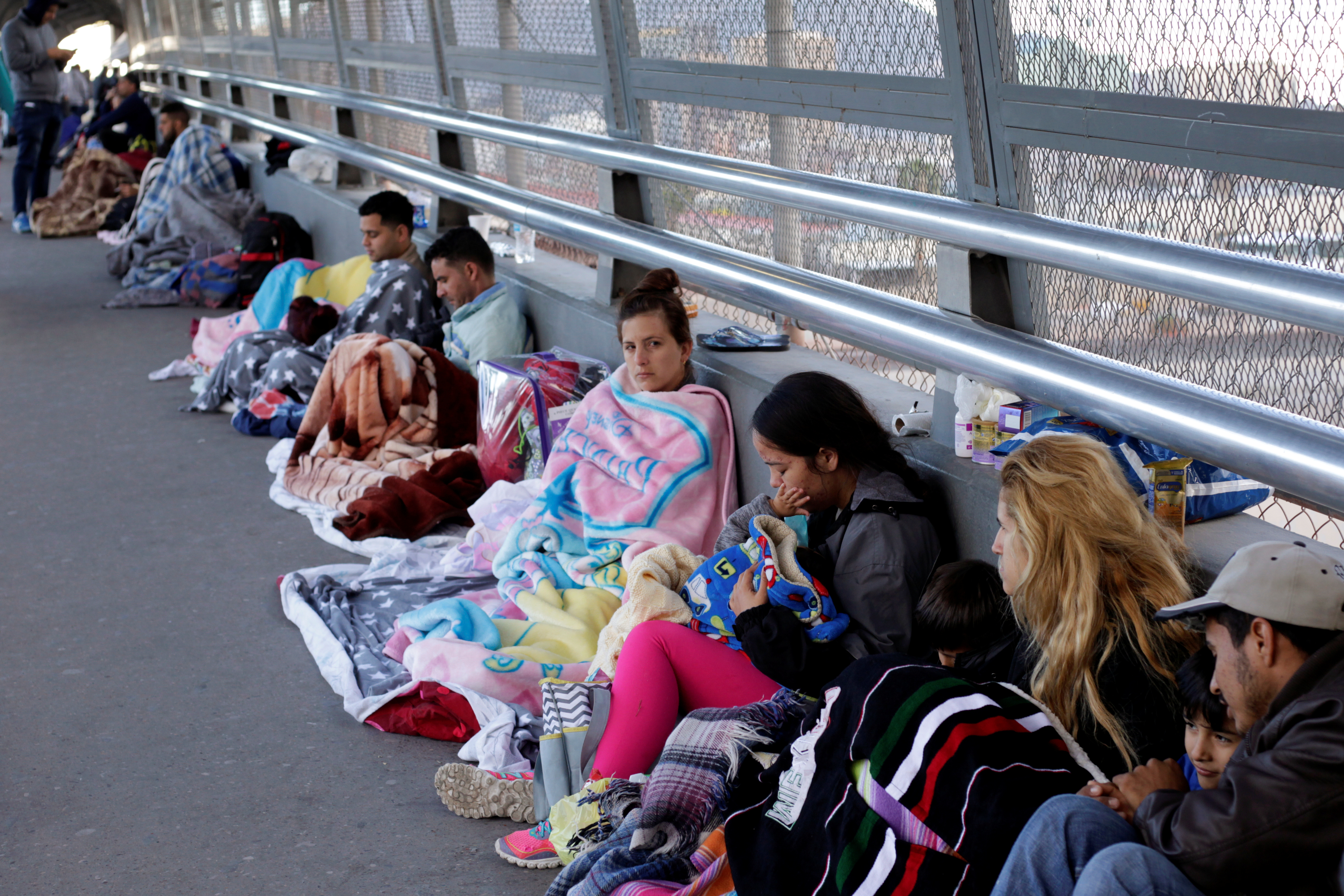
A group of Central Americans who are hoping to apply for asylum, wait at the border on an international bridge between Mexico and the U.S. in Ciudad Juarez, Mexico October 31, 2018. REUTERS/Jose Luis Gonzalez

A group of Central Americans who are hoping to apply for asylum, wait at the border on an international bridge between Mexico and the U.S. in Ciudad Juarez, Mexico October 31, 2018. REUTERS/Jose Luis Gonzalez

Republican Senator Chuck Grassley, an ally of the president and head of the powerful Senate Judiciary Committee, echoed some of the president’s strong rhetoric about the caravan in a letter to the secretaries of the Department of Homeland Security and the State Department.

In the letter, Grassley said his office had received information that several members of the caravan had “significant criminal histories” and was seeking information about “potential national security threats that reportedly exist among the members.”

Trump said on Wednesday the United States could send as many as 15,000 troops to the border to confront the migrant caravan, more than twice the number previously disclosed by defense officials.

Republican lawmakers and other Trump supporters have applauded the deployment. But critics argue Trump has manufactured a crisis to drive Republican voters to the polls.

On another immigration front, Trump said this week he would seek to scrap the constitutional right of citizenship for U.S.-born children of noncitizens and illegal immigrants, saying he would issue an executive order on so-called birthright citizenship.

Trump and some other Republicans say the right – granted by the Constitution’s post-Civil War 14th Amendment – creates an incentive for people to enter the country illegally to have children. Critics, including some other Republicans, say the president cannot change the Constitution by fiat. Such an action would virtually guarantee a legal challenge.

(Reporting by Roberta Rampton and Jeff Mason; Additional reporting by Makini Brice and Lisa Lambert; Editing by Peter Cooney)

New migrant caravan departs Salvadoran capital for U.S.

People walk in a caravan of migrants departing from El Salvador en route to the United States, in San Salvador, El Salvador, October 31, 2018. REUTERS/Jose Cabezas

By Nelson Renteria

SAN SALVADOR (Reuters) – About 2,000 migrants began walking north from El Salvador’s capital on Wednesday, the latest of several groups trying to reach the United States, even as President Donald Trump increases pressure to halt the flow of people.

The migrants departed in two groups, including men and women pushing strollers and others with children on their shoulders. On Sunday, a separate group comprising about 300 people set off for the U.S. border from the Salvadoran capital.

People walk in a caravan of migrants departing from El Salvador en route to the United States, in San Salvador, El Salvador, October 31, 2018. REUTERS/Jose Cabezas

People walk in a caravan of migrants departing from El Salvador en route to the United States, in San Salvador, El Salvador, October 31, 2018. REUTERS/Jose Cabezas

A caravan estimated to number at least 3,500 people, which left Honduras in mid-October and is now in southern Mexico, has become a major issue in U.S. congressional elections on Nov. 6.

The bulk of migrants caught trying to enter the United States illegally via Mexico come from El Salvador, Honduras and Guatemala. Many make the dangerous journey north to escape high levels of poverty and violence in their homelands.

The United States is in the process of sending 5,200 troops to its southern border as part of Trump’s crackdown on illegal immigration. The prospect has so far not discouraged people from leaving El Salvador.

“It scares us a little. But since we’re seeing a ton of people going together, we can help one another to cross,” said Jose Machado, one of the migrants departing San Salvador, carrying a backpack stuffed with clothing and toiletries.

Trump, who has threatened to slash U.S. aid to Central America and close the U.S. border with Mexico, said in a tweet on Wednesday that Mexico needs to keep up efforts to discourage the migrants, who he described as “tough fighters.”

A clash at the Mexico-Guatemala border on Sunday left one migrant dead and several law enforcement officers injured.

“Mexican soldiers hurt, were unable, or unwilling to stop Caravan. Should stop them before they reach our Border, but won’t!” Trump said in a Tweet.

White House press secretary Sarah Sanders on Wednesday praised Mexico’s actions to slow the movement of people, but told Fox News: “They can do more.”

Police estimated the two groups leaving San Salvador numbered around 1,000 each. One cohort left around dawn, followed by a second later in the morning.

Some waved Salvadoran flags as motorists honked in support and shouted, “God bless you.”

(Reporting By Nelson Renteria, Additional reporting by Doina Chiacu in Washington, Writing by Daina Beth Solomon; Editing by Dave Graham and Alistair Bell)

Thousands of U.S. troops could be sent to Mexico border: source

Migrants, part of a caravan of thousands from Central America en route to the U.S., walk on the train tracks, in Arriaga, Mexico October 26, 2018. REUTERS/Ueslei Marcelino

WASHINGTON (Reuters) – The total number of U.S. troops heading to the border with Mexico could be in the thousands but there is no firm figure yet, a U.S. official told Reuters on Monday, offering a much higher estimate than the 800 to 1,000 initially forecast.

The Pentagon declined comment on potential troop numbers, saying planning was still underway for a mission that aims to bolster President Donald Trump’s battle against migrants trekking toward the United States.

(Reporting by Phil Stewart; Editing by Chizu Nomiyama)

White House invites Putin to Washington

FILE PHOTO: U.S. President Donald Trump and Russia's President Vladimir Putin shake hands as they meet in Helsinki, Finland July 16, 2018. REUTERS/Kevin Lamarque

By Margarita Antidze

TBILISI (Reuters) – The White House has formally invited Russian President Vladimir Putin to Washington, U.S. National Security Advisor John Bolton said on Friday, returning to an idea that was put on hold in July amid anger in the U.S. over the prospect of such a summit.

President Donald Trump held a summit with Putin in Helsinki, the Finnish capital, and then issued Putin an invitation to visit Washington in the autumn. But that was postponed after Trump faced allegations of cozying up to the Kremlin.

“We have invited President Putin to Washington,” Bolton said at a news conference during a visit to ex-Soviet Georgia, days after meeting Putin and senior security officials in Moscow.

Bolton said he gave Putin an invitation to visit next year during his trip to Moscow, U.S. broadcaster RFE/RL reported.

It was not immediately clear if Putin had accepted the invitation. Putin last held a meeting with a U.S. president on American soil in 2015 when he met Barack Obama on the sidelines of a U.N. General Assembly.

Trump’s earlier invitation to Putin sparked an outcry in Washington, including from lawmakers in Trump’s Republican party, who argued that Putin was an adversary not worthy of a White House visit.

The topic of Putin visiting the United States is a highly-charged one, because U.S. intelligence agencies allege that Russia interfered in the 2016 presidential election to help Trump win. Russia denies any election meddling.

Trump has said it is in U.S. interests to establish a solid working relationship with Putin.

Trump and Putin plan to hold a bilateral meeting in Paris on Nov. 11 on the sidelines of events to commemorate the centenary of the end of World War One.

Bolton said that the Paris meeting would be brief.

(Reporting by Margarita Antidze, Writing by Tom Balmforth, Editing by Robin Pomeroy, William Maclean)

Second day of bombs target Democrats, critics of Trump

Police officers check a street after a suspected bomb was found in New York City, U.S., October 25, 2018 in this picture obtained from social media. Terry McAllister/via REUTERS

By Susan Heavey and Jonathan Allen

WASHINGTON/NEW YORK (Reuters) – Authorities discovered suspicious packages sent to former Vice President Joe Biden and actor Robert de Niro on Thursday, a day after several high-profile Democrats and critics of U.S. President Donald Trump were targeted with similar devices.

None of the nine confirmed devices exploded but authorities stepped up their manhunt for the would-be serial bomber, with crucial congressional elections less than two weeks away in what has become a contentious campaign season.

Leading Democrats called the threats a symptom of a coarsening brand of political rhetoric promoted by Trump, who also condemned the acts but blamed the media, his frequent foil, for much of the angry tone of the time.

A suspicious package addressed to Biden was found at a mail facility in New Castle County in Delaware, a federal law enforcement official told Reuters. MSNBC reported a second suspicious package also was discovered.

De Niro, who received a loud ovation when he hurled an obscenity at Trump at the Tony Awards last June, also was targeted, the official said.

At a Wisconsin rally Wednesday night Trump, who has denounced the media as an “enemy of the people,” called attention to “how nice I’m behaving tonight” but on Thursday morning he attacked the media.

“A very big part of the Anger we see today in our society is caused by the purposely false and inaccurate reporting of the Mainstream Media that I refer to as Fake News,” Trump wrote. “It has gotten so bad and hateful that it is beyond description. Mainstream Media must clean up its act, FAST!”

All the people who were targeted are frequently maligned by right-wing critics, including former U.S. President Barack Obama, former Secretary of State and presidential candidate Hillary Clinton and Obama’s Attorney General Eric Holder.

Also targeted were former CIA Director John Brennan, prominent Democratic Party donor George Soros and California Representative Maxine Waters, an outspoken critic of Trump. Two packages were sent to Waters, who Trump has called “an extraordinarily low IQ person.”

The bomb packages were sent as the nation prepared for Nov. 6 elections that will decide whether Democrats take control of one or both houses of Congress from Republicans and deny Trump the majority his party now holds in both chambers.

There has been no claim of responsibility.

Several politicians, including U.S. Senate Majority Leader Mitch McConnell and New York City Mayor Bill de Blasio, described the package bombs as an act of terrorism.

“Someone is trying to intimidate. Someone is trying to quash voices in this country using violence,” De Blasio said. “I am confident that we will find the perpetrator or perpetrators.”

The CNN bureau in New York received a package addressed to Brennan, who has appeared as a CNN analyst, leading police to evacuate the Time Warner building in a busy Manhattan neighborhood near Central Park.

The package sent to CNN, which Trump has frequently derided for its coverage of him, contained an envelope of white powder that experts were analyzing, New York City Police Commissioner James O’Neill said.

‘AGGRESSIVE INVESTIGATION’

Trump told the Wisconsin rally his government would conduct “an aggressive investigation.”

“Any acts or threats of political violence are an attack on our democracy itself,” Trump said. “We want all sides to come together in peace and harmony.”

Last week, Trump, who joined other Republicans in accusing Democrats of encouraging “mob” tactics, heaped praise on a Montana congressional candidate who assaulted a reporter during his successful 2017 campaign.

The first package turned up on Monday and was addressed to Soros, the billionaire financier and advocate of liberal, open-border values who is a frequent target of right-wing conspiracy theories.

The parcel intended for Holder ended up rerouted to the return address printed on all the packages – the Florida office of U.S. Representative Debbie Wasserman Schultz, a former chair of the Democratic National Committee, according to the FBI.

The FBI said on Wednesday the packages consisted of a manila envelope with a bubble-wrap interior containing “potentially destructive devices.” Each bore a computer-printed address label and six “Forever” postage stamps, the FBI said.

Other officials said the devices contained in the envelopes were similar to the one found in the mailbox of the Soros home and later detonated by police. At least one bomb was packed with shards of glass, a federal source said.

(Reporting by Susan Heavey in Washington and Jonathan Allen in New York; Additional reporting by Brendan O’Brien in Milwaukee, Wisconsin, Mark Hosenball in Washington and Barbara Goldberg in New York; Editing by Lisa Shumaker and Jeffrey Benkoe)

Immigrant caravan organizer detained after Trump threatens Honduras

Honduran migrants, part of a caravan trying to reach the U.S., are seen during a new leg of their travel in Esquipulas, Guatemala October 16, 2018. REUTERS/Jorge Cabrera

By Doina Chiacu and Jorge Cabrera

WASHINGTON/ESQUIPULAS, Guatemala (Reuters) – The organizer of a migrant caravan from Honduras was detained on Tuesday in Guatemala after U.S. President Donald Trump threatened to withdraw funding and aid from Honduras if the flow of migrants north to the United States was not stopped.

Guatemalan police officers detained Bartolo Fuentes, a former member of the Honduran Congress, from the middle of a large crowd he and three other organizers had led from San Pedro Sula, Honduras, since Saturday, bound for Mexico.

The Honduran security ministry said Fuentes was detained because he “did not comply with Guatemalan immigration rules” and would be deported back to Honduras in the coming hours.

Up to 3,000 migrants, according to organizers’ estimates, crossed from Honduras into Guatemala on Monday on a trek northward, after a standoff with Guatemalan police in riot gear and warnings from Washington that migrants should not try to enter the United States illegally.

Guatemala’s government has not given official figures for how many migrants are in the group.

“The United States has strongly informed the President of Honduras that if the large Caravan of people heading to the U.S. is not stopped and brought back to Honduras, no more money or aid will be given to Honduras, effective immediately!” Trump wrote on Twitter.

It was Trump’s latest effort to demonstrate his administration’s tough stance on immigration.

The message was driven home by Vice President Mike Pence, who wrote in a tweet that he had spoken to Honduran President Juan Orlando Hernandez.

“Delivered strong message from @POTUS: no more aid if caravan is not stopped. Told him U.S. will not tolerate this blatant disregard for our border & sovereignty,” Pence tweeted.

The move could further encourage Honduras to move closer to China because of what the Central American country sees as weak U.S. support, amid intensified efforts by Beijing to win recognition from Central American countries currently aligned with Taiwan.

Hernandez said last month that cuts in U.S. support for Central America would hinder efforts to stem illegal immigration. He welcomed China’s growing diplomatic presence in the region as an “opportunity.”

In an interview with Reuters, Hernandez lamented that prior U.S. commitments to step up investment in Honduras, Guatemala and El Salvador had been scaled back since Trump took office.

Honduras is one of a dwindling number of countries that still have formal diplomatic ties with Taiwan, an island nation off the Chinese coast that Beijing views as a renegade province.

Last week, Pence told Central American countries the United States was willing to help with economic development and investment if they did more to tackle mass migration, corruption and gang violence. Thousands of migrants have left the impoverished region in recent years.

Honduran migrants, part of a caravan trying to reach the U.S., board a truck during a new leg of their travel in Esquipulas, Guatemala October 16, 2018. REUTERS/Jorge Cabrera

Honduran migrants, part of a caravan trying to reach the U.S., board a truck during a new leg of their travel in Esquipulas, Guatemala October 16, 2018. REUTERS/Jorge Cabrera

GROWING GROUP

The current group making their way north plan to seek refugee status in Mexico or pass through to the United States, saying they are fleeing poverty and violence.

The group more than doubled in size from Saturday, when it set off from northern Honduras in what has been dubbed “March of the Migrant,” an organizer said.

“What Trump says doesn’t interest us,” organizer Fuentes said in an interview shortly before his detention. “These people are fleeing. These people are not tourists.”

He was traveling with hoards of men, women and children, packs in hand, walking northward on a Guatemalan highway about 55 miles (89 km) from the border with Honduras.

Widespread violence and poverty prompt thousands of Central Americans, mainly from El Salvador, Honduras and Guatemala, to make the arduous journey north toward Mexico and the United States in search of a better life.

Guatemala said in a statement on Sunday that it did not promote or endorse “irregular migration.” Guatemalan police initially blocked migrants from reaching a customs booth, Reuters images showed.

Trump ran for president in 2016 on promises to toughen U.S. immigration policies and build a wall along the 2,000-mile(3,220-km) border with Mexico.

Illegal immigration is likely to be a top issue in Nov. 6 U.S. congressional elections when Democrats are seen as having a good chance of gaining control of the House of Representatives from Trump’s fellow Republicans.

(Reporting by Doina Chiacu in Washington and Jorge Cabera in Esquipulas, Guatemala; additional reporting by Frank Jack Daniel in Mexico City; editing by Frances Kerry and Jonathan Oatis)

Trump sees Michael’s wrath, rescuers search for bodies

U.S. President Donald Trump visits a street in the the town of Lynn Haven, Florida, as he tours areas ravaged by Hurricane Michael in Florida and Georgia, U.S., October 15, 2018. REUTERS/Kevin Lamarque

By Steve Holland

LYNN HAVEN, Fla. (Reuters) – President Donald Trump got a first-hand look on Monday at the “total devastation” that Hurricane Michael brought to Florida, as rescuers searched for scores of missing and hundreds of thousands of residents remained without electricity.

U.S. President Donald Trump, first lady Melania Trump and Florida Governor Rick Scott (R) help distribute water in the town of Lynn Haven, Florida, during a tour of areas ravaged by Hurricane Michael in Florida U.S., October 15, 2018. REUTERS/Kevin Lamarque

U.S. President Donald Trump, first lady Melania Trump and Florida Governor Rick Scott (R) help distribute water in the town of Lynn Haven, Florida, during a tour of areas ravaged by Hurricane Michael in Florida U.S., October 15, 2018. REUTERS/Kevin Lamarque

Trump and first lady Melania Trump passed out bottles of water at an aid center in Lynn Haven, a city of about 18,500 people near Panama City in northwestern Florida, after taking a helicopter flight from Eglin Air Force Base about 100 miles (160 km) to the west.

“To see this personally is very tough – total devastation,” said Trump, who later traveled to neighboring Georgia to see storm damage there.

At least 18 deaths in four states have been blamed on Michael, which crashed into the Panhandle last Wednesday as one of the most powerful storms on record to hit the continental United States.

Thousands of rescuers, including volunteers, are still combing remote areas of the Florida Panhandle for those reported missing. They include 46 in Mexico Beach, according to ABC News. The town took a direct hit from the hurricane, and at least one person died there.

With most Mexico Beach homes already searched for survivors, rescue workers began using cadaver dogs to try to recover any human remains that might be buried under debris.

“The next phase is recovery,” Ignatius Carroll, a Miami fire captain who leads a Federal Emergency Management Agency rescue team, said by phone as he combed through wreckage. “We start using the dogs for larger rubble piles that were created by the storm.”

Searchers went through debris by hand, rather than with machines, so as not to destroy any bodies, Mexico Beach Councillor Linda Albrecht said.

“We expect to find everybody, because that’s our mentality. We expect everything to work out, but who knows what’s down the road?” said Albrecht, who returned to her home on Sunday to find it destroyed.

About 200,000 people remained without power in the U.S. Southeast, with residents cooking with fires and barbecue grills during daylight in hard-hit coastal towns such as Port St. Joe, Florida.

BILLIONS IN INSURED LOSSES

Insured losses for wind and storm surge from Hurricane Michael will run between an estimated $6 billion and $10 billion, risk modeler AIR Worldwide said. Those figures do not include losses paid out by the National Flood Insurance Program or uninsured property, AIR Worldwide said.

With top sustained winds of 155 miles per hour (250 kph), Michael hit the Florida Panhandle as a Category 4 hurricane on the five-step Saffir-Simpson scale.

Rescue efforts have been hampered by roads choked with downed trees after coastal woodlands and forests were uprooted by the storm.

Water service was restored to some in Panama City on Monday but Bay County officials said it was not yet safe to drink. Homeowners were advised to keep toilet flushes to a minimum because the sewer system was operating only at half capacity.

U.S. President Donald Trump riding aboard Marine One tours storm damage from Hurricane Michael along the Gulf Coast of Florida, October 15, 2018. REUTERS/Kevin Lamarque

U.S. President Donald Trump riding aboard Marine One tours storm damage from Hurricane Michael along the Gulf Coast of Florida, October 15, 2018. REUTERS/Kevin Lamarque

The Florida Division of Emergency Management said that while power was returning in most areas, at least 85 percent of customers in four mainly rural Panhandle counties were without electricity on Monday. Officials said it could be weeks before power returns to the most-damaged areas.

“We’re living in the daylight, and living in the dark once night gets here,” said Port St. Joe Mayor Bo Patterson, whose town of 3,500 was without power.

(Reporting by Steve Holland; Additional reporting by Terray Sylvester, Bernie Woodall in Florida, Makini Brice and Roberta Rampton in Washington, Rich McKay in Atlanta and Andrew Hay in New Mexico; Editing by Will Dunham and Peter Cooney)