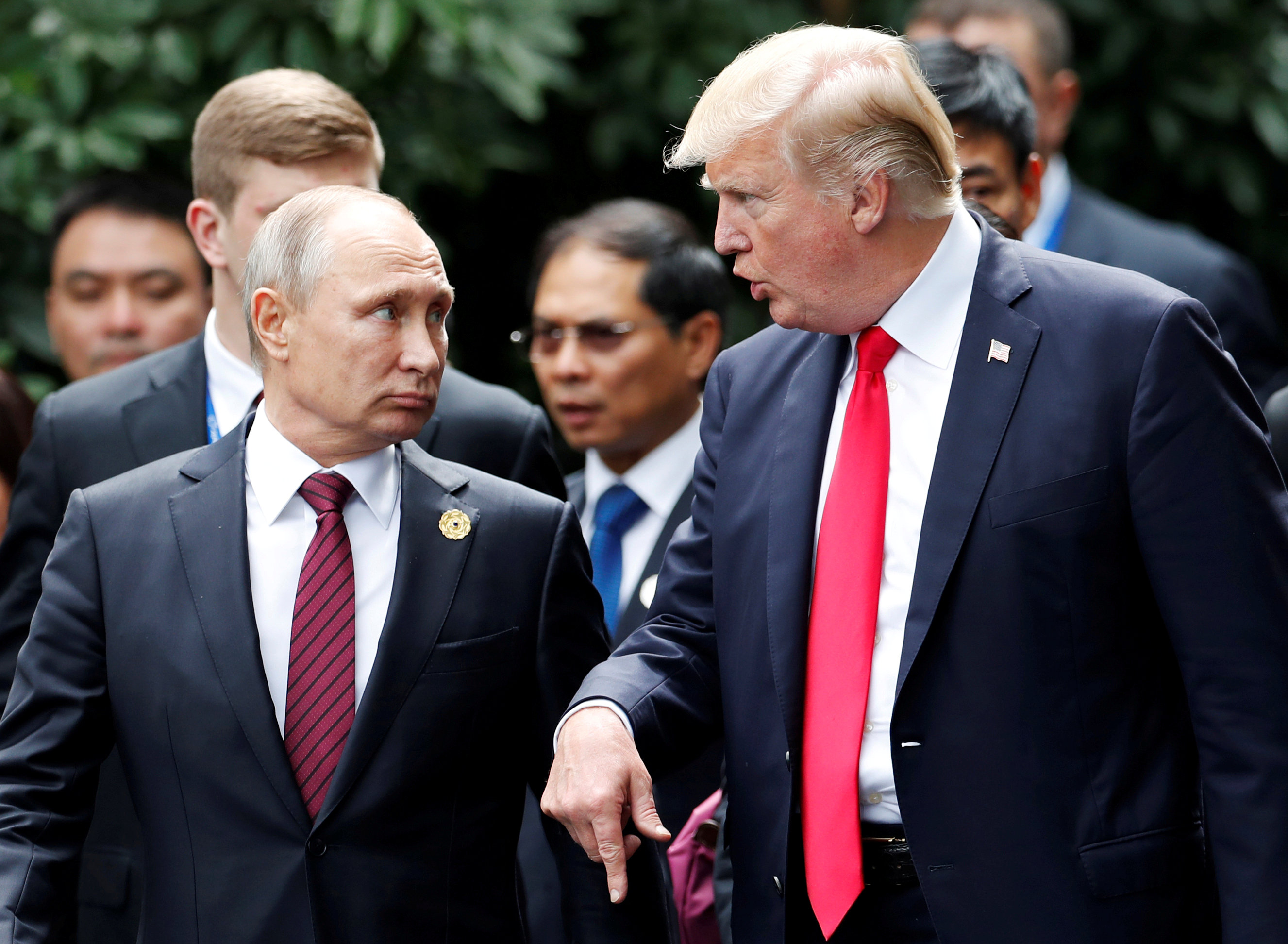
For Putin, Helsinki talks with Trump a win before he even sits down

FILE PHOTO: FILE PHOTO: U.S. President Donald Trump shakes hands with Russian President Vladimir Putin during the their bilateral meeting at the G20 summit in Hamburg, Germany, July 7, 2017. REUTERS/Carlos Barria/File Photo/File Photo

By Andrew Osborn

MOSCOW (Reuters) – For U.S. President Donald Trump, a summit with Vladimir Putin risks a political backlash at home and abroad. For the Russian president, however, the fact the summit is even happening is already a big geopolitical win.

Despite Russia’s semi-pariah status among some Americans and U.S. allies, the Kremlin has long been trying to arrange a summit, betting that Putin and Trump will get on well and stop a sharp downwards spiral in bilateral ties.

While nobody on either side expects big breakthroughs, including on U.S. sanctions, the summit is seen by Moscow as U.S. recognition of Russia’s status as a great power and an overdue U.S. realization that its interests must be taken into account.

“The fact that a Putin-Trump meeting will happen says only one thing: that for all its hysteria, the United States is not able to isolate or ignore Russia,” said Alexei Pushkov, a prominent Russian senator from the ruling United Russia party.

“It took a long time for Washington to get that idea, but it got there in the end.”

Western grievances over Russia’s annexation of Crimea, its backing of pro-Russian separatists in Ukraine and its support for Syria’s Bashar al-Assad haven’t gone away.

Other accusations, denied by Moscow, include that it meddled in U.S. and European politics, supplied the weapon that shot down a passenger plane in 2014 over Ukraine and tried to kill a former Russian spy in Britain with a nerve agent.

Kremlin critics at home and abroad see Trump’s decision to grant Putin a summit against that backdrop as conferring international legitimacy and status on Putin, something they say he doesn’t deserve given the lack of meaningful change in Russia’s policies internationally.

But in Russia, where the political system is obsessed with hierarchy, status and displays of raw power, Putin has “already got his victory,” said Andrey Kortunov, head of RIAC, a foreign policy think-tank close to the Foreign Ministry.

“It allows him to make his point that Russia is not isolated, that Russia is a great power, and to some extent can even claim an equal status with the United States, at least in the security field,” said Kortunov.

Expectations are high in Russia that Putin, with more than 18 years of global experience, will have the edge on Trump, who had not held elected office before he was inaugurated last year. The two men have met twice before at other events and spoken by phone at least eight times.

Vitaly Tretyakov, a political author, described Trump on state TV on the day the summit was agreed as “a neophyte in world politics” to whom Putin could explain Russian thinking and why Russia was right to annex Crimea.

Sergei Mironov, a senior lawmaker from the pro-Kremlin Just Russia party, said in another political talk show that Putin would definitely have the upper hand in Helsinki.

“… Vladimir Putin will give a real master class to the inexperienced politician Donald Trump,” he said.

START OF A THAW?

For older Russians, the summit venue – Helsinki – reinforces Putin’s narrative by evoking memories of Cold War show-downs between the Soviet Union and the United States at a time when Moscow was the capital of a real superpower.

While ties with China, India and the European Union may be even more important in economic terms, Russian politicians still measure their own country’s soft and hard power globally against that of the United States.

Nobody in Russia expects the summit to resolve the differences that have led to painful U.S. sanctions. A survey by state pollster VTsIOM published on Monday showed that more than half of 1,600 Russian adults polled predicted the summit would yield no tangible results.

But for Russian politicians who erupted in applause on learning that Trump won the U.S. election in hopes of rapprochement only to see ties worsen, Helsinki offers a precious opportunity for a possible thaw in relations.

Hard-liners saw a rare visit to Moscow this month of a delegation of Republican lawmakers as proof the tide is turning.

“Six months ago we suggested to them (the lawmakers) that we communicate by Skype. For them, it was political suicide, but now it’s not,” pro-Putin lawmaker Vyacheslav Nikonov, the grandson of Stalin’s foreign minister, told state TV this month.

Nikonov said Trump was now strong enough to pursue his own agenda.

“It’s one of the signs that the wind is blowing in our sails, thanks in large part to Trump,” he said. “I don’t remember any pro-Russian (U.S.) presidents, but I want to remind you that he (Trump) is one of the most pro-Russian politicians at the moment in the United States.”

Kremlin-backed media have stressed the importance of the summit taking place on neutral territory to ensure Trump is not seen as having the upper hand.

Dmitry Kiselyov, presenter of Russia’s main weekly TV news show “Vesti Nedeli,” said Moscow had seen how Trump had received other leaders on home soil, showing footage of Trump holding Japanese Prime Minister Shinzo Abe’s hand in a vice-like grip, brushing dandruff off French President Emmanuel Macron’s shoulder and glowering next to German Chancellor Angela Merkel.

“On neutral territory everyone will be calmer,” Kiselyov, who is close to the Kremlin, said in a report on the subject.

(Editing by Sonya Hepinstall)
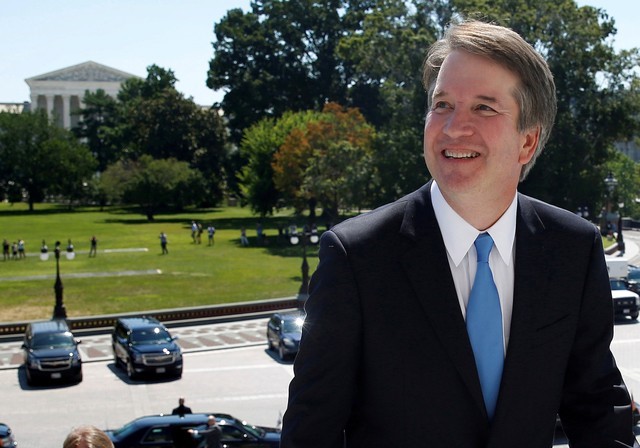
Trump high court pick Kavanaugh may face contentious cases soon

With the U.S. Supreme Court building in the background, Supreme Court nominee judge Brett Kavanaugh arrives prior to meeting with Senate Majority Leader Mitch McConnell on Capitol Hill in Washington, U.S., July 10, 2018. REUTERS/Joshua Roberts

By Lawrence Hurley and Andrew Chung

WASHINGTON (Reuters) – President Donald Trump’s Supreme Court nominee may not have to wait too long for controversial cases if he is confirmed to the job, with disputes involving abortion, immigration, gay rights, voting rights and transgender troops possibly heading toward the justices soon.

Republicans are hoping Brett Kavanaugh, the conservative U.S. appeals court judge selected on Monday by Trump to replace retiring Justice Anthony Kennedy, will be confirmed by the Senate before the next Supreme Court term opens in October.

There are no blockbusters among the 38 cases already on the docket for the justices, but they could add disputes on controversial issues being appealed from lower courts.

Legal battles are developing over state laws restricting abortion including one in Arkansas that effectively bans medication-induced abortions. The justices in May opted not to intervene in a case challenging that law, waiting instead for lower courts to rule, but it could return to them in the future.

Other abortion-related cases could reach the court within two years.

These involve laws banning abortions at early stages of pregnancies, including Iowa’s prohibition after a fetal heartbeat is detected. There is litigation arising from plans by certain states including Louisiana and Kansas to stop reimbursements under the Medicaid insurance program for the poor for Planned Parenthood, a national abortion provider.

There also are challenges to state laws imposing difficult-to-meet regulations on abortion providers such as having formal ties, called admitting privileges, at a local hospital.

Kavanaugh’s judicial record on abortion is thin, although last year he was on a panel of judges that issued an order preventing a 17-year-old illegal immigrant detained in Texas by U.S. authorities from immediately obtaining an abortion.

GAY RIGHTS

Another issue expected to return to the court is whether certain types of businesses can refuse service to gay couples because of religious objections to same-sex marriage.

The high court in June sided, on narrow legal grounds, with a Colorado baker who refused to make a wedding cake for two men because of his Christian beliefs, but sidestepped the larger question of whether to allow broad religious-based exemptions to anti-discrimination laws.

That issue could be back before the justices as soon as the court’s next term in a case involving a Washington state Christian florist who similarly spurned a gay couple.

Kennedy, who wrote the baker ruling, cast decisive votes backing gay rights four times, most notably in 2015 when the court legalized same-sex marriage nationwide. It is not known how Kavanaugh would vote on those issues as he has not been involved in any gay rights cases during his 12 years as a judge.

Trump’s bid to ban transgender people from the military has been challenged in lower courts. That issue could make its way to the Supreme Court.

After lower courts blocked Trump’s ban last year, he announced in March he would endorse Defense Secretary James Mattis’ plan to restrict the military service of transgender people who have a condition called gender dysphoria. Trump’s administration has asked courts to allow that policy to go into effect, but so far to no avail.

Sharon McGowan, a lawyer with gay rights group Lambda Legal, said she saw no evidence Kavanaugh would be any less conservative on gay and transgender rights than Trump’s other appointee to the court, Neil Gorsuch.

On immigration, litigation is continuing over Trump’s plan to rescind a program created under Democratic former President Barack Obama that protected from deportation hundreds of thousands of young immigrants brought to the United States illegally as children.

Lower courts blocked Trump’s plan to scrap the program. Congress has failed to agree on a plan to replace it.

Kavanaugh could have to deal with cases involving a practice called partisan gerrymandering in which state legislators redraw electoral maps to try to cement their own party in power. In June, the justices avoided a broad ruling on whether partisan gerrymandering violates the constitutional rights of voters and whether federal judges can intervene to rectify it.

Democrats have said Republican gerrymandering has helped Trump’s party keep control of the U.S. House of Representatives and various state legislatures.

Kennedy previously kept his conservative colleagues from closing the door to litigation in federal court challenging partisan gerrymandering.

The partisan gerrymandering case most likely to return to the Supreme Court involves claims that Republican legislators in North Carolina manipulated the boundaries of the state’s 13 U.S. House districts to ensure lopsided wins for the party.

Attorney Paul Smith of the Campaign Legal Center, which represents the North Carolina plaintiffs, said they had been focused on trying to convince Kennedy to rule in their favor, and now will try to convince Chief Justice John Roberts, seen as the next-most-moderate of the conservative justices. Smith viewed Kavanaugh as likely voting with the court’s most conservative justices to reject gerrymandering challenges.

(Reporting by Lawrence Hurley and Andrew Chung; Editing by Will Dunham)

Oregon ranchers who sparked standoff to return home after Trump pardon

FILE PHOTO: A U.S. flag covers a sign at the entrance of the Malheur National Wildlife Refuge near Burns, Oregon, U.S. January 3, 2016. REUTERS/Jim Urquhart/File Photo

(Reuters) – Two Oregon ranchers whose sentencing on arson convictions sparked the 2016 armed occupation of a wildlife refuge were due to return home on Wednesday, after being pardoned by U.S. President Donald Trump, the family said in a statement.

The 41-day standoff, which occurred in response to the jailing of the ranchers for setting a fire that spread to public land, marked a flare-up in the long-simmering dispute over federal land policies in the U.S. West. It turned deadly when police shot one of the occupiers.

The family of jailed rancher Dwight Hammond, 76, and his son, Steven, 49, in a statement late Tuesday thanked Trump.

“Our family is grateful to the president and all who worked to make this possible,” the statement read. “We will continue on our path, continue ranching and continue believing in America.”

The pair were expected to arrive at Burns Municipal Airport in southeastern Oregon, about 120 miles (190 km) east of Bend, after on Wednesday morning, the family statement said.

The ranchers were convicted in 2012 for setting a fire that spread onto public land, after years of disputes with the U.S. Bureau of Land Management. The Hammonds said they were using standard brush-control techniques, but federal prosecutors said that in at least one instance they were trying to hide evidence of the slaughtering of a herd of deer.

They were initially sentenced to less than the legal minimum five years in prison by a judge who said the minimum was too harsh. Following an appeal by prosecutors, a different judge ordered the men back to prison to serve the full five years, sparking protests and the occupation of the Malheur National Wildlife Refuge.

The White House on Tuesday called that decision “unjust.” It noted that Dwight Hammond had served about three years in prison and Steven had served four.

Jennifer Rokala, executive director of the Center for Western Priorities, in a statement expressed dismay at the pardon, calling the Hammonds “lawless extremists.”

The leaders of the Malheur standoff, including activists Ammon and Ryan Bundy, were cleared of federal charges for their role in the protest.

The pardons are the latest in a series that have raised questions about whether Trump is using the power to reward supporters. Others have included conservative pundit Dinesh D’Souza, for campaign finance crimes, and former Arizona sheriff Joe Arpaio, who campaigned for Trump before being convicted in a case regarding racial profiling.

(Reporting by Scott Malone in Boston; Editing by Steve Orlofsky)

South Korea scraps annual government war drill as talks with North go on

FILE PHOTO - South Korean President Moon Jae-in and North Korean leader Kim Jong Un meet in the truce village of Panmunjom inside the demilitarized zone separating the two Koreas, South Korea, April 27, 2018. Korea Summit Press Pool/Pool via Reuters

SEOUL (Reuters) – South Korea said on Tuesday it has decided to scrap an annual government mobilization drill this year as part of a suspended joint exercise with the United States but will carry out its own drills to maintain readiness. The ministers of safety and defense made the announcement at a media briefing on Tuesday. The drill, called the Ulchi exercises, usually takes place every August in tandem with the joint Freedom Guardian military drill with the United States.

Seoul and Washington said in June they would halt the joint exercise after U.S. President Donald Trump pledged to end war games following his summit with North Korean leader Kim Jong Un in Singapore on June 12.

Seoul’s presidential office has said the suspension of the combined exercise could facilitate ongoing nuclear talks between North Korea and the United States.

South Korea would develop a new drill model by incorporating Ulchi and the existing Taeguk command post exercises, which would be aimed at fighting militancy and large-scale natural disasters, the ministers said.

That incorporated exercise would be launched in October when the Hoguk field training drill takes place, the ministers said.

“Our military will carry out planned standalone drills this year and decide on joint exercises through close consultations with the United States,” Defence Minister Song Young-moo said.

(Reporting by Hyonhee Shin, Christine Kim; Editing by Paul Tait)

Americans in UK warned to keep ‘low profile’ during Trump visit

Temporary signs indicate road closures around the U.S. ambassador's residence, where special fences have been erected prior to the U.S. presidential visit at the end of the week, in Regent's Park in London, Britain, July 10, 2018. REUTERS/Henry Nicholls

By Michael Holden

LONDON (Reuters) – The U.S. Embassy in London issued an alert on Tuesday to Americans in the British capital, warning them to keep a low profile during President Donald Trump’s visit later this week in case protests against him turn violent.

Trump arrives in Britain on Thursday after a NATO summit and thousands of protesters are expected to join demonstrations during his visit, including plans to fly a blimp over parliament portraying Trump as an orange, snarling baby.

While Britain regards the United States as its closest ally, some Britons see Trump as crude, volatile and opposed to their values on a range of issues. His comments on militant attacks in Britain and his re-tweeting of anti-Muslim videos posted by a leader of a far-right UK party sparked anger.

More than 50,000 people have signed up to demonstrate in London on Friday against his visit although a counter-gathering to welcome him is also planned.

“Numerous demonstrations are being planned for July 12 to 14, 2018, surrounding the visit of the President of the United States to the United Kingdom,” the U.S. embassy said in the alert on its website.

“Several of the events are expected to attract large crowds and there will be road closures in connection with those events.”

Its advice to U.S. citizens was to “keep a low profile” and “exercise caution if unexpectedly in the vicinity of large gatherings that may become violent”.

Trump arrives in Britain on Thursday after the NATO summit in Belgium and will stay overnight at the central London residence of the U.S. ambassador where a high metal security fence was erected outside.

He will hold talks with Prime Minister Theresa May at her 16th-century manor house, meet Queen Elizabeth at Windsor Castle and attend a black-tie dinner at the home of former World War Two leader Winston Churchill – all outside London.

The U.S. president is also due to travel to Scotland where he owns two golf courses and Scotland’s interim police chief has said more than 5,000 officers would be needed for to cover the trip, including specialist riot and armed officers.

Ahead of his visit, Trump said Britain was currently “in somewhat turmoil” as Prime Minister May grappled with a political crisis after two top ministers quit over her plans for trade ties with the European Union after Britain leaves the bloc next March.

“I have NATO, I have the UK, which is in somewhat turmoil, and I have (Vladimir Putin),” Trump said as he set off on his trip to Europe which includes a meeting with the Russian President in the Finnish capital Helsinki.

“Frankly, Putin may be the easiest of them all. Who would think?”

Relations between Britain and Russia are at a post-Cold War low since May blamed the Kremlin for the poisoning of former Russian agent Sergei Skripal with a Soviet-era military nerve agent in March.

(Editing by Guy Faulconbridge)

The issues on the table when Trump and Putin meet

FILE PHOTO: Russia's President Vladimir Putin talks to U.S. President Donald Trump during their bilateral meeting at the G20 summit in Hamburg, Germany, July 7, 2017. REUTERS/Carlos Barria//File Photo

MOSCOW/WASHINGTON (Reuters) – Donald Trump and Vladimir Putin will sit down in a room together in the Finnish capital on July 16 for their first summit meeting.

The U.S. president’s spontaneous approach to negotiations, and the inscrutable style of the Kremlin leader, make predicting the outcome of the summit with any accuracy close to impossible.

We do however, have a reasonable idea of the issues the two leaders and their aides will have mapped out before the meeting: the areas where they each want something from their counterpart, and the places they are willing to give ground.

Below are the issues likely to figure:

ARMS RACE RHETORIC

Both Trump and Putin have been using bellicose rhetoric about their nuclear arsenals, drawing their countries closer to a new arms race. Trump has said the U.S. nuclear capability needs renewing. He told Reuters last year, “if countries are going to have nukes, we’re going to be at the top of the pack.” Putin in March this year unveiled an array of new nuclear weapons, and warned Western governments “now they need to take account of a new reality.” An arms race would be dangerous and expensive for both sides. An agreement to scale back the rhetoric would be a win for both Putin and Trump. Progress towards extending the New Start arms treaty, which expires in 2021, would give substance to that agreement.

SANCTIONS RELIEF

Putin would like Trump to soften sanctions that Washington imposed over the annexation of Ukraine’s Crimea region and backing for separatists in eastern Ukraine, involvement in the Syrian civil war and allegations of Russian meddling in the U.S. elections in 2016. While a 2017 law bars Trump from easing many sanctions without Congress’ approval, he can offer some relief without a nod from Congress. The Republican president, who did not want to sign the law and has missed several deadlines for imposing sanctions included in it, could send a signal that the administration does not plan to expand the list of Russian firms and individuals subject to economic and travel restrictions. That would unfreeze much-needed investment and lending from international investors who, at the moment, are reluctant to commit to Russia for fear of the sanctions’ impact.

SYRIAN DEAL

Washington ally Israel is anxious that, with the conflict in Syria entering its end game, Iranian and Iran-backed forces will be left gathered around Israel’s borders. At the summit, Trump may ask Putin, the most powerful outside player in Syria since Russia’s military intervention there, to use his influence with Tehran to curb Iran’s military presence. This would be tough to deliver for Putin: it would risk a rupture with his allies in Tehran, and could leave Russian forces having to do the lion’s share of the remaining fighting in Syria, a burden that Moscow does not want to shoulder.

DIPLOMATIC TIT-FOR-TAT

Russia’s diplomatic presence in the United States, and the U.S. missions in Russia, are depleted after two rounds of tit-for-tat diplomatic expulsions in the past two years. The first was over alleged Russian meddling in the U.S. election, and the second, this year, was in response to the poisoning in England of former Russian spy Sergei Skripal and his daughter. Putin and Trump could agree in Helsinki to restore the full complement of diplomatic staff. That would not change the substance of the U.S.-Russia relationship, but it would be a symbol of a new start.

RUSSIA’S BACKYARD

Since Russia’s annexation of Crimea in 2014, the NATO alliance has stepped up military exercises in eastern Europe. The aim, according to NATO leaders, is to reassure alliance members who fear a Russian incursion. That has angered Russia. It says NATO is bearing down on its backyard. The Kremlin has likened it to Russia stationing missiles in Mexico. If Trump scaled back the exercises, that would be a big win for Putin. Two senior NATO diplomats told Reuters they are prepared for a worst-case scenario that Trump would announce a freeze on U.S. military exercises or withdraw troops from the Baltics in a gesture to Putin. At the NATO summit in Brussels that precedes Helsinki, NATO states will seek Trump’s assurances that he will stand firm on the exercises.

UKRAINIAN ALLY

Washington has stood by Ukraine’s pro-Western leaders in their stand-off with Russia. That has included the United States providing Kiev with hundreds of millions of dollars worth of military aid. Helsinki would be a triumph for Putin if he persuaded Trump to drop that military aid. Ukrainian officials say they have assurances from Trump aides he won’t do this, but acknowledge anything can happen when Trump and Putin are in a room together. In return, the Russian leader could make concessions over eastern Ukraine, where pro-Moscow separatists control swathes of territory. Diplomats say there is a deal to be done allowing armed international peacekeepers to patrol the area. However, Putin will not contemplate any concessions over Crimea.

(Writing by Christian Lowe and Mary Milliken; Editing by Gareth Jones)

Top Supreme Court candidates’ views on abortion under scrutiny

FILE PHOTO: Trees cast shadows outside the U.S. Supreme Court in Washington, U.S., June 25, 2018. REUTERS/Toya Sarno Jordan/File Photo

By Andrew Chung

NEW YORK (Reuters) – From the moment Justice Anthony Kennedy announced his retirement from the U.S. Supreme Court last week, speculation has centered on whether his replacement would vote to overturn a woman’s right to abortion.

But the individuals considered top contenders for Kennedy’s seat have produced a sparse record of legal rulings and writings on the subject, which makes it hard to predict how they might rule in abortion-related cases.

President Donald Trump promised during his campaign to appoint “pro-life justices” who would overturn Roe v. Wade, the landmark 1973 ruling that legalized abortion nationwide. In recent days, however, the president has said he will not ask candidates about their views on the subject. Trump has said he will announce his nominee on July 9 and that he will make his selection from a list of candidates compiled by conservative legal activists.

On Friday, the president said he had narrowed the field to about five, and sources familiar with the president’s thinking say the top contenders are Brett Kavanaugh, a judge on the District of Columbia U.S. Court of Appeals; Amy Coney Barrett, who was named by Trump to the Chicago-based 7th U.S. Circuit Court of Appeals; Thomas Hardiman, who serves on the Philadelphia-based 3rd U.S. Circuit Court of Appeals; Raymond Kethledge of the Cincinnati, Ohio-based 6th U.S. Circuit Court of Appeals; and Amul Thapar, whom Trump named to the 6th Circuit.

Of that group, Barrett, a professor at Notre Dame Law School before Trump appointed her to the appeals court, has attracted the most attention on abortion.

She has spoken publicly about her conviction that life begins at conception, and in a 2003 law journal article, she argued that courts could be more flexible in overturning prior “errors” in precedent. She noted that courts have struggled over when to keep “an erroneous decision” on the books, citing as an example Planned Parenthood v. Casey, a major 1992 Supreme Court ruling that upheld Roe.

Some progressive groups have pointed to the article as evidence of Barrett’s willingness to overturn Roe. But she has also raised doubts about whether the high court would ever overturn Roe, according to a 2013 article in Notre Dame Magazine.

Her traditional Catholic beliefs became a flashpoint last September during her confirmation hearing in the Senate. “The dogma lives loudly within you,” Democratic Senator Dianne Feinstein said to Barrett during the hearing. Barrett told the senators that her faith would not affect her decisions as a judge.

While little is known about Kavanaugh’s personal views on abortion, last October he was part of a panel of judges that issued an unsigned order preventing an illegal immigrant teenager detained by the government from immediately obtaining an abortion. That decision was overturned by the full appeals court a few days later.

Dissenting from that decision, Kavanaugh warned that the court was embracing “a new right for unlawful immigrant minors in U.S. government detention to obtain immediate abortion on demand.” Litigation over the issue is continuing.

Hardiman joined an opinion in 2010 that overturned the conviction of an anti-abortion protester arrested outside the Liberty Bell Center in Philadelphia. Though the court said park rangers had violated his free speech rights, the case was not about the right to abortion itself.

In April, Hardiman allowed the Little Sisters of the Poor, a Catholic order of nuns, to intervene in a lawsuit against Trump’s plan to expand employer exemptions from an Obamacare birth control insurance requirement. For years, the organization has been at the forefront in challenging the mandate’s legality. Though the case was not directly about abortion, groups favoring abortion rights worry that Hardiman’s ruling signals his sympathies on the issue.

Democratic politicians and liberal groups have said they assume that all those on Trump’s list of potential candidates would overturn Roe v. Wade, given that Trump has said he will only consider such candidates.

“I take the president at his word,” said Daniel Goldberg, legal director for Alliance For Justice, a liberal legal advocacy group that has researched Trump’s judicial nominees.

Leonard Leo, a conservative legal activist on leave from the Federalist Society, is advising Trump on judicial selections, and he said no one asked the candidates about their views on abortion before they were placed on the list.

“These people weren’t even talked to when they were put on the list,” said Leo. “No one was asked these questions and as far as I know no one has been asked these questions if they were brought into the process in the White House.”

Republicans control the Senate by only a slim majority, making it important for Trump’s nominee to win the support of all Republican members, including moderates.

On Sunday, Republican Senator Susan Collins said on CNN that she would not support a nominee who “demonstrated hostility” to Roe.

(Reporting by Andrew Chung; Editing by Sue Horton)

Trump-Putin summit to unfold in Cold War venue Helsinki on July 16

The Market Square and the Presidential palace pictured in Helsinki, Finland on June 28, 2018. U.S. President Donald Trump and Russian President Vladimir Putin are to meet in Helsinki, the capital of Finland on July 16, 2018. LEHTIKUVA / Onni Ojala/via REUTERS

By Doina Chiacu and Andrew Osborn

WASHINGTON/MOSCOW (Reuters) – U.S. President Donald Trump and Russian President Vladimir Putin will hold their first summit on July 16 in Helsinki, a renowned venue for Cold War diplomacy, with nervous U.S. allies in Europe and Russia skeptics looking on.

FILE PHOTO: U.S. President Donald Trump and Russia's President Vladimir Putin talk during the family photo session at the APEC Summit in Danang, Vietnam November 11, 2017. REUTERS/Jorge Silva/File Photo

FILE PHOTO: U.S. President Donald Trump and Russia’s President Vladimir Putin talk during the family photo session at the APEC Summit in Danang, Vietnam November 11, 2017. REUTERS/Jorge Silva/File Photo

The Kremlin and the White House simultaneously announced the place and date of the summit a day after striking a deal on holding the meeting following a visit to Moscow on Wednesday by U.S. national security adviser John Bolton.”The two leaders will discuss relations between the United States and Russia and a range of national security issues,” the White House said in a statement similar to one released by the Kremlin.

Trump will meet Putin after attending a July 11-12 summit of NATO leaders and making a visit to Britain. The summit’s date will give Putin a chance to attend the July 15 closing ceremony of the soccer World Cup which his country is hosting.

The two leaders have met twice before on the sidelines of international gatherings and spoken at least eight times by phone. They have also made positive comments about each other from time to time with Putin praising Trump’s handling of the economy.

Their summit could irritate U.S. allies however who want to isolate Putin, such as Britain, or countries like Ukraine who are nervous about what they see as Trump’s overly friendly attitude toward the Russian leader.

It is also likely to go down badly among critics who question Trump’s commitment to the NATO alliance and who have been concerned about his frictions with longtime allies such as Canada and Germany over trade.

LOW EXPECTATIONS

Trump has long expressed a desire for better relations with Moscow, even as Washington tightens sanctions, and the Kremlin has long pushed for a summit.

It made no secret on Wednesday of its delight that such a meeting had finally been agreed with Kremlin aide Yuri Ushakov saying the two men were likely to talk for several hours. He spoke of a possible joint declaration on improving U.S.-Russia relations and international security.

Trump congratulated Putin by phone in March after the Russian leader’s landslide re-election victory.

But since then, already poor ties between Washington and Moscow have deteriorated over the conflict in Syria and the poisoning of a former Russian spy in Britain which sparked big diplomatic expulsions in both countries.

Expectations for a summit are therefore low.

A special counsel in the United States has indicted Russian firms and individuals as part of a probe into possible collusion between Russia and Trump’s 2016 presidential campaign. Trump denies wrongdoing and calls the investigation a “witch hunt.”

The U.S. intelligence community’s conclusion that Moscow sought to interfere in that campaign to tilt the election in Trump’s favor has also been hanging over relations with Russia since Trump took office in January last year.

Bolton told reporters in Moscow on Wednesday he expected Russian interference in U.S. politics to be discussed at the summit and said he did not rule out Trump discussing Russia rejoining the Group of Seven industrialized countries to make it the G8 again.

After Trump and Putin met briefly in Vietnam in November 2017, Trump was criticized in the United States for saying he believed Putin when the Russian president denied accusations that Russia meddled in the 2016 election.

In a Twitter post on Thursday before the Helsinki meeting was announced, Trump again appeared to cast doubt on Russian involvement. “Russia continues to say they had nothing to do with Meddling in our Election!” he wrote.

In Washington on Wednesday, Trump listed Syria and Ukraine as being among the many subjects he would discuss with Putin.

(Additonal reporting by Denis Pinchuk in Moscow, Editing by Toby Chopra and Frances Kerry, William Maclean)

Justice Kennedy, U.S. Supreme Court’s pivotal vote, to retire

By Lawrence Hurley

WASHINGTON (Reuters) – Supreme Court Justice Anthony Kennedy said on Wednesday he plans to retire after three decades as a pivotal vote on the highest U.S. judicial body, giving President Donald Trump an opportunity to make the court more firmly conservative.

The conservative Kennedy, who turns 82 in July and is the second-oldest justice on the nine-member court, has become one of the most consequential American jurists since joining the court in 1988 as an appointee of Republican President Ronald Reagan. He proved instrumental in advancing gay rights, buttressing abortion rights and erasing political spending limits. His retirement takes effect on July 31, the court said.

“It has been the greatest honor and privilege to serve our nation in the federal judiciary for 43 years, 30 of those years on the Supreme Court,” Kennedy said in a statement.

The statement issued by the court said that Kennedy’s decision was motivated by his decision to spend more time with his family.

Kennedy is a traditional conservative who sometimes joined the liberal justices on key rulings, earning a reputation as the court’s “swing” vote who heartened conservatives and liberals alike, depending on the issue. Kennedy on Tuesday joined the court’s four other conservatives in giving Trump a huge legal victory by upholding the Republican president’s travel ban targeting people from several Muslim-majority countries.

Kennedy’s decision was disclosed on the final day of the court’s current term, which began in October. On Wednesday, he joined his fellow conservative justices in a 5-4 ruling that dealt a major setback to organized labor by shutting off a key union revenue source.

Trump on Wednesday said Kennedy had great vision and heart. The president said he will begin a search immediately for a new justice, with a list of 25 candidates. The Republican-led Senate can be expected to push to have the new nominee confirmed and on the court before the justices begin their next term in October.

Trump already has left an imprint on the court, restoring its 5-4 conservative majority with the appointment of Justice Neil Gorsuch last year after the president’s fellow Republicans in the Senate in 2016 refused to consider Democratic former President Barack Obama’s nominee, Merrick Garland.

While Kennedy’s replacement will not change the numerical ideological balance on the court, Trump could appoint a justice who would be more staunchly conservative than Kennedy and less likely to occasionally side with the court’s liberal wing.

MAJOR SOCIAL ISSUES

Without Kennedy on the bench, the high court could move to the right on major social issues including abortion and gay rights. Kennedy wrote the landmark 2015 ruling that legalized same-sex marriage nationwide.

Conservative activists have long dreamed of building a firmly conservative majority on the court that would push to overturn the landmark 1973 ruling in the case Roe v. Wade that legalized abortion nationwide.

Kennedy disappointed conservatives by joining Supreme Court decisions that affirmed the Roe decision, including a landmark 1992 ruling in the case Planned Parenthood v. Casey.

Gorsuch already has demonstrated that he is one of the most conservative members of the court, aligning himself with Justices Clarence Thomas and Samuel Alito. [nL1N1OE2GT]

The U.S. Senate, which must confirm nominees before they can join the court, is controlled 51-49 by Trump’s fellow Republicans, meaning that if they remain unified they can overcome any Democratic opposition like that mounted against Gorsuch. Senate Republicans changed the chamber’s rules during the Gorsuch nomination battle to prevent Democrats from insisting on a 60-vote super-majority, allowing court nominees to win confirmation by a simple majority vote.

Kennedy personally delivered his retirement letter to the White House on Wednesday afternoon, after he told his fellow justices of his plans at their afternoon conference.

Trump picked Gorsuch from a list of names, mostly conservative federal appeals court judges, he circulated during his 2016 election campaign. The White House last November issued an expanded list that includes other prominent conservatives, including Judge Brett Kavanagh, a former Kennedy law clerk who serves on the U.S. appeals court in Washington.

While Kennedy sided with conservative colleagues on many issues and authored the landmark 2010 ruling that allowed unlimited corporate spending in political campaigns, his tenure also included strong support for the liberal cause of gay rights.

Kennedy, mild-mannered and professorial, followed a thoughtful, middle-of-the-road approach and often posed probing, intellectual questions of lawyers arguing cases. He became the swing vote on the ideologically divided court after fellow centrist conservative Justice Sandra Day O’Connor retired in 2006.

Kennedy was Reagan’s third choice to fill the court seat left open by the retirement of Lewis Powell in 1987. The Senate rejected Reagan’s first nominee, outspoken conservative Robert Bork, in a fierce partisan fight and second choice Douglas Ginsburg withdrew after admitting to past marijuana use.

(Reporting by Lawrence Hurley; Editing by Will Dunham)

Supreme court backs Trump on travel ban targeting Muslim-majority nations

Trees cast shadows outside the U.S. Supreme Court in Washington, U.S., June 25, 2018. REUTERS/Toya Sarno Jordan

By Lawrence Hurley

WASHINGTON (Reuters) – The U.S. Supreme Court on Tuesday handed Donald Trump one of the biggest victories of his presidency, upholding his travel ban targeting several Muslim-majority countries.

The 5-4 ruling, with the court’s five conservatives in the majority, ends for now a fierce fight in the courts over whether the policy represented an unlawful Muslim ban. Trump can now claim vindication after lower courts had blocked his travel ban announced in September, as well as two prior versions, in legal challenges brought by the state of Hawaii and others.

The court held that the challengers had failed to show that the ban violates either U.S. immigration law or the U.S. Constitution’s First Amendment prohibition on the government favoring one religion over another.

Writing for the court, Chief Justice John Roberts said that the government “has set forth a sufficient national security justification” to prevail.

“We express no view on the soundness of the policy,” Roberts added.

The ruling affirmed broad presidential discretion over who is allowed to enter the United States. It means that the current ban can remain in effect and that Trump could potentially add more countries. Trump has said the policy is needed to protect the country against attacks by Islamic militants.

The current ban, announced in September, prohibits entry into the United States of most people from Iran, Libya, Somalia, Syria and Yemen. The Supreme Court allowed it to go largely into effect in December while the legal challenge continued.

The challengers have argued the policy was motivated by Trump’s enmity toward Muslims and urged courts to take into account his inflammatory comments during the 2016 presidential campaign. Trump as a candidate called for “a total and complete shutdown of Muslims entering the United States.”

The travel ban was one of Trump’s signature hardline immigration policies that have been a central part of his presidency and “America First” approach. Trump issued his first version just a week after taking office, though it was quickly halted by the courts.

(Reporting by Lawrence Hurley; Editing by Will Dunham)