Father says little Honduran girl on Time cover was not taken from mother

Getty photo of Honduras Girl at the border

By Gustavo Palencia

TEGUCIGALPA (Reuters) – The Honduran toddler pictured sobbing in a pink jacket before U.S. President Donald Trump on an upcoming cover of Time magazine was not separated from her mother at the U.S. border, according to a man who says he is the girl’s father.

An upcoming cover of Time magazine. Courtesy Time Inc.

The powerful original photograph, taken at the scene of a border detention by Getty Images photographer John Moore, became one of the iconic images in the flurry of media coverage about the separation of families by the Trump administration.

Dozens of newspapers and magazines around the globe published the picture, swelling the tide of outrage that pushed Trump to back down Wednesday and say families would no longer be separated.

“My daughter has become a symbol of the … separation of children at the U.S. border. She may have even touched President Trump’s heart,” Denis Valera told Reuters in a telephone interview.

Valera said the little girl and her mother, Sandra Sanchez, have been detained together in the Texas border town of McAllen, where Sanchez has applied for asylum, and they were not separated after being detained near the border.

Honduran deputy foreign minister Nelly Jerez confirmed Valera’s version of events.

Varela said he was awestruck and pained when he first saw the photo of his crying daughter on TV. “Seeing what was happening to her in that moment breaks anyone’s heart,” he said.

The photo was used on a Facebook fundraiser that drew more than $17 million dollars in donations from close to half a million people for the Refugee and Immigrant Center for Education and Legal Services (RAICES), a Texas-based nonprofit that provides legal defense services to immigrants and refugees.

The Trump administration’s “zero-tolerance” immigration policy had led to the separation of 2,342 children from their parents at the U.S.-Mexico border between May 5 and June 9.

Video footage of separated children sitting in cages, an audiotape of wailing children and Moore’s photo had sparked worldwide anger over Trump’s immigration policies.

Sanchez and her daughter had left Puerto Cortes, a major Honduran port north of the capital city, Tegucigalpa, without telling Valera or the couple’s three other children, he said.

He said he imagined that Sanchez left with the little girl for the United States, where she has family, in search of better economic opportunities.

“If they are deported, that is OK as long as they do not leave the child without her mother,” Valera said. “I am waiting to see what happens with them.”

(Writing by Suman Nasihadham; Editing by Clarence Fernandez)

North Korea, China discuss ‘true peace’, denuclearization

North Korean leader Kim Jong Un and Chinese President Xi Jinping raise a toast in Beijing, China, in this undated photo released June 20, 2018 by North Korea's Korean Central News Agency. KCNA via REUTERS

By Christine Kim and Christian Shepherd

SEOUL/BEIJING (Reuters) – North Korea’s Kim Jong Un and Chinese President Xi Jinping came to an understanding on issues discussed at a summit of the two leaders, including denuclearization of the Korean peninsula, the North’s state media said on Wednesday.

Kim and Xi assessed the historic meeting Kim had with U.S. President Donald Trump in Singapore last week and exchanged opinions on ways to resolve the issue of denuclearization, Korean Central News Agency (KCNA) said.

The North Korean leader also promised during a meeting with Xi in Beijing to cooperate with Chinese officials to secure “true peace” in the process of “opening a new future” on the Korean peninsula, it said.

Xi told Kim the neighbors’ joint efforts could definitely ensure peace and stability on the Korean peninsula, China’s official Xinhua news agency said.

“I have faith that, with the joint efforts of China and North Korea, our relationship can definitely benefit both countries and both peoples,” he said, during a meeting at Beijing’s Diaoyutai state guest house.

Kim told Xi that previously China and North Korea had helped each other out like family members. “General Secretary comrade Xi Jinping has shown us touching and familial support and concern,” he said, according to Xinhua.

Kim wrapped up his two-day trip to Beijing on Wednesday with a visit to an agricultural sciences exhibition and the Beijing subway command center, Xinhua added.

The visit follows his Singapore summit, where Kim and Trump reaffirmed a commitment to work toward complete denuclearization of the Korean peninsula.

Trump surprised officials in South Korea and the United States after that meeting by saying he would end “provocative” joint U.S.-South Korean military exercises.

The United States and South Korea said they had agreed to suspend a joint military exercise set for August, although decisions regarding subsequent drills have not yet been made.

On Wednesday, South Korean Foreign Minister Kang Kyung-hwa said the decision to suspend the exercise could be reconsidered, based on future developments with North Korea.

“I think we’ve made it clear this is a goodwill gesture to strengthen dialogue momentum,” Kang said.

“It’s not irreversible. They could come back if the dialogue loses speed, or if North Korea doesn’t live up to its denuclearization commitment,” she said.

Kim is on his third visit to China this year. Xi offered high praise to the North Korean leader on Tuesday for the “positive outcome” of last week’s summit with Trump.

KCNA also reported that Xi said relations between China and North Korea had reached a new level of development since Kim’s first visit in March and that the pacts by the two leaders were being carried out “one-by-one”.

Kim also told Xi he was willing to bolster friendship and cooperation, it said.

It was widely expected that Kim would visit Beijing to brief Xi on his summit with Trump, which included Pyongyang agreeing to hand over the remains of troops missing from the 1950-53 Korean War.

Two U.S. officials told Reuters on Tuesday North Korea could start that process within the next few days.

(Reporting by Christine Kim; Additional reporting by Joori Roh and Joyce Lee in SEOUL and Idrees Ali in WASHINGTON; Editing by Paul Tait and Clarence Fernandez)

North Korean film on Kim’s Singapore trip reveals new focus on economy

U.S. President Donald Trump and North Korean leader Kim Jong Un walk after lunch at the Capella Hotel on Sentosa island in Singapore June 12, 2018. REUTERS/Jonathan Ernst

By Hyonhee Shin

SEOUL (Reuters) – North Korea has produced a film on leader Kim Jong Un’s summit meeting with President Donald Trump this week, feeding, as one would expect, a fervid cult of personality but also seemingly highlighting his dream of economic development.

The 42-minute film, titled “Epochal meeting that pioneered new history between the Democratic People’s Republic of Korea and the United States”, aired on North Korean state television on Thursday.

It shows the highlights of Kim’s three-day trip to the city-state of Singapore, including exchanges during his historic summit with Trump on Tuesday, and visits he made to some of Singapore’s top sites that evening.

Rigidly controlled North Korean state media usually give ordinary people little exposure to the affluence of their Asian neighbors.

For years, media have relentlessly extolled the successes of their state, and its leaders from the Kim family, proudly defying the evil United States and its lackey allies, even as many ordinary North Koreans starved.

But this film lavished praise on prosperous, capitalist Singapore, lauding the “clean, beautiful and advanced” nation and suggesting it had lessons to offer.

“Our comrade supreme leader said he is eager to learn the excellent knowledge and experiences in various fields from your country,” the state media presenter cited Kim as telling Singapore officials.

Kim was briefed on urban planning and lauded the island nation’s “world-class” cargo-handling capacity, as well as its well-equipped ports and its economy.

One analyst said the film was underscoring Kim’s stated pledge to make the economy a priority, after he had announced the achievement of a long-held ambition to develop nuclear weapons.

North Korean leader Kim Jong Un arrives in Singapore, June 10, 2018 in this picture obtained from social media. Singapore's Ministry of Communications and Information via REUTERS

North Korean leader Kim Jong Un arrives in Singapore, June 10, 2018 in this picture obtained from social media. Singapore’s Ministry of Communications and Information via REUTERS

MESSAGE OF HOPE?

Kim shifted his focus at a ruling party congress in April, abandoning the parallel pursuit of nuclear weapons and economic development he had expounded since taking power in 2011, to focus instead exclusively on development.

“It’s to give the message that ‘We could be as rich if we develop the market economy’,” Ahn Chan-il, a North Korean defector who now runs a Seoul-based think-tank, said of the film’s message.

“Ordinary North Koreans might feel some discontent for now, seeing Kim and his aides enjoying overseas travel when they’re struggling to feed themselves, but this film could give them hope at the same time.”

The film made much of Kim’s surprise evening outing to some of Singapore’s most famous waterfront sites, among them a rooftop bar and infinity swimming pool at one of its plushest hotels, where surprised guests filmed him with camera phones.

In one scene, Kim’s sister, Kim Yo Jong, was seen walking with him along a promenade, clearly impressed with the high-rise skyline.

Inevitably, Kim is portrayed in the film as a global peacemaker, sitting and smiling as an equal with the U.S. president derided just months earlier by state media as a “lunatic old man”.

Trump, accompanied by Kim, was shown returning the salute of Defence Minister No Kwang Chol, who was clad in his military uniform, raising questions among Trump’s critics back home.

The film also showed Trump offering Kim a peek inside the U.S. presidential limousine, known as “The Beast,” calling it a gesture of “special respect and goodwill”.

Such images reflected a new confidence in the North Korean leadership that the isolation was over and they had at last been accepted as legitimate members of the international community.

But the message could confound some ordinary North Koreans, said a South Korean official.

“It was recognition that North Korea has really craved, but it might also be a double-edged sword for Kim,” said the official, who declined to be identified because of the sensitivity of the matter.

“Imagine how perplexed ordinary North Koreans could be by the image of the evil United States so deeply rooted in their minds, and then this sudden mood of a thaw.”

(Reporting by Hyonhee Shin; Additional reporting by Ju-min Park and Jeongmin Kim; Editing by Robert Birsel)

Trump, Kim agree on denuclearization, U.S. promises security guarantees

U.S. President Donald Trump shakes hands with North Korean leader Kim Jong Un at the Capella Hotel on Sentosa island in Singapore June 12, 2018. REUTERS/Jonathan Ernst

By Steve Holland, Soyoung Kim and Jack Kim

SINGAPORE (Reuters) – U.S. President Donald Trump said North Korean leader Kim Jong Un pledged at a historic summit on Tuesday to move toward complete denuclearization, while the United States promised its old foe security guarantees.

The start of negotiations aimed at banishing what Trump described as North Korea’s “very substantial” nuclear arsenal could have far-reaching ramifications for the region, and in one of the biggest surprises of the day, Trump said he would stop military exercises with old ally South Korea.

But Trump and Kim gave few other specifics in a joint statement signed at the end of their summit in Singapore, and several analysts cast doubt on how effective the agreement would prove to be in the long run at getting North Korea to give up its cherished nuclear weapons.

“President Trump committed to provide security guarantees to the DPRK and Chairman Kim Jong Un reaffirmed his firm and unwavering commitment to complete denuclearization of the Korean Peninsula,” the statement said, referring to North Korea by the initials of its official name, the Democratic People’s Republic of Korea.

The two leaders had appeared cautious and serious when they arrived for the summit at the Capella hotel on Singapore’s Sentosa, a resort island with luxury hotels, a casino and a Universal Studios theme park.

Body language expert said they both tried to project command as they met, but also displayed signs of nerves.

After a handshake, they were soon smiling and holding each other by the arm, before Trump guided Kim to a library where they met with only their interpreters. Trump had said on Saturday he would know within a minute of meeting Kim whether he would reach a deal.

Trump later told a news conference he expected the denuclearization process to start “very, very quickly” and it would be verified by “having a lot of people in North Korea”.

U.S. Secretary of State Mike Pompeo and North Korean officials would hold follow-up negotiations “at the earliest possible date”, the statement said.

Despite Kim announcing that North Korea was destroying a major missile engine-testing site, Trump said sanctions on North Korea would stay in place for now.

John Hopkins University’s North Korea monitoring project 38 North said last week North Korea had razed a facility for testing canister-based ballistic missiles.

U.S. President Donald Trump shows North Korean leader Kim Jong Un his car, nicknamed "The Beast", during their walk around Capella hotel after a working lunch at a summit in Singapore, June 12, 2018, in this still image taken from video. Host Broadcaster/via REUTERS ATTENTION EDITORS - THIS IMAGE WAS PROVIDED BY A THIRD PARTY. NO RESALES. NO ARCHIVES. BROADCASTERS: NO USE AFTER 72 HOURS; DIGITAL: NO USE AFTER 30 DAYS.

U.S. President Donald Trump shows North Korean leader Kim Jong Un his car, nicknamed “The Beast”, during their walk around Capella hotel after a working lunch at a summit in Singapore, June 12, 2018, in this still image taken from video. Host Broadcaster/via REUTERS ATTENTION EDITORS – THIS IMAGE WAS PROVIDED BY A THIRD PARTY. NO RESALES. NO ARCHIVES. BROADCASTERS: NO USE AFTER 72 HOURS; DIGITAL: NO USE AFTER 30 DAYS.

Trump said the regular military exercises the United States holds with South Korea were expensive and provocative. His halting of the drills could rattle South Korea and Japan, which rely on a U.S. security umbrella.

Trump said the exercises would not be revived “unless and until we see the future negotiation is not going along like it should”.

Earlier, Kim said he and Trump had “decided to leave the past behind. The world will see a major change”.

However, several experts said the summit failed to secure any concrete commitments by Pyongyang for dismantling its nuclear arsenal. They also noted the statement did not refer to human rights in one of the world’s most repressive nations.

TRADING FOR A PROMISE

Anthony Ruggiero, senior fellow at Washington’s Foundation for Defense of Democracies think-tank, said it was unclear if negotiations would lead to denuclearization, or end with broken promises, as had happened in the past.

“This looks like a restatement of where we left negotiations more than 10 years ago and not a major step forward,” he said.

Daniel Russel, formerly the State Department’s top Asia diplomat, said the absence of any reference to the North’s ballistic missiles was “glaring”.

“Trading our defense of South Korea for a promise is a lopsided deal that past presidents could have made but passed on,” he said.

North Korea has long rejected unilateral nuclear disarmament, instead referring to the denuclearization of the peninsula. That has always been interpreted as a call for the United States to remove its “nuclear umbrella” protecting South Korea and Japan.

People watch a TV broadcasting a news report on summit between the U.S. and North Korea, in Seoul, South Korea, June 12, 2018. REUTERS/Kim Hong-Ji

People watch a TV broadcasting a news report on summit between the U.S. and North Korea, in Seoul, South Korea, June 12, 2018. REUTERS/Kim Hong-Ji

The document made no mention of the sanctions on North Korea and nor was there any reference to a peace treaty formally ending the 1950-53 Korean War, which killed millions of people and ended in a truce.

But the joint statement did say the two sides had agreed to recover the remains of prisoners of war and soldiers missing in action, so they could be repatriated.

Trump said China, North Korea’s main ally, would welcome the progress he and Kim had had made.

“Making a deal is great thing for the world. It’s also a great thing for China,” he said.

China, which has opposed North Korea’s nuclear ambitions, said it hoped North Korea and the United States could reach a basic consensus on denuclearization.

“At the same time, there needs to be a peace mechanism for the peninsula to resolve North Korea’s reasonable security concerns,” China’s top diplomat, state councillor Wang Yi, told reporters in Beijing.

Russia’s Deputy Foreign Minister Sergei Ryabkov said the Kremlin had a positive assessment of the summit but “the devil is in the details”, the TASS news agency reported.

If the summit does lead to a lasting detente, it could fundamentally change the security landscape of Northeast Asia, just as former U.S. President Richard Nixon’s visit to China in 1972 led to the transformation of China.

But Li Nan, senior researcher at Pangoal, a Beijing-based Chinese public policy think-tank, said the meeting had only symbolic significance.

“There is no concrete detail on the denuclearization of the Korean peninsula and the provision of security guarantees by the United States,” Li said. “It is too early to call it a turning point in North Korea-U.S. relations.”

The dollar retreated after jumping to a 3-week high but global shares crept higher on news of the agreement.

Graphic: https://tmsnrt.rs/2l2UwW7

HARD NEGOTIATOR

Trump said he had formed a “very special bond” with Kim and relations with North Korea would be very different in future. He called Kim “very smart” and a “very worthy, very hard negotiator”.

Just a few months ago, Kim was an international pariah accused of ordering the killing of his uncle, a half-brother and hundreds of officials suspected of disloyalty. Tens of thousands of North Koreans are imprisoned in labor camps.

Trump said he raised the issue of human rights with Kim, and he believed the North Korean leader wanted to “do the right thing”.

Trump also said U.S. college student Otto Warmbier did not die in vain days after he was released from North Korean custody in 2017, as his death helped initiate the process that led to the summit.

“I believe it’s a rough situation over there, there’s no question about it, and we did discuss it today pretty strongly … at pretty good length, and we’ll be doing something on it,” Trump said.

During a post-lunch stroll through the gardens of the hotel where the summit was held, Trump said the meeting had gone “better than anybody could have expected”.

Kim stood silently alongside, but he had earlier described the summit as a “a good prelude to peace”.

Trump also rolled out what amounted to a promotional video starring the two leaders before the talks, which was watched by the North Korean officials on an iPad.

As the two leaders met, Singapore navy vessels, and air force Apache helicopters patrolled, while fighter jets and a Gulfstream 550 early warning aircraft circled high overhead.

Within North Korea, the summit is likely to go down well.

“Signing the joint statement would show North Korean citizens that Kim Jong Un is not a leader just within North Korea but also in international society, especially with his position equivalent to Trump,” said Ahn Chan-il, a defector from North Korea who lives in the South.

(Additional reporting by Dewey Sim, Aradhana Aravindan, Himani Sarkar, Miral Fahmy, John Geddie, Joyce Lee, Grace Lee, Matt Spetalnick and David Brunnstrom in Singapore and Christine Kim in Seoul; Editing by Raju Gopalakrishnan, Robert Birsel)

Who has Kim Jong Un’s ‘nuclear button’ in Pyongyang while he’s away?

FILE PHOTO: North Korean leader Kim Jong Un watches the launch of a Hwasong-12 missile in this undated photo released by North Korea's Korean Central News Agency (KCNA) on September 16, 2017. KCNA via REUTERS

By Josh Smith

SEOUL (Reuters) – When Donald Trump meets North Korean leader Kim Jong Un on Tuesday for perhaps the most significant nuclear talks since the Cold War, the American president will have his link to the U.S. nuclear arsenal nearby at all times.

As the leader of a newly minted nuclear state, much less is known about how Kim maintains control of his nuclear arsenal while he travels.

Kim began the year by declaring to the world that “a nuclear button is always on the desk of my office,” which was widely interpreted as an allusion to his personal control over North Korea’s nuclear arsenal.

Trump fired back in a tweet, saying “I too have a Nuclear Button, but it is a much bigger and more powerful one than his, and my Button works!”

When the two meet in Singapore for high-stakes nuclear negotiations, Trump will be accompanied, as always, by a staffer carrying his “button” in the form of the “nuclear football” containing equipment used to authorize a strike.

North Korea is one of the most insular states in the world and command and control of its nuclear facilities is kept within a tight, impenetrable circle.

Additionally, Kim – who came to power in 2011 – has only just begun making trips outside North Korea. He has been to Beijing twice and has briefly crossed the frontier at the Demilitarized Zone with South Korea to meet its president. Singapore will be the furthest he is known to have traveled since taking over.

But analysts who closely watch North Korea believe it is unlikely Kim would have come to Singapore without being confident of the arsenal’s security – and the ability to order its use.

“We don’t know how developed North Korea’s secure communications capabilities are, so whether Kim Jong Un will be within easy reach of his National Command Authority during his stay in Singapore is an open question,” said Andrew O’Neil, a North Korea nuclear policy expert at Griffith University in Queensland, Australia.

“That said, given that most assume… North Korea’s nuclear command, control, communications and intelligence is configured to promote a high degree of centralization in Kim’s decision-making, it beggars belief that Kim would not be within secure reach to authorize a possible launch if required,” O’Neil added.

Kim likely delegated authority to watch over the arsenal to one of a number of trusted North Korean officials who stayed in Pyongyang, including Choe Ryong Hae, one of several senior leaders who saw Kim off at the airport as he departed for Singapore, said Michael Madden, a leadership expert with the 38 North website, which monitors North Korea.

“Kim can authorize or approve a missile strike while he is away,” Madden said. “There’s a protocol for launches.”

Trusted officials would maintain control of fixed telecommunications hotlines in the country, and there is likely a code system to activate the systems involved in launching North Korea’s ballistic missiles.

“There are only certain designated facilities where these communications can be activated,” Madden said

North Korea’s missile program: https://tmsnrt.rs/2t6WEPL

SECURITY CONCERNS

Many questions remain unanswered, however, including whether the North Koreans have robust enough communication systems to make sure no one panics and launches an attack, said Vipin Narang, an associate professor at the Massachusetts Institute of Technology’s Security Studies Program.

“Its command and control structure while Kim is traveling is unlikely to be robust enough for him to be able to reliably issue or stop launch sequences,” he said.

He said that was because North Korea was likely to have configured its nuclear forces to permit rapid authorization to launch in order to offset the risk of a first strike from the United States.

(Reporting by Josh Smith; Editing by Raju Gopalakrishnan)

North Korea talks heading in right direction, U.S. envoy says

North Korean envoy Kim Yong Chol speaks ahead of a working dinner with U.S. Secretary of State Mike Pompeo in New York, U.S., May 30, 2018. U.S. Department of State/Handout via REUTERS

By Steve Holland and Hyonhee Shin

WASHINGTON/SEOUL (Reuters) – Talks between the United States and North Korea are headed in the right direction, a top U.S. envoy said on Friday, ahead of a rare visit to the White House by a senior North Korean official.

At a planned meeting with U.S. President Donald Trump in Washington, Kim Yong Chol, a close aide of Kim Jong Un, will hand over a letter from the North Korean leader as the two sides try to put a derailed summit meeting back on track.

Trump hopes to meet Kim Jong Un in Singapore on June 12 and pressure him to give up his nuclear weapons, although he conceded on Thursday that might require more rounds of direct negotiations.

“I’d like to see it done in one meeting,” Trump told Reuters. “But often times that’s not the way deals work. There’s a very good chance that it won’t be done in one meeting or two meetings or three meetings. But it’ll get done at some point.”

In Seoul, U.S. negotiators expressed optimism after meeting their North Korean counterparts for preparatory talks at Panmunjom, on the fortified border between the two Koreas.

“We believe that we’re moving in the right direction to the ongoing series of consultations, including (U.S. Secretary of State) Pompeo’s engagement with Vice Chairman Kim Yong Chol … our discussions at Panmunjom and of course the discussions in Singapore as well,” U.S Ambassador to the Philippines Sung Kim, a veteran diplomat and expert on North Korea, told South Korea’s foreign minister, Kang Kyung-hwa.

The discussions in Panmunjom have focused on possible agenda items for Trump and Kim, while meetings in Singapore are more focused on logistics, officials said.

In a separate high-level meeting on Friday, officials from North and South Korea agreed to hold talks later this month on military issues and reunions of families separated by the 1950-53 Korean War, they said.

It was not clear what North Korea’s leader wrote in his letter to Trump, and White House spokesman Hogan Gidley said late on Thursday that the details of the meeting in Washington were still being worked out.

Pompeo is slated to meet Trump at the White House at 1 p.m. (1700 GMT).

After trading threats of war last year, the two men agreed to meet for an historic summit on June 12. But Trump canceled last week, citing Kim’s “tremendous anger and open hostility” in a string of public statements.

Even as he pulled out, though, Trump urged Kim to “call me or write” if he wanted to revive the meeting.

Within a day, both sides were in new talks to save the summit, and Kim Yong Chol flew to New York this week to meet Secretary of State Mike Pompeo, raising hopes that the summit might be back on.

Despite saying the two sides made “real progress”, Pompeo also cautioned that there might be no quick solution.

“They’ll have to choose a path that is fundamentally different than the one that their country has proceeded on for decades. It should not be to anyone’s surprise that there will be moments along the way, that this won’t be straightforward,” he said.

NUCLEAR THREAT

North Korea’s nuclear weapons program has made significant advances in recent years and poses a threat to the United States. Trump’s main goal in any talks is to eliminate that threat.

Kim has rejected previous U.S. calls for North Korea’s unilateral nuclear disarmament and argued instead for a “phased” approach to denuclearization of the entire Korean peninsula. That in the past has also meant removal of the U.S. nuclear umbrella protecting South Korea and Japan.

In Pyongyang, Kim hosted Russian Foreign Minister Sergei Lavrov on Thursday, while a Kremlin spokesman told reporters a summit between Russian and North Korean leaders could take place.

During his meeting with Lavrov, Kim said his will to see denuclearization on the peninsula remained “unchanged, consistent and fixed” and hoped improved North Korea-U.S. relations would be solved on a “stage-by-stage” basis.

The North Korean visit to the White House on Friday will be the first since 2000, when President Bill Clinton met senior figure Jo Myong Rok in an unsuccessful attempt to win the reclusive nation’s nuclear disarmament.

They met for 45 minutes and Jo brought Clinton a letter from Kim Jong Il, the late father of North Korea’s current leader.

Jo wore full military uniform when he was with Clinton, then donned a business suit to meet then Secretary of State Madeleine Albright.

To make his trip this week, Kim Yong Chol needed special permission for travel to the United States because he had been blacklisted.

South Korea has accused him of masterminding deadly attacks on a South Korean warship and an island in 2010, and U.S intelligence linked him to a cyber attack on Sony Pictures in 2014.

(Reporting by Steve Holland; Editing by Michael Perry, Robert Birsel)

Exclusive: Trump – nuclear deal may take more than one meeting with North Korea’s Kim

U.S. President Donald Trump waves before boarding Air Force One to depart for travel to Texas from Joint Base Andrews in Maryland, U.S., May 31, 2018. REUTERS/Leah Millis

y Steve Holland

ABOARD AIR FORCE ONE (Reuters) – U.S. President Donald Trump said on Thursday it may take more than one meeting with North Korean leader Kim Jong Un to seal a denuclearization deal and that he would like Pyongyang to dismantle its nuclear weapons program as quickly as possible under any agreement.

Trump, in a brief interview with Reuters aboard Air Force One as he flew to Texas for Republican fund raising events, said he was still hoping for a summit with Kim on June 12 in Singapore.

The president emphasized that it may take more than one meeting to reach an agreement.

“I’d like to see it done in one meeting. But oftentimes that’s not the way deals work,” Trump said.

“There’s a very good chance that it won’t be done in one meeting or two meetings or three meetings. But it’ll get done at some point. It may get done really nicely and really intelligently, or it may not get done intelligently. It may have to be the hard way,” he said.

The president said he believed Kim wanted a deal.

“But I think it’ll get done in a very smart, organized fashion and I think that Kim Jong Un wants to see it also. And I’m going to be very happy when the day arrives when we can take sanctions off, and have a very good relationship with the entire Korean Peninsula,” Trump said.

U.S.-ally South Korea and North Korea have technically been at war for decades, even though the Korean War’s military combat ended in 1953, because a peace agreement was never signed.

The president said he will most likely be visited by North Korean envoy Kim Yong Chol on Friday at the White House after the official’s meetings with U.S. Secretary of State Mike Pompeo in New York.

The North Korean official is carrying a letter to Trump from Kim Jong Un.

“I look forward to seeing the letter and I look forward to June 12 where hopefully we can make progress,” Trump said.

Disputes between Washington and Pyongyang led Trump to announce last Thursday he was canceling the meeting with Kim, only to say the following day that it could still go ahead. The days since have seen a flurry of diplomatic efforts to get the summit back on track.

In a letter to Kim last Thursday cancelling the summit, Trump accused North Korea of “open hostility,” but urged Kim to “call me or write” if he had a change of heart.

In his interview with Reuters, the U.S. president said a nuclear deal with North Korea would have to cover its missile program.

“It means missiles,” Trump said.

He said he wanted to see denuclearization occur at a rapid pace.

“I’d like to see a total denuclearization in as quick a period of time as is practicable,” he said. “You’re talking about machinery, you’re talking about things that can’t necessarily happen immediately but they can happen in as rapid a fashion as they can happen. That’s what I want to happen.”

North Korea has made advances in missile technology in recent years but Trump has sworn not to allow it to develop nuclear missiles that could hit the United States.

(Reporting by Steve Holland; Additional reporting by David Brunnstrom; Editing by Bill Trott and Grant McCool)

On again? Trump says still chance of June 12 North Korea summit

U.S. President Donald Trump leaves the White House for a trip to Annapolis, Maryland, in Washington, U.S. May 25, 2018. REUTERS/Carlos Barria

By Roberta Rampton and Christine Kim

WASHINGTON/SEOUL (Reuters) – U.S. President Donald Trump dangled the possibility on Friday that a June 12 summit with North Korea’s leader Kim Jong Un, could still take place, just a day after he canceled the meeting citing Pyongyang’s “open hostility.”

Trump indicated the summit could be salvaged after welcoming a conciliatory statement from North Korea saying it remained open to talks.

“It was a very nice statement they put out,” Trump said as he left the White House to deliver a commencement address at the U.S. Naval Academy. “We’ll see what happens – it could even be the 12th.

“We’re talking to them now. They very much want to do it. We’d like to do it.”

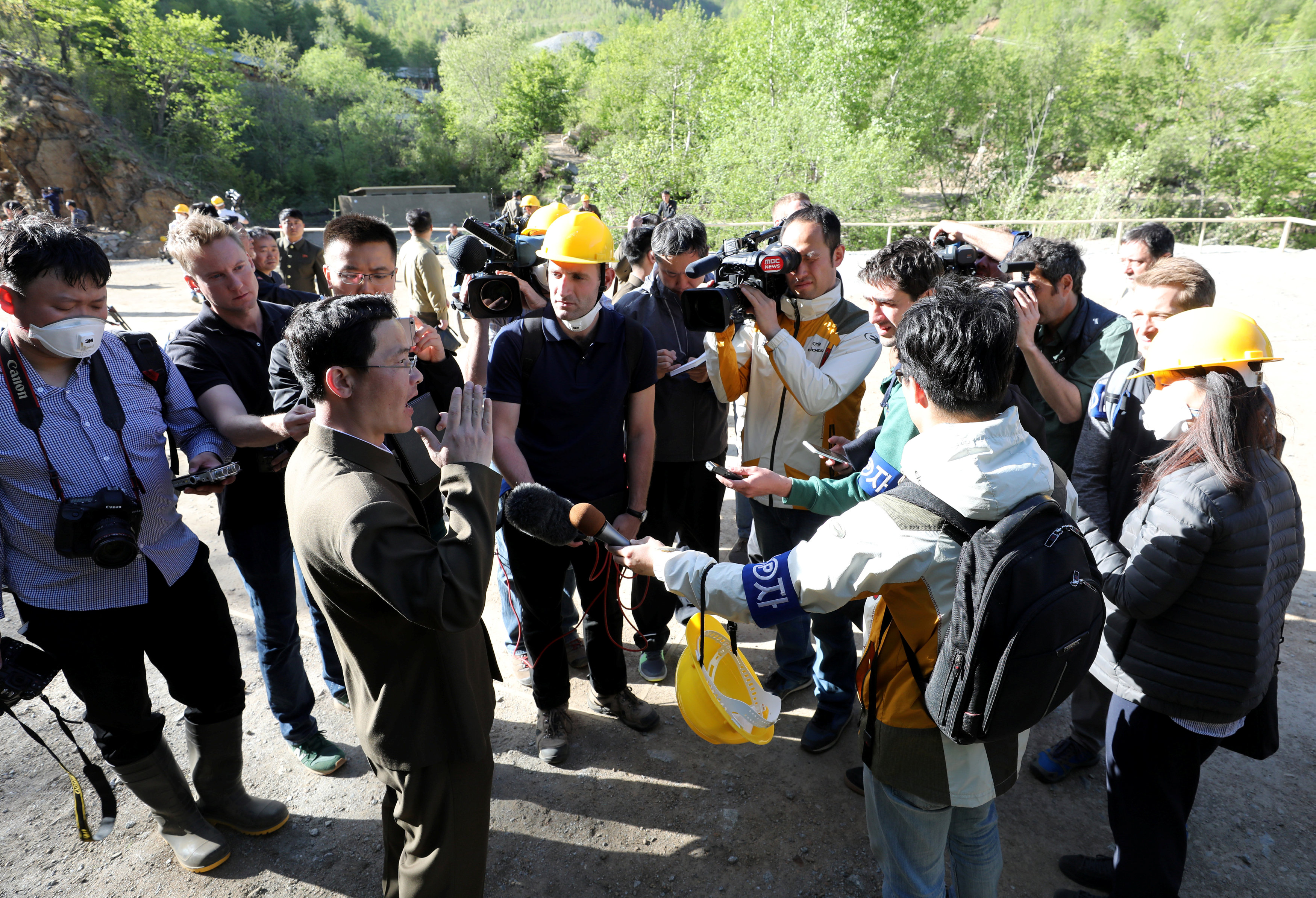
An official form North Korea's Nuclear Weapons Institute talks to reporters during the dismantlement process in Punggye-ri, North Hamgyong Province, North Korea May 24, 2018. Picture taken May 24, 2018 News1/Pool via REUTERS

An official form North Korea’s Nuclear Weapons Institute talks to reporters during the dismantlement process in Punggye-ri, North Hamgyong Province, North Korea May 24, 2018. Picture taken May 24, 2018 News1/Pool via REUTERS

Earlier on Twitter, Trump had noted “very good news to receive the warm and productive statement from North Korea.”

After decades of tension on the Korean Peninsula and antagonism with the United States over Pyongyang’s nuclear weapons program, Kim and Trump agreed to what would be the first meeting between a serving U.S. president and a North Korean leader. The plan followed months of war threats and insults traded between the leaders, as well as advances in North Korean missiles capable of reaching the United States.

Trump scrapped the meeting on Thursday after repeated threats by North Korea to pull out of the summit in Singapore over what it saw as confrontational remarks by U.S. officials. Trump cited North Korean hostility in canceling the summit.

In Pyongyang, North Korean Vice Foreign Minister Kim Kye Gwan said North Korea’s criticisms of certain U.S. officials had been a reaction to American rhetoric and that the current antagonism showed “the urgent necessity” for the summit.

“His sudden and unilateral announcement to cancel the summit is something unexpected to us and we cannot but feel great regret for it,” Kim Kye Gwan said of Trump in a statement on state media.

He said North Korea remained open to resolving issues with Washington “regardless of ways, at any time.”

Trump’s latest about-face sent officials scrambling in Washington. U.S. Defense Secretary Jim Mattis told reporters diplomats were “still at work” and said Trump had just sent a note out on the summit, which could be back on “if our diplomats can pull it off.”

North Korea had sharply criticized suggestions by Trump’s national security adviser, John Bolton, and Vice President Mike Pence that it could share the fate of Libya if it did not swiftly surrender its nuclear arsenal. Libyan leader Muammar Gaddafi was deposed and killed by NATO-backed militants after halting his nascent nuclear program.

Kim Kye Gwan said North Korea appreciated Trump having made the bold decision to work toward a summit.

“We even inwardly hoped that what is called ‘Trump formula’ would help clear both sides of their worries and comply with the requirements of our side and would be a wise way of substantial effect for settling the issue,” he said.

Trump had initially sought to placate North Korea, saying he was not pursuing the “Libya model” in getting the North to abandon its nuclear weapons program. White House press secretary Sarah Huckabee Sanders said: “This is the President Trump model. He’s going to run this the way he sees fit.”

A command post of Punggye-ri nuclear test ground is blown up during the dismantlement process in Punggye-ri, North Hamgyong Province, North Korea May 24, 2018. Picture taken May 24, 2018. News1/Pool via REUTERS

A command post of Punggye-ri nuclear test ground is blown up during the dismantlement process in Punggye-ri, North Hamgyong Province, North Korea May 24, 2018. Picture taken May 24, 2018. News1/Pool via REUTERS

SALVAGE THE SUMMIT

U.S. regional allies Japan and South Korea, as well as North Korea’s main ally, China, urged the two countries to salvage the summit on Friday.

At an economic forum in St. Petersburg, Chinese Vice President Wang Qishan said such a summit was necessary to ensure security on the Korean peninsula, which touched on China’s core interests.

Japanese Prime Minister Shinzo Abe, at the same forum, regretted the cancellation of the summit and said the world should keep doing its bit to make it happen.

In Seoul, South Korean President Moon Jae-in, who had urged Trump at a White House meeting on Tuesday not to let a rare opportunity slip away, said on Thursday he was “perplexed” by the cancellation.

South Korea also would continue efforts to improve ties with the North, the presidential office said after Moon’s top security advisers met for the second time on Friday.

Some analysts worried that canceling the summit could prompt a resumption in hostilities, including renewed shorter-range missile tests or stepped-up cyber attacks by Pyongyang and increased sanctions or deployment of new military assets by Washington.

In his letter, Trump warned Kim of the United States’ greater nuclear might, reminiscent of the president’s tweet last year asserting that he had a “much bigger” nuclear button than Kim.

While the Trump administration had insisted on North Korea’s complete, verifiable and irreversible dismantling of its nuclear program, Pyongyang had always couched its language in terms of denuclearization of the Korean peninsula.

It has said in previous, failed talks that it could consider giving up its arsenal if the United States provided security guarantees by removing its troops from South Korea and withdrawing its so-called nuclear umbrella of deterrence from South Korea and Japan.

Before Trump scrapped the meeting on Thursday, North Korea said it had completely dismantled its Punggye-ri nuclear test facility “to ensure the transparency of discontinuance” of nuclear testing.


(Additional reporting by Doina Chiacu, Idrees Ali, David Brunnstrom and Matt Spetalnick in WASHINGTON, Christian Lowe, Denis Pinchuk and Katya Golubkova in St Petersburg; Writing by So Young Kim and Doina Chiacu; Editing by Bill Trott)

Trump pardons late black boxing champion Jack Johnson

WASHINGTON (Reuters) – U.S. President Donald Trump on Thursday issued a posthumous pardon to boxer Jack Johnson, the first African-American heavyweight champion, who was jailed a century ago due to his relationship with a white woman.

Boxer Jack Johnson. Courtesy LOC/via REUTERS

Boxer Jack Johnson. Courtesy LOC/via REUTERS

“I believe Jack Johnson is a worthy person to receive a pardon, to correct a wrong in our history,” Trump said.

In a case that came to symbolize racial injustice, Johnson was arrested in 1912 with Lucille Cameron, who later became his wife, for violating the Mann Act. The law was passed two years earlier and made it a crime to take a woman across state lines for immoral purposes.

Johnson died in 1946.

In signing the pardon, the president cited “tremendous racial tension” during the time Johnson was champion. “He really represented something that was both very beautiful and very terrible at the same time,” Trump said.

Actor Sylvester Stallone, famous as the star of the “Rocky” boxing-movie franchise, and former world heavyweight boxing champion Lennox Lewis flanked Trump for the pardon in the Oval Office. In April, Trump tweeted that he was considering the pardon after talking to Stallone.

Earlier on Thursday, Stallone posted a photo of himself at the White House on Instagram with the caption “Waiting for the moment to go into the oval office for the pardon…”

In the Oval Office, Trump said of Stallone: “I love his movies.”

“This has been a long time coming,” Stallone said, adding that Johnson served as the inspiration for the character of Apollo Creed in the Rocky movies.

(Reporting by Susan Heavey and James Oliphant; writing by Lisa Lambert; editing by Cynthia Osterman and Tom Brown)

Americans report stronger finances in Trump’s first year: Federal Reserve

FILE PHOTO: The Federal Reserve headquarters in Washington, U.S., September 16, 2015. REUTERS/Kevin Lamarque/File Photo

WASHINGTON (Reuters) – The share of Americans who report they are doing “at least okay” financially rose in President Donald Trump’s first year in office, according to Federal Reserve data published on Tuesday.

The data was in line with other readings detailing America’s long recovery from the 2007-09 recession, including years of mostly steady job growth and a more recent uptick in wages.

The U.S. central bank said 74 percent of U.S. adults said their finances were at least okay in 2017, four percentage points higher than in 2016. Improvement was strongest in lower income households.

Still, about two in five adults faced a high likelihood of material hardship, such as an inability to afford sufficient food, medical treatment, housing or utilities, according to the Fed’s report, which was based on a survey of 12,246 people last year.

Also, about one in five people reported they personally knew someone who had been addicted to opioids. White adults were about twice as likely to be personally exposed to opioid addiction than blacks or Hispanics, regardless of education levels, the Fed said.

People exposed to opioid addiction also gave more dismal assessments of the local and national economies, although jobless rates in their areas were not higher than in areas where people were less exposed to opioids, the Fed said in the report.

“This analysis suggests the need to look beyond economic conditions to understand the roots of the current opioid epidemic,” according to the report.

The Fed has conducted the survey since 2013, although last year was the first time people were asked about opioid addiction.

Trump took office in January 2017 after a presidential election campaign that included promises to boost the economy and fight opioid addiction.

While the U.S. unemployment rate had been falling for several years before Trump assumed office, it has continued to fall and is currently at a 17-year low at 3.9 percent.

(Reporting by Jason Lange; Editing by Susan Thomas)