Where U.S. coronavirus cases are on the rise

By Chris Canipe and Lisa Shumaker

(Reuters) – Several southern U.S. states reported sharp increases in COVID-19 infections, with Alabama, South Carolina and Virginia all seeing new cases rise 35% or more in the week ended May 31 compared with the prior week, according to a Reuters analysis.

South Carolina health officials said they expected more increases in the future due to a lack of social distancing and mask-wearing at protests triggered by the death of George Floyd while in police custody in Minnesota.

“If people don’t follow current recommendations for social distancing and avoiding crowds of any kind, we can anticipate seeing increased numbers,” the South Carolina health department said in a statement to Reuters.

Graphic: Tracking the novel coronavirus in the U.S.

South Carolina said the recent rise in its new cases, which have been going up for three weeks, was in part due to the completion of testing in the state’s 194 nursing homes.

Alabama’s health department attributed the state’s steady increase in cases since early May to community transmission, clusters of outbreaks, and more testing.

Virginia officials were not immediately available for comment.

Nationally, new COVID-19 cases fell for a fifth straight week, down 4.7% last week compared with a 0.8% drop the prior week, according to the Reuters analysis of data from The COVID Tracking Project, a volunteer-run effort to track the outbreak.

As all 50 states have partially reopened, cases are rising in 17 states compared with 20 in the prior week. (For an interactive graphic, click here)

The Centers for Disease Control and Prevention (CDC) has recommended states wait for their daily number of new COVID-19 cases to fall for 14 days before easing social distancing restrictions.

Thirteen states have met the criteria for the week ended May 31, compared with 14 states and the District of Columbia the prior week, the analysis showed. Pennsylvania and New York lead with seven straight weeks of declines, and new cases are also falling in New Jersey, Connecticut, Rhode Island and Massachusetts.

(Graphic: World-focused tracker with country-by-country interactive, )

(Reporting by Chris Canipe in Kansas City, Missouri, and Lisa Shumaker in Chicago; Editing by Tiffany Wu)

Five police shot during U.S. protests, Trump says he could bring in military

By Jonathan Ernst and Brendan O’Brien

WASHINGTON/MINNEAPOLIS (Reuters) – At least five U.S. police were hit by gunfire during violent protests over the death of a black man in police custody, police and media said, hours after President Donald Trump said he would deploy the military if unrest does not stop.

Trump deepened outrage on Monday by posing at a church clutching a bible after law enforcement officers used teargas and rubber bullets to clear the way for him to walk there after he made his remarks in the White House Rose Garden.

Demonstrators set fire to a strip mall in Los Angeles, looted stores in New York City and clashed with police in St Louis, Missouri, where four officers were taken to hospital with non-life-threatening injuries.

An emotional St Louis police commissioner, John Hayden, said about 200 protesters were “jumping up and down like crazy people”, looting and throwing fireworks and rocks at officers.

“We had to protect our headquarters building, they were throwing fireworks on officers, fireworks were exploding on officers,” he told reporters. “They had officers with gas poured on them. What is going on? How can this be? Mr Floyd was killed somewhere else and they are tearing up cities all across the country.”

A police officer was also shot during protests in the Las Vegas Strip area, AP news agency said, quoting police. Another officer was “involved in a shooting” in the same area, the agency said.

It gave no details of the shootings or the officers’ condition. Police declined to comment to Reuters.

Trump has condemned the killing of George Floyd, a 46-year-old African American who died after a white policeman pinned his neck under a knee for nearly nine minutes in Minneapolis on May 25, and has promised justice.

But, with anti-police brutality marches and rallies having turned violent after dark each day in the past week, he said rightful protests could not be drowned out by an “angry mob”.

“Mayors and governors must establish an overwhelming law enforcement presence until the violence has been quelled,” Trump said. “If a city or state refuses to take the actions that are necessary to defend the life and property of their residents, then I will deploy the United States military and quickly solve the problem for them.”

Floyd’s death has reignited simmering racial tensions in a politically divided country that has been hit hard by the coronavirus pandemic, with African Americans accounting for a disproportionately high number of cases.

CRITICISM OF CHURCH VISIT

After his address, Trump posed for pictures with his daughter, Ivanka, and U.S. Attorney General William Barr at St. John’s Episcopal Church near the White House.

The presiding bishop of the Episcopal Church diocese in Washington D. C., Michael Curry, was among those who criticized Trump’s use of the historic church for a photo opportunity.

“In so doing, he used a church building and the Holy Bible for partisan political purposes,” he said on Twitter. The church suffered minor fire damage during protests on Sunday night.

The White House said it was clearing the area before a curfew.

A few hours later, thousands of people marched through Brooklyn, shouting “Justice now!” while some passing drivers honked in support.

Television images showed crowds smashing windows and looting luxury stores along Fifth Avenue in Manhattan before the city’s 11 p.m. curfew. Mayor Bill de Blasio said the curfew would be moved to 8 p.m. on Tuesday.

Two police officers were struck by a car at a demonstration in Buffalo, New York, on Monday night. Officials said the driver and passengers were believed to be in custody. It was not clear whether the incident was intentional.

In Hollywood, dozens of people were shown in television images looting a drug store. Windows were shattered at a nearby Starbucks and two restaurants.

AUTOPSIES

A second autopsy ordered by Floyd’s family and released on Monday found his death was homicide by “mechanical asphyxiation,” or physical force that interfered with his oxygen supply. The report says three officers contributed to his death.

The Hennepin County Medical Examiner later released autopsy findings that also called Floyd’s death homicide by asphyxiation. The county report said Floyd suffered cardiopulmonary arrest while being restrained by police and that he had arteriosclerotic and hypertensive heart disease, fentanyl intoxication and recent methamphetamine use.

Derek Chauvin, the 44-year-old Minneapolis police officer who kneeled on Floyd, was arrested on third-degree murder and second-degree manslaughter charges. Three other officers involved in the arrest have not been charged.

Floyd’s death was the latest case of police brutality against black men that was caught on videotape and prompted an outcry over racism in U.S. law enforcement.

Dozens of cities are under curfews not seen since riots after the 1968 assassination of Martin Luther King Jr. The National Guard deployed in 23 states and Washington, D.C.


(Reporting by Aakriti Bhalla, Subrat Patnaik, Lisa Lambert, Andy Sullivan, Maria Caspani, Peter Szekely, Lucy Nicholson, David Shepardson, Michael Martina, Brendan O’Brien, Sharon Bernstein, Lisa Richwine and Dan Whitcomb; Writing by Dan Whitcomb and Nick Macfie; Editing by Cynthia Osterman, Lincoln Feast, and Timothy Heritage)

Tensions in U.S. rise after another night of broken glass, fires and looting

By Lisa Lambert

WASHINGTON (Reuters) – President Donald Trump on Monday urged U.S. states to crack down on violent protests that have engulfed cities, saying officials should “dominate” and arrest people to restore order after a sixth straight night of vandalism and looting, media reported.

Residents and business owners in cities from New York to Santa Monica, California, spent Monday sweeping up broken glass and taking stock of damage after protests over racial inequities and excessive police force turned violent again overnight.

“You have to dominate,” Trump told the governors in a private call, the New York Times reported. “If you don’t dominate, you’re wasting your time – they’re going to run over you, you’re going to look like a bunch of jerks.”

CBS News, which also obtained audio of the call, said Trump had pinned the violence on the “radical left.”

Dozens of cities across the United States remain under curfews at a level not seen since riots following the 1968 assassination of civil rights activist Martin Luther King Jr. The National Guard deployed in 23 states and Washington, D.C.

Authorities fought to put out fires near the White House and halt the looting of shops in numerous cities. The Federal Emergency Management Agency reported “significant ongoing” civil unrest in 36 U.S. cities, including smaller ones like Fargo, North Dakota, and Roanoke, Virginia.

One person was killed in Louisville, Kentucky, overnight where police and National Guard troops returned fire while trying to disperse a crowd.

“It’s devastating and heartbreaking,” Alex Flowers, 30, said as she swept broken glass from the sidewalk outside Wasteland, a used-clothing store in Santa Monica, California, early on Monday. “I came to help clean up the city that has been destroyed and help the business owners and employees.”

The unrest, which erupted as the country was easing lengthy lockdowns to stop the spread of the coronavirus, began with peaceful protests over the death of a black man, George Floyd, in police custody in Minneapolis last Monday.

Video footage showed a white police officer kneeling on the neck of Floyd, 46, for nearly nine minutes before he died. Derek Chauvin, a since-fired 44-year-old police officer, has been charged with third-degree murder and second-degree manslaughter. He was released on $500,000 bail and is due to appear in court on June 8, according to jail records.

‘I’LL FIGHT WITH YOU’

On Monday, dozens of people quietly paid their respects to Floyd at the scene outside the Cup Foods where he lost his life. Visitors left flowers and signs honoring Floyd on the pavement. A little girl wrote, “I’ll fight with you,” in aqua blue chalk in the road.

“This is therapeutic. My heart was real heavy this morning so I came down extra early and when I got here, the heaviness lifted,” said Diana Jones, 40, the mother of four children. “This right here let’s me know that things are going to be ok.”

In the U.S. capital, St. John’s Episcopal Church, a historic place near the White House where many U.S. presidents have worshipped, suffered minor damage while the nearby headquarters of the AFL-CIO labor group was vandalized.

Floyd’s death was the latest in a string of similar incidents to prompt an outcry over racism in law enforcement. It reignited outrage across a politically and racially divided country that has been hit hard by the coronavirus pandemic.

Many cities affected by the unrest are just restarting some normal economic activity after more than two months of stay-at-home orders to stem the outbreak, which has killed more than 104,000 people and plunged more than 40 million people into joblessness.

White House spokeswoman Kayleigh McEnany told Fox News that Antifa, an anti-fascist group, was “certainly behind” the violence. Trump branded the group a terrorist organization, though it was unclear whether they were involved in any violence.

New York City Police Commissioner Dermot Shea told a news briefing with Mayor Bill de Blasio that police are seeing “outside agitators coming and trying to rally people to do bad things.”

Trump has condemned the killing of Floyd and promised justice but has made no major public statement to address the crisis. In tweets he has described protesters as “thugs” and threatened to use the U.S. military.

Critics accuse the Republican president, who is seeking re-election in November, of stoking conflict and racial tension rather than seeking to bring the country together and address the underlying issues.

Democratic presidential candidate Joe Biden, critical of Trump’s handling of the crisis, met black community leaders in a church and said he would create a police oversight board within his first 100 days in the White House.

Black people account for 6.8% of Minnesota’s population but 29% of coronavirus cases, state and federal data show.

(Reporting by Lisa Lambert, Andy Sullivan, Maria Caspani, Peter Szekely, Lucy Nicholson, Michael Martina and Brendan O’Brien; Writing by Paul Simao; Editing by Steve Orlofsky and Howard Goller)

Factbox: China’s numerous diplomatic disputes

BEIJING (Reuters) – China is engaged in diplomatic disputes on numerous fronts, from acrimony with the United States to a backlash over its clampdown on Hong Kong, a border dispute with India and criticism over its handling of the novel coronavirus.

Following are some of the main points of contention between China and other countries:

UNITED STATES

From disputes over trade and technology, to U.S. criticism over the coronavirus outbreak and China’s accusation of U.S. backing for protests in Hong Kong, ties between the world’s two biggest economies are at their lowest point in decades.

HONG KONG

China’s plan to impose national security legislation on Hong Kong provoked U.S. retaliation and disapproval from other Western capitals. The city’s former colonial ruler Britain said it would offer extended visa rights to British national overseas (BNO) passport holders from Hong Kong.

CORONAVIRUS

Several countries, including the United States and Australia, have called for China to be held to account for its early handling of the coronavirus, which emerged late last year in the city of Wuhan. China has also faced criticism for what some have characterized as heavy-handed “virus diplomacy”.

TAIWAN

China has stepped up diplomatic and military pressure on Chinese-claimed but democratically ruled Taiwan, trying to coax it into accepting Chinese rule. Taiwan President Tsai Ing-wen, re-elected by a landslide in January, has rejected that, saying only Taiwan’s people can decide its future.

INDIA

China and India are engaged in the most serious military standoff on their disputed border since 2017, with soldiers in the remote Ladakh region accusing each other of encroachment.

XINJIANG

China has been criticized in Washington and elsewhere over its treatment of ethnic Uighur Muslims in its western Xinjiang region. Last month, the U.S. House of Representatives overwhelmingly approved legislation calling for sanctions on officials responsible for the oppression of Uighurs.

HUAWEI

The United States has raised security concerns over equipment provided by Chinese telecoms gear giant Huawei, warning that allies that use it in their networks risked being cut off from valuable intelligence-sharing feeds. Last month, the United States moved to block global chip supplies to Huawei, which denies that its equipment poses a security risk.

CANADA

Ties have been strained since Canada arrested Huawei executive Meng Wanzhou, daughter of the firm’s founder, in late 2018. Soon after, China detained two Canadians and blocked imports of some canola seed. Meng lost a court ruling last month in her fight against extradition to the United States.

EUROPEAN UNION

EU foreign ministers agreed last week to toughen their strategy on China to counter its increasingly assertive diplomacy against a backdrop of concern about Hong Kong. The bloc has been frustrated over market access for its companies in China, which has sought to block an EU report alleging that China was spreading disinformation about the coronavirus outbreak, according to diplomatic sources.

AUSTRALIA

China last month imposed tariffs on barley imports from Australia, the latest escalation between them. Relations soured in 2018 when Australia banned Huawei from its 5G broadband network, and China has been angered by Australia’s call for an independent inquiry into the coronavirus.

SOUTH CHINA SEA

China has overlapping claims in the energy-rich South China Sea, which is also an important trade route, with the Philippines, Brunei, Vietnam, Malaysia and Taiwan. The United States has accused China of taking advantage of the distraction of the coronavirus to advance its presence in the waters.

(Writing by Tony Munroe; Editing by Robert Birsel)

Kremlin says Putin ‘supports dialogue’ after Trump’s proposed G7 invite

MOSCOW (Reuters) – The Kremlin said on Monday it needed more details before responding to U.S. President Donald Trump’s proposal to invite Russia to attend a Group of Seven nations summit, but that President Vladimir Putin supported dialogue on the issue.

Trump said on Saturday he would postpone a G7 summit he had hoped to hold next month until September or later and expand the list of invitees to include Australia, Russia, South Korea and India.

“President Putin is a supporter of dialogue in all directions, but in this case, in order to respond to such initiatives, we need to receive more information, which we unfortunately do not have,” said Kremlin spokesman Dmitry Peskov.

“We don’t know the details of this proposal yet, we don’t know if it is official,” he said, adding that Moscow needed to know what might be on the agenda of the proposed meeting and its format, before responding.

Russia was expelled from what was then the G8 in 2014 when Trump’s predecessor, Barack Obama, was U.S. president, after Moscow annexed the Crimea region from Ukraine. Russia still holds the territory, and various G7 governments have rebuffed previous calls from Trump to readmit Moscow.

Peskov said other formats such as the G20 gave Russia a platform to discuss international issues with other countries.

“There are very comfortable and effective mechanisms for all participants for international dialogue, such as the G20, which allows the world’s leading economies to discuss the most pressing problems,” he said.

Some Russian analysts believe Moscow should regard Trump’s potential invitation with skepticism.

“Trump’s intention to invite Putin as a guest of the #G7 makes no sense for Russia. All blame, no gain is what it’ll get. This chapter should remain closed,” Dmitri Trenin, director of the Carnegie Moscow Center and a former colonel in the Russian army, wrote on Twitter on Sunday.

(Reporting by Alexander Marrow, Maxim Rodionov and Andrey Kuzmin; Editing by Andrew Osborn)

Facebook, Snapchat join chorus of companies condemning George Floyd death, racism

(Reuters) – Facebook Inc and Snap Inc became the latest U.S. companies condemning racial inequality in the United States as violent protests flared up across major cities over the death of George Floyd, an unarmed black man who died while in police custody in Minneapolis last week.

The two tech companies stood with Intel Corp, Netflix Inc and Nike Inc in taking a public stance against Floyd’s death – voicing concerns about discrimination against African-Americans.

“We stand with the Black community – and all those working towards justice in honor of George Floyd, Breonna Taylor, Ahmaud Arbery and far too many others whose names will not be forgotten,” Facebook’s Chief Executive Officer Mark Zuckerberg said in a Facebook post late Sunday.

He said the social network will commit $10 million to organizations that are working on racial justice.

The arrest of Floyd, 46, was captured by an onlooker’s cell phone video that went viral and showed a police officer restraining him while pressing his knee on Floyd’s neck as he moaned: “Please, I can’t breathe.”

His death caused yet another round of outrage across the nation on the treatment of African-Americans by police officers, polarizing the country politically and racially as states begin to ease lockdowns during the COVID-19 pandemic.

“I am heartbroken and enraged by the treatment of black people and people of color in America,” Snapchat Chief Executive Officer Evan Spiegel said in an internal memo.

“We must begin a process to ensure that America’s black community is heard throughout the country.”

On Friday, Nike flipped its iconic slogan to raise awareness about racism.

“For Once, Don’t Do It. Don’t pretend there’s not a problem in America. Don’t turn your back on racism,” the company said in a video that has over six million views and was shared by celebrities and rival Adidas AG.

(Reporting by Neha Malara in Bengaluru; Additional reporting by Uday Sampath; Editing by Sweta Singh, Bernard Orr)

China tells state firms to halt purchases of major U.S. farm products: sources

By Hallie Gu, Keith Zhai and Jing Xu

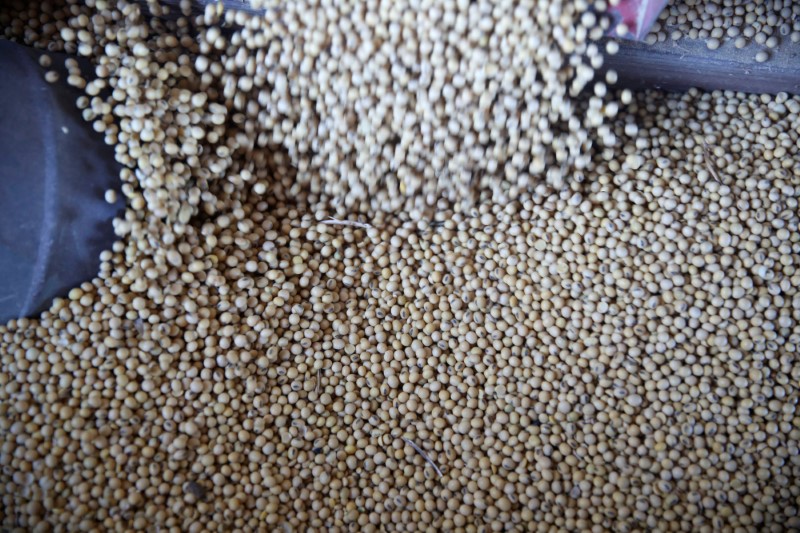
BEIJING/SINGAPORE (Reuters) – China has told state-owned firms to halt purchases of soybeans and pork from the United States, two people familiar with the matter said, after Washington said it would eliminate special treatment for Hong Kong to punish Beijing.

Large volume state purchases of U.S. corn and cotton have also been put on hold, one of the sources said.

China could expand the order to include additional U.S. farm goods if Washington took further action, the people said.

“China has asked main state firms to suspend large scale purchases of major U.S. farm products like soybeans and pork, in response to U.S. reaction to Hong Kong,” the source said.

“Now we will watch and see what the U.S. does next.”

U.S. President Donald Trump said on Friday he was directing his administration to begin the process of eliminating special treatment for Hong Kong, ranging from extradition treatment to export controls, in response to China’s plans to impose new security legislation in the territory.

China is ready to halt imports of more agriculture products from the United States if Washington takes more action on Hong Kong, the sources said.

(GRAPHIC: Value of U.S. agriculture exports to China – https://fingfx.thomsonreuters.com/gfx/ce/yzdvxdxdzvx/USAGExportstoChinaMar2020.png)

Chinese importers have canceled 10,000 to 20,000 tonnes of American pork shipments – equivalent to roughly one week’s orders in recent months – following Trump’s comments on Friday, the source said.

State purchases of bulk volumes of U.S. corn and cotton have also been suspended but the details were not clear.

In a worst-case scenario, if Trump continues to target China, Beijing will have to scrap the Phase 1 trade deal, a second source familiar with the government plan said.

“There’s no way Beijing can buy goods from the U.S. when receiving constant attacks from Trump,” the person said.

China pledged to buy an additional $32 billion worth of U.S. agriculture products over two years above a baseline based on 2017 figures, under the initial trade deal the two countries signed in January.

China has bought soybeans, corn, wheat and soyoil from the United States this year, to fulfill its commitment under the trade deal. Beijing also stepped up purchases of U.S. pork, after the deadly African swine fever decimated its pig herd.

The U.S. Department of Agriculture reported that China bought $1.028 billion worth of soybeans and $691 million of pork in the first quarter of 2020.

Private importers haven’t received a government order to suspend buying of U.S. farm produce, according to a third source with a major trading house, but commercial buyers are very cautious at the moment, the person added.

“A certain scale of trade will be halted,” given rising tensions between China and the U.S. in other areas, but it is not a full stop, said a fourth source familiar with the government plan.

However, China would be able to find other sellers easily (of the farm products), he added.

The sources all declined to be named due to the sensitivity of the matter.

(Reporting by Hallie Gu, Jing Xu in Beijing and Keith Zhai in Singapore; Additional reporting by Dominique Patton, and Gavin Maguire; Editing by Edmund Blair and Susan Fenton)

China warns U.S. it will retaliate on moves over Hong Kong

BEIJING (Reuters) – China said on Monday U.S. attempts to harm Chinese interests will be met with firm countermeasures, criticizing a U.S. decision to begin ending special treatment for Hong Kong as well as actions against Chinese students and companies.

China’s parliament last week voted to move forward with imposing national security legislation on Hong Kong, which U.S. President Donald Trump said on Friday was a tragedy for the people of the city, and which violated China’s promise to protect its autonomy.

Trump ordered his administration to begin the process of eliminating special U.S. treatment for Hong Kong to punish China, ranging from extradition treatment to export controls.

But he stopped short of calling an immediate end to privileges that have helped the former British colony remain a global financial center.

Chinese foreign ministry spokesman Zhao Lijian said China firmly opposed the U.S. steps.

“The announced measures severely interfere with China’s internal affairs, damage U.S.-China relations, and will harm both sides. China is firmly opposed to this,” Zhao told reporters during a regular briefing.

“Any words or actions by the U.S. that harm China’s interests will meet with China’s firm counterattack,” he said.

But Hong Kong shares surged more than 3% on Monday as investors took comfort that Trump did not immediately end the special U.S. privileges.

At the close of trade, the Hang Seng index was up 3.36%, its biggest one-day percentage gain since March 25.

“Chinese policymakers would likely want to see precisely what the US implements before responding with further policy adjustments or retaliation of their own,” Goldman Sachs wrote in a note on Sunday.

In making his Friday announcement, Trump used some of his toughest rhetoric yet against China, saying it had broken its word over Hong Kong’s autonomy by moving to impose the new national security legislation and the territory no longer warranted U.S. economic privileges.

Trump said China’s “malfeasance” was responsible for massive suffering and economic damage worldwide.

He said the United States would also impose sanctions on individuals seen as responsible for “smothering – absolutely smothering – Hong Kong’s freedom” but he did not name any of the potential sanctions targets.

Trump gave no time frame for the action, suggesting he may be trying to buy time before deciding whether to implement the most drastic measures, which have drawn strong resistance from U.S. companies operating in Hong Kong.

Earlier, Hong Kong’s Beijing-backed government told the United States to keep out of the national security debate and warned that withdrawal of the financial hub’s special status could backfire on the U.S. economy.

(Reporting by Gabriel Crossley; writing by Se Young Lee and Tony Munroe; Editing by Robert Birsel)

Fires burn near White House in violent U.S. protests

By Brendan O’Brien and Carlos Barria

MINNEAPOLIS (Reuters) – Fires burned near the White House, stores were looted in New York City and Southern California, and a tanker truck drove into marchers in Minneapolis as the United States struggled to contain chaotic protests over race and policing.

A protester runs while looting after marching against the death in Minneapolis police custody of George Floyd, in the Manhattan borough of New York City, U.S., June 1, 2020. REUTERS/Eduardo Munoz

National Guard troops were deployed in 15 states and Washington, D.C. in an attempt to quell a sixth night of violence on Sunday. The unrest began with peaceful protests over the death of a black man, George Floyd, in police custody.

“I hate to see my city like this but at the end we need justice,” said 18-year-old Jahvon Craven as he stood on an overpass watching protesters below on Interstate 35 in downtown Minneapolis moments before an 8 p.m. curfew went into effect.

Video footage showed a white Minneapolis police officer kneeling on the neck of Floyd, 46, for nearly nine minutes before he died on May 25.

His death caused outrage across a nation that is politically and racially divided during a polarizing presidential campaign, reigniting protests that have flared repeatedly in recent years over police killings of black Americans.

A protester rises from his chair as a tear gas canister stops at his feet during nationwide unrest following the death in Minneapolis police custody of George Floyd, in Raleigh, North Carolina, U.S. May 31, 2020. REUTERS/Jonathan Drake

Authorities imposed curfews on dozens of cities across the United States, the most since the aftermath of the assassination of Martin Luther King Jr in 1968 — also during an election campaign and in the upheaval of anti-war demonstrations.

President Donald Trump has condemned the killing of Floyd and promised justice, but has also described the current protesters as “thugs”.

“Get tough Democrat Mayors and Governors,” Trump, a Republican, said on Twitter on Sunday afternoon. “These people are ANARCHISTS. Call in our National Guard NOW.”

In Louisville, Kentucky, WLKY-TV, a local CBS affiliate, reported that a man was shot and killed by police early on Monday. It was unclear if he was protesting. Police said they had been fired on before the shooting, WLKY reported.

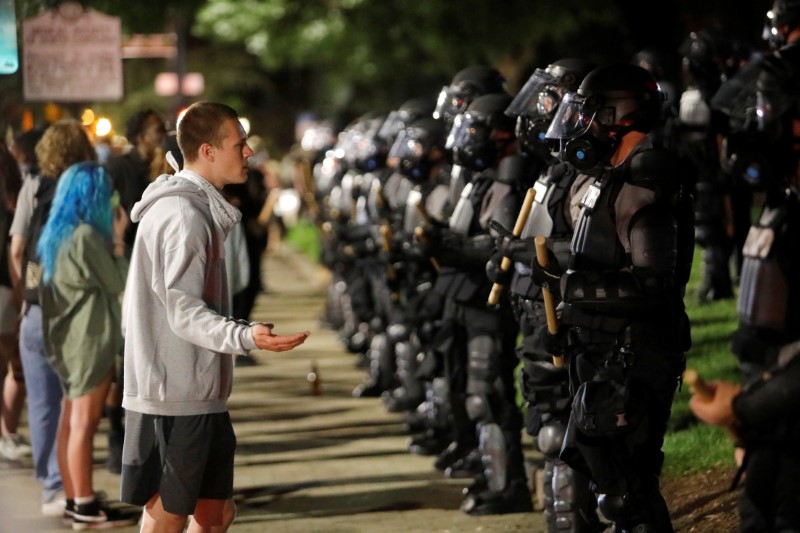
A protester pleads with riot police during nationwide unrest following the death in Minneapolis police custody of George Floyd, in Raleigh, North Carolina, U.S. May 31, 2020. Picture taken May 31, 2020. REUTERS/Jonathan Drake

CHAOTIC SCENES AROUND WHITE HOUSE

In Washington, D.C., protesters set fires near the White House on Sunday. The smoke mixed with billowing clouds of tear gas as police sought to clear from the area crowds chanting “George Floyd”.

Sporadic violence broke out in Boston following peaceful protests as activists threw bottles at police officers and lit a cruiser on fire. Philadelphia announced a 6 p.m. to 6 a.m. curfew.

On Sunday afternoon, a tanker truck drove into demonstrators on the I-35 highway in Minneapolis, which had been closed to traffic. The driver was pulled from the cab and beaten by protesters before police took him into custody. It did not appear any protesters were hit by the truck.

On the West Coast, there were also clashes in Portland, Oregon, where TV footage showed small fires burning as police fired tear gas at protesters who set off fireworks.

In Santa Monica, California, upscale stores were looted along the city’s popular Third Street Promenade before police moved in to make arrests. The vandalism followed a largely peaceful march.

Further south, in the Los Angeles suburb of Long Beach, a group of young men and women smashed windows of a shopping mall and looted stores before they were dispersed before a 6 p.m. curfew.

The demonstrations brought out a diversity of people.

“It means a lot to see people other than black people joining the demonstration,” said Candace Collins, a young black woman at a march in Culver City, California.

Thousands of people gathered peacefully on Sunday afternoon for a rally in St. Paul, adjacent to Minneapolis, as state troopers surrounded the state capitol building. About 170 stores in the city have been looted, its mayor told CNN.

Protests spread around the globe, with events in London and Berlin on Sunday and others on Monday including in New Zealand, Australia and the Netherlands.

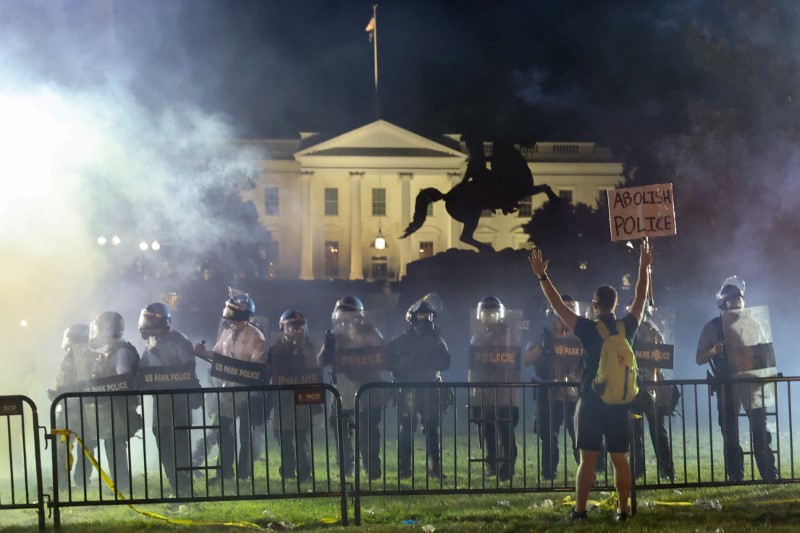
Police in riot gear keep protesters at bay in Lafayette Park near the White House in Washington, U.S. May 31, 2020. REUTERS/Jonathan Ernst

NO LET-UP

The eruptions of violence have not let up despite the arrest on Friday of former Minneapolis police officer, Derek Chauvin, 44. He has since been charged with third-degree murder.

In New York City, where store windows were smashed, police arrested about 350 people and 30 officers suffered minor injuries during clashes. Mayor Bill de Blasio said police conduct was being investigated, with videos showing a police vehicle lurching into a crowd of protesters who were pelting it with debris in Brooklyn.

De Blasio said he had not seen a separate video showing an officer pulling down the mask of a black protester to spray something in his face.

Among those arrested for unlawful assembly on Saturday night was de Blasio’s 25-year-old daughter, Chiara, according to a New York Police Department source, who said she was issued a “desk appearance ticket” and released.

Protests have also flared in Chicago, Seattle, Salt Lake City, Cleveland and Dallas.

(Reporting by Brendan O’Brien and Carlos Barria in Minneapolis; Additional reporting by Peter Szekely, Maria Caspani and Sinead Carew in New York, Susan Heavey in Washington, Brad Brooks in Austin, Texas, Zach Fagenson in Miami and Bill Tarrant and Dan Whitcomb in Los Angeles and Aakriti Bhalla; Writing by Dan Whitcomb and Alex Richardson; Editing by Bill Tarrant, Lincoln Feast and Timothy Heritage)

Protests flare around the United States over Minneapolis killing

By Brendan O’Brien and Carlos Barria

MINNEAPOLIS (Reuters) – Protests flared late into the night in many cities in the United States over the killing of George Floyd, a black man who died this week after being pinned down by the neck by a white police officer in Minneapolis.

A protester shields himself from tear gas with his skateboard while demonstrating against the death in Minneapolis police custody of African-American man George Floyd, and of Dion Johnson, who was killed in Arizona, outside of Phoenix police headquarters in Phoenix, Arizona, U.S. May 29, 2020. Picture taken May 29, 2020. REUTERS/Nicole Neri

The sometimes violent demonstrations hit cities from New York to Atlanta in a tide of anger over the treatment of minorities by law enforcement.

Derek Chauvin, the former Minneapolis police officer shown in video footage pinning Floyd down on the street with his knee, was charged with murder in the case on Friday.

Chauvin, who was dismissed from the police with three fellow officers the day after Monday’s fatal encounter, was arrested on third-degree murder and manslaughter charges for his role in the death of Floyd, 46.

In Detroit, a 19-year-old man protesting in the city was shot dead on Friday night by a suspect who pulled up to demonstrators in a sport utility vehicle and fired gunshots into the crowd, then fled, the Detroit Free Press and other local media reported. Police could not immediately be reached for comment.

A vandalized New York Police Department vehicle is seen the morning after a protest following the death of African-American George Floyd in Minneapolis Police custody, in the Brooklyn borough of New York City, U.S., May 30, 2020. REUTERS/Andrew Kelly

Hundreds in the city had joined a “March Against Police Brutality” late in the afternoon outside the Detroit Public Safety Headquarters.

Many chanted, “No justice, no peace.” Some carried signs that read, “End police brutality” and “I won’t stop yelling until everyone can breathe.”

Thousands of chanting protesters filled the streets of New York City’s Brooklyn borough near the Barclays Center indoor arena. Police armed with batons and pepper spray made scores of arrests in sometimes violent clashes.

In lower Manhattan, demonstrators at a “We can’t breathe” vigil and rally were pressing for legislation outlawing the police “chokehold” used by a city police officer in the 2014 death of Eric Garner, who was also black.

In Washington, police and Secret Service agents were out in force around the White House before dozens of demonstrators gathered across the street in Lafayette Square chanting,”I can’t breathe.”

A fire fighter works to put out a burning business as the sun rises after another night of continued demonstrations after African-American man George Floyd was killed while in police custody days ago in Minneapolis, Minnesota, U.S., May 30, 2020. REUTERS/Leah Millis

The protests erupted and spread around the country this week after video footage taken by an onlooker’s cell phone was widely circulated on the internet. It shows Floyd gasping for air and repeatedly groaning, “Please, I can’t breathe,” while a crowd of bystanders shouted at police to let him up.

The video reignited rage that civil rights activists said has long simmered in Minneapolis and cities across the country over persistent racial bias in the U.S. criminal justice system.

CHAOTIC SCENES IN ATLANTA

In Atlanta, Bernice King, the youngest daughter of civil rights icon Martin Luther King Jr., implored people to go home on Friday night after more than 1,000 protesters marched to the state capitol from the Centennial Olympic Park, blocking traffic and an interstate highway along the way.

The demonstration turned chaotic and at times violent. Fires burned in downtown Atlanta near the CNN Center, the network’s headquarters.

At least one police car was among several vehicles burnt. Windows were smashed at the CNN building, along with storefronts. Police pushed back the crowd, but they hurled bottles at officers.

A protester faces a U.S. Secret Service uniformed division officer during a demonstration against the death in Minneapolis police custody of African-American man George Floyd, as the officers keep demonstrators away from the White House during a protest in Lafayette Park in Washington, U.S. May 30, 2020. REUTERS/Tom Brenner TPX IMAGES OF THE DAY

Protesters also took to the streets in other cities including Denver and Houston.

In Minneapolis, hundreds of protesters defied an 8 p.m. curfew to gather in the streets around a police station burnt the previous night.

“We are out here because we, as a generation, realize things have to change,” said one marcher, Paul Selman, a 25-year-old black man.

The charges brought by Hennepin County prosecutors against the police officer came after a third night of arson, looting and vandalism in which protesters set fire to a police station, and the National Guard was deployed to help restore order in Minnesota’s largest city.

Authorities had hoped Chauvin’s arrest would allay public anger. But defying an 8 p.m. curfew imposed by Mayor Jacob Frey, about 500 demonstrators clashed anew with riot police outside the battered Third Precinct building.

Police, creating a two-block buffer area around the precinct house, opened fire with tear gas, plastic bullets and concussion grenades, scattering the crowd.

Another group of protesters later converged near the city’s Fifth Precinct station until police arrived and fired tear gas and plastic bullets to break up that gathering. A nearby bank and post office were set on fire.

Still, Friday night’s crowds were far smaller and more widely dispersed than the night before.

Law enforcement kept a mostly low profile, a strategy seemingly calculated to reduce the risk of violent confrontations, as was the case in several urban centers across the country where sympathy protests arose.

Hennepin County Attorney Mike Freeman, announcing Chauvin’s arrest, said the investigation into Chauvin, who faces up to 25 years in prison if convicted, was ongoing and he anticipated also charging the three other police officers, identified by the city as Thomas Lane, Tou Thao and J Alexander Kueng.

Floyd, a Houston native who had worked security for a nightclub, was arrested for allegedly using counterfeit money at a store to buy cigarettes on Monday evening.

(Reporting Brendan O’Brien and Carlos Barria in Minneapolis; Additional reporting by Lisa Lambert in Washington, Nathan Layne in Wilton, Connecticut, Andrew Hay in Taos, New Mexico, Peter Szekely and Jonathan Allen in New York and Steve Gorman in Los Angeles, Rich McKay in Atlanta and Steve Gorman in Los Angeles; Writing by Steve Gorman; Editing by Cynthia Osterman, Daniel Wallis and Frances Kerry)