U.S. Supreme Court gives states latitude to prosecute illegal immigrants

By Andrew Chung

WASHINGTON (Reuters) – The U.S. Supreme Court on Tuesday widened the ability of states to use criminal laws against illegal immigrants and other people who do not have work authorization in the United States in a ruling involving identity theft prosecutions in Kansas.

The 5-4 ruling, with the court’s conservative justices in the majority, overturned a 2017 Kansas Supreme Court decision that had voided the convictions of three restaurant workers for fraudulently using other people’s Social Security numbers.

In the opinion written by Justice Samuel Alito, the high court found that Kansas did not unlawfully encroach on federal authority over immigration policy.

The court’s four liberal justices disagreed. While a 1986 federal law called the Immigration Reform and Control Act did not explicitly prevent states from pursuing such prosecutions, they said in a dissent written by Justice Stephen Breyer, the law’s overall purpose hands the policing of work authorization fraud “to the federal government alone.”

President Donald Trump’s administration backed Kansas in the case. Trump has made his hardline policies toward immigration a centerpiece of his presidency and 2020 re-election campaign. Kansas is one of several conservative states that have sought to crack down on illegal immigrants.

In the dissent, Breyer said allowing prosecutions like those pursued by Kansas “opens a colossal loophole” in allowing states to police federal work authorization.

Though immigration-related employment fraud is a federal matter, Kansas contended that its prosecutions were not immigration-related and did not conflict with federal immigration law. Kansas had argued that a ruling in favor of the immigrants would undermine its ability to combat the growing problem of identity theft.

Immigrant rights groups have said that giving states power to prosecute employment fraud would let them take immigration policy into their own hands.

The three men – Ramiro Garcia, Donaldo Morales and Guadalupe Ochoa-Lara – were not authorized to work in the United States and provided their employers Social Security numbers that were not their own.

A Social Security number is used to identify people for employment and tax purposes. People who enter the country illegally do not get assigned Social Security numbers, which are given by the U.S. government to all legal residents.

The case focused on the employment verification process under federal immigration law requiring employers, on a form known as the I-9, to attest that an employee is authorized to work. The law also states that the form “may not be used for purposes other than for enforcement of this act.”

While the federal government has the sole authority to prosecute individuals for providing fraudulent information during the I-9 employment verification process, the state prosecuted the three men for using the same false information on different forms used to withhold wages for tax purposes.

In Tuesday’s ruling, Alito wrote, “The submission of tax-withholding forms is fundamentally unrelated to the federal employment verification system.”

The ruling, by giving states some latitude in law enforcement affecting illegal immigrants, could provide ammunition to California in its defense of its so-called sanctuary policies. These policies limit cooperation with federal immigration authorities to protect certain illegal immigrants from deportation.

Trump’s administration sued California and is appealing to the Supreme Court after losing in a lower court. The justices could act in that case as early as next week. The administration also has sued other states and localities over sanctuary policies.

(Reporting by Andrew Chung; Additional reporting by Lawrence Hurley; Editing by Will Dunham)

U.S. Supreme Court rejects challenge to ban on gun ‘bump stocks’

By Andrew Chung

WASHINGTON (Reuters) – The U.S. Supreme Court on Monday rebuffed a bid by gun rights advocates to overturn President Donald Trump’s ban on “bump stocks” – devices that enable semi-automatic weapons to fire rapidly like a machine gun – implemented after the 2017 Las Vegas mass shooting.

The justices left in place a lower court’s decision that upheld the Trump administration’s action to define bump stocks as prohibited machine guns under U.S. law.

The ban, which went into effect in March 2019, was embraced by Trump following a massacre that killed 58 people at a music festival in Las Vegas in which the gunman used bump stocks. It represented a rare recent instance of gun control at the federal level in a country that has experienced a series of mass shootings.

Numerous gun control proposals have been thwarted in the U.S. Congress, largely because of opposition by Republican lawmakers and the influential National Rifle Association gun rights lobby.

The Firearms Policy Foundation, a gun rights group, and other plaintiffs sued in federal court to try to reverse Trump’s action. The Supreme Court last year refused to block the ban from going into effect while the legal challenges against it were considered in the courts. The justices also refused to temporarily exempt from the plaintiffs in the case from the ban.

Bump stocks use a gun’s recoil to bump its trigger, enabling a semiautomatic weapon to fire hundreds of rounds per minute, which can transform it into a machine gun. The ban required owners to turn in or destroy the attachments and those caught in possession of them could face up to 10 years in prison.

The Las Vegas gunman, Stephen Paddock, was found to have fired more than 1,100 rounds of ammunition in about 11 minutes, employing semi-automatic rifles modified with bump stocks.

The plaintiffs challenged a new rule issued by the Bureau of Alcohol, Tobacco, Firearms and Explosives at Trump’s direction that classified bump stock devices as forbidden machine guns under the 1934 National Firearms Act.

A federal court refused to issue an injunction against the ban, saying the plaintiffs would likely lose the case. The U.S. Court of Appeals for the District of Columbia Circuit upheld that decision, deferring to the bureau’s new interpretation of the National Firearms Act.

Justice Neil Gorsuch, a conservative member of the court appointed by Trump, issued a statement agreeing with the decision to deny the appeal. But he criticized the lower court’s deference to a federal agency – the bureau – that had changed its interpretation of a longstanding law.

“How, in all this, can ordinary citizens be expected to keep up?” Gorsuch asked, adding that the bump stock dispute may return to the Supreme Court at a later date.

The Supreme Court in December heard arguments in the first major gun dispute to come before the justices since 2010 – a challenge backed by the NRA to a handgun transport restriction in New York City.

(Reporting by Andrew Chung; Editing by Will Dunham)

Additional U.S. coronavirus cases are ‘likely,’ Trump says

WASHINGTON (Reuters) – President Donald Trump said additional coronavirus cases in the United States were “likely” but that the country was prepared for any circumstance, at a news conference on Saturday after reports of the first U.S. patient death from the virus.

The first U.S. death from the flu-like illness was a medically high-risk patient in her late fifties in the state of Washington, Trump told reporters at the White House conference.

Trump said he would meet with pharmaceutical companies on Monday to discuss potential vaccines. The global spread of the illness has prompted the United States to consider imposing entry restrictions at the U.S.-Mexico border.

(Reporting by Steve Holland, Editing by Rosalba O’Brien)

Exclusive: U.S. mulls using sweeping powers to ramp up production of coronavirus protective gear

By Ted Hesson and Alexandra Alper

WASHINGTON (Reuters) – President Donald Trump’s administration is considering invoking special powers through a law called the Defense Production Act to rapidly expand domestic manufacturing of protective masks and clothing to combat the coronavirus in the United States, two U.S. officials told Reuters.

The use of the law, passed by Congress in 1950 at the outset of the Korean War, would mark an escalation of the administration’s response to the outbreak. The virus first surfaced in China and has since spread to other countries including the United States.

U.S. health officials have told Americans to begin preparing for the spread of the virus in the United States.

The law grants the president the power to expand industrial production of key materials or products for national security and other reasons. The biggest producers of face masks in the United States include 3M Corp and Honeywell International Inc.

Trump, a Republican seeking re-election on Nov. 3, has faced criticism from Democrats over his administration’s response to the outbreak.

Health and Human Services (HHS) Secretary Alex Azar told lawmakers this week that the United States needs a stockpile of about 300 million N95 face masks – respiratory protective devices – for medical workers to combat the spread of the virus. The United States currently has only a fraction of that number available for immediate use, Azar testified.

During an interagency call on Wednesday, officials from HHS and the Department of Homeland Security (DHS) discussed the possibility of invoking the Defense Production Act for the manufacture of “personal protective equipment” that can be worn to prevent infection, according to a DHS official.

Such equipment can include masks, gloves and body suits.

Azar said at a congressional hearing on Wednesday that China controls “a lot of the raw materials as well as the manufacturing capacity” related to face masks.

“Very little of this stuff is apparently made in the (United) States, so if we’re down to domestic capability to produce, it could get tough,” the DHS official told Reuters.

A White House official confirmed that the administration was exploring the use of the law to spur manufacturing of protective gear. Both the DHS official and the White House requested anonymity to discuss the issue.

“Let’s say ‘Company A’ makes a multitude of respiratory masks but they spend 80% of their assembly lines on masks that painters wear and only 20% on the N95,” the White House official said. “We will have the ability to tell corporations, ‘No, you change your production line so it is now 80% of the N95 masks and 20% of the other.'”

“It allows you to basically direct things happening that need to get done,” the official added.

HHS declined to comment. DHS did not immediately respond to a request for comment.

‘VERY LOW’

Trump said on Wednesday the coronavirus risk to the United States remained “very low,” but that federal health officials were prepared to take action and that Vice President Mike Pence would take control of the U.S. response.

Chuck Schumer, the top Senate Democrat, on Thursday accused Trump of “towering and dangerous incompetence” and said the president “must get his act together” on the coronavirus threat.

Invoking the Defense Production Act is one of a number of options under consideration by the administration to combat the virus, the officials said, and no final decision has been made. Trump invoked the law in 2017 to address technological shortfalls in a vaccine production capability and other items such as microelectronics.

The law grants the president broad authority to “expedite and expand the supply of resources from the U.S. industrial base to support military, energy, space, and homeland security programs,” according to a summary on the Federal Emergency Management Agency website.

Azar testified on Wednesday that the United States has a stockpile of around 12 million of the N95 masks that are in line with certifications from the U.S. National Institute for Occupational Safety and Health (NIOSH). HHS also has another 5 million N95 masks that are no longer NIOSH certified, Azar said, perhaps because they are past the expiration date.

In addition to those masks, the U.S. government has a stockpile of 30 million “gauze type” surgical masks, which the U.S. Centers for Disease Control and Prevention has said are less effective because they are loose-fitting.

Azar said the government needs a stockpile of approximately 300 million N95 masks.

U.S. Food and Drug Administration Commissioner Stephen Hahn said in a written statement on Thursday that the agency had heard reports of increased market demand for some types of protective medical gear and “supply challenges,” but was not aware of specific shortages.

CDC Director Robert Redfield testified at a House subcommittee on Thursday that he would ask ordinary Americans not to buy N95 masks at this time.

“There’s no role for these masks in the community,” he said. “These masks need to be prioritized for healthcare professionals.”

(Reporting by Ted Hesson and Alexandra Alper; Additional reporting by Michael Erman, Jeff Mason, Mike Stone and David Brunnstrom; Editing by Ross Colvin, Will Dunham and Daniel Wallis)

Trump says coronavirus risk in U.S. is low; CDC confirms first case of unknown origin

By Jeff Mason and Jonathan Allen

WASHINGTON/NEW YORK (Reuters) – President Donald Trump told Americans on Wednesday that the risk from coronavirus remained “very low,” and placed Vice President Mike Pence in charge of the U.S. response to the looming global health crisis.

At a White House briefing, Trump defended his administration’s handling of the crisis and said health experts were “ready, willing and able” to move quickly if the virus spreads.

Trump made his comments as public health officials warned Americans to prepare for more coronavirus cases. The Centers for Disease Control and Prevention confirmed an infection of the new coronavirus in California in someone who had not traveled outside the United States or been exposed to a person known to have the virus, a first for the country.

How the person was infected was not known. It brought the total number of cases in the United States to 15, according to the CDC.

New York Mayor Bill de Blasio called on the government to help the city obtain 300,000 extra protective masks. There were no confirmed cases in the city but de Blasio announced plans to provide up to 1,200 hospital beds if needed.

U.S. stock markets fell for the fifth consecutive day on investors’ alarm about the respiratory disease spreading.

At the White House, Trump said he was not ready to institute new travel restrictions for countries such as South Korea and Italy that are dealing with outbreaks – although he could not rule it out. The State Department raised its travel alert level for South Korea and urged Americans to reconsider going there.

The CDC has advised Americans to not visit China and South Korea, and on Wednesday stepped up travel warnings for Iran, Italy and Mongolia.

“The risk to the American people remains very low,” Trump said, flanked by Pence and public health officials.

He said the spread of the virus in the United States was not “inevitable” and then went on to say: “It probably will, it possibly will. It could be at a very small level, or it could be at a larger level. Whatever happens we’re totally prepared.”

Dr. Anthony Fauci, the head of the National Institute of Allergy and Infections Diseases, said that while the virus was contained in the United States, Americans must prepare for a potential outbreak as transmissions spread outside of China.

U.S. Health and Human Services Secretary Alex Azar said the United States has 59 coronavirus cases, including 42 American passengers repatriated from the Diamond Princess cruise ship docked in Japan.

‘POSSIBILITY OF PANDEMIC’

“We have to be alert to the possibility of a pandemic,” Peter Marks, director of the Food and Drug Administration’s Center for Biologics Evaluation and Research, said in an interview.

House of Representatives Speaker Nancy Pelosi, a Democrat, said in a statement that the Trump administration “has mounted an opaque and chaotic response to this outbreak.”

She said the House would put forward a “funding package with transparency and accountability that fully addresses the scale and seriousness of this public health crisis.”

Trump is seeking $2.5 billion from Congress to boost the government’s virus response, an amount Democrats said falls far short of what is needed. Senate Democratic Leader Chuck Schumer called for $8.5 billion to prepare.

Global stock markets have slumped in recent days due to worries over a prolonged disruption to supply chains and economies from the virus, which has infected about 80,000 people and killed nearly 3,000, mostly in China.

U.S. stocks turned lower in afternoon trading – the S&P 500 index fell for a fifth straight day and the Dow Jones Industrial Average <.DJI> ended down 123.77 points, or 0.46%. [.N]

Trump, who is running for a second term in the November election, has been increasingly alarmed by the drop in U.S. stock markets, which he considers a barometer of the health of the American economy and sees as important to his re-election.

He told reporters at the White House that fears of the coronavirus had hurt the stock markets. But he also blamed the Democratic presidential candidates for spooking investors.

“I think the financial markets are very upset when they look at the Democrat candidates standing on that stage making fools out of themselves,” Trump said in reference to debates among the Democratic contenders vying for the right to challenge him.

Earlier in the day, Trump accused two cable TV news channels, CNN and MSNBC, of presenting the danger from the virus in as bad a light as possible and upsetting financial markets.

(Reporting by Jeff Mason and Jonathan Allen; additional reporting by Steve Holland, Makini Brice, Susan Heavey and Michael Erman; Writing by John Whitesides and Alistair Bell; Editing by Jonathan Oatis, Bill Berkrot and Grant McCool)

Trump will hold White House news conference on coronavirus on Wednesday

WASHINGTON (Reuters) – U.S. President Donald Trump said he will hold a news conference on the coronavirus at 6 p.m. (2300 GMT) on Wednesday, as infections surge globally and U.S. health officials urge Americans to prepare for it to spread in the United States.

(Reporting by Makini Brice and Susan Heavey; Editing by Andrew Heavens)

Trump returns to U.S. as country warily eyes spread of coronavirus

By Steve Holland and Susan Heavey

WASHINGTON (Reuters) – President Donald Trump returned to Washington on Wednesday to face increasing concerns over the coronavirus as U.S. public health officials warned Americans to prepare for a possible outbreak and financial markets remained on edge.

Trump, back from a 2-day visit to India, said on Twitter that he would meet with U.S. officials for a briefing on the coronavirus later on Wednesday and hold a news conference.

Dr. Anthony Fauci, the head of the National Institute of Allergy and Infections Diseases who will brief the president, said while the virus is contained in the United States, Americans need to get ready for a potential outbreak.

As person-to-person transmissions spread in other countries outside of China, including South Korea, Japan, Italy and Iran, the coronavirus is likely to spread further, he said.

“Things are stable here … and at the same time we need to be ready to do things to contain an outbreak if it were to occur, Fauci told CNN in an interview.

Officials at the U.S. Centers for Disease Control and Prevention (CDC), in a shift, on Tuesday said the virus’ march across the globe had raised concern about community spread in the United States, even as it remained unclear if and when that might happen, or how severe it might be.

The Republican president has been largely out of Washington since Feb. 18, first visiting a string of western U.S. states before heading off to India.

During his travels, he praised U.S. health officials while publicly downplaying the possible spread of the virus and its impact on financial markets, saying he hopes it will disappear with the arrival of warmer spring weather in the United States.

Trump has been increasingly alarmed at the drop in the stock market, which he considers a key barometer of economic health.

He has repeatedly touted his administration’s decision to bar foreign travelers who had been to China within the virus’ 14-day incubation period and to funnel flights from China to specific airports for screenings.

CDC officials, who Trump said would be at the 6 p.m. (2300 GMT) White House news conference, have advised Americans to not visit China and South Korea, and to exercise caution when traveling to Japan, Italy or Iran.

The CDC is also considering expanding airport screenings to target passengers from countries that have seen a recent spike in cases such as Italy and South Korea, NBC News reported, citing the agency.

Meanwhile, the Trump administration is seeking $2.5 billion from Congress to boost its virus response, but Democrats have warned that amount falls far short of what is needed.

Both Republican and Democratic lawmakers grilled two top Trump officials – Health Secretary Alex Azar and Homeland Security Secretary Chad Wolf – about the nation’s readiness on Tuesday. House lawmakers will also hear from Fauci, Azar and other officials at a budget hearing Wednesday afternoon.

Trump’s request also included $1 billion for a vaccine, something Fauci told CNN was in development but would take at least 18 months “at best” to come to market.

(Reporting by Steve Holland and Susan Heavey; additional reporting by Makini Brice; Editing by Chizu Nomiyama)

‘Namaste Trump’: Modi holds huge rally for president’s visit

By Steve Holland and Alasdair Pal

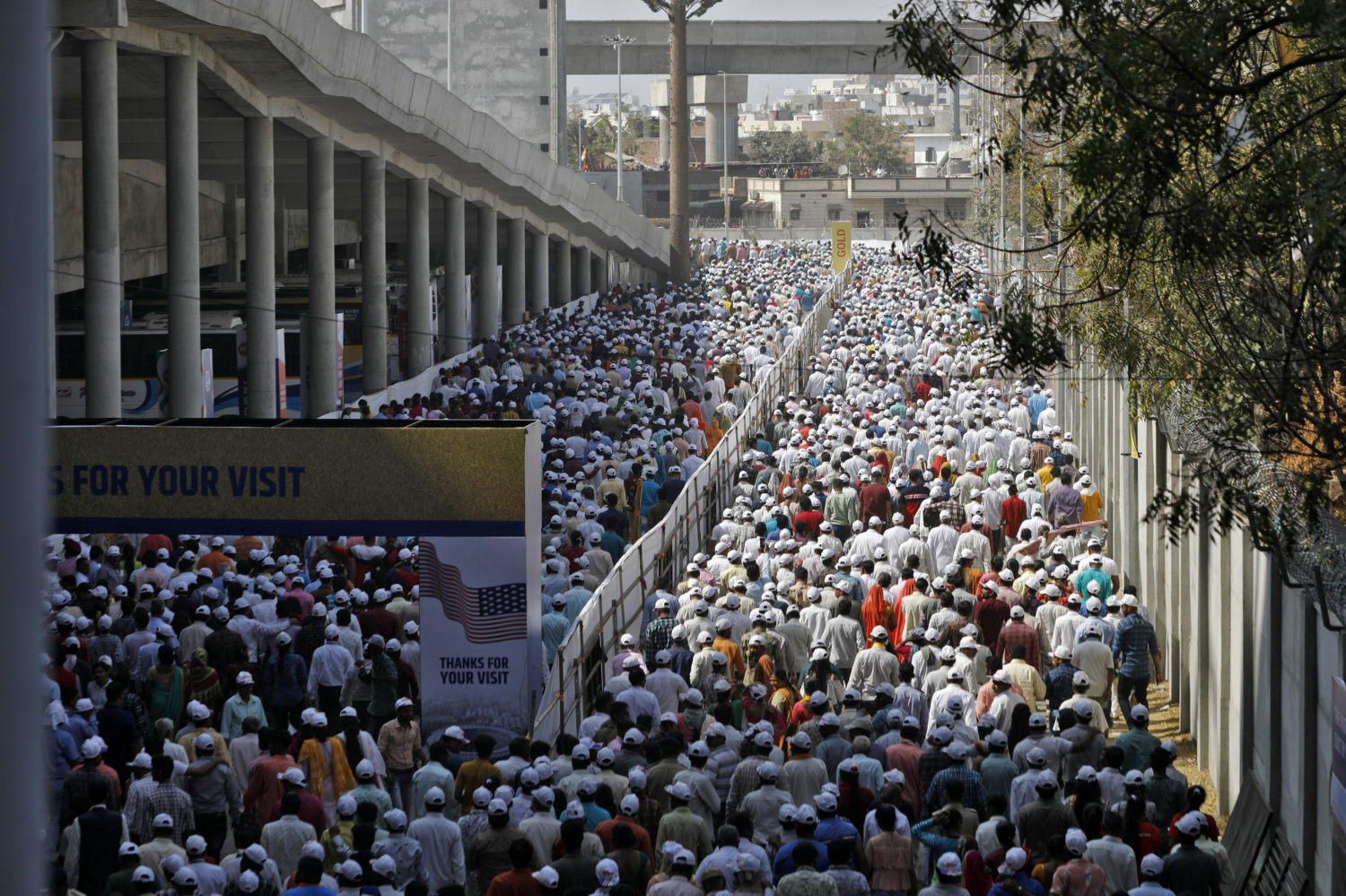
AHMEDABAD, India (Reuters) – Donald Trump was cheered by more than 100,000 Indians at the opening of the world’s largest cricket stadium on Monday, promising “an incredible trade deal” and “the most feared military equipment on the planet” at his biggest rally abroad.

Indians wore cardboard Trump masks and “Namaste Trump” hats to welcome the U.S. president at the huge new Motera stadium in Prime Minister Narendra Modi’s own political homeland, the western city of Ahmedabad.

Modi, a nationalist who won re-election last year and has shifted his country firmly to the right with policies that his critics decry as authoritarian and ethnically divisive, touts his relationship with Trump as proof of his own global standing.

U.S. officials have described Trump’s visit as a way to counter China’s rise as a superpower.

“You have done a great honor to our country. We will remember you forever, from this day onwards India will always hold a special place in our hearts,” Trump said to thunderous applause.

India is one of the few big countries in world where Trump’s personal approval rating is above 50%. It has built up ties with the United States in recent years as Washington’s relationship has become strained with India’s foe Pakistan.

“As we continue to build our defense cooperation, the United States looks forward to providing India with some of the best and most feared military equipment on the planet,” Trump said.

Trump said the two countries will sign deals on Tuesday to sell military helicopters worth $3 billion and that the United States must become the premier defense partner of India, which relied on Russian equipment during the Cold War. Reuters reported earlier that India has cleared the purchase of 24 helicopters from Lockheed Martin <LMT.N> worth $2.6 billion.

But in a sign of the underlying political tensions in India, violent protests broke out in Delhi – where Trump is due on Tuesday – over a new citizenship law that critics say discriminates against Muslims and is a further attempt to undermine the secular foundations of India’s democracy.

Vehicles were set on fire in the eastern part of Delhi, metal barricades torn down, and thick smoke billowed through the air as thousands of those who are supporting the new law clashed with those opposing it.

In his speech Trump extolled India’s rise as a stable and prosperous democracy as one of the achievements of the century. “You have done it as a tolerant country. And you have done it as a great, free country,” he said.

Trump planned to raise the issue of religious freedoms in India with Modi, an administration official said last week.

People leave the Sardar Patel Stadium after U.S. President Donald Trump and Indian Prime Minister Narendra Modi addressed a “Namaste Trump” event in Ahmedabad, India, February 24, 2020. REUTERS/Adnan Abidi

VERY BIG DEALS

In Ahmedabad, Modi embraced Trump as he stepped off Air Force One, along with his wife, Melania.

Folk dancers carrying colorful umbrellas danced alongside the red carpet as drummers, trumpeters and other musicians performed at the airport to welcome Trump and the U.S. delegation. Crowds lined the route along his cavalcade, many taking pictures on their phones.

The two sides did not manage to hammer out a trade deal ahead of the visit, with differences remaining over agriculture, medical devices, digital trade and proposed new tariffs. Trump said he was going to discuss economic ties with Modi, describing him as a tough negotiator.

“We will be making very, very major, among the biggest ever made, trade deals. We are in the early stages of discussion for an incredible trade agreement to reduce barriers of investment between the United States and India,” he said.

“And I am optimistic that working together, the prime minister and I can reach a fantastic deal that’s good and even great for both of our countries – except that he is a very tough negotiator.”

Modi, who has built a personal rapport with Trump, is pulling out the stops for the president although prospects for even a limited trade deal during the visit are seen as slim.

“There is so much that we share, shared values and ideals … shared opportunities and challenges, shared hopes and aspirations,” said Modi at the rally.

Trump, who faces his own re-election campaign this year, has frequently praised Modi for his crowd-pulling power.

Last year, Trump held a “Howdy Modi” rally with Modi in Houston, drawing 50,000 people, mainly Indian Americans. At the time, Trump likened Modi to Elvis Presley as a draw for crowds.

Later, Trump and his entourage which includes daughter Ivanka and son-in-law Jared Kushner flew to Agra to see the Taj Mahal at sunset. Children lined the route cheering and waving flags as his convoy drove past.

Trump and Melania posed for pictures at the Taj, the 17th century monument to love. “It’s incredible,” he told reporters.

(Additional reporting by Neha Dasgupta, Euan Rocha in New Delhi, Zeba Siddiqui in Agra; Writing by Sanjeev Miglani; Editing by Raju Gopalakrishnan, Giles Elgood and Peter Graff)

Stone sentenced to 3-1/3 years, Trump signals no immediate pardon for adviser

By Sarah N. Lynch and Jan Wolfe

WASHINGTON (Reuters) – A federal judge on Thursday sentenced President Donald Trump’s long-time adviser Roger Stone to three years and four months in prison and said his lies to lawmakers investigating Russian interference in the 2016 U.S. presidential election posed a threat to American democracy.

After U.S. District Judge Amy Berman Jackson sentenced the veteran Republican operative in Washington, Trump indicated he has no immediate plans to pardon Stone and would let the legal process play out, while adding that “at some point I’ll make a determination.”

“I personally think he was treated very unfairly,” Trump said in Las Vegas.

In a stern lecture during a 2-1/2-hour sentencing hearing, Jackson delivered an implicit rebuke to Trump, who has attacked her along with the jury and prosecutors in the high-profile case.

“There was nothing unfair, phony or disgraceful about the investigation or the prosecution,” Jackson said, citing words that the Republican president has used.

Stone’s lawyer had asked that he get no prison time. The 67-year-old Stone, who has been a friend and adviser to Trump for decades, was convicted on Nov. 15 on all seven counts of lying to Congress, obstruction of justice and witness tampering.

“He was not prosecuted – as some have complained – for standing up for the president. He was prosecuted for covering up for the president,” Jackson said.

“The truth still exists. The truth still matters,” Jackson added. “Roger Stone’s insistence that it doesn’t, his belligerence, his pride in his own lies are a threat to our fundamental institutions – to the very foundation of our democracy.”

The judge also said Stone “knew exactly what he was doing” when he posted an image on social media last year with a gun’s cross-hairs placed over her head.

“The defendant engaged in threatening and intimidating conduct toward the court,” Jackson said. “This is intolerable to the administration of justice.”

Stone declined to speak at the hearing. Clad in a dark gray pinstripe suit with a polka dot handkerchief in the pocket, Stone stood at a lectern as the judge delivered the sentence.

After leaving, Stone – still subject to a judicial gag order – told reporters, “I have nothing to say.” In a chaotic scene outside the courthouse, Stone walked through a throng of people with a slight smile on his face and climbed into a waiting vehicle.

Stone’s lawyers have asked Jackson for a new trial, and his allies have complained that some of the jurors have expressed anti-Trump sentiments on social media. Some Trump’s allies have urged him to pardon Stone.

At a Las Vegas event for rehabilitated prisoners, Trump praised Stone as a “good person” and “smart guy” while repeating his claim that the trial’s jury forewoman was “totally tainted.” Trump said he would not use the presidency’s “great powers” as Stone seeks a new trial, but left open the possibility of a pardon.

“I’m going to watch the process. I’m going to watch it very closely,” Trump said.

Democrats said a pardon would be a green light for others to break the law to further Trump’s interests.

“To pardon Stone when his crimes were committed to protect Trump would be a breathtaking act of corruption,” Democratic Representative Adam Schiff, who led the impeachment drive against Trump that ended in his Senate acquittal this month, wrote on Twitter.

On Tuesday, Trump granted clemency to prominent convicted white-collar criminals including financier Michael Milken and former Illinois Governor Rod Blagojevich.

Jackson’s sentence fell well short of the seven to nine years initially recommended by the case’s original prosecutors before they were overruled by the Justice Department after Trump complained publicly. Those prosecutors quit the case. Jackson, appointed by Trump’s Democratic predecessor Barack Obama, said the department’s reversal did not influence her sentencing decision. The judge also fined Stone $20,000.

“This was still a very substantial sentence, especially for a non-violent, first-time offender of his age,” said Mark Allenbaugh, a consultant who formerly worked for the U.S. Sentencing Commission.

Stone was one of several Trump associates who were convicted or pleaded guilty to charges stemming from former Special Counsel Robert Mueller’s investigation that detailed Russian meddling in the 2016 election to boost Trump’s candidacy.

He was convicted of lying to the House of Representatives Intelligence Committee about his attempts to contact WikiLeaks, the website that released damaging emails about Trump’s 2016 Democratic election rival Hillary Clinton that U.S. intelligence officials have concluded were stolen by Russian hackers.

‘A HUMAN BEING’

Defense attorney Seth Ginsberg said Stone’s career as a self-described “dirty trickster” overshadowed other aspects of a spiritual man who has served as a mentor, loves animals and is devoted to his family.

“Mr. Stone is, in fact, not simply that public persona, but a human being,” he said.

The judge noted Stone was not charged with or convicted of having any role in conspiring with Russia. But Jackson said Stone’s effort to obstruct a congressional investigation into Russian election meddling “was deliberate, planned – not one isolated incident.” The investigators were not some “secret anti-Trump cabal,” Jackson said, but lawmakers on a committee led at the time by Republicans.

Stone’s career has stretched from the Watergate scandal era of the early 1970s to Trump’s campaign four years ago. Stone has labeled himself an “agent provocateur” and famously has the face of former President Richard Nixon tattooed on his back.

Wearing sunglasses and a dark fedora as he entered the courthouse accompanied by an entourage of family, friends and lawyers, Stone strode past a giant inflatable rat dressed as Trump and a sign calling for his pardon. One onlooker shouted: “Traitor!”

After prosecutors made their sentencing recommendation last week, Trump called them “corrupt” and railed against this “miscarriage of justice.” Attorney General William Barr intervened and the Justice Department overruled the recommendation. Congressional Democrats have accused Trump and Barr of politicizing the U.S. criminal justice system and threatening the rule of law.

(Reporting by Sarah N. Lynch and Jan Wolfe; Additional reporting by Makini Brice, Jeff Mason, Lisa Lambert, Steve Holland and David Morgan; Editing by Andy Sullivan and Will Dunham)

Trump stands by attorney general who accused him of making job ‘impossible’

(Reuters) – President Donald Trump on Tuesday said he has total confidence in U.S. Attorney General William Barr, who last week said in an interview that Trump’s tweeting habit had made it impossible for him to do his job.

“I do make his job harder…I do agree with that,” Trump told reporters before boarding Air Force One. “The Attorney General is a man with great integrity.”

Last week senior Justice Department officials withdrew an earlier sentencing recommendation for longtime Trump friend Roger Stone, who was found guilty in November of seven counts of lying to Congress, prompting upheaval within the department.

More than 1,000 former department officials have now called for Barr to resign.

Trump has used Twitter to attack the four prosecutors who had argued the case as well as the judge presiding over it.

Barr said in an ABC Interview last Thursday that he cannot do his job “with a constant background commentary” and that it is “time to stop the tweeting about Department of Justice criminal cases.”

While Trump offered words of support for Barr, he also spoke enthusiastically about tweeting. “Social media for me has been very important because it gives me a voice,” he said.

(Reporting by Steve Holland; Writing by Lisa Lambert; Editing by Howard Goller)