Trump leaves ‘question mark’ over use of force to protect Gulf oil

Flight deck of the U.S aircraft carrier USS Abraham Lincoln (CVN 72) is seen as sailors swip the deck for foreign object and debris (FOD) walk-down on the flight deck of the Nimitz-class aircraft carrier USS Abraham Lincoln (CVN 72) in Arabian Sea, May 19, 2019. Garrett LaBarge/U.S. Navy/Handout via REUTERS

By Babak Dehghanpisheh and Sylvia Westall

GENEVA/DUBAI (Reuters) – U.S. President Donald Trump said he was prepared to take military action to stop Tehran having a nuclear bomb but left open whether he would sanction the use of force to protect Gulf oil supplies.

Fears of a confrontation between Iran and the United States have mounted since Washington blamed long-time foe Iran for Thursday’s attacks on two oil tankers near the strategic Strait of Hormuz shipping lane.

Tehran denies responsibility but the incidents, and similar attacks in May, have further soured relations that have plummeted since Trump pulled the United States out of a landmark international nuclear deal with Iran in May of last year.

Since exiting the accord, which gave Iran sanctions relief in return for curbs on its nuclear program, Trump has restored and extended U.S. sanctions. That has forced countries around the world to boycott Iranian oil or face sanctions of their own.

But in an interview with Time magazine, Trump, striking a different tone from some Republican lawmakers who have urged a military approach to Iran, said last week’s tanker attacks in the Gulf of Oman had had only a “very minor” impact so far.

Asked if he would consider military action to prevent Iran from obtaining nuclear weapons or to ensure the free flow of oil through the Gulf, Trump said:

“I would certainly go over nuclear weapons, and I would keep the other a question mark.”

The 2015 nuclear deal with Iran aimed to head off any pathway to an Iranian nuclear bomb but Trump says the deal failed to address Iran’s missile program or punish it for waging proxy wars in Middle East countries.

Tehran has decried the toughening of U.S. sanctions and urged other signatories to take action to save the nuclear pact or see Iran turn its back on the deal.

CALLS FOR RESTRAINT

Iran said on Monday it would soon breach limits on how much-enriched uranium it can stockpile under a 2015 nuclear deal, which had sought to limit its nuclear capabilities.

Exceeding the uranium cap at the heart of the accord could prompt a diplomatic crisis, forcing the other signatories, which include China, Russia and European powers, to confront Iran.

The White House National Security Council condemned the statement as “nuclear blackmail” while Russia and China, two other signatories of the accord, on Tuesday urged restraint.

Russia told the United States it should drop what it called provocative plans to deploy more troops to the Middle East and cease actions that looked like a conscious attempt to provoke war with Iran, and urged restraint on all sides.

“What we see are unending and sustained U.S. attempts to crank up political, psychological, economic and yes military pressure on Iran in quite a provocative way,” Deputy Foreign Minister Sergei Ryabkov was cited as saying by Russian media.

“They (these actions) cannot be assessed as anything but a conscious course to provoke war,” he said.

China’s top diplomat Wang Yi warned the world should not open a “Pandora’s Box” in the Middle East, as he denounced U.S. pressure on Iran and urged Tehran to heed the deal.

Chancellor Angela Merkel said Germany, another signatory, was doing all it could to ease tensions with Iran but said Iran must abide by the 2015 deal.

IRAN DEFIANT

Acting U.S. Defense Secretary Patrick Shanahan on Monday announced the deployment of about 1,000 more troops to the Middle East for what he said were defensive purposes, citing concerns about a threat from Iran.

The deployment is in addition to a 1,500-troop increase announced last month in response to tanker attacks in May.

Iranian President Hassan Rouhani said in a speech that Iran did not seek war and dismissed U.S. efforts to isolate Iran.

“Iran will not wage war against any nation,” he said. “Despite all of the Americans’ efforts in the region and their desire to cut off our ties with all of the world and their desire to keep Iran secluded, they have been unsuccessful.”

Heightened Iran-U.S. tensions have stoked fears of increased violence in countries where Iran and its Gulf Arab regional rivals are locked in a sometimes bloody struggle for influence.

Saudi air defenses intercepted two drones fired by Yemen’s Iran-aligned Houthi group, Saudi media said on Tuesday. The group’s Al Masirah TV said the Houthis had sent drones to strike the airport of the Saudi city of Abha.

MILITARY BASE

Three rockets landed on a military base hosting U.S. forces north of Baghdad late on Monday, an Iraqi military statement said, without providing further details. There was no immediate claim of responsibility for the attack.

U.S. officials said last month there was an increased threat from Iran-backed militias against U.S. interests in Iraq, and the U.S. embassy in Baghdad evacuated hundreds of staff.

The United States is discussing options with its allies on how to protect international shipping in the Gulf of Oman following the recent attacks, two senior Trump administration officials said last week.

A senior Gulf official said Washington was considering establishing a military coalition, including other nations, to protect oil tankers.

“We hope they will implement this proposal soon,” said the official, who said he had been briefed by a U.S. official and had heard details from Gulf “partners”.

(Additional reporting by Alexander Cornwell in Dubai, Tom Balmforth and Maxim Rodionov in Moscow, Ben Blanchard in Beijing, Writing by William Maclean, Editing by Janet Lawrence and Jon Boyle)

Trump says U.S. agency will begin removing millions of illegal immigrants

Immigration and Customs Enforcement (ICE) detainees arrive at FCI Victorville federal prison in Victorville, California, U.S. June 8, 2018. REUTERS/Patrick T. Fallon

WASHINGTON (Reuters) – President Donald Trump said on Monday that U.S. authorities would begin next week removing millions of immigrants who are in the United States illegally.

“Next week ICE will begin the process of removing the millions of illegal aliens who have illicitly found their way into the United States,” Trump tweeted, referring to the Immigration and Customs Enforcement agency. “They will be removed as fast as they come in,” he said. He did not offer specifics.

There are an estimated 12 million immigrants who are in the United States illegally, mainly from Mexico and Central America.

Under a deal reached earlier this month, Mexico has agreed to take Central American immigrants seeking asylum in the United States until their cases are heard in U.S. courts.

The agreement, which included Mexico pledging to deploy National Guard troops to stop Central American immigrants from reaching the U.S. border, averted a Trump threat to hit Mexican imports with tariffs.

Trump also said in the tweet that Guatemala “is getting ready to sign a Safe-Third Agreement.”

U.S. Vice President Mike Pence suggested last week that Guatemala could receive asylum seekers from its neighbors as a so-called safe third country.

Details of the plan have not been made public, and Guatemala has not publicly confirmed talks that the U.S. State Department said were taking place in Guatemala on Friday.

U.S. rights group Human Rights First said, however, it was “simply ludicrous” for the United States to assert that Guatemala was capable of protecting refugees when its own citizens are fleeing violence.

Mexico has agreed that if its measures to stem the flow of migrants are unsuccessful, it will discuss signing a safe third country agreement with the United States.

(Reporting by Eric Beech; Editing by Mohammad Zargham and Peter Cooney)

Trump likely to meet with Xi when G20 gathers: White House

FILE PHOTO: FILE PHOTO: U.S. President Donald Trump and China's President Xi Jinping meet business leaders at the Great Hall of the People in Beijing, China, November 9, 2017. REUTERS/Damir Sagolj/File Photo - RC11ACBFE610

WASHINGTON (Reuters) – U.S. President Donald Trump and Chinese President Xi Jinping will likely meet on the sidelines of the Group of 20 summit later this month in Japan, a White House spokesman said on Thursday, although he suggested a meeting was not yet firmly scheduled.

“It looks like we’re moving in that direction,” White House spokesman Hogan Gidley told Fox News Channel when asked if the two leaders would have a bilateral meeting.

Trump has repeatedly said he expects to meet Xi at the G20 gathering to talk about the trade dispute between the two nations.

(Reporting by Tim Ahmann; Editing by Chizu Nomiyama)

U.S. holds out for more from Mexico in talks over tariffs, border

By Roberta Rampton

WASHINGTON (Reuters) – Mexican and U.S. officials are set to resume talks on trade and migration on Thursday, with the United States resisting calls from its southern neighbor, businesses and some Republican lawmakers to ease up on a plan to impose import tariffs on Mexico.

Vice President Mike Pence, who led an initial round of negotiations in Washington on Wednesday, said talks were positive but emphasized the Trump administration still wants Mexico to commit to working harder to combat illegal immigration.

“We welcomed the efforts of the Mexican officials to offer solutions to the crisis at our southern border, but we need Mexico to do more,” Pence said on Thursday.

He was echoing President Donald Trump, who said on Wednesday that “not nearly enough” progress was made in the first round of talks, and warned that the tariffs would go into effect on Monday if Mexico cannot help stem the flow of mostly Central American migrants heading for the U.S. border.

Last week, Trump said Mexico must take a harder line on migrants or face 5% tariffs on all its exports to the United States from June 10, rising to as much as 25% later this year.

The unexpected announcement rattled global financial markets and even Trump’s fellow Republicans fretted about the potential economic impact on U.S. businesses and consumers who would have to absorb the costs.

MEXICO ECONOMY

Mexico would also take an economic hit that analysts warn could spark a recession. Credit ratings agency Fitch downgraded Mexico’s sovereign debt rating on Wednesday, citing trade tensions among other risks, while Moody’s lowered its outlook to negative.

Staff-level meetings are scheduled to begin at 2 p.m. (1800 GMT) on Thursday with Mexican officials at the White House, a White House official said. Mexican Foreign Minister Marcelo Ebrard earlier had meetings at the U.S. State Department.

The immigration issue came into sharper focus on Wednesday with news that U.S. border officers said they apprehended more than 132,000 people crossing from Mexico in May, the highest monthly total in more than a decade and reaching what officials said were “crisis” levels.

German bond yields fell to new lows on Thursday and U.S. treasury yields resumed their fall as trade tensions doused a rally fueled by hopes for more central bank stimulus ahead of a European Central Bank meeting. [US/]

Sentiment had soured on a lack of progress in talks between U.S. and Mexican officials, and Trump issuing a fresh threat to hit China with tariffs on at least another $300 billion worth of goods.

With Trump on a trip to Europe until Friday night, a quick agreement in the U.S.-Mexico talks is not anticipated by the U.S. side, although Mexican President Andres Manuel Lopez Obrador struck a positive note.

“The U.S. authorities have behaved very well, (including) President Trump, because they haven’t closed themselves off to dialogue and we hope that a deal is reached today,” he told a news conference on Thursday.

Nevertheless, Mexican officials have prepared a list of U.S. products that may face retaliatory tariffs if talks do not end in agreement.

The tariffs would target U.S. products from agricultural and industrial states regarded as Trump’s electoral base, a tactic China has also used with an eye toward the Republican’s re-election bid in the 2020 U.S. presidential election.

Mexico ramped up efforts to halt the flow of Central American migrants crossing the border to the United States on Wednesday, with Mexican soldiers, armed police and immigration officials blocking migrants along its own southern border with Guatemala.

It was unclear whether the hardening of Mexico’s response would appease Trump, who is struggling to make good on his key 2016 presidential campaign promise to build a wall along the U.S.-Mexico border as part of a hard-line immigration stance.

Senator Chuck Grassley, Republican chairman of the finance committee, had expressed hope on Wednesday of a quick deal with Mexico but he was more cautious on Thursday.

“The fact that there wasn’t any agreement probably isn’t surprising as long as they are going to be here two or three days,” said Grassley, one of several Republican lawmakers who have expressed concern about imposing tariffs on Mexico.

(Reporting by Roberta Rampton in Washington; Additional reporting by Alexandra Alper, Susan Cornwell and Lesley Wroughton in Washington and Anthony Esposito and Diego Ore in Mexico City; Writing by Alistair Bell; Editing by Bernadette Baum and James Dalgleish)

Donald Trump welcomed to Buckingham Palace by Queen Elizabeth

U.S. President Donald Trump inspects an honour guard at Buckingham Palace, in London, Britain, June 3, 2019. REUTERS/Simon Dawson/Pool

By Steve Holland and Toby Melville

LONDON (Reuters) – Britain rolled out the royal red carpet for Donald Trump on Monday but the pomp, pageantry and banquet with Queen Elizabeth looked set to be overshadowed by the U.S. President’s views on Brexit, the UK’s next leader and a row over China’s Huawei.

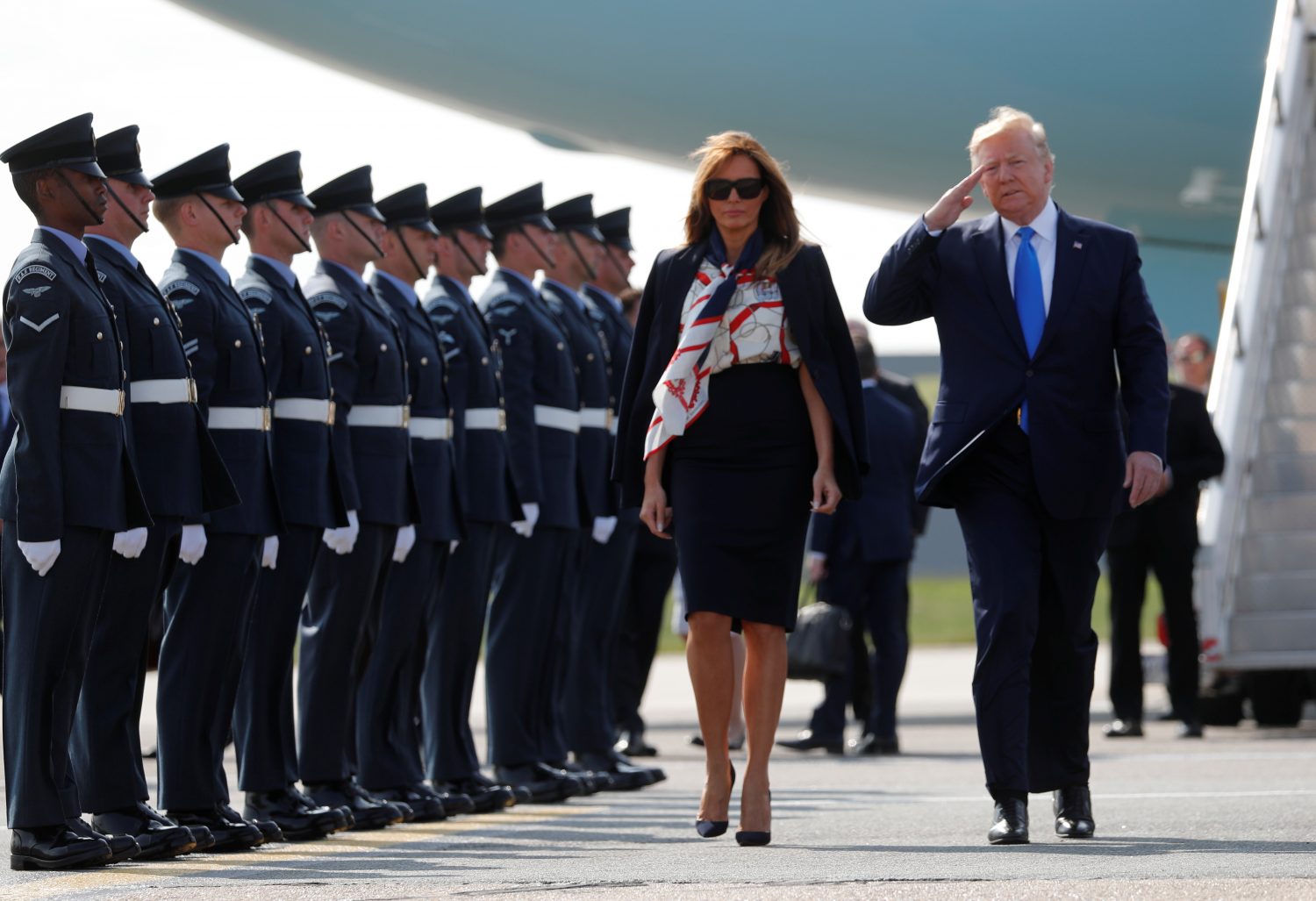
U.S. President Donald Trump and First Lady Melania Trump arrive for their state visit to Britain, at Stansted Airport near London, Britain, June 3, 2019. REUTERS/Carlos Barria

U.S. President Donald Trump and First Lady Melania Trump arrive for their state visit to Britain, at Stansted Airport near London, Britain, June 3, 2019. REUTERS/Carlos Barria

Trump and his wife, Melania, were greeted by the 93-year-old monarch at Buckingham Palace at the start of a three-day state visit which sees him feted with the full force of royal ceremony: a formal dinner with the queen, tea with heir Prince Charles, and a tour of Westminster Abbey, coronation church of English monarchs for 1,000 years.

“I look forward to being a great friend to the United Kingdom, and am looking very much forward to my visit,” Trump wrote on Twitter as he landed at London’s Stansted Airport.

But beyond the theater, the proudly unpredictable 45th U.S. president is rocking the boat with the United States’ closest ally, whose political establishment has been in chaos for months over Britain’s departure from the European Union.

As he was flying into the British capital, he reignited a feud with London Mayor Sadiq Khan – who had written on Sunday that Britain should not be rolling out the red carpet for the U.S. president – describing him as a “stone cold loser.

The state visit, promised by Prime Minister Theresa May back in January 2017 when she became the first foreign leader to meet him after he took office, is cast as a chance to celebrate Britain’s “special relationship” with the United States, boost trade links and reaffirm security cooperation.

At Buckingham Palace, Melania, stood beside Elizabeth and Charles’s wife Camilla, while Charles and Trump inspected the guard.

Trump will have lunch with the queen before the monarch’s second son Prince Andrew accompanies him to Westminster Abbey where the president will lay a wreath at the Grave of the Unknown Warrior.

The day culminates with a lavish state banquet at Buckingham Palace – where men wear white tie coats with tails and women evening gowns.

U.S. President Donald Trump and First Lady Melania Trump meet Britain's Prince Charles and Camilla, Duchess of Cornwall, as they arrives at Buckingham Palace, in London, Britain, June 3, 2019. REUTERS/Simon Dawson/Pool

U.S. President Donald Trump and First Lady Melania Trump meet Britain’s Prince Charles and Camilla, Duchess of Cornwall, as they arrives at Buckingham Palace, in London, Britain, June 3, 2019. REUTERS/Simon Dawson/Pool

UNCONVENTIONAL

But away from the pageantry, Trump is set to make his trip the most unconventional state visit in recent British history.

He has already waded far into Britain’s turbulent domestic politics, where more than a dozen candidates are vying to replace May, who announced last month she was quitting after failing to get her EU divorce deal through parliament.

The president, who has regularly criticized May’s Brexit tactics, said Britain must leave the bloc on the due date of Oct. 31 with or without a deal and praised a more radical Brexit-supporting potential successor as British leader.

He also called for arch-Brexiteer Nigel Farage, a scourge of May’s ruling Conservative Party, to conduct talks with the EU.

Brexit is the most significant geopolitical move for the United Kingdom since World War Two and if it ever happens then London will be more reliant on the United States as ties loosen with the other 27 members of the EU.

HUAWEI TENSIONS

At a meeting with May, Trump will also warn Britain that security cooperation, a cornerstone of the western intelligence network, could be hurt if London allows China’s Huawei a role in building parts of the 5G network, the next generation of cellular technology.

The Trump administration has told allies not to use its 5G technology and equipment because of fears it would allow China to spy on sensitive communications and data. Huawei denies it is, or could be, a vehicle for Chinese intelligence.

U.S. Secretary of State Mike Pompeo told Britain last month it needed to change its attitude toward China and Huawei, casting the world’s second-largest economy as a threat to the West similar to that once posed by the Soviet Union.

Britain’s relationship with the United States is an enduring alliance, but some British voters see Trump as crude, volatile and opposed to their values on issues ranging from global warming to his treatment of women.

Hundreds of thousands protested against him during a trip last year and a blimp depicting Trump as a snarling, nappy-clad baby will fly outside Britain’s parliament during the visit. Other protesters plan a “carnival of resistance” in central London.

Jeremy Corbyn, the socialist leader of Britain’s opposition Labour Party, who has declined an invitation to attend the state banquet, scolded Trump for getting involved in British politics.


While Monday is dominated by pageantry, the second day of Trump’s trip will focus on politics, including breakfast with business leaders, talks with May in 10 Downing Street, a news conference and a dinner at the U.S. ambassador’s residence.

(Additional reporting by Kate Holton, Andrew MacAskill, Alistair Smout and William Schomberg; Writing by Guy Faulconbridge and Michael Holden; Editing by Jon Boyle)

North Korea executes envoy in a purge after failed U.S. summit: media

FILE PHOTO - North Korea's leader Kim Jong Un, North Korean Foreign Minister Ri Yong Ho and Kim Yong Chol, Vice Chairman of the North Korean Workers' Party Committee, attend the extended bilateral meeting in the Metropole hotel with U.S. President Donald Trump and his delegation during the second North Korea-U.S. summit in Hanoi, Vietnam February 28, 2019. REUTERS/Leah Millis

By Hyonhee Shin and Joyce Lee

SEOUL (Reuters) – North Korea executed its nuclear envoy to the United States as part of a purge of officials who steered negotiations for a failed summit between leader Kim Jong Un and U.S. President Donald Trump, a South Korean newspaper said on Friday.

Kim Hyok Chol was executed in March at Mirim Airport in Pyongyang, along with four foreign ministry officials after they were charged with spying for the United States, the Chosun Ilbo reported, citing an unidentified source with knowledge of the situation.

FILE PHOTO - Kim Hyok Chol, North Korea's special representative for U.S. affairs, leaves the Government Guesthouse in Hanoi, Vietnam, February 23, 2019. REUTERS/Athit Perawongmetha

FILE PHOTO – Kim Hyok Chol, North Korea’s special representative for U.S. affairs, leaves the Government Guesthouse in Hanoi, Vietnam, February 23, 2019. REUTERS/Athit Perawongmetha

“He was accused of spying for the United States for poorly reporting on the negotiations without properly grasping U.S. intentions,” the source was quoted as saying.

The February summit in Vietnam’s capital Hanoi, the second between Kim and Trump, failed to reach a deal because of conflicts over U.S. calls for complete denuclearization of the Korean peninsula and North Korean demands for sanctions relief.

Reuters was unable to independently confirm the report. Previously, North Korean officials have been executed or purged only to reappear with a new title, according to media reports.

A spokeswoman at South Korea’s Unification Ministry declined to comment. An official at the presidential Blue House in Seoul said it was inappropriate to comment on an unverified report.

The United States is attempting to check on the reports of the envoy’s execution, Secretary of State Mike Pompeo said during his visit to Berlin on Friday

When asked about reports of a “shakeup” of Kim Jong Un’s negotiating team in a May 5 interview with ABC News, Pompeo said it did appear that his future counterpart would be somebody else “but we don’t know that for sure.”

A diplomatic source told Reuters there were signs Kim Hyok Chol and other officials were punished, but there was no evidence they were executed and they may have been sent to a labor camp for re-education.

The newspaper reported that other officials had been punished, but not executed.

Kim Yong Chol, Kim Jong Un’s right-hand man and the counterpart to Pompeo before the Hanoi summit, had been sent to a labor and reeducation camp in Jagang Province near the Chinese border, the Chosun Ilbo reported.

Officials who worked with Kim Yong Chol have been out of the public eye since the summit, while seasoned diplomats who appeared to have been sidelined, including vice foreign minister Choe Son Hui, were seen returning to the spotlight.

A South Korean lawmaker told Reuters in April that Kim Yong Chol had been removed from a key party post.

RISE AND FALL

Kim Hyok Chol was seen as a rising star when he was appointed to spearhead working-level talks with U.S. nuclear envoy Stephen Biegun weeks before the Hanoi summit.

However, little was known about his expertise or his role in the talks. The four executed alongside him included diplomats working on relations with Vietnam, the Chosun report said.

“This is a man who might provide some tactical advice to the leader but is otherwise a message bearer with little negotiating or policymaking latitude,” said Michael Madden, a North Korea leadership expert at the Washington-based Stimson Center.

“Instead, they put in someone like Kim Hyok Chol to insulate Choe Son Hui and more substantive diplomatic personnel, to a certain degree he is expendable and his superiors are not.”

The penalized members of Kim Yong Chol’s team included Kim Song Hye, who led the preparations, and Sin Hye Yong, a newly elevated interpreter for the Hanoi summit. They were said to have been detained in a camp for political prisoners, the newspaper said.

The diplomatic source said Kim Song Hye’s punishment seemed inevitable because she was a “prime author” of the North’s plan to secure sanctions relief in return for dismantling the Yongbyon main nuclear complex.

The idea was rejected by the United States which demanded a comprehensive roadmap for denuclearization.

Kim Song Hye had also worked closely with Kim Yo Jong, the North Korean leader’s younger sister and a senior party official whom Kim Song Hye accompanied to South Korea for the Winter Olympics last year.

Kim Yo Jong was also lying low, the paper reported, citing an unidentified South Korean government official.

Madden, however, said Kim Yo Jong’s status was unchanged as Kim Jong Un’s top aide, citing her attendance at key party meetings in April and appearance in state media reports.

Sin Hye Yong was charged with making critical interpretation mistakes that included missing an unspecified “last-minute offer” the North Korean leader supposedly made as Trump was about to walk out, Chosun reported.

‘TWO-FACED’

North Korea’s official party mouthpiece Rodong Sinmun warned on Thursday that “two-faced” officials would face the “stern judgment of the revolution”.

“It is an anti-Party, anti-revolutionary act to pretend to be revering the leader in front of him when you actually dream of something else,” it said in a commentary.

Hong Min, a senior fellow at the Korea Institute for National Unification in Seoul, said it was possible Kim Hyok Chol and other officials faced some penalty but further verification was needed.

“Executing or completely removing people like him would send a very bad signal to the United States because he was the public face of the talks and it could indicate they are negating all they have discussed,” Hong said.

(Reporting by Joyce Lee and Hyonhee Shin; Additional reporting by David Brunnstrom in BERLIN and Hyunjoo Jin in SEOUL; Editing by Paul Tait, Lincoln Feast and Darren Schuettler)

Trump will make ‘dramatic’ statement about border this week

U.S. President Donald Trump boards Air Force One for travel to Colorado from Joint Base Andrews, Maryland, U.S. May 30, 2019. REUTERS/Jonathan Ernst

WASHINGTON (Reuters) – U.S. President Donald Trump said on Thursday he will make a “dramatic” statement about the country’s southern border with Mexico either later on Thursday or on Friday.

He told reporters the statement would be his biggest on the issue to date and would be about people crossing the border illegally.

“This is a big-league statement, but we are going to do something very dramatic on the border,” Trump said, adding he was not closing the border.

Trump has made immigration a cornerstone of his presidency after promising on his election campaign trail to build a wall along the U.S. border with Mexico.

Still, he has struggled to win enough support from lawmakers in the House and Senate to change immigration policy or to garner funds to build the wall.

In February, he declared a national emergency on the border with Mexico in order to access funds to build the wall. But last week, a federal judge blocked some of the funds Trump had sought to use for construction of the wall.

(Reporting by Steve Holland; Writing by Makini Brice; Editing by Bernadette Baum)

Mueller says charging Trump was never an option for Russia probe

U.S. Special Counsel Robert Mueller makes a statement on his investigation into Russian interference in the 2016 U.S. presidential election at the Justice Department in Washington, U.S., May 29, 2019. REUTERS/Jim Bourg

By Sarah N. Lynch and Andy Sullivan

WASHINGTON (Reuters) – U.S. Special Counsel Robert Mueller said on Wednesday his investigation into Russia’s interference in the 2016 election was never going to end with criminal charges against President Donald Trump and indicated it was up to Congress to decide if impeachment proceedings are justified.

In his first public comments since starting the investigation in May 2017, Mueller said Justice Department policy prevented him from bringing charges against a sitting president, telling reporters it was “not an option we would consider.”

But he also said his two-year investigation did not clear Trump of improper behavior and pointed out there were other ways to hold presidents accountable.

“The Constitution requires a process other than the criminal justice system to formally accuse a sitting President of wrongdoing,” Mueller said as he announced his resignation from the Justice Department.

Democrats in Congress are debating whether to try to move ahead with impeachment, an effort that is almost certain to fall short in the Republican-controlled Senate.

The White House and several top Republicans said it was time to move on to other matters, while several Democratic presidential candidates called for impeachment.

“What Robert Mueller basically did was return an impeachment referral,” Senator Kamala Harris said on Twitter.

“Given that Special Counsel Mueller was unable to pursue criminal charges against the President, it falls to Congress to respond to the crimes, lies and other wrongdoing of President Trump – and we will do so,” said Jerrold Nadler, the Democratic chairman of the House of Representatives Judiciary Committee.

A redacted version of Mueller’s report was published in April, concluding that Russia repeatedly interfered in the 2016 election and that Trump’s election campaign had multiple contacts with Russian officials, but did not establish a criminal conspiracy with Moscow to win the White House.

Mueller’s report also declined to make a judgment on whether Trump obstructed justice, although the report outlined 10 instances in which Trump tried to impede the investigation, including seeking to have Mueller fired.

“If we had confidence that the president clearly did not commit a crime, we would have said so,” Mueller said. “We did not, however, make a determination as to whether the president did commit a crime.”

TRUMP DECLARES ‘CASE CLOSED’

Trump, who has repeatedly denounced Mueller’s investigation as a “witch hunt” and “hoax” meant to hobble his presidency, said the matter was settled.

“Nothing changes from the Mueller Report,” he said on Twitter. “There was insufficient evidence and therefore, in our Country, a person is innocent. The case is closed! Thank you.”

Mueller, who headed the FBI from 2001 to 2013, said he would not elaborate beyond what was contained in his 448-page report, signaling to Democrats that he was unlikely to provide them more ammunition for impeachment if he were to testify on Capitol Hill.

“Beyond what I’ve said here today and what is contained in our written work, I do not believe it is appropriate for me to speak further,” he said.

He did not take questions after making his statement.

The House Judiciary Committee’s top Republican, Representative Doug Collins, said relitigating Mueller’s findings would only divide the country. “It is time to move on from the investigation and start focusing on real solutions for the American people,” he said.

Only one Republican so far, Representative Justin Amash, has said Trump has committed impeachable offenses. “The ball is in our court, Congress,” he said on Twitter.

Mueller’s investigation ensnared dozens of people, including several top Trump advisers and a series of Russian nationals and companies.

Among them are his former campaign chairman, Paul Manafort, who is serving 7 1/2 years in prison for financial crimes and lobbying violations, and his former personal lawyer, Michael Cohen, who recently began a three-year sentence for campaign-finance violations and lying to Congress.

Since the report’s release, Democratic lawmakers have tried without success to get the unredacted report and underlying evidence.

Barr now is leading a review of the origins of the Russia investigation in what is the third known inquiry into the FBI’s handling of the matter. Trump harbors suspicions that the Democratic administration of President Barack Obama started the investigation in 2016 to undermine his presidency.

(Additional reporting by Makini Brice and Mark Hosenball; Editing by Tim Ahmann and Bill Trott)

Disaster aid bill worth $19.1 billion blocked again in House

FILE PHOTO - A man cycles past Capitol Hill in Washington, D.C., U.S. April 29, 2019. REUTERS/Clodagh Kilcoyne

WASHINGTON (Reuters) – The U.S. House of Representatives on Tuesday failed again to pass a $19.1 billion disaster aid bill supported by President Donald Trump after a Republican lawmaker objected to the measure.

Following Senate passage of the legislation last Thursday by a vote of 85-8, House Democratic leaders had hoped to win quick, unanimous approval of the bill on a voice vote and send it to Trump for his expected signature.

But with most lawmakers out of town for a recess until June 4, individual House Republicans have been able to block passage twice – once last Friday and again on Tuesday – by demanding an official roll call vote. Any roll call vote would have to wait until the full House returns to work next week.

For months, lawmakers have been haggling over the disaster aid bill in response to hurricanes in the southeastern United States, severe flooding in the Midwest, devastating wildfires in California and other events.

The $19.1 billion in the bill is intended to help farmers cover their crop losses and rebuild infrastructure hit by disasters, including repairs to U.S. military bases.

On Tuesday conservative Republican Representative Thomas Massie objected to passage, saying, “The speaker of this House should have called a vote on this bill before sending every member of Congress on recess for 10 days and I object.”

On Friday, Representative Chip Roy, a first-term Republican, objected to the bill, citing concerns that the legislation did not include $4.5 billion Trump had requested to deal with a surge of Central American immigrants on the southwestern border.

Roy, a conservative, also complained that the cost of the bill was not offset by savings to other government programs. His move was praised by Heritage Action, the advocacy arm of the conservative Heritage Foundation, which says Congress should plan for disasters that occur every year instead of approving “emergency” funds for them after the fact.

Congress regularly approves disaster aid bills without any cuts to other programs. The measure is widely expected to pass the House once members return next week from a week-long Memorial Day recess.

(Reporting by Susan Cornwell and Richard Cowan; editing by Tim Ahmann and Chizu Nomiyama)

Iran sees no prospect of negotiations with U.S.: foreign ministry

FILE PHOTO: A staff member removes the Iranian flag from the stage after a group picture with foreign ministers and representatives of the U.S., Iran, China, Russia, Britain, Germany, France and the European Union during Iran nuclear talks at the Vienna International Center in Vienna, Austria, July 14, 2015. REUTERS/Carlos Barria/File Photo

LONDON (Reuters) – Iran sees no prospect of negotiations with the United States, a foreign ministry spokesman said on Tuesday, a day after U.S. President Donald Trump said a deal with Tehran on its nuclear program was possible.

Washington withdrew last year from a 2015 international nuclear deal with Tehran, and is ratcheting up sanctions in efforts to strangle Iran’s economy by ending its international sales of crude oil.

Trump said on Monday: “I really believe that Iran would like to make a deal, and I think that’s very smart of them, and I think that’s a possibility to happen.”

Asked about Trump’s comments in a news conference in Tehran, Iranian Foreign Ministry spokesman Abbas Mousavi was quoted as saying by the semi-official Fars news agency: “We currently see no prospect of negotiations with America.”

“Iran pays no attention to words; What matters to us is a change of approach and behavior.”

Trump also said that United States was not looking for regime change in Iran, adding that “we are looking for no nuclear weapons.”

Iranian Vice President Eshaq Jahangiri said on Tuesday the country was not allowed to pursue the development of nuclear weapon as this was banned by Supreme Leader Ayatollah Ali Khamenei, Iran’s highest authority.

Tensions have risen between Iran and the United States since Washington deployed a carrier strike group and bombers and announced plans to deploy 1,500 troops to the Middle East, prompting fears of a conflict.

(Reporting by Bozorgmehr Sharafedin; Editing by Andrew Heavens and John Stonestreet)