Trump’s Supreme Court nominee emphasizes judicial independence

U.S. Supreme Court nominee judge Brett Kavanaugh testifies during his Senate Judiciary Committee confirmation hearing on Capitol Hill in Washington, U.S., September 5, 2018. REUTERS/Chris Wattie

By Lawrence Hurley

WASHINGTON (Reuters) – Brett Kavanaugh, President Donald Trump’s U.S. Supreme Court nominee, sought to stake out his independence on Wednesday as he faced his first questions during the second day of his contentious Senate confirmation hearing.

“I think the first quality of a good judge in our constitutional system is independence,” the conservative federal appeals court judge said in response to a question by the Judiciary Committee’s Republican chairman, Chuck Grassley.

“No one is above the law in our constitutional system,” Kavanaugh added.

As they did the day before, protesters repeatedly interrupted the session, opposing Kavanaugh’s nomination.

The confirmation hearing opened on Tuesday with a chaotic session in which Democrats complained that Republicans withheld documents concerning Kavanaugh’s work in former President George W. Bush’s White House more than a decade ago that they said they needed to review to properly vet the nominee. Capitol Police on Tuesday removed 61 protesters opposed to Kavanaugh from the room and charged them with disorderly conduct.

Trump has often criticized the federal judiciary. Kavanaugh underscored the importance of judicial independence, saying, “That takes some backbone. That takes some judicial fortitude.”

In citing examples of judicial independence, Kavanaugh mentioned a 1954 ruling ending racial segregation in public schools and a 1974 ruling ordering President Richard Nixon to hand over subpoenaed materials during the Watergate scandal.

He also said he would respect past Supreme Court rulings.

Democratic senators plan to press Kavanaugh on abortion, gun rights, among other issues.

Kavanaugh, who made an opening statement to the committee on Tuesday, entered the hearing room and took his seat alone at the witness table, pouring some bottled water into a glass moments before the hearing began.

Shortly after Grassley opened the session, protesters began interrupting the proceedings and were hauled out of the room by security personnel.

If confirmed, Kavanaugh is expected to move the court, which already had a conservative majority, further to the right. Senate Democrats have vowed a fierce fight. But with Trump’s fellow Republicans holding a slim majority in the Senate, and with no sign of any of them voting against the nomination, it remains likely Kavanaugh will be confirmed to the lifetime job on top U.S. judicial body.

Trump picked Kavanaugh to replace Justice Anthony Kennedy, who announced his retirement on June 27. At age 53, Kavanaugh could serve on the court for decades.

Republicans said Democrats have more than enough documents to assess Kavanaugh’s record, including his 12 years of judicial opinions as a judge on the U.S. Court of Appeals for the District of Columbia Circuit.

The hearing has given Democrats a platform to make their case against Kavanaugh ahead of November’s congressional elections in which they are seeking to regain control of Congress from the Republicans.

Liberals are concerned Kavanaugh could provide a decisive fifth vote on the nine-justice court to overturn or weaken the landmark 1973 Roe v. Wade ruling that legalized abortion nationwide.

Kavanaugh also is likely to be questioned about his views on investigating sitting presidents and the probe by Special Counsel Robert Mueller into alleged Russian meddling in the 2016 U.S. presidential election and possible collusion between Moscow and Trump’s 2016 campaign. Trump has denied any such collusion and has called Mueller’s investigation “witch hunt.”

In 2009, Kavanaugh wrote a law review article saying presidents should be free from the distractions of civil lawsuits, criminal prosecutions and investigations while in office.

(Reporting by Lawrence Hurley, Ginger Gibson and Amanda Becker; Editing by Will Dunham)

Trump warns Syria not to ‘recklessly attack’ Idlib province

FILE PHOTO:A general view taken with a drone shows part of the rebel-held Idlib city, Syria June 8, 2017. REUTERS/Ammar Abdullah/File Photo

By David Shepardson

WASHINGTON (Reuters) – U.S. President Donald Trump on Monday warned Syrian President Bashar al-Assad and his allies Iran and Russia not to “recklessly attack” Syria’s rebel-held Idlib province, warning that hundreds of thousands of people could be killed.

“The Russians and Iranians would be making a grave humanitarian mistake to take part in this potential human tragedy. Hundreds of thousands of people could be killed. Don’t let that happen!” Trump wrote in a tweet.

A source has told Reuters that Assad is preparing a phased offensive to regain Idlib.

The northern province and surrounding areas are the last major enclave held by insurgents fighting Assad, who has been backed by both Russian and Iranian forces in Syria’s seven-year-old civil war. They are home to some three million civilians.

Trump has sought better relations with Russia since taking office in 2017 but the United States has been unable to rein in Moscow’s military and diplomatic support for Assad.

U.S. Secretary of State Mike Pompeo on Friday said Washington views any government assault on Idlib as an escalation of Syria’s war, and the State Department warned that Washington would respond to any chemical attack by Damascus.

Nikki Haley, the U.S. ambassador to the United Nations, wrote on Twitter late on Monday: “All eyes on the actions of Assad, Russia, and Iran in Idlib. #NoChemicalWeapons”

Iran called for militants to be “cleaned out” of Idlib, as it prepared for talks with Syria and Russia about confronting the last major enclave held by rebels opposed to Assad.

Iranian Foreign Minister Mohammad Javad Zarif visited Damascus to discuss plans for an upcoming summit between the leaders of Iran, Russia and Turkey, which Tehran will host on Sept. 7 to discuss Idlib, Iran’s Fars news agency reported.

Turkey, which has long supported anti-Assad rebels, has cooperated with Russia and Iran on talks over Syria in recent years and has troops in the Idlib region on an observation mission.

Last week, Iran’s defense minister traveled to Damascus and signed an agreement for defense cooperation between the two countries with his Syrian counterpart.

(Reporting by David Shepardson; Editing by Alistair Bell)

Predicting Trump: Chinese turn to fortune tellers to divine trade war

FILE PHOTO: A worker places U.S. and China flags near the Forbidden City ahead of a visit by U.S. President Donald Trump to Beijing, in Beijing, China November 8, 2017. REUTERS/Damir Sagolj/File Photo

SHANGHAI (Reuters) – As analysts crunch trade data and political commentators dissect official statements for signs of how the Sino-American trade war will develop, some ordinary Chinese are using different sources to predict U.S. President Donald Trump’s next moves: fortune tellers.

Armed with photos of Trump and his date of birth, the superstitious in China are turning to the divine – from masters on cosmic energy to experts on ancient spirits – for tips on what the president has got up his sleeve in the escalating trade spat between the world’s two largest economies.

The trade dispute has not only raised uncertainty over China’s economic growth, it has also unsettled the lives of some ordinary Chinese people, who are seeking advice on things like where to invest, how to run their business and even whether or not they should pursue plans to emigrate to the United States.

Victor Ng, a Feng Shui master from a line of famous practitioners in Hong Kong, says he usually analyses the birth date and time of birth of his clients for insights. With the trade row dominating headlines and increasing uncertainty about the future, he has been adding some ingredients to the mix.

“Because this time the U.S.-China trade war is ongoing, I will also look at the fate of the leaders of the U.S. and China – for instance, Xi Jinping’s birth date and the birth date of Donald Trump. This is how we analyze the situation,” he said.

In the western city of Xi’an, fortune teller Xie Xianglin says he has seen “many, many more” people approaching him for readings on the future of the trade war. Most are entrepreneurs and investors, said Xie, who charges 500 yuan ($73) to analyze the relevant spirits.

“Seven people have asked about investment and also about emigration trends,” he said of recent visitors.

In Shanghai’s leafy Fuxing Park, for at least three weekends in a row in July, heated debate broke out intermittently between retirees discussing the victims and villains of the trade war.

The park is an unofficial meeting ground for retirees at the weekend – and more recently, some have appeared there brandishing photos of Trump and his birth date looking for tips on his next step, said three people who had seen it happen.

Chinese people, including the country’s leaders, have a long tradition of putting their faith in soothsaying and geomancy, looking for answers in times of doubt, need and chaos.

Members of the ruling Communist Party, however, are officially banned from participating in what the government dubs superstitious practices, including visiting soothsayers.

For investment broker Ricky Fong, readings by Ng, a master of the ancient Chinese belief in a system of laws that governs energy, or Feng Shui, have helped him navigate the impact of the trade war on his business.

“When it comes to the U.S.-China trade war, in my view the importance is huge, with regards to investment – really big,” said Fong, in Hong Kong.

“Master Ng gives me a lot of very detailed data to work with. When it comes to the traditional financial tools they also provide data, but the Feng Shui master gives me another kind. He can use traditional methods to read my fate, and tell me how to better handle the situation,” Fong added.

Recently, amid the trade war, Ng advised Fong to invest in Kuangchi Science Ltd <0439.HK> after a reading of the company stock number and Fong’s birth date, which Ng believes gives an indication of a person’s fortune with a particular firm. Fong says he bought at 0.375 per share and sold at 0.77 per share.

For now, at least some readings on the fate of Trump and the trade war are pointing in the right direction.

“The trade war will end up with a reconciliation in the near future,” said fortune teller Xie, who offered a free reading to Reuters.

(Reporting by Engen Tham in Shanghai and Aleksander Solum in Hong Kong; Editing by John Ruwitch and Lincoln Feast)

Images indicate North Korea halted dismantling of launch site: think tank

North Korean Leader Kim Jong Un and his wife Ri Sol Ju give field guidance at construction sites in Samjiyon County, North Korea, in this undated photo released by North Korea's Korean Central News Agency (KCNA) on August 18, 2018. KCNA via REUTER

By David Brunnstrom and Matt Spetalnick

WASHINGTON (Reuters) – Satellite photos from last week indicate North Korea halted work to dismantle a missile engine test site in the first part of August, in spite of a promise to U.S. President Donald Trump at a June summit, a Washington think tank reported on Wednesday.

The 38 North project said commercial satellite imagery of the Sohae Satellite Launching Station taken on Aug. 16 indicated “no significant dismantlement activity” at either the site’s engine test stand or launch pad since Aug. 3.

U.S. Secretary of State Mike Pompeo said last month that reports that North Korea had started dismantling facilities at Sohae were consistent with a commitment North Korean leader Kim Jong Un made at a summit with Trump in Singapore on June 12.

The 38 North report said significant progress in tearing down the test stand had been made from July to early August, but added: “The components previously removed remain stacked on the ground.”

It said work to take down a rail-mounted transfer/processing building at the launch pad also appeared to have stalled and it was not clear if the work that had taken place on that was associated with dismantling or modification of the structure.

The 38 North report comes at a time of widespread doubts about North Korea’s willingness to go along with U.S. demands for it to give up its nuclear weapons.

There was no immediate comment from the White House.

The U.N. nuclear watchdog, the International Atomic Energy Agency (IAEA), said in a report on Monday that it had not found any indication that North Korea had stopped its nuclear activities.

In Singapore, Kim agreed in broad terms to work toward denuclearization of the Korean peninsula but he has given no sign he is willing to give up his arsenal unilaterally.

In an interview with Reuters on Monday, Trump defended his efforts to convince Pyongyang to give up its nuclear weapons, saying he believed North Korea had taken specific steps toward denuclearization. He said he would “most likely” meet again with Kim.

However, several members of the U.S. negotiating team said they had seen no progress toward denuclearization and no sign that North Korea was prepared to negotiate seriously until the United States promised relief from sanctions in return.

North Korea state media last week blamed lack of progress in talks since the summit on members of the U.S. negotiating team and said breaking the deadlock would demand “a bold decision on the part of President Trump.” A commentary in its Rodong Sinmun newspaper on Saturday said those opposed to dialogue were seeking to derail talks by making baseless references to “secret nuclear facilities” in North Korea.

U.S. officials have been trying to persuade North Korea to declare the extent of its weapons programs, something Pyongyang had always refused to do in past failed rounds of talks.

Trump’s national security adviser, John Bolton, said this month that Pyongyang had not taken the necessary steps to denuclearize while U.S. Ambassador to the United Nations Nikki Haley said Washington was “not willing to wait for too long.”

Bolton said Trump, in a letter to Kim, had proposed sending Pompeo back to North Korea for what would be his fourth visit this year and that the president was ready to meet with Kim again at any time.

(Reporting by David Brunnstrom and Matt Spetalnick in Washington; Editing by James Dalgleish)

No indication North Korean nuclear activities stopped

FILE PHOTO: North Korean leader Kim Jong Un provides guidance with Ri Hong Sop (3rd L) and Hong Sung Mu (L) on a nuclear weapons program in this undated photo released by North Korea's Korean Central News Agency (KCNA) in Pyongyang September 3, 2017. KCNA via REUTERS/File Photo

VIENNA (Reuters) – The U.N. nuclear watchdog said it did not find any indication that North Korea had stopped its nuclear activities, adding to doubts about the country’s willingness to abandon its arsenal.

“The continuation and further development of the DPRK’s nuclear program and related statements by the DPRK are a cause for grave concern,” the International Atomic Energy Agency (IAEA) said in a report published late on Monday.

The report, which refers to the country’s official name Democratic People’s Republic of Korea, is to be submitted to the IAEA’s board meeting next month.

U.S. President Donald Trump said in an interview with Reuters on Monday he believed North Korea had taken specific steps toward denuclearization and that he would “most likely” meet again with North Korean leader Kim Jong Un.

Trump held a landmark summit with Kim on June 12, at which the North Korean leader agreed in broad terms to work toward denuclearization of the Korean peninsula.

However, the country has given no indication it is willing to give up its weapons unilaterally as the Trump administration has demanded.

“As the agency remains unable to carry out verification activities in the DPRK, its knowledge of the DPRK’s nuclear program is limited and, as further nuclear activities take place in the country, this knowledge is declining,” the IAEA said.

Between late April and early May there were indications of

the operation of the steam plant that serves a radiochemical laboratory, the report said. However, the duration of the steam plant’s operation was not sufficient to have supported the reprocessing of a complete core from the experimental nuclear power plant reactor.

Dismantling Pyongyang’s nuclear weapons program and verifying it would be a large and complex task. The IAEA has said it is best placed to verify a deal.

(Reporting by Kirsti Knolle; Editing by David Holmes)

Exclusive: Trump vows ‘no concessions’ with Turkey over detained U.S. pastor

U.S. President Donald Trump reacts to a question during an interview with Reuters in the Oval Office of the White House in Washington, U.S. August 20, 2018. REUTERS/Leah Millis

By Steve Holland, Jeff Mason and James Oliphant

WASHINGTON (Reuters) – U.S. President Donald Trump on Monday ruled out agreeing to any demands from Turkey to gain the release of a detained American pastor and said he was not concerned that his tough stance could end up hurting European and emerging market economies.

In a wide-ranging Oval Office interview with Reuters, Trump complained about interest rate hikes by the Federal Reserve and suggested he was having second thoughts about Jerome Powell, his choice for Fed chair. He also said he “most likely” will have a second meeting with North Korean leader Kim Jong Un and indicated he would consider lifting U.S. sanctions on Russia if Moscow took some actions in return.

Trump said he thought he had a deal with Turkish President Tayyip Erdogan when he helped persuade Israel to free a detained Turkish citizen. He had thought Erdogan would then release pastor Andrew Brunson, who denies Turkey’s allegations that he was involved in a plot against Erdogan two years ago.

“I think it’s very sad what Turkey is doing. I think they’re making a terrible mistake. There will be no concessions,” he said.

Turkey has demanded that the United States hand over Fethullah Gulen, a Turkish cleric in the United States suspected in the coup plot against Erdogan, but the United States has balked at this.

Trump has imposed tariffs on imports of Turkish steel and aluminum in response to Erdogan’s refusal to free Brunson, raising concerns of economic damage in Europe and in emerging market economies.

“I’m not concerned at all. I’m not concerned. This is the proper thing to do,” he said, when asked about the potential damage to other economies.

Trump said Erdogan had wanted the Turkish citizen returned from Israel.

Trump and Erdogan met in Brussels for a NATO summit in mid-July where they discussed Brunson’s case and what could be the way forward to release the pastor, a senior White House official said earlier.

Turkey had sought U.S. help to persuade the Israelis to release a Turkish woman who was being held in Israel, the senior official said. In exchange, Turkey would release Brunson and other Americans being held in Turkey.

Trump said he kept his side of the bargain.

“I got that person out for him. I expect him to let this very innocent and wonderful man and great father and great Christian out of Turkey,” Trump said.

The dispute threatens to intensify a split between the United States and Turkey, a key NATO ally that plans to buy Russian missiles.

Israel, which confirmed that Trump had requested Ebru Ozkan’s release, deported her on July 15. Ankara has denied ever agreeing to free Brunson in return.

Trump added: “I like Turkey. I like the people of Turkey very much. Until now I had a very good relationship as you know with the president. I got along with him great. I had a very good relationship. But it can’t be a one-way street. It’s no longer a one-way street for the United States.”

PUTIN, TRUMP MEETING

Trump drew a barrage of criticism at home and abroad after he stood side by side with Russian President Vladimir Putin at a July 16 summit in Helsinki and cast doubt on his own intelligence agencies’ findings that Russia meddled in the 2016 U.S. elections.

In the Reuters interview, he ticked off areas that he discussed privately with Putin, including security for Israel, Syria and Russia’s annexation of Crimea and incursion into eastern Ukraine, and the Nord Stream 2 pipeline from Russia to Germany that will supply natural gas to Germany.

Trump said Putin did not raise with him the issue of U.S. sanctions on Russia but that he would consider lifting them if Russia took steps on such areas as Syria or Ukraine.

“I would consider it if they do something that would be good for us. But I wouldn’t consider it without that,” he said.

Turning to Iran, Trump showed little interest in meeting Iranian President Hassan Rouhani to discuss the dispute over Iran’s nuclear program after earlier this month expressing a willingness to do so.

The Iranians, including Supreme Leader Ali Khamenei, have dismissed the offer. Trump said it did not matter to him whether he met Iran’s leaders and that there had been no U.S. outreach toward Iran to discuss talks.

Trump’s withdrawal of the United States from the nuclear deal between Iran and world powers earlier this year has raised tensions between Washington and Tehran.

“If they want to meet that’s fine, and if they don’t want to meet, I couldn’t care less,” he said.

Trump cast doubt on whether he will meet Chinese President Xi Jinping during an international Asia-Pacific summit in Papua New Guinea in November. Trump again talked up the warmth of his relationship with Xi, but said little progress has been made on his drive to rebalance the U.S.-Chinese trade relationship.

“Maybe. I’m not sure that it’s been set up yet. We’ll see,” he said, when asked about a possible meeting with Xi.

He also said he had “no time frame” for resolving his administration’s trade dispute with China.

“I’m like them, I have a long horizon,” he said.

(Reporting by Steve Holland, Jeff Mason and James Oliphant in Washington; Additional reporting by Matt Spetalnick; Editing by Ross Colvin and James Dalgleish)

Russia’s Putin, despite sanctions, still hopes for better U.S. ties

MOSCOW (Reuters) – Russian President Vladimir Putin still hopes to pull Moscow’s ties with Washington out of a deep crisis, but nobody will go into mourning if this ambition is not reciprocated by the United States, the Kremlin said on Monday.

Moscow is bracing itself for a slew of new U.S. sanctions despite Putin meeting U.S. President Donald Trump at a summit in Helsinki in July, an encounter both sides said went well.

Initial Russian triumphalism after the summit turned sour however as anger over what some U.S. lawmakers saw as an over deferential Trump performance galvanized a new sanctions push.

The U.S. State Department has said it will impose fresh sanctions by the end of this month, while bi-partisan legislation from senators calls for other curbs to be widened.

Moscow is also bracing itself for potential U.S. measures designed to frustrate its Nord Stream 2 gas pipeline project.

Kremlin spokesman Dmitry Peskov told reporters on a conference call that the new U.S. sanctions proposals were unfriendly, illegal and would harm world trade.

“Let’s wait and see what will happen, if anything,” said Peskov, saying any Russian response would be dictated by Russia’s own national interests.

“The Russian president is hoping for the best and, despite all this, wants to pull our bilateral ties out of the deep crisis they are in. He (Putin) still has that desire. But at the same time, nobody plans to go into mourning if our approach is not reciprocated by Washington.”

(Reporting by Tom Balmforth and Polina Ivanova; Editing by Andrew Osborn)

Joy, disbelief as Korean families separated by war meet after 65 years

North and South Korean family members meet during a reunion at North Korea's Mount Kumgang resort, near the demilitarized zone (DMZ) separating the two Koreas, North Korea, August 20, 2018. Yonhap via REUTERS

By Hyonhee Shin

SEOUL (Reuters) – About 90 families from North and South Korea wept and embraced on Monday as the neighbors held their first reunion events in three years for relatives wrenched apart by the Korean War for more than six decades.

The brief reunions are set to total just 11 hours over the next three days in the North’s tourist resort of Mount Kumgang after the neighbors renewed exchanges this year following a standoff over Pyongyang’s nuclear and missile programs.

North Korean leader Kim Jong Un and South Korean President Moon Jae-in agreed to the reunion events at a summit in April.

About 330 South Koreans from 89 families, many in wheelchairs, embraced 185 separated relatives from the North with tears, joy, and disbelief. Some struggled to recognize family not glimpsed in more than 60 years.

A man selected as a participant for a reunion shows pictures of his deceased mother and little brothers living in North Korea, at a hotel used as a waiting place in Sokcho, South Korea, August 19, 2018. REUTERS/Kim Hong-Ji

A man selected as a participant for a reunion shows pictures of his deceased mother and little brothers living in North Korea, at a hotel used as a waiting place in Sokcho, South Korea, August 19, 2018. REUTERS/Kim Hong-Ji

“How are you so old?” Kim Dal-in, 92, asked his sister, Yu Dok, after gazing at her briefly in silence.

“I’ve lived this long to meet you,” replied the 85-year-old, wiping away tears as she clasped a photograph of her brother in his youth.

Siblings Kim Gyong Sil, 72 and Gyong Yong, 71, wearing the traditional hanbok dress, colored pale violet, stood nervously staring at the entrance, awaiting their 99-year-old mother Han Shin-ja. They could not speak for minutes, wailed loudly and rubbed their cheeks and hands.

“When I fled home in the war…,” Han said, faltering as she choked with emotion and left her sentence incomplete.

The separated families are victims of a decades-long political gridlock since the 1950-53 war ended in a truce rather than a peace treaty, with ties increasingly strained as Pyongyang rapidly stepped up its weapons programs.

More than 57,000 South Korean survivors have registered for the family reunions, which usually end in painful farewells.

For years, Seoul has called for regular meetings between separated families, including the use of video conferences, but the program often fell victim to fragile ties.

At his historic June summit with U.S. President Donald Trump in June, Kim pledged to abandon his country’s nuclear programs if Washington provided security guarantees, but the two sides have since struggled to agree how to reach that goal.

The reunions should be scaled up sharply, held regularly, and include exchanges of visits and letters, said Moon, himself a member of a separated family from the North’s eastern port city of Hungnam.

“It is a shame for both governments that many of the families have passed away without knowing whether their lost relatives were alive,” he told presidential secretaries at a meeting.

Lee Geum-seom, who has been selected as a participant for a reunion, is helped by volunteers as she arrives at a hotel used as a waiting place in Sokcho, South Korea, August 19, 2018. REUTERS/Kim Hong-Ji

Lee Geum-seom, who has been selected as a participant for a reunion, is helped by volunteers as she arrives at a hotel used as a waiting place in Sokcho, South Korea, August 19, 2018. REUTERS/Kim Hong-Ji

“Expanding and accelerating family reunions is a top priority.”

Ninety-three families from both sides of the border had been initially due to hold a three-day gathering from Monday, but four South Korean members canceled at the last minute because of poor health, the Red Cross said.

From Thursday, 88 more groups of relatives will meet, comprised of 469 individuals from the South and 128 from the North, Seoul’s Unification Ministry says.

For Lee Jong-shik, 81, Monday’s reunion was a hard-won second chance to track down his younger brother, Ri Chong Song, after the failure of a 2009 effort when a different individual showed up, to the dismay of the family from the South.

“I tried so hard, too, searching for you for seven years,” Ri told his brother.

The participants included the families of a prisoner of war and five people abducted by North Korean authorities during the conflict, though the six South Koreans they had hoped to meet had died.

The reunions, which began in 1985, can be a traumatic experience, say survivors, who know they are unlikely to see their relatives again since many are 80 or older and first-timers typically get priority for visits.

About 132,600 individuals were listed as separated families by the end of July. Of the 57,000 survivors, 41.2 percent are in their 80s and 21.4 percent in their 90s, government data show.

The oldest South Korean participant is 101-year-old Baek Seong-gyu, who was reunited with his daughter-in-law and granddaughter.

“Most participants are elderly and many suffer from hypertension, diabetes and have underlying medical conditions,” said physician Han Sang-jo. “Ahead of the reunions, we are thoroughly checking their health.”

Many brought gifts of clothing, medicine, and food for their North Korean relatives since anything deemed extravagant by Pyongyang was unlikely to pass muster.

Moon Hyun-sook, 91, said she put together clothes, cosmetics, and medicine for her two sisters, younger than she is by 12 and 26 years.

“Whenever I saw pretty clothes, I always thought how cute they would look in them,” she said.

(Reporting by Hyonhee Shin and Joyce Lee in SEOUL, Hyun Young Yi in SOKCHO, and Joint Press Corps; Editing by Soyoung Kim and Clarence Fernandez)

Turkey’s lira weakens 4 percent, Trump says won’t take pastor’s detention ‘sitting down’

A street vendor sells food on a main street in central Ankara, Turkey August 17, 2018. REUTERS/Umit Bektas

By Daren Butler, David Dolan and Humeyra Pamuk

ISTANBUL (Reuters) – Turkey’s battered lira weakened 3 percent on Friday after a Turkish court rejected an American pastor’s appeal for release, drawing a stiff rebuke from President Donald Trump, who said the United States would not take the detention “sitting down”.

The case of Andrew Brunson, an evangelical Christian missionary from North Carolina who has lived in Turkey for two decades, has become a flashpoint between Washington and Ankara and accelerated a widening currency crisis.

The lira has lost nearly 40 percent of its value against the dollar this year as investors fret about President Tayyip Erdogan’s influence over monetary policy.

Heavy selling in recent weeks has spread to other emerging market currencies and global stocks and deepened concerns about the economy, particularly Turkey’s dependence on energy imports and whether foreign-currency debt poses a risk to banks.

Borrowing costs may rise further after both Moody’s and Standard Poor’s ratings agencies cut Turkey’s sovereign credit ratings deeper into “junk” territory late on Friday.

“They should have given him back a long time ago, and Turkey has in my opinion acted very, very badly,” Trump told reporters at the White House, referring to Brunson. “So, we haven’t seen the last of that. We are not going to take it sitting down. They can’t take our people.”

Trump’s comments came after a court in Izmir province rejected an appeal to release Brunson from house arrest, saying evidence was still being collected and the pastor posed a flight risk, according to a copy of the court ruling seen by Reuters.

Brunson is being held on terrorism charges, which he denies. Trump, who counts evangelical Christians among his core supporters, has increasingly championed the pastor’s case.

It was not immediately clear what additional measures, if any, Trump could be considering. U.S. Treasury Secretary Steven Mnuchin told Trump on Thursday that more sanctions were ready if Brunson were not freed.

The United States and Turkey have imposed tit-for-tat tariffs in an escalating attempt by Trump to induce Erdogan into giving up the pastor. Erdogan has cast the tariffs, and the lira’s sell-off, as an “economic war” against Turkey.

The lira last traded at 6.0100 to the dollar at 2159 GMT, 3 percent weaker after tumbling as much as 7 percent earlier. Turkey’s dollar bonds fell, while the cost of insuring exposure to Turkish debt rose.

As the row deepens, Turkey has sought to improve strained ties with European allies. In a telephone call on Friday, Finance Minister Berat Albayrak and his French counterpart Bruno Le Maire discussed U.S. sanctions against Turkey and cooperation between their countries, Albayrak’s ministry said.

SPEED-BUMPS

“Diplomatic negotiations hit speed-bumps and that’s not unusual in these kinds of situations,” said Jay Sekulow, a personal attorney for Trump who is also representing Brunson’s family. “We remain hopeful there will be a prompt resolution. Having said that, we fully support the president’s approach.”

Whatever action the United States takes looks likely to cause more pain for Turkish assets.

People change money at a currency exchange office in Istanbul, Turkey August 17, 2018. REUTERS/Murad Sezer

People change money at a currency exchange office in Istanbul, Turkey August 17, 2018. REUTERS/Murad Sezer

“There has been no improvement in relations with the U.S. and additional sanctions may be on the horizon,” said William Jackson of Capital Economics in a note to clients, adding that the lira could see a downward trend in 2019 and beyond.

Turkey’s banking watchdog has taken steps to stabilize the currency, limiting futures transactions for offshore investors and lowering limits on swap transactions. On Friday, it further broadened those caps.

But some economists have called for more decisive moves.

Turkey and its firms face repayments of nearly $3.8 billion on foreign currency bonds in October, Societe Generale has calculated. It estimates Turkey’s short-term external debt at $180 billion and total external debt at $460 billion – the highest in emerging markets.

Companies that for years have borrowed abroad at low-interest rates have seen their cost of servicing foreign debt rise by a quarter in lira terms in two months.

After each downgrading Turkey by one notch, S&P said it expected a recession next year while Moody’s said a weakening of Turkey’s public institutions had made policymaking less predictable.

Fitch Ratings had earlier said the absence of an orthodox monetary policy response to the lira’s fall, and the rhetoric of Turkish authorities, had “increased the difficulty of restoring economic stability and sustainability”.

DEEP CONCERNS

Albayrak, Erdogan’s son-in-law, told investors on Thursday that Turkey would emerge stronger from the currency crisis, insisting its banks were healthy and signaling it could ride out the dispute with Washington.

Economists gave Albayrak’s presentation a qualified welcome and the lira initially found some support, helped by Qatar’s pledge to invest $15 billion in Turkey.

Deep concerns remain about the potential for damage to the economy, however. Turkey is dependent on imports, priced in hard currency, for almost all of its energy needs.

Erdogan has remained defiant, urging Turks to sell their gold and dollars for lira. But foreign currency deposits held by local investors rose to $159.9 billion in the week to Aug. 10, from $158.6 billion a week earlier, central bank data showed.

Turkish markets will be closed from midday on Monday for the rest of the week for the Muslim Eid al-Adha festival.

(Additional reporting by Ece Toksabay, Tuvan Gumrukcu, and Nevzat Devranoglu in Ankara; Karin Strohecker and Claire Milhench in London; Jeff Mason and Karen Freifeld in Washington; Editing by Catherine Evans and James Dalgleish)

South Korea’s diehard Trump supporters hail ‘guardian of liberty’

A member of a conservative right-wing civic group attends an anti-North Korea and pro-U.S. protest in Seoul, South Korea, August 4, 2018. REUTERS/Kim Hong-Ji

By Jeongmin Kim and Minwoo Park

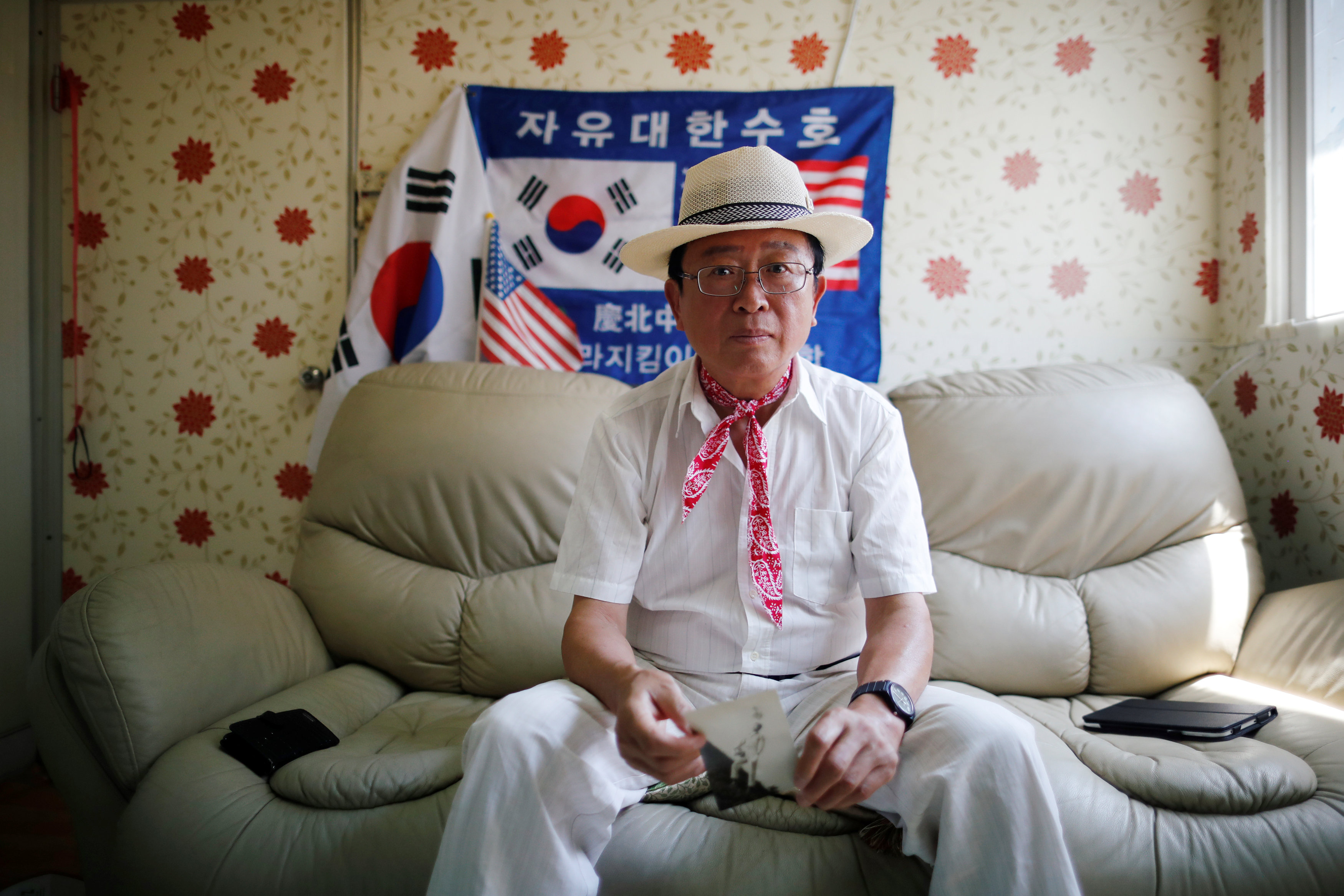
SEOUL (Reuters) – Every time an image of U.S. President Donald Trump appears on TV in South Korea, 69-year-old Vietnam War veteran Chung Seung-jin solemnly salutes.

The U.S. flag Chung keeps in his home in Seoul gets similar respect every morning.

Vietnam War veteran Chung Seung-jin poses for photographs after an interview with Reuters at his home in Suwon, South Korea, July 31, 2018. REUTERS/Kim Hong-Ji

Vietnam War veteran Chung Seung-jin poses for photographs after an interview with Reuters at his home in Suwon, South Korea, July 31, 2018. REUTERS/Kim Hong-Ji

“I salute President Trump and the U.S. flag every day to show how much I trust him,” Chung told Reuters as he attended a recent anti-North Korea rally in the sweltering summer heat in downtown Seoul.

“I salute to pay respect to Mr. Trump, supporting his reign as the leader of the world and guardian of liberty.”

For many South Korean conservatives who liked Trump’s initial tough talk against North Korea’s Kim Jong Un, his abrupt embrace of the autocratic leader at their historic Singapore summit in June was nothing short of a betrayal.

Trump, who ridiculed Kim as “rocket man” last year, has since called the North Korean leader “funny” and “smart” and even praised his ability to retain his authoritarian grip on power.

“Trump said Kim is an ‘amazing leader’, thus legitimizing him. This makes us, the patriotic citizens, feel betrayed,” said Cho Won-jin, leader of the right-wing Korean Patriots’ Party.

Members of a conservative right-wing civic group attend an anti-North Korea and pro-U.S. protest in Seoul, South Korea, August 4, 2018. REUTERS/Kim Hong-Ji

Members of a conservative right-wing civic group attend an anti-North Korea and pro-U.S. protest in Seoul, South Korea, August 4, 2018. REUTERS/Kim Hong-Ji

But for a colorful handful of Trump supporters who gather regularly on the streets of Seoul to call for aggressive action against North Korea, faith in the U.S. president is unshaken.

“I have saluted Trump today as always with utmost sincerity,” said 76-year-old demonstrator Lee Yoon-jo, nodding at a large picture of a beaming Trump at a demonstration in downtown Seoul.

As he saluted, demonstrators held giant U.S. and South Korean flags in front of the U.S. embassy, alongside banners in Korean and English reading “The United States is a thankful brother country that has been devoted to a free Korea”.

Gratitude for U.S. support in the 1950-1953 Korean War, as well as anti-communist rhetoric used by the South’s military rulers in the 1970s still resonate with many older South Koreans, said analyst Jeong Chan-dae of Sungkonghoe University.

“To these elderly conservatives, the U.S. is more than just an ally and more of a ‘savior’,” he said.

Holding a faded black-and-white photograph from his time he fought alongside American allies in the Vietnam War in 1968, Chung said: “Without the U.S., South Korea would never have been able to exist.”

Trump and Kim met in Singapore in June, where they announced an agreement in which Kim reaffirmed his “unwavering” commitment to denuclearize. Little progress on that front has been made in the weeks since.

A Gallup Korea poll conducted just after the summit found 48 percent of South Korean conservatives thought the meeting went well, compared to 79 percent of progressives.

Standing on a corner in Seoul, surrounded by flags and anti-North Korean banners, the small knot of demonstrators are unfazed by the shift in tone, noting that Trump could still resort to “regime change” if a denuclearisation deal doesn’t pan out.

“President Trump has always masterfully guided and protected South Korea and the free world and always will,” Lee said, again giving a military salute. “Thank you, Mr. President.”

(Reporting by Jeongmin Kim and Minwoo Park; Writing by Josh Smith; Editing by Nick Macfie)