Over 80% of U.S. small businesses expect longer impact of pandemic: survey

By Andrea Shalal

WASHINGTON (Reuters) – Eighty-one percent of small U.S. companies surveyed by Veem, a global payments network, expect the new coronavirus pandemic to affect their business over the next 12-16 months, and nearly 90% are bracing for an economic slowdown, the company said Monday.

San Francisco-based Veem, which helped thousands of small companies apply for loans under the federal government’s $660 billion emergency Paycheck Protection Program (PPP), said small businesses were moving quickly to adapt to the changing climate.

Of the 690 firms surveyed, 65% said they had either submitted an application for the federal aid or planned to do so in the near future, Veem said in its first report on the sentiment among small to mid-sized businesses.

The Small Business Administration has so far approved more than 2.5 million loans totaling $536 billion, it said Friday.

The U.S. economy – the largest in the world – has been particularly hard hit by widespread shutdowns aimed at containing the spread of COVID-19, the disease caused by the coronavirus. U.S. government data on Friday showed the unemployment rate surging to 14.7% last month. The White House said joblessness could hit 20% in May.

The crisis was having a mixed impact on small businesses, said Veem chief executive Marwan Forzley, with some companies struggling to survive, while others benefited as their businesses were deemed essential or they switched to working online.

“When you look at the data, there’s surprising resiliency with these small and mid-sized businesses. Despite all the uncertainty, they’re trying to make changes in their businesses, to … either benefit from the situation or repurpose their business so that they’re not as badly impacted.”

Nearly 70% of the companies surveyed cited some uncertainty about the U.S. economy in 2020, and 55% said they had already experienced some significant impact to revenue.

About 30% of the companies were more optimistic, suggesting that some industries were better positioned to thrive in the current environment, Forzley said, citing online retailers and other e-commerce businesses.

More than half of the companies reported moderate to high supply-chain disruptions as a result of factory shutdowns, border restrictions and industry-wide furloughs, and more than one third said they were now setting up regional supply chains or rapidly pivoting their supply chain to make needed supplies.

Nearly one-quarter of the companies were investing in new technology or aligning their information technology systems.

Liquidity remained a “key pain point”, the survey showed, with 52% of companies cutting operational costs and 59% applying for loans, the survey showed. Only 13% said they had not taken any measures to prepare for a slowdown.

Nearly 54% of the companies said they were freezing hiring and 23% were downsizing staff, but nearly 18% said they planned to increase staff training and support.

(Reporting by Andrea Shalal. Editing by Gerry Doyle)

Rare syndrome tied to COVID-19 kills three children in New York, Cuomo says

By Nathan Layne

(Reuters) – Three children in New York have died from a rare inflammatory syndrome believed to be linked to the novel coronavirus, Governor Andrew Cuomo said on Saturday, a development that may augur a pandemic risk for the very young.

Both Cuomo and his counterpart in the neighboring state of New Jersey also spoke on Saturday about the pandemic’s growing toll on mental health, another factor on the minds of governors as they weigh the impact of mounting job losses against health risks in moving to loosen restrictions on daily life.

Nearly all of the 50 U.S. states will have taken steps to relax lockdown measures by this weekend, including states like Arizona and Mississippi, which are reporting increasing infections of COVID-19, the disease caused by the virus, highlighting the risk of a new wave of outbreaks.

Cuomo told a daily briefing that he was increasingly worried about a syndrome that shares symptoms with toxic shock and Kawasaki disease, which he said included inflammation of the blood vessels and potentially fatal damage to the heart.

He said three children – including a five-year old disclosed on Friday – have died from such symptoms while also testing positive for COVID-19 or related antibodies, suggesting a link that was still not fully understood.

Cuomo, who has emerged as a leading national voice on states’ response to the coronavirus crisis, said state health officials were reviewing 73 similar cases, which have rattled a prior assumption that children were largely not susceptible to the novel coronavirus.

“We are not so sure that is the fact anymore. Toddler, elementary school children are presenting symptoms similar to Kawasaki disease or toxic shock-like syndrome,” Cuomo said. “It’s very possible that this has been going on for several weeks and it hasn’t been diagnosed as related to COVID.”

Cuomo said state health officials had partnered with the New York Genome Center and the Rockefeller University to look at whether there is a genetic basis for the syndrome and have been asked by the federal Centers for Disease Control and Prevention to develop national criteria for identifying and treating cases.

The syndrome shares symptoms with toxic shock and Kawasaki disease, which is associated with fever, skin rashes, swelling of the glands, and in severe cases, inflammation of arteries of the heart. Scientists are still trying to determine whether the syndrome is linked with the new coronavirus because not all children with it have tested positive for the virus.

At a separate briefing, New Jersey Governor Phil Murphy said the death of a four-year old disclosed on Friday was not related to the syndrome. “This is a very specific situation with this blessed little kid and we are going to leave it at that.”

‘TOXIC MIX’

New York and New Jersey are at the epicenter of the pandemic in the United States, accounting for nearly half of the 77,737 American deaths from COVID-19, according to a Reuters tally, and the two states have among the strictest lockdown rules still in place.

They are also at the center of a devastating economic toll underscored in government data released on Friday showing the U.S. unemployment rate rose to 14.7% last month, up from 3.5% in February and shattering the post-World War Two record of 10.8% set in November 1982.

Cuomo said his state has seen increasing reports of mental health issues, substance abuse and domestic violence, all tied to the economic stress and isolation of the lockdowns.

On Friday a study released by the Well Being Trust and the American Academy of Family Physicians estimated an additional 75,000 people could lose their lives to suicide, drugs and other contributors to “deaths of despair” stemming from the crisis.

Murphy echoed those concerns.

“The cure for the health crisis is keeping people isolated,” Murphy told his briefing. “You add to that job loss, small businesses that have been crushed. It’s a toxic mix.”

Cuomo said 226 New Yorkers died from COVID-19 on Friday, up from 216 a day earlier, but less than half the levels recorded two weeks ago. He said hospitalizations and intubations continued their downward trend, further evidence the state has gained a measure of control over the virus.

Murphy said an additional 166 residents of his state had died over the past 24 hours from COVID-19, bringing its total fatalities to 9,116, while total cases rose by 1,759 to 137,085.

On a positive note, Murphy said the number of people hospitalized for the disease continued to fall, with the 422 patients discharged over the past 24 hours outpacing the 364 newly admitted for treatment.

Yet Murphy warned against complacency and said his constituents should continue to practice social distancing.

“We are not out of the woods, folks. Let’s not forget that,” he said.

(Reporting by Nathan Layne in Wilton, Connecticut; Editing by Daniel Wallis and Dan Grebler)

No plans to separate Trump, Pence despite White House coronavirus cases: source

WASHINGTON (Reuters) – The Trump administration has no plans to keep President Donald Trump and Vice President Mike Pence apart, a person familiar with the matter said on Sunday, as concerns rise about the spread of the coronavirus within the White House.

The New York Times first reported the lack of plans to keep Trump and Pence separated despite concern they both could be incapacitated by the disease, citing two senior administration officials.

The White House did not respond to a request for comment.

Two coronavirus cases in the White House last week spurred fears of contagion for the president and vice president, who are leading the U.S. response to the pandemic, and who have both resumed travel and business schedules even as the U.S. death toll from the virus nears 80,000.

Pence’s press secretary, Katie Miller, the wife of Trump’s senior adviser, Stephen Miller, tested positive for the coronavirus a day after confirmation that Trump’s personal valet had been diagnosed with the disease.

White House Press Secretary Kayleigh McEnany sought on Friday to defend administration efforts to protect Trump and Pence, pointing to new measures taken by the White House including contact tracing and putting in place all guidelines recommended for essential workers.

The White House has also instituted daily coronavirus tests for Trump and Pence.

Anthony Fauci, a high-profile member of the White House coronavirus response team, Robert Redfield, director of the U.S. Centers for Disease Control and Prevention, and U.S. Food and Drug Administration Commissioner Stephen Hahn, were in self-quarantine on Saturday after coming into contact with someone who had tested positive for the disease.

If Republicans Trump and Pence were both to become incapacitated, Democratic House of Representatives Speaker Nancy Pelosi would assume presidential duties under U.S. law.

Last month, British Prime Minister Boris Johnson was admitted to an intensive care unit after becoming the first leader of a major power to announce he had tested positive for the highly contagious respiratory virus. Foreign Secretary Dominic Raab deputized for Johnson during his convalescence.

(Reporting by Alexandra Alper; Editing by Peter Cooney)

Major U.S. airlines endorse temperature checks for passengers

By David Shepardson

WASHINGTON (Reuters) – A major U.S. airline trade group on Saturday said it backed the U.S. Transportation Security Administration (TSA) checking the temperatures of passengers and customer-facing employees during the coronavirus pandemic.

Airlines for America, which represents the largest U.S. airlines including American Airlines <AAL.O>, United Airlines <UAL.O>, Delta Air Lines <DAL.N> and Southwest Airlines <LUV.N>, said the checks “will add an extra layer of protection for passengers as well as airline and airport employees. Temperature checks also will provide additional public confidence that is critical to relaunching air travel and our nation’s economy.”

A U.S. official said Saturday no decision has been made on whether to mandate the checks, but said the issue is the subject of extensive talks among government agencies and with U.S. airlines and added a decision could potentially be made as early as next week.

One possible route would be for a pilot project or to initially begin temperature checks at the largest U.S. airports. Questions remain about what the government would do if someone had a high temperature and was turned away from a flight.

U.S. officials said the temperature checks would not eliminate the risk of coronavirus cases but could act as a deterrent to prevent people who were not feeling well from traveling.

TSA Administrator David Pekoske told employees during a town hall meeting Wednesday that no decision had been made regarding possible temperature checks of passengers at airports and that questions remained about where such checks might take place and which agency might perform them.

“It’s been a discussion that’s been ongoing for several weeks now,” he said.

A TSA spokesman did not immediately comment Saturday.

Frontier Airlines said on Thursday it would begin temperature screenings for all passengers and crew members on June 1 and bar anyone with a temperature at or exceeding 100.4 degrees Fahrenheit (38 C).

The move, the first among major U.S. airlines, followed the industry mandating facial coverings for all passengers and heightened cleaning procedures to address coronavirus concerns.

The airline group said having temperature checks performed by the TSA “will ensure that procedures are standardized.”

The endorsement comes amid signs of a modest travel rebound from historic lows. On Friday, TSA screened 215,444 people at airport checkpoints, the first time the number topped 200,000 since March 26. But that is still a fraction of the 2.6 million screened on the equivalent day last year.

(Reporting by David Shepardson; Editing by Chris Reese)

U.S. adds social distancing to Atlantic hurricane season emergency response plan

By Rich McKay

(Reuters) – With the 2020 Atlantic hurricane season fast approaching, U.S. officials on Thursday said they were readying more buses, hotel rooms and shelter space for social distancing to reduce the spread of the novel coronavirus during potential evacuations.

The Federal Emergency Management Agency said in a telephone briefing that it anticipated a higher-than-average number of storms during the U.S. storm season beginning on June 1. It urged states and cities to step up their preparations.

“COVID will make it a little more difficult,” FEMA Administrator Pete Gaynor said, referring to the disease caused by the virus. “We’re asking local leaders to think about how they will manage evacuating and shelter. You’re going to need extra space.”

Last year, there were about 15 hurricane-related deaths in the United States, and at least 70 in the Bahamas, where Hurricane Dorian caused billions of dollars in damage.

COVID-19 has killed more than 73,000 people in the United States in the past two months.

In partnership with the American Red Cross, FEMA said it was preparing to house more evacuees in hotel rooms where families can stay, instead of packing them into shelters. They are also working to provide more buses to transport evacuees to avoid tight conditions.

An official estimate on the number of storms during the 2020 Atlantic hurricane season, which runs through Nov. 30, is expected to be released by the National Oceanic and Atmospheric Administration on May 21.

But several forecasters see a more active season than average, with 18 named tropical storms and eight hurricanes.

Last year there were 12 named storms of which, seven strengthened into hurricanes, including two major ones, according to the National Hurricane Center.

The most deadly storm was Dorian, which ravaged the Bahamas, killed scores and left whole communities obliterated.

Gaynor said FEMA had more money than ever going into the hurricane season, with $6 billion devoted to federal response to the pandemic that officials could on draw on, as well as $80 billion remaining in disaster relief funds.

Brad Kieserman, vice president for disaster operations and logistics at the American Red Cross, said his organization had reserved more than 20,000 overnight stays at thousands of hotels.

“I can’t reinforce enough: our goal collectively is to keep people safe,” he said.

FEMA is also working to provide more face masks and other protective gear to help states fight COVID-19, as many hospitals and other U.S. facilities struggle to maintain enough masks and protective gear.

FEMA is also working with states to maximize each state’s ability to test for the virus, Gaynor said, but each state must decide how many people get tested.

(Reporting by Rich McKay in Atlanta; Editing by Tom Brown)

U.S. Post Office board meets as COVID takes its toll and funding dries up

WASHINGTON (Reuters) – The U.S. Postal Service’s Board of Governors meets on Friday at a critical juncture as it faces accusations from the White House that it charges package shippers such as Amazon.com too little and as the new coronavirus cuts its revenue by about $13 billion.

The meeting also comes two days after the governors announced that they had selected Republican donor Louis DeJoy to be the next postmaster general to replace a retiring Megan Brennan.

Top of mind for the governors will be the budget shortfall, according to a person knowledgeable about the agenda.

The service, which was struggling before efforts to stop the spread of the new coronavirus prompted a widespread economic shutdown, is funded entirely through services and postage and has been hurt by advertisers’ decision to reduce mail during the pandemic.

The U.S. Congress has authorized the Treasury Department to lend it up to $10 billion as part of a $2.3 trillion coronavirus stimulus package. President Donald Trump has threatened to block that aid.

Since early in his administration, the president has criticized the post office, saying it was poorly run and charges too little to deliver packages. Many of those packages are sent by online retailers such as Amazon.com, whose founder and CEO Jeff Bezos also owns the Washington Post, which has been critical of the president.

Without assistance, the service may run out of money in September, even as Americans increasingly turn to online shopping as the pandemic batters the U.S. economy. The current postmaster general told a congressional committee last month that the new coronavirus alone could mean $13 billion in lost revenue this year.

The pandemic has also caused a surge of interest in expanding options to vote by mail rather than crowding into polling places, making it more important that funding extends past November for the presidential election.

The board meeting will also address the post office’s response to COVID-19, the respiratory disease caused by the coronavirus, including employee safety, according to a person knowledgeable about the agenda.

The disease has killed more than 50 of the service’s 600,000 workers, said James Horwitz, a spokesman for the American Postal Workers Union. A spokesman for the postal service declined to confirm the deaths. COVID-19 has killed more than 75,000 Americans.

The U.S. Postal Service has been struggling for years as online communication replaces letters, and after a 2006 law required it to pre-fund its employee-pension and retirement health care costs for the next seventy-five years.

(Reporting by Diane Bartz; Editing by Daniel Wallis)

Some White House staff to wear masks after valet tests positive: Trump

WASHINGTON (Reuters) – U.S. President Donald Trump on Friday said certain White House staff members have started wearing face masks, one day after the White House said his personal valet had tested positive for the novel coronavirus.

Trump, asked whether those who serve him food would now cover their faces, told Fox News in an interview that such White House staff would now be covering their faces.

“They’ve already started,” he said on the network’s “Fox and Friends” morning program.

The White House on Thursday said Trump and Vice President Mike Pence tested negative for the virus and were feeling well after the staffer – a U.S. military service member who works at the White House as a valet – came down with the virus. It also said the two leaders would now be tested daily, versus weekly.

Trump has said he would not wear a mask and has not publicly worn a mask to any of his events so far amid the COVID-19 pandemic, but told reporters this week that he tried some on behind the scenes during his visit to a Honeywell face mask factory in Arizona.

He is scheduled to attend a public event at the World War Two memorial later on Friday before meeting with Republican members of Congress at the White House, according to the White House.

The Republican president also told Fox News that he has not yet been tested for antibodies to the novel coronavirus but probably would be soon. Such a test could confirm previous exposure to the virus.

(Reporting by Susan Heavey; additional reporting by Lisa Lambertl editing by Chizu Nomiyama and Jonathan Oatis)

Exclusive: U.S. companies got emergency government loans despite having months of cash

By Joshua Franklin and Lawrence Delevingne

NEW YORK/BOSTON (Reuters) – When American companies recently applied for U.S. government loans meant to help small businesses survive the coronavirus crisis, they had to certify they needed the cash to cover basic needs like salaries and rent. The money, up to $10 million, was meant to tide them over for eight weeks.

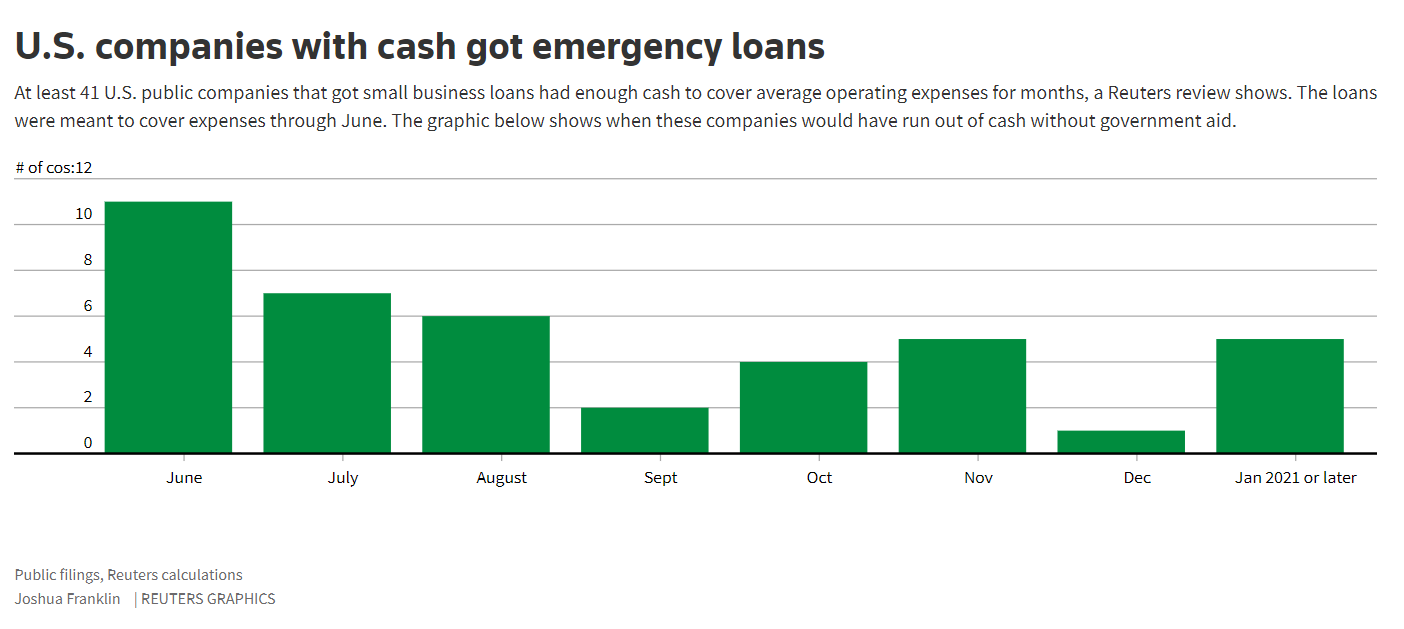
Some recipients, though, had considerable cash on hand. Forty-one publicly traded companies that got the emergency aid already had enough to cover basic expenses for two months or more when they applied for the funds, a Reuters analysis found — even if their revenue dropped to zero. Thirty had three months or more of cash. Six had enough to last at least until December, according to the review, which was based on average monthly operating expenses from 2019.

All told, these relatively flush 41 companies were able to secure $104 million in government aid, at a time when legions of smaller companies with little in their coffers were being turned down. Seventeen of the 41 recipients had market capitalizations of at least $100 million.

“It’s disheartening to see relief spending go to companies that don’t appear to desperately need a lifeline,” said Danielle Brian, executive director of the Project On Government Oversight, a Washington-based non-profit that monitors government spending. “This shows just how urgently we need more oversight of this program and the rest of the federal government’s relief spending.”

Reuters examined the latest available financial information for 276 publicly traded companies that applied for the forgivable loans in the first round of the U.S. government’s Paycheck Protection Program (PPP) in April. The list includes companies tracked by data provider FactSquared through the end of April.

A WIDELY CRITICIZED PROGRAM

The PPP program, crafted by Congress to aid small businesses, has come under wide criticism. One critique is that publicly traded companies who received the cash could have raised funds elsewhere, given their easier access to capital markets. Until now, though, the accuracy of the borrowers’ claims about their financial needs to the government has not been closely scrutinized. The Reuters analysis is the most comprehensive to date.

As part of the loan application, company executives had to certify in good faith that “current economic uncertainty makes this loan necessary to support” their ongoing operations. In regulatory filings and in press releases, some of the 41 recipients sounded a different note as they took the loans, signaling optimism about their finances. At least five of the 41 made statements attesting to solid financial health or projecting additional revenues because of the crisis.

Graphic: U.S. companies with cash got emergency loans IMAGE link  

Among them was biotech company Athersys Inc. It issued an upbeat outlook in an April 15 securities filing for a $50 million share offering, in which it also said it had secured a $1.3 million PPP loan.

“As of the date of this prospectus supplement, the COVID-19 pandemic has not had a significant adverse effect on our business,” the company wrote.

Other recipients issued bright outlooks. Medical device maker Repro Med Systems Inc and electronics supplier Micropac Industries Inc said the pandemic had not had a significant impact on their businesses.

Diagnostics company Enzo Biochem Inc said it expected COVID-19 related products to partially offset revenue declines. Infectious disease testing business Accelerate Diagnostics Inc said its first-quarter sales were expected to rise – and entered into a collaboration for coronavirus testing.

‘WE RISKED MISSING THE OPPORTUNITY’

In a statement to Reuters on Tuesday, Athersys said that it fully met the program certification requirements when it applied, due to the uncertain outlook and upcoming costly clinical trials. It said it returned the money after the Treasury Department said in late April that many public companies were unlikely to satisfy the certification criterion. The company was planning to disclose the loan’s return on Thursday, when it releases first-quarter financial results.

“There was uncertainty regarding whether we might be able to complete financing, given market chaos and uncertainty, as well as other factors,” the company said in explaining why it sought the loan. “If we had not applied for the funding at the time we did, we risked missing the opportunity altogether.”

Micropac did not respond to a request for comment on Monday. On Tuesday morning, it said in a securities filing that it planned to return the loan. Enzo, Accelerate and Repro Med did not respond to requests for comment.

The U.S. Treasury, which oversees the program, referred Reuters to Secretary Steven Mnuchin’s recent comments. Mnuchin told reporters last week that he was shocked that some large companies had taken the loans, and said the certifications had been put in the loan application forms to force borrowers to read the requirements. He said there were 26,000 loans over $2 million, and those would likely be audited.

The small business loan program was initially funded with $349 billion. Congress had to top it off with another $310 billion because the money, which was supposed to be handed out on a first-come, first-served basis, ran out while many applicants were still awaiting the grants.

Mnuchin said on Monday that 2.2 million loans worth an average $79,000 had been made in the second round. The $104 million the 41 public companies were granted would have been enough to keep some 1,300 small businesses afloat with an average grant.

‘WHAT THE HELL ARE THEY DOING?’

Jeff Lewis-Mathieu, co-owner of security systems installer Prairie Signal Company Inc, said his small Chicago-based business has been waiting for weeks in its application for a $40,000 PPP loan.

Lewis-Mathieu said he is continuing to pay his two employees, but is not paying himself, and doesn’t know how long the business can survive after a roughly 50% drop in revenue. He said he has watched in frustration as larger public companies get millions of dollars in loans.

“When you see that, it’s like, ‘What the hell are they doing?’ They are sucking all the funds out that guys like me actually need,” Lewis-Mathieu said.

Part of the problem, some critics say, is the loose wording of the program’s rules. Virginia Canter, chief ethics counsel at nonprofit watchdog group Citizens for Responsibility and Ethics in Washington, said the administration should have issued clearer guidance about who’s eligible. “The government should have seen this coming and is now trying to clean it up,” Canter said.

The Treasury has offered amnesty to public companies that return any money they borrowed by May 14, saying it would deem they made the application in good faith if they did so. Of the 41 companies identified by Reuters, 12 have said so far that they already had or planned to return the money by the deadline. In one case, the company said it declined the loan before receiving the money.

Mnuchin said last month that companies could be subject to a Department of Justice investigation if they did not return the money. Several white collar defense attorneys said prosecutors would likely probe the most egregious cases of conflicting representations and seek internal communications showing executives knew they didn’t really need the money.

“Federal regulators are going to be looking at discrepancies very closely. If there’s a big disconnect, subpoenas may be on the way,” said Michael Birnbaum, a former U.S. Securities and Exchange Commission enforcement attorney who is now at Morrison & Foerster LLP.

KEY TERMS LOOSELY DEFINED

Such cases may be hard to prove, however. Alan Wink, managing director at accounting firm EisnerAmper, said it was clear from the Reuters analysis that some healthy companies received PPP funds. But he noted that PPP terms were loosely defined by the government, and that key ones, like “current economic uncertainty” and “necessary,” were open to interpretation.

The Reuters analysis of borrowers’ needs has a limitation: The ratio of cash to average operating expenses used by the news agency does not provide a complete picture of a company’s financial health. The analysis is based on financial information disclosed through Wednesday morning.

Still, Wink and two finance professors consulted for this article said the Reuters metric was a conservative way to assess the ability of a business to meet operating expenses.

Some of the companies that took loans said publicly they were financially secure, with some seeing increased demand for their products around the time they asked for the aid.

Athersys, for example, said its stem cell therapy was being tested on COVID-19 patients. The company’s shares have more than doubled since mid-March, giving it a market value of more than $500 million.

In its April 15 announcement, Athersys noted that it had $37.5 million in cash and cash equivalents as of April 9. That’s enough to cover nearly nine months of operating expenses, based on the company’s average expenses for 2019.

In its statement to Reuters, Athersys said the nine-month ratio did not present a complete picture of its financial condition and operational plans, which include two clinical trials. “Our historical spending is not an accurate indicator of our future needs given how our business is evolving,” the company said.

Repro Med said on Monday it was an essential business under New York guidelines and had seen net sales rise 27% in the first quarter. The company said its devices, which are used to help inject drugs, allow high-risk patients to receive treatment at-home, “important advantages during these challenging times.”

“We have not experienced any material disruption to our business thus far,” Chief Executive Don Pettigrew said in the statement. The company, which has a market value of about $430 million, secured some $1.5 million under the PPP in late April.

A HEALTHY RISE IN REVENUE

Accelerate Diagnostics received a $4.78 million PPP loan on April 14. The company has a market value of around $570 million. The next day, the company noted in a press release that first-quarter sales rose 28% to $2.3 million from the same period in 2019, based on preliminary figures. It also announced a new agreement to distribute its coronavirus antibody tests in the United States and abroad.

It said total cash and cash equivalents were $92 million as of March 31. That’s enough to cover average 2019 operating expenses for 13 months, the review found.

Another company, Enzo Biochem, said on April 9 it “expects COVID-19 related products and services to partially offset revenue declines” caused by the crisis. The company, with a market value of about $130 million, said it had $48 million in cash as of March 31. That was enough to cover seven months of its average 2019 operating expenses.

The company applied for and got a PPP loan of nearly $7 million, a regulatory filing shows. On April 23, it announced it had launched its first COVID-19 diagnostic test, sending its shares soaring.

Micropac makes electronic components for the defense, medical and other industries. The company, with a market capitalization of about $34 million, had enough cash to cover eight months of average 2019 operating expenses as of February 29, the review shows.

Micropac “has not experienced significant financial impact directly related to the pandemic,” it said in a regulatory filing on April 14. Three days later, it obtained nearly $2 million in PPP funds.

(Reporting by Lawrence Delevingne and Joshua Franklin. Additional reporting by Noel Randewich. Editing by Paritosh Bansal, Greg Roumeliotis and Michael Williams.)

U.S. coronavirus deaths exceed 75,000: Reuters tally

By Lisa Shumaker

(Reuters) – U.S. deaths from the novel coronavirus topped 75,000 deaths on Thursday, according to a Reuters tally, after the White House shelved a step-by-step guide prepared by health officials to help states safely reopen.

Deaths in the United States, the epicenter of the global pandemic, have averaged 2,000 a day since mid-April despite efforts to slow the outbreak.

The death toll is higher than any fatalities from the seasonal flu going back to 1967 and represents more U.S. deaths than during the first 10 years of the AIDS epidemic, from 1981 to 1991.

U.S. cases are over 1.25 million as new infections continue to rise in many states, including Illinois, Maryland, Minnesota, Tennessee, Texas, Virginia and Wisconsin, according to a Reuters tally and an analysis of historical data from the COVID Tracking Project. New York and New Jersey, the two states with the highest number of cases, have been experiencing declines in new positive cases in recent weeks.

Some health experts are predicting a resurgence in deaths later this summer as U.S. states lift stay-at-home orders and Americans begin eating out at restaurants and going to gyms again.

A University of Washington research model often cited by White House officials earlier this week nearly doubled its projected U.S. death toll to over 134,000 by Aug. 4.

An internal Trump administration forecast predicted a surge in fatalities to 3,000 a day by the end of May.

States are eager to reopen due to surging unemployment rates. About 33.5 million people have filed claims for unemployment benefits since March 21, roughly 22.1% of the working-age population.

A 17-page document prepared by the Centers for Disease Control and Prevention was shelved to avoid giving “overly prescriptive” guidance, said a member of President Donald Trump’s White House task force.

(Writing by Lisa Shumaker; Additional reporting by Christine Chan in New York; Editing by Howard Goller)

‘Like a science experiment’: A New York family learns the limits of coronavirus tests

By Jonathan Allen

NEW YORK (Reuters) – After a week or so sick in bed in their New York City apartment in March, members of the Johnson-Baruch family were convinced they had been stricken by the novel coronavirus. Subsequent test results left them with more questions than answers.

Tests both for the virus itself and for the antibodies the immune system produces to fight the infection are becoming more widely available, but they are not perfect. The tests can come back with false positives, false negatives or confoundingly ambiguous results. Doctors cannot always offer definitive explanations.

For Maree Johnson-Baruch, her husband, Jason Baruch, and their two teenage daughters, their experience ran the gamut.

They all became sick around the same time with the same symptoms. But each set of tests they subsequently took, whether for antibodies or the virus, came back with conflicting results among family members – some positive some negative. Eventually, after several weeks and additional tests, they were able to confirm that all four had indeed been infected.

“I feel a little bit like a science experiment,” Johnson-Baruch said. “But no one really knows how this virus is behaving.”

Widespread testing is touted by many policymakers and public health experts as a central tool for reopening closed economies and for tamping down any future outbreaks of the virus. But these public health experts have said that the limitations of tests must be factored in, and that there must be time for more research into the degree that antibodies, for example, confer immunity against future infection.

Johnson-Baruch, an actress, began to feel ill shortly after she finished her final performance in the pivotal supporting role of Madame Giry in the Broadway musical “The Phantom of the Opera.” It was a Thursday matinee on March 12, the day New York City began closing non-essential businesses to try to slow the spread of the virus.

Over the weekend she had occasional aches but thought she was just imagining symptoms. By Monday, she had a fever. One by one, her husband and daughters fell sick over the following week. Johnson-Baruch noticed she could not smell the pine-scented disinfectant she was using to clean the family’s apartment.

The family called the New York State Department of Health’s coronavirus hotline. The federal government had botched the rollout of test kits, which then remained scarce – and limited in New York mostly to only those sick enough to require hospitalization. The family followed the advice to recuperate at home and by April everyone felt recovered.

Soon after, Johnson-Baruch read about a new experimental therapy at Manhattan’s Mount Sinai Hospital in which the antibody-rich blood plasma of patients who have recovered from COVID-19, the respiratory disease caused by the virus, is donated to people hospitalized with the illness.

In late April, she and her husband put on face masks and went to the hospital, where healthcare workers decked in protective gear drew blood.

“The strange thing was I tested positive and Jason tested negative,” Johnson-Baruch said.

Such disparities do not surprise Dr. Ania Wajnberg, who oversees Mount Sinai’s antibody testing efforts.

The antibody test developed at Mount Sinai fails to detect antibodies in about 6% of patients who actually have them. The intensity and recentness of the original infection can also affect whether antibodies are detected, Wajnberg said.

“I do think sometimes the results are surprising to people,” Wajnberg said. “And, more than anything, I get tons of questions about what the results mean, and we don’t know exactly what they mean.”

Although antibodies are thought to be likely to provide at least some immunity for some period of time, it remains the subject of study.

“Overall, everyone understands that this is so new and that they are sort of participating in the learning process,” Wajnberg said.

‘WE WERE SURPRISED’

About six weeks after calling the state health department, Johnson-Baruch heard back from an official saying the family could finally get a test for the actual virus that works by looking for distinctive parts of the pathogen’s genetic material, RNA, in a patient’s sample.

“We were well over a month out of our symptoms by that point, so we were surprised to get the call from them sort of out of the blue,” Johnson-Baruch said.

Johnson-Baruch noticed her eldest daughter particularly squirmed when healthcare workers stuck swabs, one by one, deep into the back of their noses.

Once again, the results surprised them. Johnson-Baruch, her husband and their youngest daughter all tested positive. Their eldest daughter tested negative.

What did it mean, the family wondered. Were they still in some sense sick? Could they still infect others?

A health department official who called to relay the results was not much help. “She was quite surprised to hear we were sick six weeks ago,” Johnson-Baruch said.

The tests used by the health department “cannot distinguish between RNA from live or dead virus,” Jonah Bruno, a department spokesman, wrote in an email. “This persistent positive test result can continue long after a person has recovered and does not necessarily indicate that a person continues to be infectious.”

Some 60 different RNA or antibody tests are now available after under emergency use authorization by the U.S. Food and Drug Administration, but the makers of those tests must continue to submit accuracy data to the regulatory agency before final approval is given.

Dr. Danielle Ompad, an epidemiologist at New York University’s School of Global Public Health, said it was challenging to get the general public to accept the limitations of tests.

“People are way more comfortable with ‘yes’ or ‘no’ than ‘maybe,'” Ompad said. “Unfortunately, that’s where the science has us right now: we just don’t know, and it’s much better to say that we don’t know than to try to make predictions without having the data there because that can be detrimental.”

The Johnson-Baruch family members are not quite done with testing. The daughter who had negative virus results has since tested positive for antibodies for the virus after going to a walk-in clinic. Such facilities made testing more widely available this month.

Jason Baruch, a lawyer for Broadway theaters, is also seeking a second antibody test, this time hoping it comes back positive. A positive test would offer some comfort that he may have some level of immunity.

“No one’s really willing to put themselves on the line and say, ‘Hey, you’re home free, you have antibodies,’ or, ‘You’re still contagious,'” Baruch said. “No one really wants to tell us – definitively – anything.”

(Reporting by Jonathan Allen; Additional reporting by Mike Segar and Aleksandra Michalska; Editing by Ross Colvin and Will Dunham)