European powers urge Trump to preserve Iran nuclear deal

Britain's Foreign Secretary Boris Johnson attends a news conference with French Foreign Minister Jean-Yves Le Drian, German counterpart Sigmar Gabriel and European Union's foreign policy chief Federica Mogherini after meeting Iran's Foreign Minister Mohammad Javad Zarif (unseen) in Brussels, Belgium January 11, 2018.

By Robin Emmott

BRUSSELS (Reuters) – Britain, France and Germany called on Donald Trump on Thursday to uphold a pact curbing Iran’s nuclear ambitions on the eve of a sanctions ruling by the U.S. president they fear could torpedo an accord he has relentlessly criticized.

Hailed by its admirers as key to stopping Iran from building a nuclear bomb, the deal lifted economic sanctions in exchange for Tehran limiting its nuclear program. It was also signed by China, France, Russia, Britain, Germany and the European Union.

The U.S. Congress requires the president to periodically certify Iran’s compliance and issue a waiver to allow U.S sanctions to remain suspended. The next deadline is on Friday.

In sharp contrast to Trump’s view that the 2015 pact was “the worst deal ever negotiated”, the foreign ministers of the three countries and the EU’s top diplomat said there was no alternative to it and that sanctions should remain lifted.

“We agree on this approach, we want to protect (the deal) against every possible decision that might undermine it,” Germany’s Sigmar Gabriel said alongside his French and British counterparts and EU foreign policy chief Federica Mogherini after meeting Iran’s Foreign Minister Mohammad Javad Zarif.

“It is absolutely necessary to have this to prevent the development of nuclear weapons at a time when other parts of the world are discussing how to get them,” Gabriel said, later specifically mentioning North Korea in his remarks.

Trump’s choice comes at a delicate time for Iran’s government, which faced protests over economic hardships and corruption that are linked to frustration among younger Iranians who hoped to see more benefits from the lifting of sanctions.

The meeting in Brussels was choreographed to send a message to Washington before Trump is due to decide whether to re-impose oil sanctions lifted under the deal. If that happens, Iran has said it would no longer be bound by the pact and could return to producing enriched uranium.

Zarif tweeted that the Brussels meeting had shown a “strong consensus” that Iran was complying with the pact, had the right to enjoy its economic benefits and “any move that undermines (it) is unacceptable”.

“E3 (Germany, France and Britain) and EU fully aware that Iran’s continued compliance (is) conditioned on full compliance by the US,” Zarif added.

European countries have benefited from renewed trade with Iran as sanctions have been lifted, while U.S. companies are still largely barred from doing business with the Islamic Republic due to other sanctions unrelated to the nuclear issue..

“GOOD NEIGHBOUR”

“The deal is working. It is delivering on its main goal which means keeping the Iranian nuclear program in check and under close surveillance,” Mogherini said, adding that the International Atomic Energy Agency had shown in nine reports that Iran is meeting its commitments.

British Foreign Secretary Boris Johnson said the pact was also a way for Iran to show it was “a good neighbour” in the region by complying.

Trump formally rejected the deal in October, although the United States has not yet pulled out.

That major shift in U.S. policy put the United States at odds with its European allies, as well as Russia and China that are also signatories to the nuclear accord, in the most visible transatlantic split on foreign policy since the 2003 U.S. invasion of Iraq.

European governments are troubled by Trump’s “America first” rhetoric and inconsistent statements on NATO and the European Union, while they consider the Iran nuclear deal one of West’s the biggest diplomatic achievements in decades.

In a gesture to Trump, France’s Foreign Minister Jean-Yves Le Drian said Paris shared Washington’s concerns about Iran’s ballistic missile program and involvement in wars in Yemen and Syria, but stressed the nuclear deal should still stand.

“We do not hide other disagreements, which exist … both in the ballistic field and over Iran’s actions in the whole region,” Le Drian said.

Tehran has repeatedly vowed to continue building up its ballistic missile arsenal, one of the biggest in the Middle East, saying it is for defense purposes only. The West sees it as a threat and has installed a U.S.-built missile shield in southeastern Europe, under NATO command.

Gabriel said Zarif agreed at the Brussels meeting to discuss the issues in a more regular and structured way, but diplomats said there was no immediate timetable for talks.

(Additional reporting by Robert-Jan Bartunek and Peter Maushagen; Editing by Robin Pomeroy, William Maclean)

South Korea’s Moon says Trump deserves ‘big’ credit for North Korea talks

South Korean President Moon Jae-in delivers a speech during his New Year news conference at the Presidential Blue House in Seoul, South Korea, January 10,

By Christine Kim and Soyoung Kim

SEOUL (Reuters) – South Korean President Moon Jae-in credited U.S. President Donald Trump on Wednesday for helping to spark the first inter-Korean talks in more than two years, and warned that Pyongyang would face stronger sanctions if provocations continued.

The talks were held on Tuesday on the South Korean side of the demilitarized zone, which has divided the two Koreas since 1953, after a prolonged period of tension on the Korean peninsula over the North’s missile and nuclear programs.

North Korea ramped up its missile launches last year and also conducted its sixth and most powerful nuclear test, resulting in some of the strongest international sanctions yet.

The latest sanctions sought to drastically cut the North’s access to refined petroleum imports and earnings from workers abroad. Pyongyang called the steps an “act of war”.

Seoul and Pyongyang agreed at Tuesday’s talks, the first since December 2015, to resolve all problems between them through dialogue and also to revive military consultations so that accidental conflict could be averted.

“I think President Trump deserves big credit for bringing about the inter-Korean talks, I want to show my gratitude,” Moon told reporters at his New Year’s news conference. “It could be a resulting work of the U.S.-led sanctions and pressure.”

Trump and North Korean leader Kim Jong Un exchanged threats and insults over the past year, raising fears of a new war on the peninsula. South Korea and the United States are technically still at war with the North after the 1950-53 Korean conflict ended with a truce, not a peace treaty.

‘BASIC STANCE’

Washington had raised concerns that the overtures by North Korea could drive a wedge between it and Seoul, but Moon said his government did not differ with the United States over how to respond to the threats posed by Pyongyang.

“This initial round of talks is for the improvement of relations between North and South Korea. Our task going forward is to draw North Korea to talks aimed at the denuclearization of the North,” Moon said. “(It’s) our basic stance that will never be given up.”

Moon said he was open to meeting North Korea’s leader at any time to improve bilateral ties, and if the conditions were right and “certain achievements are guaranteed”.

“The purpose of it shouldn’t be talks for the sake of talks,” he said.

However, Pyongyang said it would not discuss its nuclear weapons with Seoul because they were only aimed at the United States, not its “brethren” in South Korea, nor Russia or China, showing that a diplomatic breakthrough remained far off.

North Korea’s Rodong Sinmun newspaper said all problems would be resolved through efforts by the Korean people alone.

“If the North and South abandon external forces and cooperate together, we will be able to fully solve all problems to match our people’s needs and our joint prosperity,” it said.

Washington still welcomed Tuesday’s talks as a first step toward solving the North Korean nuclear crisis. The U.S. State Department said it would be interested in joining future talks, with the aim of denuclearizing the North.

The United States, which still has 28,500 troops stationed in South Korea, initially responded coolly to the idea of inter-Korean meetings. Trump later called them “a good thing” and said he would be willing to speak to Kim.

Lee Woo-young, a professor at the University of North Korean Studies in Seoul, said it was wise of Moon to praise Trump, his sanctions and pressure campaign.

“By doing that, he can help the U.S. build logic for moving toward negotiations and turning around the state of affairs in the future, so when they were ready to talk to the North, they can say the North came out of isolation because the sanctions were effective.”

The United States and Canada are set to host a conference of about 20 foreign ministers on Jan. 16 in Vancouver to discuss North Korea, without the participation of China, Pyongyang’s sole major ally and biggest trade partner.

China would not attend the meeting and is resolutely opposed to it, said foreign ministry spokesman Lu Kang.

“It will only create divisions within the international community and harm joint efforts to appropriately resolve the Korean peninsula nuclear issue,” he told a regular briefing on Wednesday.

LARGE OLYMPICS DELEGATION

Pyongyang also said it would send a large delegation to next month’s Winter Olympics in South Korea.

Washington agreed with Seoul last week to postpone until after the Olympics joint military exercises that Pyongyang denounces as rehearsals for invasion. But it also said the apparent North-South thaw had not altered the U.S. intelligence assessment of the North’s weapons programs.

The United States has also warned that all options, including military, are on the table in dealing with the North.

“We cannot say talks are the sole answer,” Moon said. “If North Korea engages in provocations again or does not show sincerity in resolving this issue, the international community will continue applying strong pressure and sanctions.”

Seoul said on Tuesday it was prepared to offer financial assistance and lift some unilateral sanctions temporarily so North Koreans could attend the Olympics. North Korea said its delegation would include athletes and officials, among others.

However, Moon said on Wednesday South Korea had no plans for now to ease unilateral sanctions against North Korea, or revive economic exchanges that could run foul of United Nations sanctions.

Moon also said his government would continue working toward recovering the honor and dignity of former “comfort women”, a euphemism for those forced to work in Japan’s wartime brothels.

But historical issues should be separated from bilateral efforts with Japan to safeguard peace on the Korean peninsula, he added.

“It’s very important we keep a good relationship with Japan,” Moon said.

On Tuesday, South Korea said it would not seek to renegotiate a 2015 deal with Japan despite determining that the pact was insufficient to resolve the divisive issue, and urged Japan for more action to help the women.


(Additional reporting by Josh Smith and Hyonhee Shin in SEOUL and Michael Martina in BEIJING, Writing by Soyoung Kim, Editing by Paul Tait)

Trump promises to ‘take the heat’ for broad immigration deal

U.S. President Donald Trump, flanked by U.S. Senator Dick Durbin (D-IL) and Representative Steny Hoyer (D-MD), holds a bipartisan meeting with legislators on immigration reform at the White House in Washington, U.S. January 9, 2018. REUTERS/Jonathan

By Jeff Mason and Richard Cowan

WASHINGTON (Reuters) – President Donald Trump said on Tuesday he was ready to accept an onslaught of criticism if lawmakers tackle broad immigration reforms after an initial deal to help the young illegal immigrants known as Dreamers and build a wall on the U.S. border with Mexico.

Trump told lawmakers at the White House he would back a two-phased approach to overhauling U.S. immigration laws with the first step focused on protecting immigrants who were brought here as children from deportation along with funding for a wall and other restrictions that Democrats have opposed.

Once that is done, Trump said, he favors moving quickly to address even more contentious issues, including a possible pathway to citizenship for 11 million illegal immigrants that is opposed by many Republicans and many of his supporters.

“If you want to take it that further step, I’ll take the heat, I don’t care,” Trump told lawmakers about a broad immigration bill. “You are not that far away from comprehensive immigration reform. And if you wanted to go that final step, I think you should do it.”

Trump campaigned for the White House in 2016 with a hard-line approach on illegal immigration, and many of his supporters consider potential citizenship for undocumented immigrants to be an unacceptable grant of amnesty.

Trump said on Tuesday he would sign a bill that gives legal status to the hundreds of thousands of undocumented immigrants brought to the country as children, known as Dreamers, as long as the bill had the border security protections he has sought, including funding for a wall.

“Now, that doesn’t mean 2,000 miles of wall because you just don’t need that … because of mountains and rivers and lots of other things,” Trump said. “But we need a certain portion of that border to have the wall. If we don’t have it, you can never have security.”

Trump and his fellow Republicans, who control the U.S. Congress, have been unable to reach agreement with Democrats on a deal to resolve the status of an estimated 700,000 young immigrants whose protection from potential deportation under the Deferred Action for Childhood Arrivals, or DACA, program ends in early March.

“A VERY PRODUCTIVE MEETING”

Under pressure from immigrant groups ahead of midterm congressional elections in November, Democrats are reluctant to give ground to Trump on the issue of the wall, his central promise from the 2016 presidential campaign.

But after the meeting, lawmakers from both parties said they would meet as early as Wednesday to continue negotiations on a deal covering DACA and border security, as well as a visa lottery program and “chain migration,” which could address the status of relatives of Dreamers who are still in the United States illegally.

“From that standpoint it was a very productive meeting,” said Senator David Perdue, a Republican. “We have a scope now.”

White House spokeswoman Sarah Sanders told reporters the broader bill with a path to citizenship was not a focus for now.

“We’re certainly open to talking about a number of other issues when it comes to immigration, but right now this administration is focused on those four things and that negotiation, and not a lot else at this front,” she said.

Republican Senator Lindsey Graham, who also was at the meeting, said negotiators in Congress still faced difficulties but it was important that Trump had shown he had “no animosity toward the Dream Act kids” and the “wall is not going to be 2,220 miles wide.”

PARTY DIFFERENCES ON BORDER SECURITY

The U.S. Congress has been trying and failing to pass a comprehensive immigration bill for more than a decade, most recently in 2013 when the Senate passed a bill that later died in the House of Representatives.

The latest immigration negotiations are part of a broader series of talks over issues ranging from funding the federal government through next September to renewing a children’s health insurance program and giving U.S. territories and states additional aid for rebuilding after last year’s hurricanes and wildfires.

Top congressional leaders did not attend the hour-long meeting. The guest list included lawmakers from both parties involved in the immigration debate, such as Graham and Democratic Senator Dick Durbin.

A majority of those protected under DACA are from Mexico and Central America and have spent most of their lives in the United States, attending school and participating in society.

Trump put their fate in doubt in early September when he announced he was ending the DACA program created by former President Barack Obama, which allowed them to legally live and work in the United States temporarily.

Steny Hoyer, the No. 2 Democrat in the House of Representatives, said a DACA bill could win support for passage even though there are differences between the parties over what constitutes necessary border security.

“Democrats are for security at the border,” Hoyer told Trump during the meeting. “There are obviously differences, however, Mr. President, on how you affect that.”

On Monday, Trump announced that he was ending immigration protections for about 200,000 El Salvadorans who have been living legally in the United States under the Temporary Protection Status program. Haitians and other groups have faced similar actions.

A congressional aide told Reuters that negotiators in Congress also have been talking about legislation that would expand TPS in return for ending a visa lottery program that Republicans want to terminate.

(Reporting by Jeff Mason and Richard Cowan; Additional reporting by Susan Cornwell, Steve Holland, Susan Heavey and Amanda Becker; Writing by John Whitesides and Jeff Mason; Editing by Leslie Adler)

Trump to order mental health aid to prevent suicide among military veterans

President Donald Trump shakes hands with Secretary of Veterans Affairs David Shulkin (L) after signing the Veterans Affairs Choice and Quality Employment Act at Trump's golf estate in Bedminster, New Jersey U.S. August 12, 2017.

WASHINGTON (Reuters) – President Donald Trump on Tuesday was set to sign an executive order that will direct government departments to try to prevent suicide among military veterans by treating mental health problems before they become more serious.

Veterans Affairs Secretary David Shulkin told reporters on a conference call that Trump wants to address an alarming trend, that of 20 veterans a day taking their own life.

“That is just an unacceptable number and we are focused on doing everything we can to try to prevent these veteran suicides,” Shulkin said.

Trump’s order will direct the departments of Defense, Homeland Security and Veterans Affairs to develop a plan in 60 days to provide access to mental health treatment and suicide prevention resources for uniformed service members in the first year following military service.

The new order will cost about $200 million year to implement, money that will be diverted from the agencies’ current budget, a senior administration official said.

(Reporting By Steve Holland; Editing by David Gregorio)

FEMA allows churches to apply retroactively for disaster aid

Interstate highway 45 is submerged from the effects of Hurricane Harvey seen during widespread flooding in Houston, Texas, U.S. August 27, 2017.

WASHINGTON (Reuters) – The U.S. Federal Emergency Management Agency said on Tuesday that churches may apply for aid relating to disasters declared after Aug. 23, 2017, following pressure from President Donald Trump and a lawsuit by Texas churches.

The federal disaster relief agency was sued in September by three Texas churches severely damaged in Hurricane Harvey, over what they called its policy of refusing to provide disaster relief to houses of worship because of their religious status.

Trump had said in a tweet that Texas churches should be able to receive money from FEMA for helping victims of Hurricane Harvey. It was not clear whether the three churches provided aid to victims.

The churches that sued are the Rockport First Assembly of God in Rockport, which lost its roof and steeple and suffered other structural damage, and the Harvest Family Church in Cypress and Hi-Way Tabernacle in Cleveland, which were both flooded.

In a complaint filed in federal court in Houston, the churches said they would like to apply for aid but it would be “futile” because FEMA’s public assistance program “categorically” excluded their claims, violating their constitutional right to freely exercise their religion.

They said FEMA’s ban on providing relief where at least half a building’s space is used for religious purposes, a policy also enforced after Hurricane Katrina in 2005 and Hurricane Sandy in 2012, contradicted a recent U.S. Supreme Court decision making it easier for religious groups to get public aid.

(Reporting by Chris Sanders; Editing by Leslie Adler)

U.S. warns North Korea against new missile test, plays down talks

U.S. Ambassador to the United Nations Nikki Haley speaks at UN headquarters in New York, U.S., January 2, 2018

By Rodrigo Campos and Christine Kim

UNITED NATIONS/SEOUL (Reuters) – The U.S. ambassador to the United Nations, Nikki Haley, warned North Korea on Tuesday against staging another missile test and said Washington would not take any talks between North and South Korea seriously if they did not do something to get Pyongyang to give up its nuclear weapons.

Haley told reporters the United States was hearing reports that North Korea might be preparing to fire another missile.

“I hope that doesn’t happen. But if it does, we must bring even tougher measures to bear against the North Korean regime,” Haley said.

South Korea on Tuesday offered talks with North Korea next week, amid a tense standoff over Pyongyang’s nuclear and missile programs, after North Korean leader Kim Jong Un said in a New Year’s Day speech that he was “open to dialogue” with Seoul.

Kim also said he was open to the possibility of North Korean athletes taking part in Winter Olympics South Korea hosts next month.

At the same time, he stressed that his country would push ahead with “mass producing” nuclear warheads in defiance of U.N. sanctions and that he had a nuclear button on his desk capable of launching missiles at the United States.

U.S. President Donald Trump responded to Kim in a Twitter post on Tuesday: “Will someone from his depleted and food starved regime please inform him that I too have a Nuclear Button, but it is a much bigger & more powerful one than his, and my Button works!”

Haley said the United States would not take talks seriously if they did not take steps toward banning North Korea’s nuclear weapons.

“North Korea can talk to anyone they want, but the U.S. is not going to recognize it or acknowledge it until they agree to ban the nuclear weapons that they have,” she said.

Haley gave no details of the missile test preparations.

Another U.S. official, who spoke on condition of anonymity, said there were indications that could point toward a potential missile launch “sooner rather than later,” but cautioned that such signs had been seen in the past and no test had resulted.

‘DRIVE A WEDGE’

U.S. State Department spokeswoman Heather Nauert said North Korea might be “trying to drive a wedge of some sort” between the United States and South Korea and added that while it was up to Seoul to decide who it talked to: “We are very skeptical of Kim Jong Un’s sincerity in sitting down and having talks.”

Trump, who has led a global drive to pressure North Korea through sanctions to give up development of nuclear-tipped missiles capable of hitting the United States, earlier held back judgment on Pyongyang’s offer to talk, saying on Twitter:

“Rocket man now wants to talk to South Korea for first time. “Perhaps that is good news, perhaps not – we will see!”

Trump has frequently derided Kim as “rocket man.” The U.S. president said sanctions and other pressures were starting to have a big impact on North Korea.

Kim and Trump have exchanged fiery barbs in the last year and the U.S. president has warned that the United States would have no choice but to “totally destroy” North Korea if forced to defend itself or its allies.

North Korea regularly threatens to destroy the United States, South Korea and Japan and tested its most powerful intercontinental ballistic missile in November, which it said was capable of delivering a warhead anywhere in the United States.

South Korea’s Unification Minister Cho Myong-gyon said the offer for high-level talks next Tuesday had been discussed with the United States. Nauert said she was not aware if the matter had been discussed in advance of the South Korean response.

Cho suggested the talks be held at the border village of Panmunjom and said they should be focused on North Korea’s participation at the Olympics, but other issues would likely arise, including the denuclearisation of North Korea.

“I repeat: The government is open to talking with North Korea, regardless of time, location and form,” Cho said.

Should the talks be held, it would be the first such dialogue since a vice-ministerial meeting in December 2015.

South Korean President Moon Jae-in welcomed Kim’s New Year address and asked his government to move as quickly as possible to bring North Korea to the Olympics, but he stressed that an improvement in inter-Korean relations “cannot go separately with resolving North Korea’s nuclear program”.

China, which has persistently urged a return to talks to ease tensions, said recent positive comments from North and South Korea were a good thing.

“China welcomes and supports North Korea and South Korea taking earnest efforts to treat this as an opportunity to improve mutual relations, promote the alleviation of the situation on the Korean peninsula and realize denuclearisation on the peninsula,” Foreign Ministry spokesman Geng Shuang said.

(Reporting by Christine Kim, Jane Chung and Hyonhee Shin in Seoul, Michael Martina in Beijing, Doina Chiacu, David Brunnstrom, David Alexander and Arshad Mohammed in Washington, and Rodrigo Campos at the United Nations; Editing by Andrew Hay, Alistair Bell and Lisa Shumaker)

After Trump criticism, China denies selling oil illicitly to North Korea

: A Chinese flag is seen in front of the Friendship bridge over the Yalu River connecting the North Korean town of Sinuiju and Dandong in China's Liaoning Province on April 1, 2017.

By Philip Wen and David Brunnstrom

BEIJING/WASHINGTON (Reuters) – China on Friday denied reports it has been illicitly selling oil products to North Korea after U.S. President Donald Trump said he was not happy that China had allowed oil to reach the isolated nation.

Trump said on Twitter the previous day that China had been “caught” allowing oil into North Korea and that would prevent “a friendly solution” to the crisis over North Korea’s nuclear and missile programs that it conducts in defiance of heavy U.N. Security Council sanctions.

“I have been soft on China because the only thing more important to me than trade is war,” Trump said in a separate interview with The New York Times.

South Korea’s Chosun Ilbo newspaper this week quoted South Korean government sources as saying that U.S. spy satellites had detected Chinese ships transferring oil to North Korean vessels about 30 times since October.

U.S. officials have not confirmed details of this report.

Chinese Foreign Ministry spokeswoman Hua Chunying told reporters she had noted recent media reports including suggestions a Chinese vessel was suspected of transporting oil to a North Korean vessel on Oct. 19.

“The Chinese side has conducted immediate investigation. In reality, the ship in question has, since August, not docked at a Chinese port and there is no record of it entering or leaving a Chinese port,” Hua said.

She said she was not aware if the vessel had docked at the port in other countries but the relevant media reports “did not accord with facts”.

“China has always implemented U.N. Security Council resolutions pertaining to North Korea in their entirety and fulfils its international obligations. We never allow Chinese companies and citizens to violate the resolutions,” Hua said.

“If, through investigation, it’s confirmed there are violations of the U.N. Security Council resolutions, China will deal with them seriously in accordance with laws and regulations.”

In the New York Times interview, Trump explicitly tied his administration’s trade policy with China, North Korea’s lone major ally, to its perceived cooperation in resolving the North Korea standoff.

“When I campaigned, I was very tough on China in terms of trade. They made — last year, we had a trade deficit with China of $350 billion, minimum. That doesn’t include the theft of intellectual property, O.K., which is another $300 billion,” Trump said, according to a transcript of the interview.

“If they’re helping me with North Korea, I can look at trade a little bit differently, at least for a period of time. And that’s what I’ve been doing. But when oil is going in, I’m not happy about that.”

An official with the U.S. State Department said the U.S. government was aware of vessels engaged in such activity involving refined petroleum and coal.

“We have evidence that some of the vessels engaged in these activities are owned by companies in several countries, including China,” the official said, speaking on condition of anonymity.

The United States says the full cooperation of China, North Korea’s neighbor and main trading partner, is vital to the success of efforts to rein in North Korea, while warning that all options are on the table, including military ones, in dealing with it.

China has repeatedly said it is fully enforcing all resolutions against North Korea, despite suspicion in Washington, Seoul and Tokyo that loopholes still exist.

‘EVADING SANCTIONS’

South Korea said on Friday it had seized a Hong Kong-flagged ship suspected of transferring oil to North Korea.

A senior South Korean foreign ministry official said the ship, the Lighthouse Winmore, was seized when it arrived at a South Korean port in late November.

“It’s unclear how much oil the ship had transferred to North Korea for how long and on how many occasions, but it clearly showed North Korea is engaged in evading the sanctions,” the official told Reuters.

South Korea’s customs service concluded that the Lighthouse Winmore had loaded about 14,000 tons of Japanese refined petroleum products in South Korea on Oct. 11, reportedly bound for Taiwan, the official said.

But instead, it transferred as much as 600 tons to the North Korea-flagged Sam Jong 2 on Oct. 19 in international waters between China and the Korean peninsula, on the order of its charterer, Billions Bunker Group Corp., based in Taiwan, the ministry official said.

It was not immediately possible to find contact information for the company.

A spokesman for Taiwan’s presidential office, Alex Huang, said the company was not incorporated in Taiwan.

“As a responsible member of international society, Taiwan will continue to fully comply with all U.N. sanctions against North Korea, in order to support peace and stability in the region,” he said in a statement.

The Hong Kong government said it was “liaising with the Korean parties concerned to obtain further information about the incident, and will take appropriate actions as necessary”.

Employees at the office of Lighthouse Ship Management, the ship’s registered manager, in the Chinese port city of Guangzhou, declined to comment and said they had no knowledge of the situation.

China’s foreign ministry spokeswoman said she did not have any information about the matter.

Both ships were among 10 vessels that the United States had proposed that the U.N. Security Council should blacklist for transporting banned items from North Korea, documents seen by Reuters this month showed.

China and Russia subsequently asked for more time to consider the U.S. proposal.

Ship tracking data in Thomson Reuters Eikon shows that the Lighthouse Winmore has mainly been doing supply runs between China and Taiwan since August.

Prior to that, it was active between India and the United Arab Emirates. In October, when it allegedly transferred petroleum products to the North Korean ship, the Lighthouse Winmore had its tracking transponder switched off.

The Trump administration has led a drive to step up global sanctions on North Korea in response to its efforts to develop nuclear-tipped missiles capable of hitting the United States.

The U.N. Security Council last week unanimously imposed new sanctions on North Korea for a recent intercontinental ballistic missile (ICBM) test, seeking to further limit its access to refined petroleum products and crude oil.

The U.S.-drafted U.N. resolution seeks to ban nearly 90 percent of refined petroleum exports to North Korea by capping them at 500,000 barrels a year.

It also caps crude oil supplies to North Korea at 4 million barrels a year and commits the Security Council to further cuts if North Korea conducts another nuclear or intercontinental ballistic missile test.

In September, the Security Council put a cap of 2 million barrels a year on refined petroleum products exports to North Korea.

(Additional reporting by Hyonhee Shin and Josh Smith in Seoul, Venus Wu and Tyrone Siu in Hong Kong and Brenda Goh in Shanghai; Writing by Ben Blanchard; Editing by Robert Birsel and Nick Macfie)

Thousands of Palestinians take part in anti-Trump protests

A demonstrator holds a sign and a Palestinian flag during clashes with Israeli troops at a protest against U.S. President Donald Trump's decision to recognise Jerusalem as the capital of Israel, near the West Bank city of Nablus, December 29, 2017.

GAZA (Reuters) – Thousands of Palestinians took to the streets of Gaza and the occupied West Bank for the fourth Friday in a row in protests against U.S. President Donald Trump’s recognition of Jerusalem as Israel’s capital.

Palestinian health officials said at least 20 protesters were wounded by live fire, mostly along the Gaza border. An Israeli military spokeswoman said soldiers had shot at “main instigators” who posed a direct threat to the troops and who were trying to damage the border security fence.

The spokeswoman said about 4,000 Palestinians across the West Bank and Gaza, some throwing rocks and fire bombs and setting tires alight, confronted Israeli soldiers who responded mainly by firing tear gas.

A Palestinian demonstrator hurls stones towards Israeli troops during clashes at a protest against U.S. President Donald Trump's decision to recognise Jerusalem as the capital of Israel, near the West Bank city of Nablus, December 29, 2017.

A Palestinian demonstrator hurls stones towards Israeli troops during clashes at a protest against U.S. President Donald Trump’s decision to recognise Jerusalem as the capital of Israel, near the West Bank city of Nablus, December 29, 2017. REUTERS/Mohamad Torokman

In Gaza, demonstrators chanted “Death to America, death to Israel, and death to Trump” and militants fired rockets into Israel, drawing strikes by Israeli tanks and aircraft.

The military said it targeted posts that belonged to Hamas, the Islamist group that controls the Palestinian enclave, after intercepting two of the three rockets fired into Israel. Police said the third struck a building, causing damage. No casualties were reported in those incidents.

Trump outraged Palestinians and sparked anger in the Middle East and among world powers with his Jerusalem declaration on Dec. 6, which reversed decades of U.S. policy on one of the most sensitive issues in the Israeli-Palestinian conflict.

Israel considers Jerusalem its eternal and indivisible capital. Palestinians want the capital of an independent Palestinian state to be in the city’s eastern sector, which Israel captured in the 1967 Middle East War and annexed in a move never recognized internationally.

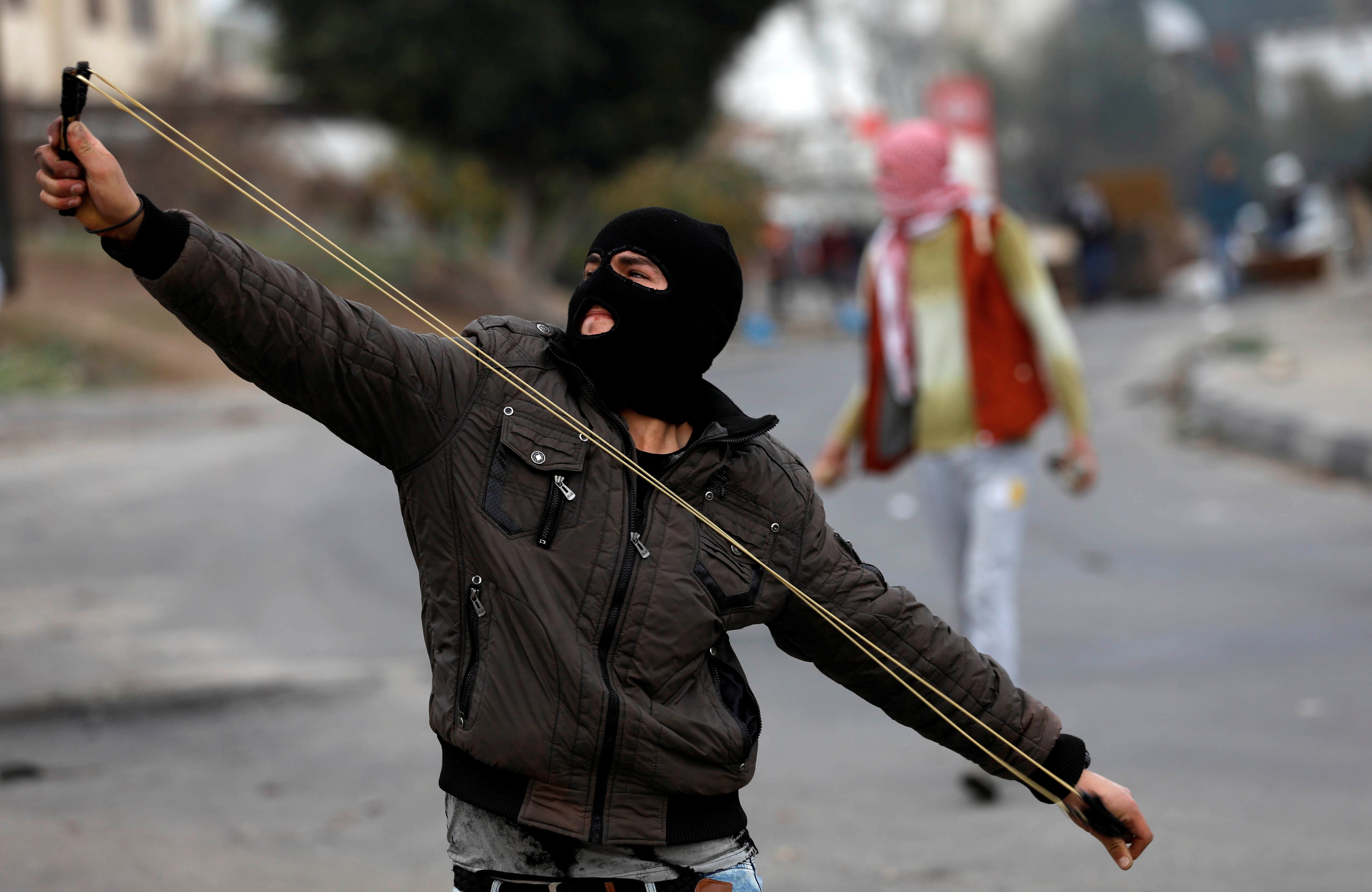
A masked Palestinian demonstrator uses a slingshot to hurl stones towards Israeli troops during clashes at a protest against U.S. President Donald Trump's decision to recognise Jerusalem as the capital of Israel, near the West Bank city

A masked Palestinian demonstrator uses a slingshot to hurl stones towards Israeli troops during clashes at a protest against U.S. President Donald Trump’s decision to recognise Jerusalem as the capital of Israel, near the West Bank city of Nablus, December 29, 2017. REUTERS/Mohamad Torokman

Most countries regard the status of Jerusalem as a matter to be settled in an eventual Israeli-Palestinian peace agreement, although that process is now stalled.

A U.N. General Assembly resolution passed on Dec. 21 rejected Trump’s Jerusalem declaration. A total of 128 countries voted for the U.N. resolution. Nine opposed it and 35 abstained. Twenty-one countries did not cast a vote.

(Reporting by Nidal al-Mughrabi and Maayan Lubell; Editing by Catherine Evans)

Arab states believe U.S. aid secure despite defying Trump Jerusalem move

Members of the United Nations Security Council vote on an Egyptian-drafted resolution regarding recent decisions concerning the status of Jerusalem, during a meeting on the situation in the Middle East, including Palestine, at U.N. Headquarters in New York City, New York, U.S., December 18, 2017.

By Suleiman Al-Khalidi and John Davison

AMMAN/CAIRO (Reuters) – Leading Arab allies threatened with cuts in aid by Donald Trump said on Friday they had no choice but to defy the U.S. president over his recognition of Jerusalem as Israel’s capital, and did not believe he would follow through.

More than 120 countries, including every Arab nation, voted at the U.N. General Assembly late on Thursday to urge the United States to withdraw its decision, announced earlier this month.

Trump threatened to cut off financial aid to countries that voted in favor of the U.N. resolution, drafted by Egypt and supported by all members of the U.N. Security Council except Washington.

He repeated his threat on Friday, writing on Twitter: “After having foolishly spent $7 trillion in the Middle East, it is time to start rebuilding our country!”

In Egypt and Jordan, among the top recipients of U.S. aid but long the most heavily invested in the Israeli-Palestinian peace process, Trump’s threats were not taken seriously enough to backtrack on firm opposition to the U.S. move.

“The Americans know more than any one else that a stable Jordan is crucial for U.S. interests in the region,” a government minister who asked not to be named said.

For its cooperation in defense and other fields, Jordan receives some $1.2 billion annually from Washington.

“We do not expect the American administration to touch assistance but if it does this will only add to Jordan’s economic woes,” the minister said.

UNPREDICTABILITY

Former Jordanian prime minister Taher al-Masri said Jordan’s role as an ally in a volatile region where unrest has led to attacks on U.S. soil would likely keep the aid safe.

“Trump is not giving us aid as charity. Jordan performs a regional role in stability that we have not gone back on delivering,” he said.

In a sign of concern over Trump’s unpredictability, some Jordanian officials privately expressed worry, however.

Masri said the U.N. resolution would have received many more votes from member states had Trump not made his threat.

For Arab and Muslim states, anything less than total rejection of Trump’s Jerusalem decision would have been impossible, he said.

Nations around the world have criticized the move as damaging chances to end the Israeli-Palestinian conflict, and Palestinian President Mahmoud Abbas has rejected any further U.S. role in the peace process.

As home to major Muslim, Jewish and Christian holy sites, Jerusalem’s status has long been fought over in rounds of failed negotiations, and ignited deadly conflict between Israeli and the Palestinians.

Jordan’s monarchy is custodian of Jerusalem’s holy shrines, making Amman sensitive to any changes of status of the disputed city.

SAFETY IN NUMBERS

Egypt, which led regional efforts to reject Trump’s decision as having a “negative impact” on security in the region, has been a key broker of past peace deals. Egypt’s foreign ministry and presidency could not be reached for comment after several attempts following the General Assembly vote.

H.A. Hellyer, an Egypt expert at the Atlantic Council, said Egypt likely felt secure over its $1.3 billion in U.S. military aid despite Trump’s threats.

“I don’t think Egypt will be worried … certainly Trump’s inner circle will not be too impressed – but I doubt that it will extend beyond that,” he said.

Egypt is an important military partner for the United States and is fighting its own Islamist insurgency in part of the vast Sinai Peninsula.

Arab countries are unanimous in their rejection of Trump’s Jerusalem move. Key allies such as Saudi Arabia and Iraq reiterated their stance at the General Assembly vote.

Iraq’s foreign ministry described the result as a “triumph for international law”.

Saudi Arabia’s delegation said their vote on the Palestinian cause reflected a “policy priority since the time of the founder (of Saudi Arabia), King Abdul Aziz.”

It is unclear if U.N. votes and strong rhetoric alone will force Washington to reverse course, however.

Israel, the closest U.S. ally in the Middle East, has heaped praise on Trump. Prime Minister Benjamin Netanyahu hailed his decision, which reversed decades of U.S. policy, as a “historic landmark”.

Israel considers Jerusalem its eternal and indivisible capital and wants all embassies based there. Palestinians want the capital of an independent Palestinian state to be in the city’s eastern sector, which Israel captured in a 1967 war and annexed in a move never recognized internationally.

(Additional reporting by Ahmed Tolba in Cairo, Ahmed Aboulenein in Baghdad, Maha El Dahan in Dubai, Dominic Evans in Istanbul, Editing by William Maclean)

Trump signs tax, government spending bills into law

U.S. President Donald Trump sits at his desk before signing tax overhaul legislation in the Oval Office of the White House in Washington, U.S., December 22, 2017.

By Susan Heavey and Lisa Lambert

WASHINGTON (Reuters) – U.S. President Donald Trump signed Republicans’ massive $1.5 trillion tax overhaul into law on Friday, cementing the biggest legislative victory of his first year in office, and also approved a short-term spending bill that averts a possible government shutdown.

Trump said he wanted to sign the tax bill before leaving Washington on Friday for his Mar-a-Lago estate in Florida, rather than stage a more formal ceremony in January, so he could keep his promise to finish work before Christmas.

“I didn’t want you folks to say I wasn’t keeping my promise. I’m keeping my promise,” he told reporters in the White House.

The two pieces of legislation represent Trump’s most significant accomplishment with Congress since taking office in January, as well as a sign of what awaits when he returns from Florida after the Christmas holiday.

The tax package, the largest such overhaul since the 1980s, slashes the corporate rate from 35 percent to 21 percent and temporarily reduces the tax burden for most individuals as well.

Trump praised several companies that have announced employee bonuses in the wake of the bill’s passage, naming AT&T, Boeing, Wells Fargo, Comcast and Sinclair Broadcast Group.

“Corporations are literally going wild over this,” he said.

Democrats had opposed the bill as a giveaway to the wealthy that would add $1.5 trillion to the $20 trillion national debt during the next decade.

The spending bill extends federal funding through Jan. 19, largely at current levels. It does nothing to resolve broader disputes over immigration, healthcare and military spending.

Republicans also are divided over whether to follow up their sweeping overhaul of the U.S. tax code with a dramatic restructuring of federal benefit programs.

House Speaker Paul Ryan has said he would like to revamp welfare and health programs but Senate Republican Leader Mitch McConnell told National Public Radio on Monday that he was not interested in cutting those programs without Democratic support.

Trump’s year also closes with significant turnover of many top staffers who had been in the White House since early in his term. On Friday, the White House confirmed Deputy Chief of Staff Rick Dearborn and Jeremy Katz, who worked under White House economic adviser Gary Cohn, were leaving.

(Additional reporting by Makini Brice; Writing by Andy Sullivan; Editing by Bill Trott)