Outbid and left hanging, U.S. states scramble for ventilators

By Nathan Layne

(Reuters) – On the final Thursday in March the Arkansas team in charge of procuring ventilators thought they had scored a coup: a vendor had agreed to sell them 500 of the breathing machines critical to keeping COVID-19 patients alive at $19,000 each.

The next day they were told the deal had vanished because a buyer representing New York was offering to purchase 10,000 units, pay cash upfront and double the price, a deal the vendor could not turn down. Reuters could not independently verify that New York bought the ventilators.

Either way, for Arkansas, the search for the machines goes on.

“We still want to purchase the 500,” said Dr. Steppe Mette, chief executive of UAMS Medical Center in Little Rock, who is helping oversee procurement of supplies for the state. “There are profiteers all over the place.”

Arkansas may never need those ventilators. It has 785 across the state, most of which are not currently in use, and data from New York and other hot spots in recent days suggest hospitalizations might be peaking.

In the past week Louisiana and Arizona scaled back their requests for ventilators from the federal government, while Oregon, Washington and California offered up spare units for use by other states.

But the episode illustrates how some states have been muscled aside in the scramble for equipment to combat a virus that has killed nearly 18,000 people in the United States, potentially leaving them vulnerable should the worst-case scenarios materialize or the virus return in subsequent waves.

The stakes are especially high when it comes to ventilators, which can be the difference between life or death for patients suffering from COVID-19, the respiratory illness caused by the novel coronavirus.

Reuters surveyed all 50 states about their ventilator needs. The 31 that either responded or have disclosed figures showed a collective intent to procure 70,000 units, including outstanding requests to the federal government and private sector.

(For an interactive graphic on ventilator inventories by state, click https://graphics.reuters.com/HEALTH-CORONAVIRUS/USA-VENTILATORS/jbyvrbjxveo/index.html)

The Federal Emergency Management Agency (FEMA) has acknowledged there aren’t enough ventilators in the Strategic National Stockpile to meet demand, and is distributing units to states most in need. According a FEMA spokesperson, the federal government has 8,644 ventilators available, including 8,044 in the stockpile and 600 from the Department of Defense.

Some states have criticized the federal government for crowding them out of the market. Rhode Island, which has 300 ventilators, one of the lower inventories among the states, said it is struggling to source the machines.

“Right now it’s almost impossible to procure ventilators,” Rhode Island Governor Gina Raimondo told reporters this week. “It’s really a very poorly organized system.”

SHANGRILA

Arkansas’ Mette said his procurement team had tried to buy the Shangrila 510S, a compact ventilator advertised on the website of the manufacturer, Beijing Aeonmed Co. Ltd. as “Ready to Confront COVID-19”, from a reseller of the machines.

The incident was significant enough that a report was given to Governor Asa Hutchinson, portions of which were read to Reuters. It says the order vanished in a matter of hours after buyers for New York secured a deal for 10,000 units, the maximum that could be produced in two months.

The office of New York Governor Andrew Cuomo did not respond to a request for comment. Cuomo has himself complained about receiving only 2,500 out of an order for 17,000 ventilators from China, with per-unit prices doubling since the outbreak.

Beijing Aeonmed said it had not applied for approval from the U.S. Food & Drug Administration (FDA) for the Shangrila 510S and that producing 10,000 units in such a short time was “unrealistic”.

Roger Biles, the head of a medical supplies company, InterMed Resources TN, helping Arkansas source ventilators from China, said the reseller told them it was New York that had bought the machines but there was no way to know for sure.

“If you snooze you lose in this environment. Product is going left and right,” Biles said. “We couldn’t get the money to them fast enough. They said they are all gone.”

Biles said the reseller provided certification that the Shangrila 510S could be sold in the United States because it had similar specifications to an approved machine, a common process to gain market access. The FDA did not respond to a request for comment.

The administration of President Donald Trump is working with Ford Motor Co and other manufacturers to produce 100,000 ventilators by the end of June, and FEMA has told states it will provide units 72 hours before any surge hits them.

Arkansas still wants a buffer, even with current projections showing it may now only need 300 ventilators at the apex of hospitalizations in the coming weeks, whereas a previous model indicated it may require 2,000 at peak.

“Prepare for the worst, hope for the best. We are still going on that philosophy,” Mette said.

(Reporting by Nathan Layne in Wilton, Connecticut and Roxanne Liu in Beijing; Editing by Paul Thomasch and Daniel Wallis)

‘Here Comes the Sun’ gets U.S. hospitals through dark days of pandemic

By Barbara Goldberg

NEW YORK (Reuters) – The most powerful medicine being used to bolster the morale of New York area healthcare workers at the epicenter of the U.S. novel coronavirus crisis may well be music.

Daily infusions of upbeat songs from The Beatles’ classic “Here Comes the Sun” to the theme from the hang-tough movie “Rocky” are being pumped through hospital public address systems to boost the spirits of nurses, doctors and support staff.

About 545,000 people were diagnosed with COVID-19 in the United States as of Sunday, and roughly 21,600 have died of the highly contagious illness.

A 4:30 p.m. daily dose of Australian pop singer Starley’s “Call On Me” has given strength to staff at one of Mount Sinai’s hospitals in New York City, who clap as a growing number of patients are discharged from the overwhelmed facility across the street from Columbia University.

“Some people would say to accept their fate. Well if this is fate then we’ll find a way to cheat,” Starley sings. “You know you can call on me, if you can’t stop the tears from falling down.”

In New Jersey, the “Rocky” theme song filled the air at St. Joseph Regional Medical Center in Paterson when Dr. James Pruden, the hospital’s director of emergency preparedness, was discharged last week as he recovered from the virus, rolling in his wheelchair past cheering staff.

On New York’s Long Island, the joyful “Here Comes the Sun” blasts overhead on the public address system at Mount Sinai South Nassau in Oceanside every time a COVID-19 patient is discharged.

In Detroit, one of the newest U.S. hot spots for the fast-spreading disease, a Beaumont Health nurse said the 1969 Beatles hit was played not just when patients are discharged but each time they are taken off a ventilator to breath on their own.

“The smiles returning to the faces. Little darling, it seems like years since it’s been here,” rings out the song that George Harrison wrote about renewal after a long, dark winter.

(Additional reporting by Herbert Lash and Jonathan Allen in New York; Editing by Tom Brown)

What you need to know about the coronavirus right now

(Reuters) – Here’s what you need to know about the coronavirus right now:

Restarting crucial industries

India is planning to restart some crucial manufacturing to ease the difficulties of the poor, despite expectations it will extend a 21-day lockdown beyond April 15, two government sources said.

Spain lifts restrictions on some businesses on Monday after shutting down all non-essential operations nearly two weeks ago. This will allow businesses that cannot operate remotely, including construction and manufacturing, to reopen. The move has been criticised by some as risking a resurgence in the spread of the virus.

Patients testing positive again

The World Health Organization (WHO) said on Saturday that it was looking into reports of COVID-19 patients testing positive again after clinically recovering from the disease.

South Korean officials had reported on Friday that 91 patients cleared of the new coronavirus had tested positive again. Jeong Eun-kyeong, director of the Korea Centers for Disease Control and Prevention, told a briefing that the virus may have been “reactivated” rather than the patients being re-infected.

Russian border becomes China’s new frontline

China’s northeastern border with Russia has become its new frontline in the fight against a resurgence in the epidemic, as new daily cases rose to a six-week high.

Half of the imported cases from the daily tally involved Chinese nationals returning home from Russia’s Far Eastern Federal District through border crossings in the Heilongjiang province.

Widespread testing needed

The United States needs to ramp up testing for the coronavirus as the White House considers when and how to lift stay-at-home restrictions and lockdowns triggered by the pandemic, U.S. health experts said on Sunday.

Diagnostic testing determines if somebody is infected with the virus and antibody testing shows who has been infected and is therefore immune. Both will be important in getting people back into the workplace and containing the virus as that happens, the experts said.

‘Ghosts’ patrol streets to keep Indonesians indoors

An Indonesian village on Java island has summoned up ghosts to help it persuade locals to stay indoors during the coronavirus outbreak.

The ghosts are in fact villagers dressed up as “pocong”, ghostly figures wrapped in white shrouds with powdered faces and kohl-rimmed eyes.

“We wanted to be different and create a deterrent effect because ‘pocong’ are spooky and scary,” said Anjar Pancaningtyas, head of a village youth group that coordinated with the police on the unconventional initiative.

In Indonesian folklore, “pocong” represent the trapped souls of the dead.

(Compiled by Karishma Singh)

‘Elbow to elbow:’ North America meat plant workers fall ill, walk off jobs

By Tom Polansek and Rod Nickel

CHICAGO/WINNIPEG, Manitoba (Reuters) – At a Wayne Farms chicken processing plant in Alabama, workers recently had to pay the company 10 cents a day to buy masks to protect themselves from the new coronavirus, according to a meat inspector.

In Colorado, nearly a third of the workers at a JBS USA beef plant stayed home amid safety concerns for the last two weeks as a 30-year employee of the facility died following complications from the virus.

And since an Olymel pork plant in Quebec shut on March 29, the number of workers who tested positive for the coronavirus quintupled to more than 50, according to their union. The facility and at least 10 others in North America have temporarily closed or reduced production in about the last two weeks because of the pandemic, disrupting food supply chains that have struggled to keep pace with surging demand at grocery stores.

According to more than a dozen interviews with U.S and Canadian plant workers, union leaders and industry analysts, a lack of protective equipment and the nature of “elbow to elbow” work required to debone chickens, chop beef and slice hams are highlighting risks for employees and limiting output as some forego the low-paying work. Companies that added protections, such as enhanced cleaning or spacing out workers, say the moves are further slowing meat production.

Smithfield Foods, the world’s biggest pork processor, on Sunday said it is shutting a pork plant indefinitely and warned that plant shutdowns are pushing the United States “perilously close to the edge” in meat supplies for grocers.

Lockdowns that aim to stop the spread of the coronavirus have prevented farmers across the globe from delivering produce to consumers. Millions of laborers also cannot get to the fields for harvesting and planting, and there are too few truckers to keep goods moving.

The United States and Canada are among the world’s biggest shippers of beef and pork. Food production has continued as governments try to ensure adequate supplies, even as they close broad swathes of the economy.

The closures and increased absenteeism among workers have contributed to drops in the price of livestock, as farmers find fewer places for slaughter. Since March 25, nearby lean hog futures have plunged 35%, and live cattle prices shed 15%, straining the U.S. farm economy.

North American meat demand has dropped some 30% in the past month as declining sales of restaurant meats like steaks and chicken wings outweighed a spike in retail demand for ground beef, said Christine McCracken, Rabobank’s animal protein analyst.

Frozen meats in U.S. cold storage facilities remain plentiful, but supply could be whittled down as exports to protein-hungry China increase after a trade agreement removed obstacles for American meat purchases.

“There’s a huge risk of additional plant closures,” McCracken said.

JBS had to reduce beef production at a massive plant in Greeley, Colorado, as about 800 to 1,000 workers a day stayed home since the end of March, said Kim Cordova, president of the local United Food and Commercial Workers (UFCW) union that represents employees.

“There’s just not enough people,” Cordova said. She added that the union knew of at least 50 cases and two deaths among employees as of Friday.

Plant worker Saul Sanchez, known affectionately as “grandpa” among some co-workers, tested positive for the virus and died on April 7 at 78 years old, according to his daughter, Beatriz Rangel. She said he only went from home to work before developing symptoms, including a low fever.

“I’m heartbroken because my dad was so loyal,” Rangel said.

Brazilian owned JBS confirmed an employee with three decades of experience died from complications associated with COVID-19, without naming Sanchez. The company said he had not been at work since March 20, the same day JBS removed people older than 70 from its facilities as a precaution. He was never symptomatic while at work and never worked in the facility while sick, according to the company.

JBS said it was working with federal and state governments to obtain tests for all plant employees.

Weld County, where the plant is located, had the fourth highest number of COVID-19 cases of any county in Colorado on Friday, according to the state. Health officials confirmed cases among JBS workers.

JBS said high absenteeism at the plant led slaughter rates to outpace the process of cutting carcasses into pieces of beef. The company disputed the union’s numbers on worker absences but did not provide its own. It took steps including buying masks and putting up plexiglass shields in lunch rooms to protect employees, said Cameron Bruett, spokesman for JBS USA.

“MY LIFE IS IN JEOPARDY”

At Wayne Farms’ chicken plant in Decatur, Alabama, some workers are upset the company recently made employees pay for masks, said Mona Darby, who inspects chicken breasts there and is a local leader of hundreds of poultry workers for the Retail, Wholesale and Department Store Union.

“My life is in jeopardy because we’re working elbow to elbow,” she said.

Wayne Farms, with annual sales exceeding $2 billion, is trying to obtain masks to distribute to employees, though supplies are limited, spokesman Frank Singleton said. He said he did not know of any instances where employees were charged for masks.

Workers at a Tyson Foods Inc chicken plant in Shelbyville, Tennessee, bought their own masks when the facility ran out, said Kim Hickerson, who loads chicken on trucks there and is a union leader. Some are talking about quitting because they are scared of getting sick, he said.

“I just put it in God’s hands,” he said.

Tyson, the top U.S. meat producer, is working to find more personal protective equipment for employees, spokesman Worth Sparkman said. The company increased cleaning at facilities and sought to space out employees, which can both slow production, according to a statement.

Workers have lost their trust in Olymel after an outbreak of the coronavirus closed a plant in Yamachiche, Quebec, according to union spokeswoman Anouk Collet. “They do not feel that the company took all the measures they could have taken to keep them safe,” she said.

Company spokesman Richard Vigneault said the plant will reopen on Tuesday with new measures in place, such as separating panels, masks and visors.

Marc Perrone, international president of the UFCW union, said meat plant workers are increasingly weighing concerns about their own safety and their responsibility to produce food.

“If we don’t take care of the food supply, the American people are going to panic,” he said.

(Reporting by Tom Polansek in Chicago and Rod Nickel in Winnipeg, Manitoba; Editing by Caroline Stauffer and Edward Tobin)

U.S. coronavirus outbreak could peak this week, CDC director says

By Doina Chiacu and Lisa Lambert

WASHINGTON (Reuters) – The coronavirus outbreak could reach its peak in the United States this week, a top U.S. health official said on Monday, pointing to signs of stabilization across the country.

The United States, with the world’s third-largest population, has recorded more fatalities from COVID-19 than any other country, more than 22,000 as of Monday morning according to a Reuters tally.

About 2,000 deaths were reported for each of the last four days in a row, the largest number of them in and around New York City. Experts say official statistics have understated the actual number of people who have succumbed to the respiratory disease, having excluded coronavirus-related deaths at home.

“We are nearing the peak right now,” Robert Redfield, director of the Centers for Disease Control and Prevention (CDC) told NBC’s “Today” show. “You’ll know when you’re at the peak when the next day is actually less than the day before.”

Sweeping stay-at-home restrictions to curb the spread of the disease, in place for weeks in many areas of the country, have taken a painful toll on the economy, raising questions over how the country can sustain business closures and travel curbs.

On Sunday, a Trump administration official indicated May 1 as a potential date for easing the restrictions while cautioning that it was still too early to say whether that goal would be met.

Redfield refused to give a time frame for the re-opening of the U.S. economy and praised social-distancing measures that he said helped curb the mortality rate.

“There’s no doubt we have to reopen correctly,” Redfield said. “It’s going to be a step-by-step gradual process. It’s got to be data-driven.”

Nancy Pelosi, speaker of the U.S. House of Representatives, cautioned that the country was not prepared to end the shutdown.

“We all desire an end to the shutdown orders so we can get Americans back to work and back to normal,” Pelosi said in a statement. “However, there is still not enough testing available to realistically allow that to happen.”

This week Congress will work on further measures to soften the blow of the pandemic. Democrats want to add money for other anti-coronavirus efforts to a measure targeted at small businesses, including funding for rapid national testing and personal protective equipment.

“It cannot wait,” Pelosi said.

President Donald Trump retweeted a call to fire Dr. Anthony Fauci after the country’s top expert on infectious diseases said lives could have been saved if the country had shut down sooner during the novel coronavirus outbreak.

The retweet fueled speculation Trump was running out of patience with the popular scientist and could fire him. The White House on Monday did not comment on Trump’s retweet.

(Reporting by Doina Chiacu and Lisa Lambert in Washington, writing by Maria Caspani; Editing by)

Food trucks start feeding big rig drivers at Interstate rest stops

By Lisa Baertlein

LOS ANGELES (Reuters) – Big rig driver Tanuya White was running essential products from Chicago to Shreveport, Louisiana, on Saturday when she stopped to sample food truck fare at a rest stop on Interstate 30 near Social Hill, Arkansas.

It was a welcome respite for White, who like other U.S. truck drivers is scrambling to find food – as well as bathrooms, showers and protective gear – after millions of businesses closed to help contain the spread of COVID-19 infections.

The Federal Highway Administration (FHWA) on April 3 gave mobile restaurants temporary permission to use Interstate rest areas to feed truckers who are transporting vital food, personal protective equipment and medical devices during the COVID-19 pandemic that has killed more than 20,000 people in the United States. “This is so needed,” White, 51, told Reuters via cellphone.

During her rest stop break, White grabbed a hot dog, french fries, funnel cake and a pot roast dinner to go.

“I haven’t had a funnel cake since I was a teenager,” White said. “I was smiling the whole time they were cooking it.”

U.S. restaurants have shuttered or switched to limited service due to stay-at-home orders covering most of the country.

While many fast-food service windows are open, truckers told Reuters their tractor-trailers don’t fit in drive-through lanes and walk-up orders are not allowed. “Sometimes you just want a decent meal,” said trucker Rodney Tweedie, 52, who transports everything from produce to beer in his “reefer” – as refrigerated trailers are known.

“Food trucks may provide vital sustenance for interstate commercial truck drivers and others who are critical to the nation’s continued ability to deliver needed food and relief supplies to the communities impacted by the economic disruptions and healthcare strains caused by COVID-19,” FHWA said in its notice.

States like Arkansas, Ohio, Indiana and Florida are rushing to issue temporary permits to get the emergency food truck program rolling.

Jennifer McKinzie said it took just hours to get the permission she needed to operate BowMcks Rolling Cuisine at two Arkansas rest stops. A few days later, McKinzie and her husband were selling a $10 pot roast dinner with potatoes, salad, gravy, bread and a drink to White and other drivers.

“I’m sure they’re tired,” said McKinzie, who enjoys giving truckers what they need to recharge.

“Yesterday, we heard a guy say, ‘I just need a Monster (energy drink).’ Today we have Monsters,” McKinzie said.

The National Association of Truck Stop Operators (NATSO) is lobbying the FHWA and governors to hit the brakes on the program. NATSO represents the interests of companies like TravelCenters of America Inc and Pilot Flying J, which is partly owned by Warren Buffett’s Berkshire Hathaway Inc.

The National Restaurant Association and the organization that represents blind vendors, who are allowed to manage vending machines at rest areas along federal Interstates, have joined NATSO’s protest.

Angie Werner, co-owner of The Meat Guy’s BBQ Shack, says she’s been blocked from serving food in rest stops.

“We want to, but the state of Michigan says we can’t,” Werner said.

(Reporting by Lisa Baertlein in Los Angeles)

U.S. officials hopeful about May 1 target date for reopening U.S.

WASHINGTON (Reuters) – The Trump administration views May 1 as a target date for relaxing stay-at-home restrictions across the United States, Food and Drug Administration Commissioner Stephen Hahn said on Sunday, but he cautioned that it was still too early to say that target would be met.

“We see light at the end of the tunnel,” he told ABC’s “This Week.” However, there were many factors to take into account in finally determining when it would be safe to lift restrictions, he said.

(Reporting By Ross Colvin; editing by Diane Craft)

With 20,500 coronavirus deaths, U.S. spends Easter Sunday on lockdown

(Reuters) – Americans spent Sunday on lockdown as the U.S. toll from the novel coronavirus pandemic surpassed 20,500 deaths and more than half a million confirmed cases over the Easter weekend.

With most of the country under stay-at-home orders to curb the spread of the disease, many turned to online church services to mark the holiest day in the Christian calendar.

“Future generations will look back on this as the long Lent of 2020, a time when disease and death suddenly darkened the whole earth,” Archbishop Jose Gomez of Los Angeles wrote to priests and parishioners nationwide, urging them to hold steadfast. “Our churches may be closed but Christ is not quarantined and his Gospel is not in chains.”

A few people take to the plaza at the Lincoln Memorial during the coronavirus disease (COVID-19) outbreak, where normally thousands of Christians would gather for worship at Easter sunrise, in Washington, U.S. April 12, 2020. REUTERS/Jonathan Ernst

The United States has seen its highest death tolls to date from the COVID-19 disease caused by the coronavirus, with roughly 2,000 deaths a day reported for the last four days in a row, the largest number in and around New York City. Even that is viewed as understated, as New York is still figuring out how best to include a surge in deaths at home in its official statistics.

As the death toll has mounted, President Donald Trump mulled over when the country might begin to see a return to normality.

His administration sees May 1 as a target date for relaxing the stay-at-home restrictions, Food and Drug Administration Commissioner Stephen Hahn said on Sunday. But he cautioned that it was still too early to say that target would be met.

“We see light at the end of the tunnel,” Hahn told ABC’s “This Week,” adding, “Public safety and the welfare of the American people has to come first. That has to ultimately drive these decisions”

The top U.S. infectious disease expert said he was cautiously optimistic that some of the country is starting to see a turnaround in the fight against the outbreak.

Dr. Anthony Fauci pointed to the New York metropolitan area, which had its highest daily death toll last week alongside a decrease in hospitalizations, intensive care admissions and the need to intubate critically ill patients.

“Not only is it flat, it’s starting to turn the corner,” Fauci said on Sunday on CNN’s “State of the Union.”

“Once you turn that corner, hopefully you’ll see a very sharp decline and then you can start thinking about how we can keep it that way and prevent it from resurging,” he said.

The Trump administration renewed talk of quickly reopening the economy after an influential university research model cut its U.S. mortality forecasts to 60,000 deaths by Aug. 4, down from at least 100,000, assuming social-distancing measures stay.

However, new government data shows a summer surge in infections if stay-at-home orders are lifted after only 30 days, according to projections first reported by the New York Times and confirmed by a Department of Homeland Security official.

https://graphics.reuters.com/HEALTH-CORONAVIRUS-USA/0100B5K8423/index.html

(Reporting by Barbara Goldberg, Doina Chiacu, Ross Colvin and Christopher Bing; Writing by Daniel Wallis; editing by Diane Craft)

Sign of the times: Mile-long line of cars outside California grocery giveaway

By Lucy Nicholson

VAN NUYS, Calif. (Reuters) – A pop-up food pantry in Southern California on Thursday drew so many people that the line of cars waiting for free groceries stretched about a mile (1.6 km), a haunting sign of how the coronavirus pandemic has hurt the working poor.

Hundreds of other people, many wearing trash bags to shelter from the rain, arrived at the one-day grocery giveaway on foot, forming a blocks-long queue in Van Nuys, in the central San Fernando Valley region of Los Angeles.

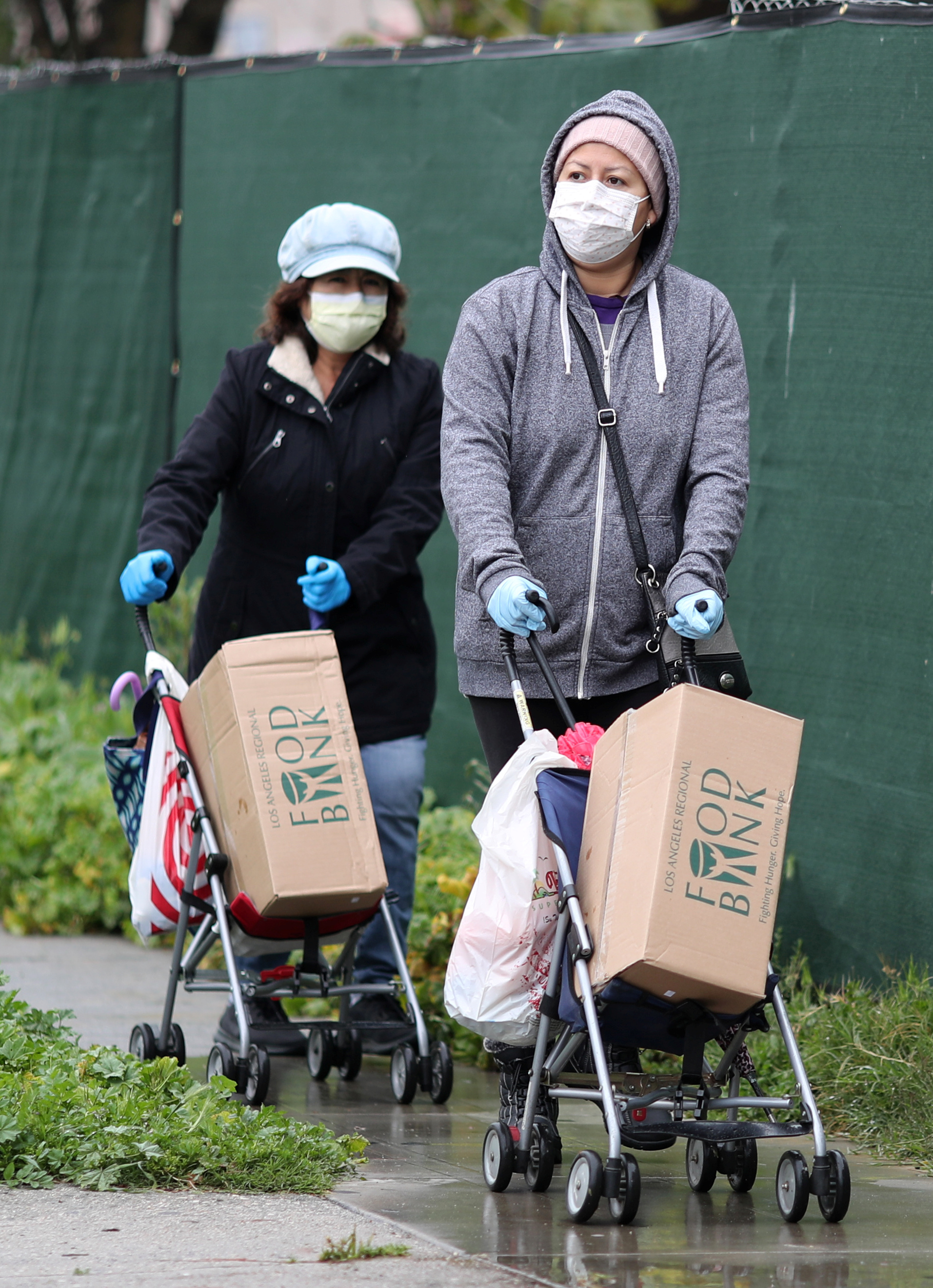
People pick up fresh food at a Los Angeles Regional Food Bank giveaway of 2,000 boxes of groceries, as the spread of the coronavirus disease (COVID-19) continues, in Los Angeles, California, U.S., April 9, 2020. REUTERS/Lucy Nicholson

Organizers said they had enough groceries to hand out to more than 2,500 families, with each receiving a 36-pound (16-kg) box of rice, lentils and other staples as well as frozen chicken, oranges and other foods.

“I have six kids and it’s difficult to eat. My husband was working in construction but now we can’t pay the rent,” said Juana Gomez, 50, of North Hollywood, as she waited for her turn.

The COVID-19 pandemic has shut down nonessential businesses across the United States, with more than 90% of Americans under some kind of stay-at-home order, depriving millions of a paycheck.

The northeast part of Los Angeles, home to many working poor Latino families, has been especially hard hit.

LA Regional Food Bank supplied the food donated outside Van Nuys City Hall. Its president, Michael Flood, said such giveaways were becoming an increasingly important way to help feed people in need, with “one or two a day” being held in different locations in Los Angeles County.

Thursday’s food giveaway — coordinated by Los Angeles City Council President Nury Martinez in partnership with the Los Angeles Federation of Labor, AFL-CIO, the Los Angeles Regional Food Bank and Labor Community Services — was open to anyone in need.

“This food saves me money because my little income goes to my rent,” said Daniel Jimenez, 40, an independent contractor for golf tournaments whose young children joined him to pick up food.

“I haven’t been working for three weeks. I have a little money saved but I’m paying rent, gas, and cellphone bills. I don’t even know when we’re going back to work,” he said.

As he spoke, volunteers shouted constant reminders to those who walked up to maintain social distancing.

“For a lot of people, they are new to the situation of needing help and not knowing where to turn,” Flood said, noting many people were now suddenly filing for unemployment and government food assistance programs.

“But that may take some time for them to get those benefits. We want to do what we can to get food in the hands of families, just so they can eat,” he said.

(Writing by Barbara Goldberg in New York; Editing by Frank McGurty and Tom Brown)

Coronavirus forces Americans to find Easter fun at least 6 feet apart

By Barbara Goldberg

NEW YORK (Reuters) – Easter is a special holiday for 6-year-old Nora Heddendorf. It’s a day when she loves to get dolled up in a fancy dress and shiny shoes, and have fun with family and friends hunting for brightly colored eggs.

This year the coronavirus pandemic has forced her to adapt. She will accessorize her Easter outfit with a white paper mask, blue disposable gloves, and a container of disinfectant wipes. And after hearing that her New Jersey town’s annual egg hunt may be canceled, she came up with the idea of a “rock hunt.”

Nora’s hunt not only substitutes brightly painted stones for eggs, which are in short supply at some stores, but it also allows her neighbors to do their hunting during their social-distancing walks.

“I was sad it was going to be canceled because of the virus,” the kindergartener told Reuters in a phone interview. “I want to make people happy.”

From the White House to small town parks, the pandemic has forced the cancellation of traditional Easter egg hunts and “rolls” across the United States, closed churches, and scotched plans for Easter meals with extended families.

But many Americans are still finding ways to have holiday fun, from an Oregon candymaker making chocolate bunnies wearing face masks to a Texas church organizing a virtual egg hunt using the video game Minecraft.

Weeks ago, Nora and her mother started organizing her hunt in their town of Medford Lakes. She assembled dozens of DIY kits, each containing five rocks, four paint colors, and instructions, all wrapped in a plastic bag. Of course, she wore disposable gloves and sprayed the contents with disinfectant.

She then left the kits outside her home for pick-up by people who want to participate. On her Facebook page, Nora’s Rocks, the young artist urged her community to return decorated rocks to her to hide.

“Thank you for helping Nora’s Rocks bring our town together while staying apart,” said the instruction letter she included in the kits.

Her mother, Samantha Heddendorf, president of an environmental cleanup company that has been decontaminating buildings affected by the coronavirus crisis, said the hunt will start on Good Friday and continue through Easter Sunday, with fresh batches of painted rocks hidden each day.

The goal is to place 500 stone “eggs” in every nook and cranny of the 1 square mile (2.6 square km) town.

“When people are doing their social distancing walks, they can look for rocks – or so-called Easter Eggs. They can have something to hunt for and pick them up and at least have a smile to celebrate Easter with,” Samantha Heddendorf said.

In Central Point, Oregon, chocolatier Jeff Shepherd had a brainstorm to save his Lillie Belle Farms from shutdown in the wake of the coronavirus. He told his Facebook followers that he would make “Covid Bunnies” – milk and dark chocolate ones with white face masks and white chocolate ones with blue face masks.

Six-year-old Nora Heddendorf displays her do-it-yourself kits for a painted rock hunt she and her mother are organizing in their town of Medford Lakes, New Jersey, U.S., March 28, 2020 amid the coronavirus disease (COVID-19) outbreak. Samantha Heddendorf/Handout via REUTERS

It was an instant hit. Shepherd was able to hire back the seven full-time staff he had laid off, has sold 5,000 bunnies, and is scrambling with back orders, now limiting purchases to six per customer.

Safe distancing to thwart virus spread is what convinced the Tate Springs Baptist Church in Arlington, Texas, to go digital with its Easter Egg hunt, using Minecraft but disabling potentially scary game elements like monsters.

“Our ultimate goal is to spread the gospel, but we want the kids to still enjoy Easter,” said Reverend Curtis James.

Back in New Jersey, Nora was excited that her idea was warmly embraced by so many, with the town mayor stopping by to witness her stuffing the kits and the local Lions Club inviting her for lunch “when this whole thing is over.”

Her favorite “thank you” was gift-wrapped rolls of toilet paper, one of the staples – including eggs – being hoarded by people panic buying during the pandemic.

“My mom smiled when the toilet paper came,” Nora said.

(Reporting by Barbara Goldberg in New York; Additional reporting by Rich McKay in Atlanta; Editing by Rosalba O’Brien)