Ohio governor tests positive for COVID-19, cancels plans to greet Trump in Cleveland

WASHINGTON (Reuters) – Ohio Governor Mike DeWine said on Thursday he had tested positive for COVID-19 as part of a safety protocol to greet U.S. President Donald Trump when he arrives in Cleveland to visit a Whirlpool washing machine factory.

A statement issued on DeWine’s Twitter feed said the governor, a Republican, had no symptoms at the present time and would return to the Ohio capital of Columbus to quarantine at home for the next 14 days. Ohio Lieutenant Governor Jon Husted also took the coronavirus test and tested negative, DeWine’s statement said.

White House Chief of Staff Mark Meadows said alternate arrangements were being made for greeting Trump and there would be no major changes to the president’s itinerary in Ohio.

“The President wishes Governor DeWine a speedy and full recovery and commends the job he’s doing for the great state of Ohio,” said White House spokesman Judd Deere.

At the Whirlpool plant in Clyde, Ohio, Trump will tout the tariffs his administration imposed on imported washing machines in 2018, which have helped increase employment at the facility while contributing to price increases for the appliances.

Trump also plans to sign a long-awaited executive order aimed at boosting U.S. production of drugs and medical equipment, including through a “Buy America” provision requiring the government to buy from domestic firms and other measures..

Later on Thursday, Trump is due to attend fundraising events at a Cleveland-area yacht club and at the Trump National Golf Club in Bedminster, New Jersey.

(Reporting by David Lawder; Editing by Chris Reese and Tom Brown)

U.S. steps up campaign to purge ‘untrusted’ Chinese apps

By Humeyra Pamuk and David Brunnstrom

WASHINGTON (Reuters) – The Trump administration said on Wednesday it was stepping up efforts to purge “untrusted” Chinese apps from U.S. digital networks and called the Chinese-owned short-video app TikTok and messenger app WeChat “significant threats.”

U.S. Secretary of State Mike Pompeo said expanded U.S. efforts on a program it calls “Clean Network” would focus on five areas and include steps to prevent various Chinese apps, as well as Chinese telecoms companies, from accessing sensitive information on American citizens and businesses.

Pompeo’s announcement comes after U.S. President Donald Trump threatened to ban TikTok. The hugely popular video-sharing app has come under fire from U.S. lawmakers and the administration over national security concerns, amid intensified tensions between Washington and Beijing.

“With parent companies based in China, apps like TikTok, WeChat and others are significant threats to personal data of American citizens, not to mention tools for CCP (Chinese Communist Party) content censorship,” Pompeo said.

In an interview with state news agency Xinhua on Wednesday, Chinese foreign minister Wang Yi said the United States “has no right” to set up the “Clean Network” and calls the actions by Washington as “a textbook case of bullying”.

“Anyone can see through clearly that the intention of the U.S. is to protect it’s monopoly position in technology and to rob other countries of their proper right to development,” said Wang.

TikTok currently faces a deadline of Sept. 15 to either sell its U.S. operations to Microsoft Corp. or face an outright ban.

In the run-up to Trump’s November re-election bid, U.S.-China ties are at the lowest ebb in decades. Relations are strained over the global coronavirus pandemic, China’s military buildup in the South China Sea, its increasing control over Hong Kong and treatment of Uighur Muslims, as well as Beijing’s massive trade surpluses and technological rivalry.

Pompeo said the United States was working to prevent Chinese telecoms firm Huawei Technologies Co Ltd from pre-installing or making available for download the most popular U.S. apps on its phones.

“We don’t want companies to be complicit in Huawei’s human rights abuses, or the CCP’s surveillance apparatus,” Pompeo said, without mentioning any specific U.S. companies.

Pompeo said the State Department would work with other government agencies to protect the data of U.S. citizens and American intellectual property, including COVID-19 vaccine research, by preventing access from cloud-based systems run by companies such as Alibaba, Baidu, China Mobile, China Telecom, and Tencent.

Pompeo said he was joining Attorney General William Barr, Secretary of Defense Mark Esper, and Acting Homeland Security Secretary Chad Wolf in urging the U.S. telecoms regulator, the Federal Communications Commission, to terminate authorizations for China Telecom and three other companies to provide services to and from the United States.

He said the State Department was also working to ensure China could not compromise information carried by undersea cables that connect the United States to the global internet.

The United States has long been lobbying European and other allies to persuade them to cut out Huawei from their telecommunications networks. Huawei denies it spies for China and says the United States wants to frustrate its growth because no U.S. company offers the same technology at a competitive price.

Pompeo’s comments on Wednesday reflected a wider and more accelerated push by Washington to limit the access of Chinese technology companies to U.S. market and consumers and, as one U.S. official put it, to push back against a “massive campaign to steal and weaponize our data against us.”

A State Department statement said momentum for the Clean Network program was growing and more than 30 countries and territories were now “Clean Countries” and many of the world’s biggest telecommunications companies “Clean Telcos.”

It called on U.S. allies “to join the growing tide to secure our data from the CCP’s surveillance state and other malign entities.”

Huawei Technologies and Tencent declined to comment. Alibaba, Apple, China Telecom, China Mobile and Baidu did not immediately respond to requests for comment.

(Reporting by Humeyra Pamuk, David Brunnstrom and Matt Spetalnick; Additional reporting by Yew Lun Tian and Yingzhi Yang in Beijing, Josh Horwitz in Shanghai, Pei Li in Hong Kong and David Kirton in Shenzhen; Editing by Mary Milliken, Rosalba O’Brien and Michael Perry)

New York seeks to break up National Rifle Association, alleging financial mismanagement

FILE PHOTO: A sign of the National Rifle Association (NRA) is seen in front of their headquarters in Fairfax, Virginia, U.S. on March 14, 2013. REUTERS/Larry Downing/File Photo

By Daniel Trotta and David Shepardson

(Reuters) – New York state’s attorney general sued to dissolve the National Rifle Association on Thursday, alleging senior leaders of the non-profit group diverted millions of dollars for personal use and to buy the silence and loyalty of former employees.

The lawsuit announced by Attorney General Letitia James alleges NRA leaders paid for family trips to the Bahamas, private jets and expensive meals that contributed to a $64 million reduction in the NRA’s balance sheet in three years, turning a surplus into a deficit.

James alleged in a statement that NRA leaders “used millions upon millions from NRA reserves for personal use,” failing to comply with the NRA’s own internal policies in addition to state and federal law.

In announcing the lawsuit, James told reporters the NRA “has operated as a breeding ground for greed, abuse and brazen illegality.” She added “no one is above the law” – including the NRA.

At the same time, the attorney general for Washington, D.C., filed suit against the NRA and its foundation, alleging the misuse of charitable funds and wasteful spending.

The confrontation pits James, a Democrat, against the largest and most powerful gun organization in the United States, one that is closely aligned with President Donald Trump’s Republican Party.

Briefing reporters, James denied the suit was motivated by the NRA’s support for Trump

The action is certain to further polarize a country where the NRA is revered by conservatives as a champion of the U.S. Constitutional right to keep and bear arms and vilified by liberals as an enabler of rampant gun violence.

“The NRA’s influence has been so powerful that the organization went unchecked for decades while top executives funneled millions into their own pockets,” James said in a statement. “The NRA is fraught with fraud and abuse, which is why, today, we seek to dissolve the NRA, because no organization is above the law.”

The NRA, which teaches gun safety in addition to advocating laws making it easier for Americans to own guns and ammunition, is subject to New York law because it is registered as a non-profit organization in New York, where it conducts most of its financial transactions.

The NRA, which has its national headquarters in Fairfax, Virginia, about 20 miles (30 km) west of Washington, D.C., did not immediately respond to a request for comment.

New York state and the NRA have tangled before. The state has taken legal action against NRA-branded insurance policies sold to gun owners, and the NRA is suing the state for closing gun stores under an executive order to halt the spread of COVID-19.

The latest lawsuit names the NRA as a whole and four senior executives of the group including Wayne LaPierre, the executive vice-president who has been atop the leadership for decades.

It also names former Treasurer and Chief Financial Officer Wilson Phillips, former Chief of Staff and Executive Director of General Operations Joshua Powell, and Corporate Secretary and General Counsel John Frazer.

The suit charges the NRA with “awarding contracts to the financial gain of close associates and family, and appearing to dole out lucrative no-show contracts to former employees in order to buy their silence and continued loyalty,” James’s office said in a statement.

“The failure of the NRA to comply with multiple fiduciary responsibilities and state and federal laws resulted in the NRA seeing substantial losses on its balance sheet: going from a surplus of $27,802,714 in 2015 to a net deficit of $36,276,779 in 2018 – contributing to a total loss of more than $64 million in just three years,” the statement said.

In addition to attempting to close down a group that has existed since 1871, James seeks to recover millions of dollars in lost assets and to stop the four executives from serving on he board of any other not-for-profit group in the state.

(Reporting by Daniel Trotta and David Shepardson; Editing by Howard Goller)

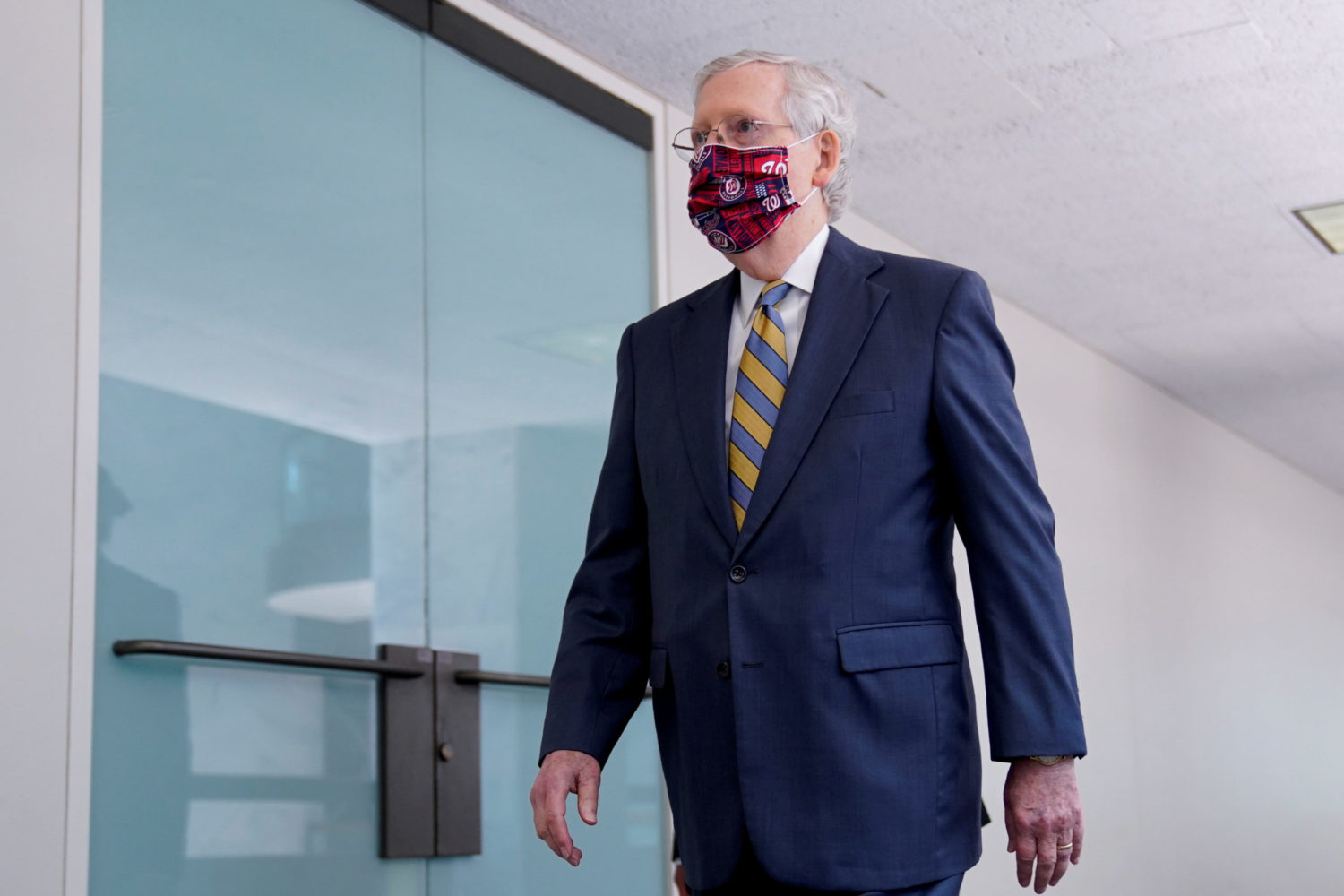
McConnell says U.S. needs ‘another boost’ as coronavirus relief talks continue

By Patricia Zengerle

WASHINGTON (Reuters) – Senate Majority Leader Mitch McConnell on Thursday said the U.S. economy needs an “additional boost” to cope with the fallout of the coronavirus pandemic, as his Democratic counterparts and White House officials try to hash out a next wave of relief.

As talks neared the end of their second week, the four principal negotiators – a group that does not include McConnell – appeared to be near agreement on some topics, but still trillions of dollars apart on major issues including the size of a federal benefit for tens of millions of unemployed workers.

McConnell said he agreed with Federal Reserve Chairman Jerome Powell and Treasury Secretary Steven Mnuchin that agreement is needed on another aid package, even though some of his fellow Republicans in the Senate do not think so.

“I think we need an additional agreement,” the Republican Senate leader told CNBC, adding “the economy does need an additional boost.” Nonpartisan analysts say McConnell’s Republicans face a risk of losing their Senate majority in November’s elections.

McConnell continued to insist that unemployment benefits in any deal should be adjusted downward and that the agreement should include liability protections against lawsuits for reopening businesses during the pandemic.

Mnuchin was due to join fellow Republican Mark Meadows, the White House chief of staff, and the two top congressional Democrats, House of Representatives Speaker Nancy Pelosi and Senate Democratic leader Chuck Schumer, for talks on Capitol Hill at 5 p.m. EDT (2100 GMT).

Others not in the negotiation room considered their own actions, as Republican senators said they had been told that no deal by Friday would mean no deal at all.

Republican President Donald Trump stood ready to use executive orders to address issues such as unemployment benefits and protections against evictions if talks failed, according to Meadows.

Republican Senator Marco Rubio told reporters that the Senate on Thursday could also take up a new version of the Payroll Protection Program that provides financial assistance to small businesses in the form of forgivable loans.

Congress passed more than $3 trillion in relief legislation early in the pandemic. But lawmakers missed a deadline last week to extend the $600 per week in enhanced unemployment payments that played a key role in propping up the economy.

Pelosi and Schumer have pushed for a comprehensive package of assistance for the unemployed, the poor, hospitals, schools and state and local governments.

“The leader and I are determined that we will come to agreement. But it has to meet the needs of the American people,” Pelosi said.

Mnuchin has warned that the Trump administration would not accept “anything close” to the $3.4 trillion in new aid sought by Democrats. Senate Republicans have proposed a $1 trillion package that many of their own members have rejected.

Exclusive: Taiwan in talks to make first purchase of sophisticated U.S. drones – sources

FILE PHOTO: Flags of Taiwan and U.S. are placed for a meeting between U.S. House Foreign Affairs Committee Chairman Ed Royce speaks and with Su Chia-chyuan, President of the Legislative Yuan in Taipei, Taiwan March 27, 2018. REUTERS/Tyrone Siu

By Mike Stone

WASHINGTON (Reuters) – The United States is negotiating the sale of at least four of its large sophisticated aerial drones to Taiwan for the first time, according to six U.S. sources familiar with the negotiations, in a deal that is likely to ratchet up tensions with China.

The SeaGuardian surveillance drones have a range of 6,000 nautical miles (11,100 km), far greater than the 160-mile range of Taiwan’s current fleet of drones.

While the sale of the unmanned aerial vehicles has been tacitly authorized by the State Department, two of the people said, it is not known whether the U.S. officials have approved exporting the drones with weapons attached, one of them said.

The deal has to be approved by members of Congress who may receive formal notification as soon as next month, two of the people said. Congress could choose to block a final agreement.

It would be the first drone sale after President Donald Trump’s administration moved ahead with its plan to sell more drones to more countries by reinterpreting an international arms control agreement called the Missile Technology Control Regime (MTCR).

While Taiwan’s military is well-trained and well-equipped with mostly U.S.-made hardware, China has a huge numerical superiority and is adding advanced equipment of its own.

Taiwan submitted its request to buy armed drones early this year, one of the people familiar with the talks said. The United States last week sent Taiwan the pricing and availability data for the deal, a key step that denotes official approval to advance the sale. It is, however, non-binding and could be reversed.

A deal for the four drones, ground stations, spares, training and support could be worth around $600 million using previous sales as a guide. There could also be options for additional units in the future, one of the people said.

The island is bolstering its defenses in the face of what it sees as increasingly threatening moves by Beijing, such as regular Chinese air force and naval exercises near Taiwan

Relations between Beijing and Washington – already at their lowest point in decades over accusations of spying, a trade war, the coronavirus and Hong Kong – could fray more if the deal gets the final go-ahead from U.S. officials. The Pentagon has said arms sales to Taiwan will continue, and the Trump administration has kept a steady pace of Navy warships passing through the Taiwan Strait.

China claims Taiwan as its own territory, and Beijing has never renounced the use of force to bring the self-ruled island under its control. Beijing has denounced the Trump administration’s increased support for Taiwan.

China’s sophisticated air defenses could likely shoot down a handful of drones, according to Bonnie Glaser, the director of the China Power Project at CSIS, a Washington think tank. But she still expects “China to scream about even the smallest arms sale that the U.S. makes to Taiwan because any sale challenges the ‘One China’ principle.”

“They get particularly agitated if they think it’s an offensive capability,” she said, adding that she expected the Trump administration to be less cautious than its predecessors.

The Taipei Economic and Cultural Representative Office in the United States did not respond to a request for comment.

“As a matter of policy we do not comment on or confirm proposed defense sales or transfers until they have been formally notified to Congress,” a State Department spokesman said.

ONLY FOR FEW U.S. ALLIES

The U.S. has been eager to sell Taiwan tanks and fighter jets, but the deal to sell drones would be notable since only a few close allies – including Britain, Italy, Australia, Japan and South Korea – have been allowed to purchase the largest U.S.-made drones.

Currently, the Taiwanese government has a fleet of 26 Albatross drones made by Taiwan’s National Chung-Shan Institute of Science and Technology, a quasi-defense ministry research agency, that can fly 160 nautical miles (300 km), or 80 before returning to base, according to records kept by the Bard Center for the Study of the Drone.

General Atomics Aeronautical Systems Inc’s SeaGuardian has an airframe that can handle carrying weapons – but only if contractually allowed by the U.S. government.

The United States has sold France unarmed MQ-9 Reapers which are similar to SeaGuardian’s, and later gave permission to arm them.

Last year, the United States approved a potential sale to Taiwan of 108 General Dynamics Corp M1A2 Abrams tanks worth around $2 billion as well as anti-tank and anti-aircraft munitions. A separate sale of 66 Lockheed Martin-made fighter jets also made it through the State Department’s process.

In recent weeks, China said it will sanction Lockheed Martin Co for involvement in the latest U.S. arms sale to Taiwan.

(Reporting by Mike Stone in Washington, D.C. ; Editing by Mary Milliken and Edward Tobin)

Trump executive order to boost U.S. drug manufacturing: Navarro

WASHINGTON (Reuters) – U.S. President Donald Trump on Thursday will sign an executive order aimed at boosting American drug manufacturing and lowering drug prices, White House trade adviser Peter Navarro said as the administration continues to grapple with the novel coronavirus outbreak.

The order, first reported by USA Today, “establishes Buy American rules for government agencies, strips away regulatory barriers to domestic pharmaceutical manufacturing, and catalyzes the Advanced Manufacturing technologies needed to keep drug prices low,” Navarro tweeted.

It will allow the Department of Health and Human Services to use a 1950 law to procure certain “essential” medicines and other equipment from U.S. companies, although it does not list specific products, USA Today reported, citing the White House.

The order also directs the U.S. Food and Drug Administration and the Environmental Protection Agency to give priority status to U.S. drug ingredient manufacturers during their regulatory review process, and addresses counterfeit medicines sold by third-party sellers, according to the report.

So far, more than 157,000 people in the United States have died from COVID-19 – about 1,000 each day – with 4.8 million known COVID-19 cases.

Trump is expected to sign the order later on Thursday, USA Today said. The Republican president is scheduled to travel to Ohio to visit a Whirlpool manufacturing plant and hold a fundraiser for his re-election campaign before traveling to his New Jersey golf resort for the weekend, according to the White House.

Representatives for the White House did not immediately respond to a request for comment.

(Reporting by Susan Heavey; editing by Jonathan Oatis)

Government health experts warn U.S. cities of ‘trouble ahead’

By Doina Chiacu

WASHINGTON (Reuters) – White House health experts are warning of an uptick in the percentage of people testing positive for COVID-19 in U.S. cities including Boston, Chicago and Washington, urging local leaders to maintain health safety measures to avoid a surge.

“This is a predictor of trouble ahead,” Dr. Anthony Fauci, director of the National Institute of Allergy and Infectious Diseases, said on Thursday.

Fauci was asked on CNN about comments made by his White House coronavirus task force colleague, Dr. Deborah Birx, identifying new areas of concern in major cities, even as authorities see encouraging signs across the South.

Baltimore and Atlanta remain at a “very high level,” as well as Kansas City, Portland, Omaha and California’s Central Valley, Birx told state and local officials in a telephone call Wednesday. A recording of the call was obtained by the journalism nonprofit Center for Public Integrity.

White House data shows small increases in the percentage of positive COVID-10 tests in Chicago, Boston and Detroit and those places need to “get on top of it”, Birx said.

Even in cities and states where most people are doing things right, Fauci said, a segment of people not wearing masks or following social distancing remains vulnerable to infection and can keep the virus smoldering in U.S. communities.

“Unless everybody pulls together, and gets the level way down over baseline, we’re going to continue to see these kind of increases that Dr. Birx was talking about in several of those cities,” Fauci said.

White House coronavirus experts have in recent days sent regular warnings to cities and states not to relax anti-coronavirus measures too much before the virus is under sufficient control.

On average, 1,000 people are dying each day nationwide from COVID-19. The U.S. death toll is now over 157,000, with 4.8 million known cases.

President Donald Trump, in contrast, has played down the staying power of the virus, saying on Wednesday “it will go away like things go away” as he urged U.S. schools to reopen on time for face-to-face lessons.

Trump also said children are “almost immune” from COVID-19, prompting Facebook Inc on Wednesday to take down a post by the Republican president containing a Fox News video clip in which he made the statement. Facebook said it violated its rules against sharing misinformation about the virus.

Chicago’s mayor said on Wednesday that school would be online-only in September, after the teachers’ union and many parents in the city objected to a plan to allow students the option of attending class twice a week in pods of 15.

Chicago is the third-largest school district in the United States behind New York and Los Angeles, with 350,000 students.

Los Angeles has already announced that students will be kept home, while New York Mayor Bill de Blasio has said he expects to have children attend classes part of the time.

(Reporting by Doina Chiacu; editing by Philippa Fletcher)

Global coronavirus deaths exceed 700,000, one person dies every 15 seconds on average

By Lisa Shumaker

(Reuters) – The global death toll from the coronavirus surpassed 700,000 on Wednesday, according to a Reuters tally, with the United States, Brazil, India and Mexico leading the rise in fatalities.

Nearly 5,900 people are dying every 24 hours from COVID-19 on average, according to Reuters calculations based on data from the past two weeks.

That equates to 247 people per hour, or one person every 15 seconds.

President Donald Trump said the coronavirus outbreak is as under control as it can get in the United States, where more than 155,000 people have died amid a patchy response to the public health crisis that has failed to stem a rise in cases.

“They are dying, that’s true,” Trump said in an interview with the Axios news website. “It is what it is. But that doesn’t mean we aren’t doing everything we can. It’s under control as much as you can control it. This is a horrible plague.”

In Brazil, President Jair Bolsonaro has minimized the gravity of the pandemic and opposed lockdown measures, even as he and several of his cabinet tested positive for the virus.

The pandemic was initially slower to reach Latin America, which is home to about 640 million people, than much of the world. But officials have since struggled to control its spread because of the region’s poverty and densely packed cities.

More than 100 million people across Latin America and the Caribbean live in slums, according to the United Nations Human Settlements Program. Many have jobs in the informal sector with little in the way of a social safety net and have continued to work throughout the pandemic.

Even in parts of the world that had appeared to have curbed the spread of the virus, countries have recently seen single-day records in new cases, signaling the battle is far from over.

Australia, Japan, Hong Kong, Bolivia, Sudan, Ethiopia, Bulgaria, Belgium, Uzbekistan and Israel all recently had record increases in cases.

Australia also reported a record number of new deaths on Wednesday, taking the country’s total to 247.

(Reporting by Lisa Shumaker; editing by Jane Wardell)

Trump signs law to fund overdue maintenance of public lands

WASHINGTON (Reuters) – U.S. President Donald Trump on Tuesday signed into law a rare bipartisan bill that will use royalties from offshore oil and gas drilling operations to fund long-overdue maintenance of public lands, national parks and Native American schools.

Trump said more than 5,500 miles of road, 17,000 miles of trails and 24,000 buildings were in critical need of repair.

“Today we’re making the most significant investment in our parks since the administration of the legendary conservationist President Theodore Roosevelt,” Trump said during a signing ceremony at the White House.

The Great American Outdoors Act will permanently direct $900 million a year to a long-standing federal program aimed at acquiring and protecting public lands.

Work on the unusual bipartisan effort was led by Republican Senators Cory Gardner of Colorado and Steve Daines of Montana, who are both up for re-election this year and spoke at the event, and Democrat Joe Manchin of West Virginia.

The law will insulate the Land and Water Conservation Fund from the congressional appropriations process, ensuring steady funding at double the level seen in recent years by tapping royalties paid by offshore oil and gas drilling operations.

The LWCF was created in 1964, but Congress in most years has diverted funding for it to other uses. It received $495 million in funding last year.

Trump said the law would provide $10 billion to address deferred maintenance needs at national parks and forests, without “bludgeoning our workers and crushing our businesses.”

He took aim at China, Russia, India and other countries that he said were continuing to pollute the environment instead of adopting costly protective measures. “We’re working with other countries to try and get them to up their game,” he said.

Vice President Mike Pence said the measure would create more than 110,000 new infrastructure jobs across the country.

(Reporting by Andrea Shalal; Editing by Tom Brown)

Stacey Abrams warns not to expect a U.S. presidential winner on Election Night

By Alessandra Galloni

(Reuters) – Voting rights advocate Stacey Abrams warned Americans on Tuesday not to expect to learn the winner of the White House on Election Night Nov. 3, as problems delivering and counting an expected flood of mail-in ballots prompted by the coronavirus pandemic could delay the result and draw a flurry of legal challenges.

“The sheer volume of people who will be voting by mail is going to preclude the ability to count those ballots and adjudicate the outcome of the election by 11 p.m. on Election Night,” Abrams, a Democrat and former leader in Georgia’s state legislature, said in a virtual Reuters Newsmaker event.

The public health crisis has drawn litigation in dozens of states from both major parties. Democrats and voting rights groups have pushed voting by mail as a safer option to cast ballots during the pandemic, while President Donald Trump and his allies have proclaimed without evidence that expanded voting by mail will lead to widespread fraud.

Abrams, once considered a possible running mate for Democratic presidential candidate Joe Biden, said cuts in Postal Service overtime imposed by Louis DeJoy, a new Trump-appointed postmaster general, may cause delays in service as voting by mail ramps up.

“And so my admonition is that we have to approach Nov. 3 with patience,” Abrams said.

A Postal Service spokesman said last week the agency was taking steps to increase operational efficiency and ensure prompt and reliable service.

Several primaries this year experienced long delays in counting and naming winners because of the mail-in ballots. Ballots from New York’s June 23 primary are still being counted in some undecided races, including a congressional contest.

Abrams said states hurt by the economic collapse lack the resources to handle a deluge of mail-in ballots, and are going to need to determine whose ballot should be questioned and who needs to provide additional information.

“But we also can’t ignore that the president has put in place a postmaster general who is slowing down the essential delivery of mail… We know that’s going to lead to a number of legal challenges,” Abrams said.

Abrams, 46, gained national prominence after narrowly losing her 2018 bid in Georgia to become the country’s first Black female governor. She accused Republican opponent Brian Kemp of voter suppression after he refused to resign as the state’s top elections officer while campaigning for governor.

Abrams, who later formed a voting rights group, Fair Fight, called on Trump and other Republicans to fund more than $3 billion in assistance to state election officials in the coronavirus relief bill being negotiated in the U.S. Senate.

Trump, who trails Biden in opinion polls, has raised a series of questions about the integrity of the election. Last week he suggested delaying the election due to the likelihood of fraud, though he does not have the authority to do so.

‘VOTER SUPPRESSION’ THE ISSUE

Election experts say voter fraud of any kind, including incidents related to mail-in ballots, is extremely rare.

“Voter fraud is not the issue. Voter suppression is the issue,” Abrams said.

She said the election funding would help state officials deal with an expected crush of mail-in ballots, as well as provide adequate polling sites for in-person Election Day voting to resolve some of the problems seen in recent primaries in Wisconsin, Georgia and elsewhere.

“The United States knows how to run elections, we just have to agree to do it properly,” she said. “Our bottom line is we have to have a full toolbox of methods of voting.”

Asked whether she had been interviewed by the Biden campaign as a potential running mate, Abrams declined to comment, referring questions on the process to the campaign. But she said she feels qualified for the job and would serve if Biden asked.

Her chances at the spot have faded in recent months as other candidates emerged as more likely selections, according to conversations with Democratic officials and Biden allies. Biden is expected to announce his running mate next week, ahead of the Democratic National Convention.

Abrams said Black voters were motivated to defeat Trump in November. They became a focus in the campaign after the racial and social justice protests in American streets sparked by the death of George Floyd, a Black man, under the knee of a white police officer.

The first dip in Black voter turnout in 20 years contributed to Democrat Hillary Clinton’s upset loss to Trump four years ago.

“Even if people don’t necessarily feel enthusiastic about the person that is Joe Biden, they are enthusiastic about the policies that are Joe Biden, and that’s what I think is going to matter in November,” Abrams said.

(Reporting by Alessandra Galloni, Joseph Ax and Colleen Jenkins; Writing by John Whitesides; Editing by Soyoung Kim and Howard Goller)