Growing split in Seoul over North Korea threatens Korea detente, nuclear talks

South Korean President Moon Jae-in and North Korean leader Kim Jong Un shake hands at the truce village of Panmunjom inside the demilitarized zone separating the two Koreas, South Korea, April 27, 2018. Korea Summit Press Pool/Pool via Reuters/File Photo

By Hyonhee Shin

SEOUL (Reuters) – When Seoul was preparing to open a liaison office in the North Korean city of Kaesong this summer after a decade of virtually no contact with its longtime enemy, South Korean officials had heated debates over whether they should seek approval from Washington.

Some top aides to President Moon Jae-in stressed it was an issue for the two Koreas alone and there was no need to involve their U.S. ally, two people with knowledge of the situation told Reuters.

But to the surprise of several officials at the meeting, Unification Minister Cho Myoung-gyon argued Washington must be consulted because Seoul’s plans might run afoul of sanctions imposed on North Korea over its nuclear weapons program.

Two dozen countries including the Britain, Germany and Sweden already have embassies in Pyongyang, and other officials saw the proposed liaison office as a far lower-level of contact with the North.

And they certainly did not expect Cho to be a leading advocate of strict enforcement of sanctions. Cho was Moon’s personal choice to head the ministry, whose prime mission is to foster reconciliation, cooperation and eventual reunification with the North.

Cho, whose 30-year public service history has been inextricably linked to reunification, was even sacked from the ministry in 2008 over his “dovish” stance toward Pyongyang.

At the suggestion of Cho and senior diplomats, Seoul ultimately sought U.S. consent before opening the office in September, one of the sources said.

All the sources spoke to condition of anonymity due to sensitivity of the matter.

Cho declined to comment for this article, but a senior official at the Unification Ministry said it was aware of criticisms of Cho.

“Inter-Korean ties are unique in their nature, but it’s been difficult, and there’s North Korea’s duplicity. It’s a dilemma we face or our fate,” the official said, asking not to be named because of the sensitivity of the issue.


CHIEF NEGOTIATOR, OR ROADBLOCK?

The previously unreported debate among Moon’s top officials illustrates a growing divide within South Korea over how to progress relations with the North while keeping Washington on the side.

Some corners of the administration argue Seoul can’t afford to be seen veering from the U.S.-led sanctions and pressure campaign until Pyongyang gives up its nuclear weapons program, while others feel closer inter-Korean ties can help expedite the stalled diplomatic process, several officials close to the situation say.

“If the internal rift leads to moving too quickly with the North without sufficient U.S. consultations, it could pose a setback to not only the nuclear talks but also the alliance and inter-Korean relations,” said Shin Beom-chul, a senior fellow at the Asan Institute for Policy Studies in Seoul.

After the inter-Korean thaw gave way to reconciliation efforts between North Korean leader Kim Jong Un and U.S. President Donald Trump earlier this year, Trump asked Moon to be “chief negotiator” between the two.

That task has become increasingly difficult as Washington and Pyongyang blame each other for the faltering nuclear talks.

U.S. officials insist punishing sanctions must remain until North Korea completely denuclearises. North Korea says it has already made concessions by dismantling key facilities and Washington must reciprocate by easing sanctions and declaring an end to the 1950-53 Korean War.

“Unlike other advisers, Minister Cho has balanced his staunch desire for peace with an understanding of the importance of retaining a strong South Korea-U.S. alignment,” said Patrick Cronin of the Centre for a New American Security, an Asia expert in close touch with both U.S. and South Korean officials.

“Some alliance discord is inevitable and not worrisome. What would be worrisome would be a clear rupture in South Korea-U.S. approaches for managing North Korea.”

The presidential Blue House declined to comment, but Moon told reporters on Monday the view that there was discord between South Korea and the United States was “groundless” because there is no difference in the two countries’ positions on the North’s denuclearization.

SLOW PROGRESS, MOUNTING FRUSTRATION

A third source familiar with the presidential office’s thinking said there was mounting frustration with Cho within the Blue House and even inside the Unification Ministry amid concerns he worried too much about U.S. views.

“What the president would want from him as the unification minister is to come up with bold ideas to make his pet initiatives happen,” the source said.

During three summits this year, Moon and Kim agreed to re-link railways and roads, and when conditions are met, restart the joint factory park in Kaesong and tours to the North’s Mount Kumgang resort that have been suspended for years.

None of those plans have made much headway, either because sanctions ban them outright, or as in the case of Kaesong, Seoul took time to convince skeptical U.S. officials that cross-border projects wouldn’t undermine sanctions.

North Korea itself has been an unpredictable partner. Discussions through the Kaesong office have been few and far between, with Pyongyang’s negotiators often failing to show up for scheduled weekly meetings without notice, Unification Ministry officials say.

Even so, the Kaesong move has caused tensions with Washington.

U.S. officials told Seoul that South Korea’s explanations on the Kaesong office were not “satisfactory,” the South’s Foreign Minister Kang Kyung-wha told a parliamentary hearing in August.

Washington was also caught off guard when a group of businessmen who used to operate factories in the now-closed Kaesong industrial park were invited for the opening ceremony of the office, a diplomatic source in Seoul said.

The allies launched a working group last month led by their nuclear envoys to coordinate North Korean policy. It was borne out of U.S. desire to “keep inter-Korean relations in check,” the source said.

Asked about the Kaesong office, a U.S. State Department official said: “We expect all member states to fully implement U.N. sanctions, including sectoral goods banned under UN Security Council resolution, and expect all nations to take their responsibilities seriously to help end (North Korea’s) illegal nuclear and missile programs.”

Another State official said the United States endorsed April’s inter-Korean summit agreement during its own summit with North Korea “because progress on inter-Korean relations must happen in lockstep with progress on denuclearization.”

Last month, Secretary of State Mike Pompeo met Cho in Washington, bluntly warning him that inter-Korean cooperation and progress on nuclear negotiations should “remain aligned.”
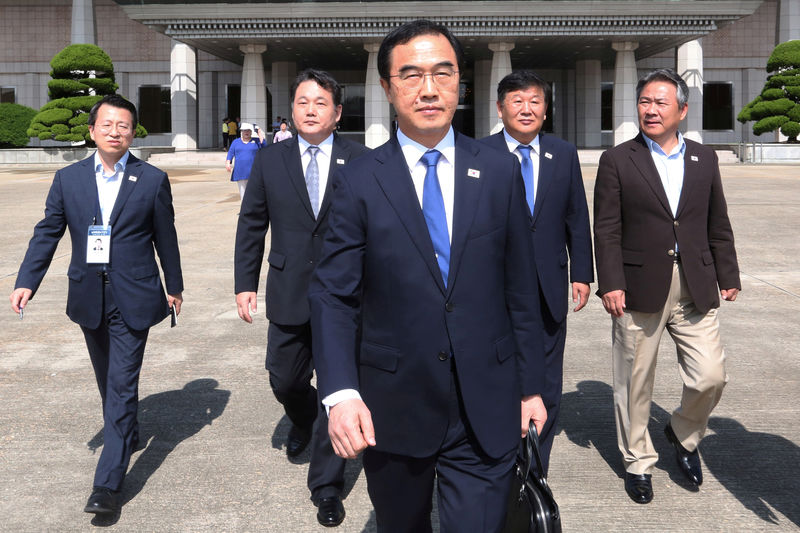
FILE PHOTO: South Korean Unification Minister Cho Myoung-gyon walks to board a plane to leave for Pyongyang, North Korea, to participate in the inter-Korean basketball matches, at Seoul Airport in Seongnam, South Korea, July 3, 2018. Ahn Young-joon/Pool via REUTERS/File Photo

FILE PHOTO: South Korean Unification Minister Cho Myoung-gyon walks to board a plane to leave for Pyongyang, North Korea, to participate in the inter-Korean basketball matches, at Seoul Airport in Seongnam, South Korea, July 3, 2018. Ahn Young-joon/Pool via REUTERS/File Photo

ROCK AND A HARD PLACE

Even as he faced pressure from Washington to hold a tough line, Cho was being criticized for dragging his feet on reconciliation.

In May, the North called off planned talks with the South led by Cho in protest against U.S.-South Korean air combat exercises. When the meeting eventually took place, Cho’s counterpart, Ri Son Gwon, openly blamed Cho for having caused a “grave situation” that resulted in the cancellation of the talks.

At the Kaesong office opening, factory owners pressed Cho to reopen the complex and said they were dismayed at the Unification Ministry for repeatedly rejecting requests to visit the border city to check on equipment and facilities idled since the 2016 shutdown.

“We’ve expressed, directly and indirectly, our complaint that the minister may be too lukewarm about our requests, even though allowing the trip has nothing to do with sanctions,” said Shin Han-yong, who chairs a group of businessmen with plants in Kaesong.

Cho recently told the parliament the delays are due to scheduling issues with the North, adding the ministry “needs more time to explain the overall circumstances” to the international community.

Shin, the expert at Asan, warned any move to undermine sanctions may expose South Korean companies to risks of punishment.

After Moon and Kim’s summit in Pyongyang in September, a senior U.S. Treasury official called compliance officers at seven South Korean banks to warn them that resuming financial cooperation with North Korea “does not align with U.S. policies” and the banks must comply with U.N. and U.S. financial sanctions, according to a South Korean regulatory document.

“Realistically we have no option but to consider U.S. positions, as the top priority is the North’s denuclearization and the United States has the biggest leverage on that,” said Kim Hyung-suk, who served as vice unification minister until last year.

“Without progress on the nuclear issues, there would be constraints at some point in sustaining inter-Korean ties. And Minister Cho knows that.”

(Editing by Soyoung Kim and Lincoln Feast.)

China confident on U.S. trade pact, Trump cites Xi’s ‘strong signals’

FILE PHOTO: U.S. President Donald Trump takes part in a welcoming ceremony with China's President Xi Jinping in Beijing, China, November 9, 2017. REUTERS/Damir Sagolj

By John Ruwitch

SHANGHAI (Reuters) – China expressed confidence on Wednesday that it can reach a trade deal with the United States, a sentiment echoed by U.S. President Donald Trump a day after he warned of more tariffs if the two sides could not resolve their differences.

The remarks, by the Chinese Commerce Ministry, follow a period of relative quiet from Beijing after Trump and Chinese leader Xi Jinping reached a temporary truce in their trade war at a meeting over dinner in Argentina on Saturday.

In a brief statement, the ministry said China would try to work quickly to implement specific items already agreed upon, as both sides “actively promote the work of negotiations within 90 days in accordance with a clear timetable and roadmap”.

“We are confident in implementation,” it said, calling the latest bilateral talks “very successful”.

Trump, in a post on Twitter, linked Beijing’s silence to officials’ travels and said he thought Xi had been sincere during their weekend meeting to hammer out progress over trade.

“Very strong signals being sent by China once they returned home from their long trip, including stops, from Argentina. Not to sound naive or anything, but I believe President Xi meant every word of what he said at our long and hopefully historic meeting. ALL subjects discussed!” Trump wrote on Wednesday.

The U.S. president a day earlier had said the ceasefire could be extended but warned tariffs would be back on the table if the talks failed and that he would only accept a “real deal” with China.

China’s Foreign Ministry referred specific questions to the Commerce Ministry, which is due to hold its weekly news briefing on Thursday in Beijing.

“We hope the two working teams from both sides can, based on the consensus reached between the two countries’ leaders, strengthen consultations, and reach a mutually beneficial agreement soon,” Foreign Ministry spokesman Geng Shuang told reporters.

The threat of further escalation in the trade war between the world’s two largest economies has loomed large over financial markets and the global economy for much of the year, and investors initially greeted the ceasefire with relief.

The mood has quickly soured, however, on skepticism that the two sides can reach a substantive deal on a host of highly divisive issues within the 90-day negotiating period, and markets continued to slide on Wednesday in part from confusion over the ceasefire’s lack of detail.

Failure would raise the specter of a major escalation in the trade battle, with fresh U.S. tariff action and Chinese retaliation possibly as early as March.

The White House has said China had committed to start buying more American products and lifting tariff and non-tariff barriers immediately while beginning talks on structural changes with respect to forced technology transfers and intellectual property protection.

Sources told Reuters that Chinese oil trader Unipec plans to resume buying U.S. crude by March after the Xi-Trump deal reduced the risk of tariffs on those imports. China’s crude oil imports from the U.S. had ground to a halt.

MARKETS DOWN

Global financial markets sank to one-week lows on Wednesday amid the renewed trade concerns, extending Tuesday’s slide.

U.S. markets were closed on Wednesday to observe former President George H.W. Bush’s death, but the effect of Wall Street’s turmoil the previous day was felt in Europe and Asia with the benchmark Shanghai stock index closing down 0.6 percent.

“Narrow agreements and modest concessions in the ongoing trade dispute will not bridge the wide gulf in their respective economic, political and strategic interests,” Moody’s Investors Service said in a report that predicted U.S.-China relations “will remain contentious”.

Officials from the United States and a number of other major economies have often criticized China for its slow approach to negotiations and not following through on commitments.

China has said comparatively little about the Trump-Xi agreement after senior Chinese officials briefed the media following the meeting, and U.S. and Chinese accounts of what the deal entails have sometimes differed.

“Officials now face the difficult task of fleshing out a deal that is acceptable to the Chinese but also involves significant enough concessions not to be torpedoed by the China hawks in the Trump administration,” Capital Economics said in a note this week, adding that higher tariffs could simply be delayed.

A Chinese official told Reuters that officials were “waiting for the leaders to return” before publicizing details.

President Xi and his most senior officials are due back in China on Thursday, having visited Panama and Portugal since leaving Argentina.

On Wednesday, the Global Times tabloid, which is run by the Chinese Communist Party’s main newspaper, said the Trump administration’s statements about the deal – including the agreement that China would buy $1.2 trillion in additional U.S. goods – were designed to highlight or even exaggerate facets of the deal that benefited the United States.

“It will be a win-win situation if a deal is realized. But if not, more fights and talks will continue alternately for a long while. Chinese society should maintain a calm attitude,” it said.

(Reporting by John Ruwitch and Wang Jing in Shanghai, Philip Wen in Beijing and Makini Brice in Washington; Writing by Ben Blanchard; Editing by Kim Coghill and Steve Orlofsky)

Bush funeral to hark back to ‘kinder, gentler’ era in U.S. politics

The flag-draped casket of former President George H.W. Bush is carried by a joint services military honor guard from the U.S. Capitol, Wednesday, Dec. 5, 2018, in Washington. Alex Brandon/Pool via REUTERS

By Steve Holland

WASHINGTON (Reuters) – Former President George H.W. Bush’s full life and decades of public service will be celebrated on Wednesday at a funeral expected to be a remembrance of an era that many Americans recall as a time of less contentious politics.

An unusual bipartisan spirit will be on display at the service at the Washington National Cathedral, starting at 11 a.m. (1600 GMT), with both Republican and Democratic politicians gathering to hail the life of a president who called for a “kinder, gentler” nation.

Bush, the 41st U.S. president, died last week aged 94.

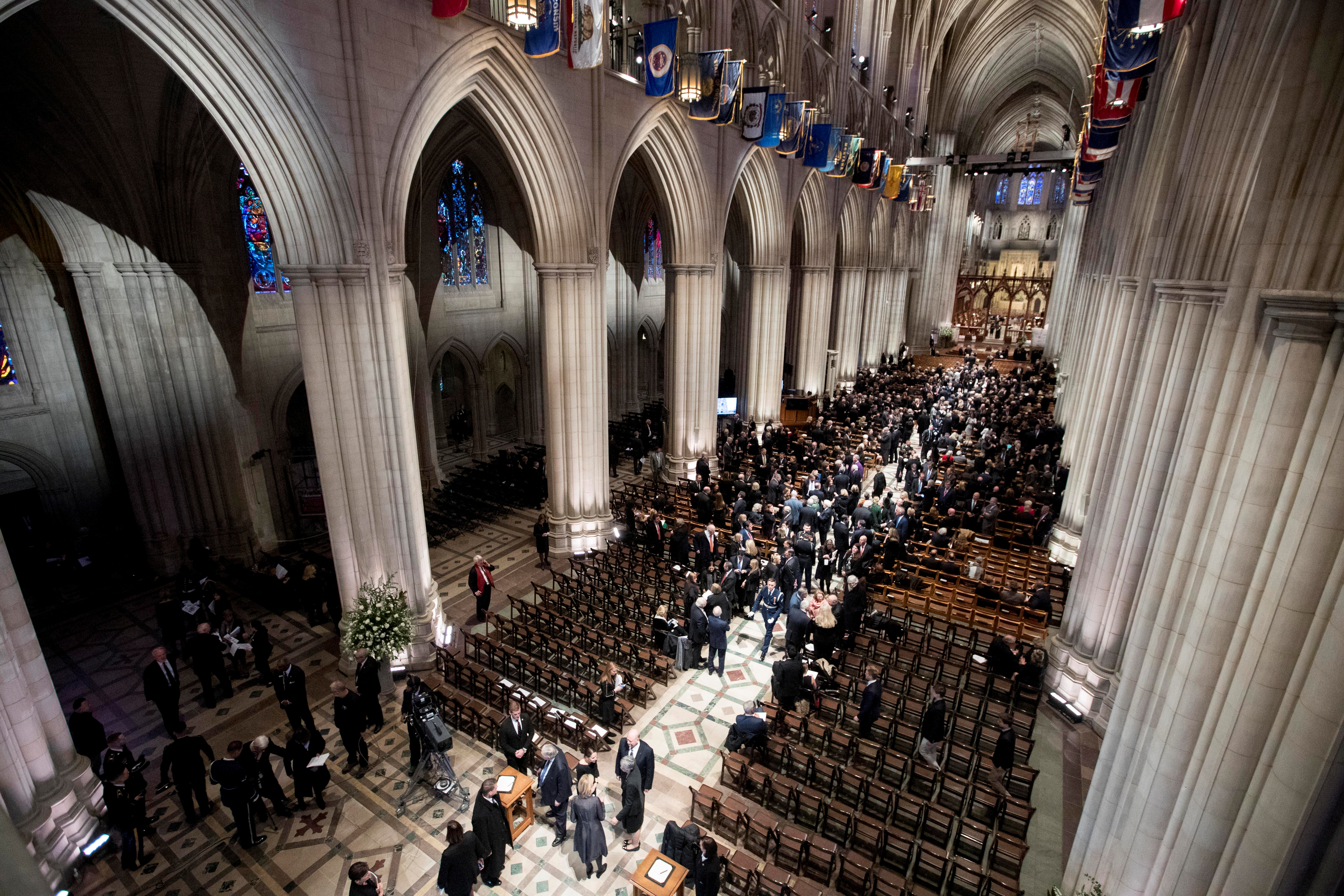
Visitors gather before a State Funeral for former President George H.W. Bush at the National Cathedral in Washington, U.S., December 5, 2018. Andrew Harnik/Pool via REUTERS

Visitors gather before a State Funeral for former President George H.W. Bush at the National Cathedral in Washington, U.S., December 5, 2018. Andrew Harnik/Pool via REUTERS

“You’ll see a lot of joy,” said Ron Kaufman, who was George H.W. Bush’s White House political director in his unsuccessful re-election campaign in 1992. “It’ll show the way of life that people took for granted in many ways and now kind of long for.”

Political feuds will be set aside in honor of the late president, a World War Two naval aviator who was shot down over the Pacific Ocean, a former head of the CIA and a commander-in-chief who defeated Iraqi forces in the 1991 Gulf War.

President Donald Trump will attend the service, along with his wife Melania Trump, but will not be a speaker.

Trump infuriated the late Bush in the past by attacking his sons, former President George W. Bush and Jeb Bush, one of Trump’s rivals in the 2016 Republican campaign.

“Looking forward to being with the Bush family. This is not a funeral, this is a day of celebration for a great man who has led a long and distinguished life. He will be missed!” Trump tweeted on Wednesday.

The Trumps spent about 20 minutes visiting with the Bush family on Tuesday. A senior White House official said Trump has privately called the late president “a good man and a nice guy” and that he has been pleased with the coordination with the Bush family this week.

Jeb Bush, a former governor of Florida, told the Wall Street Journal’s CEO Council on Tuesday: “The president and first lady have been really gracious.”

Bush has been remembered as a patrician figure who represented a bygone era of civility in American politics, although he came across as out of touch with ordinary Americans as economic troubles bit hard in the early 1990s.

Former President George W. Bush, former first lady Laura Bush, Neil Bush, Sharon Bush, Bobby Koch, Doro Koch, Jeb Bush and Columba Bush, stand just prior to the flag-draped casket of former President George H.W. Bush being carried by a joint services military honor guard from the U.S. Capitol, Wednesday, Dec. 5, 2018, in Washington. Alex Brandon/Pool via REUTERS

Former President George W. Bush, former first lady Laura Bush, Neil Bush, Sharon Bush, Bobby Koch, Doro Koch, Jeb Bush and Columba Bush, stand just prior to the flag-draped casket of former President George H.W. Bush being carried by a joint services military honor guard from the U.S. Capitol, Wednesday, Dec. 5, 2018, in Washington. Alex Brandon/Pool via REUTERS

EX-PRESIDENTS

All surviving former U.S. presidents will be at the cathedral along with their wives: Barack and Michelle Obama, Bill and Hillary Clinton, and Jimmy and Rosalynn Carter. Bill Clinton defeated George H.W. Bush in 1992, but in the years after leaving office developed a strong friendship with him.

George W. Bush will deliver a eulogy, along with former Canadian Prime Minister Brian Mulroney, retired Wyoming Republican Senator Alan Simpson and presidential biographer and former journalist Jon Meacham.

Attendees will include Britain’s Prince Charles and leaders of Germany, Jordan, Australia and Poland, along with a host of former world leaders, such as former British Prime Minister John Major, who was in office during Bush’s term.

Marlin Fitzwater, who was the late president’s White House press secretary, said the ceremony “will show a quality of gentility and kindness that he was noted for.”

Of Trump’s presence, Fitzwater said: “It’s important for our presidents to pay respect to each other and I’m glad President Trump will be there.”

Bush navigated the United States through the end of the Cold War and was president when the Berlin Wall fell in 1989.

He was dogged by domestic problems, including a sluggish

economy, and faced criticism for not doing enough to stem the tens of thousands of deaths from the AIDS virus ravaging America.

When he ran for re-election in 1992, he was pilloried by Democrats and many Republicans for violating his famous 1988 campaign promise: “Read my lips, no new taxes.” Democrat Bill Clinton coasted to victory.

Bush’s casket will be transported to the cathedral from the Capitol Rotunda, where the late president has lain in state since Monday night. Thousands of people have filed past to pay their respects, some getting a chance to see Sully, a service dog that was Bush’s friendly companion.

(Reporting by Steve Holland; Additional reporting by Richard Cowan; Writing by Steve Holland and Alistair Bell; Editing by Lisa Shumaker and Frances Kerry)

If Iran can’t export oil from Gulf, no other country can, Iran’s president says

Iranian President Hassan Rouhani gives a public speech during a trip to the northern Iranian city of Shahroud, Iran, December 4, 2018. Official President website/Handout via REUTERS

GENEVA (Reuters) – Iranian President Hassan Rouhani made an apparent threat on Tuesday to disrupt other countries’ oil shipments through the Gulf if Washington presses ahead with efforts to halt Iranian oil exports.

The United States has imposed sanctions on Iran and U.S. officials say they aim to reduce Iran’s oil exports to zero in a bid to curb the Islamic Republic’s missile program and regional influence.

“America should know that we are selling our oil and will continue to sell our oil and they are not able to stop our oil exports,” Rouhani said in a televised speech during a trip to the northern Iranian city of Shahroud.

“If one day they want to prevent the export of Iran’s oil, then no oil will be exported from the Persian Gulf,” he said.

Rouhani made similar comments in July.

Also in July, an Iranian Revolutionary Guards commander, Ismail Kowsari, was quoted as saying that Tehran would block oil shipments through the Strait of Hormuz if the United States banned Iranian oil sales.

Tensions have risen between Iran and the United States after U.S. President Donald Trump withdrew from a multilateral nuclear deal in May and reimposed sanctions on the Islamic Republic.

Rouhani said the United States would not succeed in cutting Iran’s economic ties with the region and the world.

“The most hostile group in America, with relation to Iran, has taken power,” Rouhani said, according to the state-run Islamic Republic News Agency (IRNA). “Of course they never had a friendship with the people of Iran and we never trusted America or others 100 percent.”

Earlier, Foreign Minister Mohammad Javad Zarif denied a Reuters report that said a European mechanism to set up an account to trade with Iran and beat the newly reimposed U.S. sanctions may not cover oil sales, the Iranian foreign ministry website reported.

“Based on the information we have, it’s not so. Because if Iran’s oil money is not deposited into the account, it’s not clear that there would be any funds for trade, because oil is a major part of Iran’s exports,” Zarif said, according to the website.

“This appears to be propaganda aimed at discouraging people,” Zarif added.

France and Germany are to take joint responsibility for the EU-Iran trade mechanism, Reuters reported.

But the agency quoted diplomats as saying that, with U.S. threats of retribution for sanctions-busting unrelenting, the goals of the nascent trade mechanism could be scaled back to encompass only less sensitive items such as humanitarian and food products.

Iranian Vice President Eshaq Jahangiri said on Tuesday that U.S. sanctions were hitting vulnerable people in Iran.

“When (Americans) say their target is the Iranian government and there won’t be pressure on the sick, the elderly and the weak in society, it’s a lie,” Jahangiri said, according to IRNA.

(Reporting by Babak Dehghanpisheh, additional reporting by Dubai newsroom; Editing by Adrian Croft and David Evans)

Trump-Xi meet, a turning point in global trade war?

FILE PHOTOS: Republican presidential nominee Donald Trump (L) holds a rally with supporters in Council Bluffs, Iowa, September 28, 2016 and Chinese President Xi Jinping waits for leaders to arrive at a summit in Shanghai May 21, 2014. REUTERS/Jonathan Ernst/Aly Song/File Photos

By Philip Blenkinsop

BRUSSELS (Reuters) – Will U.S. President Donald Trump’s much-heralded meeting with Chinese counterpart Xi Jinping in Argentina on Saturday lead to an easing of the Sino-U.S. trade conflict?

That has been the main question of financial and commodity markets leading up to the G20 summit in Buenos Aires. The answer is likely to steer investors at the start of the coming week.

Signals leading up to the meeting were at best mixed.

“I think we’re very close to doing something with China, but I don’t know that I want to do it,” Trump said as he set out on his journey from the White House.

The state-run China Daily newspaper said any deal was unlikely to be a comprehensive solution to the impasse due to “diverging demands and agendas”.

Economists at UBS expressed hope that a positive message could at least emerge, with a path towards resolution sometime next year, but that recent U.S. actions and statements had tempered their optimism.

ING was downbeat on a breakthrough coming soon, adding that two sides remained far apart on the extent to which China’s trade surplus with the United States could be reduced.

ING Bank forecasts that global trade growth will slow from 2.6 percent this year to 1.3 percent in 2019, the weakest rate since 2009, when the global financial crisis was at its height.

The estimate is based on an intensified U.S.-China trade war in which Washington increases tariffs on $200 billion of products to 25 percent in January from 10 percent now and then targets the $267 billion of Chinese exports not already subject to measures.

Without that, global trade growth could be unchanged at 2.6 percent. However, if Trump also decides to hike import duties on cars, that growth would slump to 0.5 percent next year, ING says.

Trump has threatened for months to impose auto tariffs, notably those made in Europe, although he has pledged to refrain from doing so for the European Union and Japan as long as it makes constructive progress in trade talks with the pair.

However, Trump reignited speculation on Wednesday by saying new auto tariffs were “being studied” and asserting they could prevent jobs cuts such as the layoffs and plant closures announced by General Motors Co.

Economists at Citi believe any tariffs would apply to finished vehicles but not to auto parts and the principal question is not if, but when, they will be unveiled.

As speculation has intensified, top executives from German carmakers Volkswagen, BMW and Daimler, previous targets of Trump’s criticism, are set to visit the White House next week.

OPEC CUTS, U.S. JOBS SPIKE?

Once markets have absorbed the fruits of the Trump-Xi exchange, investors may shift focus to at least two events at the end of the week.

The Organization of the Petroleum Exporting Countries (OPEC) and its allies meet on Dec. 6-7 and are expected to discuss a possible production cut. Oil prices have fallen by more than 20 percent in November, to make it the biggest monthly drop in a decade.

The United States will also report its widely watched monthly jobs report on Friday.

Economists polled by Reuters forecast that the unemployment rate will hold at a 49-year low of 3.7 percent and that year-on-year wage growth will also match the 3.1 percent of October, itself a nine-and-a-half-year high.

The figures, if confirmed, should make it a near-certainty that the Federal Reserve will raise interest rates for a fourth time this year at its Dec. 18-19 meeting, even as its chairman Jerome Powell signals a more cautious approach on future rate hikes next year.

“While sentiment may be a bit gloomy after the fallout from G20 meeting the more positive tone to the U.S. macro story could improve spirits as we move through the week,” said James Knightley, chief international economist at ING.

(Reporting by Philip Blenkinsop; Editing by Richard Balmforth)

Exclusive: Trump weighs authorizing U.S. troops to medically screen migrants

United States Marines fortify concertina wire along the San Ysidro Port of Entry border crossing as seen from Tijuana, Mexico November 20, 2018. REUTERS/Adrees Latif

By Idrees Ali and Phil Stewart

WASHINGTON (Reuters) – President Donald Trump’s administration is considering giving U.S. troops on the border with Mexico the authority to carry out medical screening of migrants, U.S. officials told Reuters on Tuesday.

The proposal, which is still in draft form and circulating within the administration, would involve the military in screenings for things like illness and injury only if U.S. Customs and Border Protection (CBP) agency personnel were overwhelmed and unable to do so on their own, the officials said.

The proposal would expand the mission for the Pentagon, which said previously it did not expect its forces to directly interact with migrants.

The Pentagon declined to comment on internal deliberations. In a statement, it said the operation would cost about $72 million through Dec. 15, based on current plans.

U.S. military duties on the border, including stringing up concertina wire and building temporary housing, have been aimed at supporting CBP personnel.

The U.S. officials who spoke to Reuters about the proposal did so on condition of anonymity because Trump has not yet signed off on the idea.

It was unclear if the proposal, if confirmed in the coming days, might prolong the deployment of at least some troops at the border.

The commander of the mission told Reuters last week that the number of troops may have peaked at around 5,800, and he would soon look at whether to begin sending forces home or shifting some to new border positions.

LAST RESORT

Trump, who won the presidency in 2016 after a campaign promising to crack down on illegal immigration, has seized upon migrant caravans headed toward the U.S. border, comparing it to an “invasion.”

Critics have derided his position as a stunt that politicizes the military.

About 6,000 Central Americans have reached the Mexican border cities of Tijuana and Mexicali, according to local officials. More bands of migrants are making their way toward Tijuana, with around 10,000 expected.

In Tijuana and other ports of entry, CBP officers are trained to check migrants and travelers for obvious signs of infectious conditions, like fever, bleeding from the eyes or other symptoms of “quarantinable and communicable diseases,” according to a 2015 report by the Congressional Research Service.

One U.S. official said that under the latest proposal, U.S. troops would carry out medical screenings only if other officials, such as from state and local governments or the National Guard, were not available or overwhelmed.

“The intent of the authorities is not to bring the troops in closer contact with the migrants but to provide medical assistance if needed,” the official said.

On Monday, Reuters reported that Trump was likely to give U.S. troops authority to protect immigration agents stationed along the U.S. border with Mexico if they come under threat from migrants seeking to cross into the United States.

(Reporting by Idrees Ali and Phil Stewart; Editing by Peter Cooney, Bill Berkrot and Lisa Shumaker)

North Korea’s Kim inspects newly developed ‘tactical’ weapon, releases U.S. prisoner

North Korean leader Kim Jong Un inspects a constructions site of Yangdeok, in this undated photo released on October 31, 2018 by North Korea's Korean Central News Agency (KCNA). KCNA/via REUTERS/File Photo

By Joyce Lee and Josh Smith

SEOUL (Reuters) – North Korea’s leader publicly inspected a new weapon for the first time in nearly a year, state media reported on Friday, while it also decided to release a U.S. prisoner, sending conflicting signals at a time of sensitive negotiations.

Kim Jong Un’s visit to the test site of a new “tactical weapon” threatened to sour the diplomatic atmosphere as negotiations between his country and the United States appear to have stalled.

“This result today is a justification of the party’s policy focused on defense science and technology, another display of our rapidly growing defense capabilities to the whole region, and a groundbreaking change in strengthening our military’s combat capabilities,” Kim said.

In Washington, in response to the North Korean announcement, a U.S. State Department spokesman said, “We remain confident that the promises made by President Trump and Chairman Kim will be fulfilled.”

The official was referring to an unprecedented summit in June between U.S. President Donald Trump and Kim in Singapore, where they agreed to work toward denuclearization and peace on the Korean peninsula and establish new relations.

But the agreement was short on specifics, and negotiations have made little headway since.

In a possibly conciliatory gesture, however, North Korea also announced on Friday it was releasing an American citizen detained since October after “illegally” entering North Korea from China.

North Korea has often held previous American detainees for more extended periods.

‘STEEL WALL’

The military test was successful and the weapon could protect North Korea like a “steel wall”, its KCNA news agency said, adding that Kim had observed “the power of the tactical weapon”.

The only picture released by state media showed Kim standing on a beach surrounded by officials in military uniforms, but no weapons were visible.

International weapons experts said the officials around Kim included a leader of the artillery corps of the Korean People’s Army.

South Korea’s defense ministry said it did not have an immediate comment but was analyzing the North Korean weapon test.

Friday’s understated announcement was more likely aimed at reassuring the North Korean military rather than trying to torpedo diplomatic talks, however, said Choi Kang, vice president of the Asan Institute for Policy Studies in Seoul.

“North Korea is trying to show its soldiers that they are becoming high-tech and keeping a certain level of military capability while trying to eliminate dissatisfaction and worries inside its military,” he added.

The test may also have been a response to recent joint military drills by the United States and South Korea, which North Korea said violated recent pacts to halt to “all hostile acts”, said Yang Uk, an analyst at the Korea Defence and Security Forum.

Kim said the weapons system tested was one in which his father, Kim Jong Il, had taken a special interest during his life, personally leading its development.

Kim’s last publicized military inspection was the launch of the Hwasong-15 intercontinental ballistic missile (ICBM) on Nov. 29 last year, though he engaged in at least eight other military-related activities this year, the South’s Unification Ministry said.

STALLED TALKS

Kim this year declared his nuclear force “complete” and said he would focus on economic development.

North Korea has continued to showcase its conventional military capabilities, including at a large military parade in its capital, Pyongyang, on Sept. 9.

But any testing of new weapons threatens to raise tension with Washington, which has said there will be no easing in international sanctions until North Korea takes more concrete steps to abandon its nuclear weapons or long-range missiles.

North Korea has increasingly expressed frustration at Washington’s refusal to ease sanctions and recently threatened to restart development of its nuclear weapons if more concessions were not made.

“They’re trying to signal that they are willing to walk away from talks and restart weapons testing,” said Adam Mount of the Federation of American Scientists. “It is the most explicit in a series of escalating statements designed to send this message.”

A meeting in New York planned this month between U.S. Secretary of State Mike Pompeo and North Korea’s Kim Yong Chol, a senior aide to Kim, was postponed.

On Thursday, U.S. Vice President Mike Pence said Trump planned to meet Kim again in 2019 and will push for a concrete plan outlining Pyongyang’s moves to end its arms programs.

(Reporting by Joyce Lee and Josh Smith; Additional reporting by Jeongmin Kim in Seoul, and Matt Spetalnick and David Brunnstrom in WASHINGTON; Editing by Sonya Hepinstall and Clarence Fernandez)

Trump to meet North Korea’s Kim in 2019, wants plan to end arms program: Pence

U.S. Vice President Mike Pence speaks during a news conference in Singapore, November 15, 2018. REUTERS/Athit Perawongmetha

By John Geddie

SINGAPORE (Reuters) – U.S. Vice President Mike Pence said on Thursday President Donald Trump plans to meet North Korean leader Kim Jong Un in 2019 and will push for a concrete plan outlining Pyongyang’s moves to end its arms programs.

The United States and North Korea have been discussing a second meeting of their leaders after a June summit in Singapore to lay the groundwork for ending a nuclear standoff between the old foes.

“The plans are ongoing. We believe that the summit will likely occur after the first of the year, but the when and the where of that is still being worked out,” Pence told reporters after meeting South Korean President Moon Jae-in.

In a separate interview with NBC News, Pence said the United States would not require Pyongyang to provide a complete list of nuclear weapons and locations before the second summit but that the meeting must produce a concrete plan.

“I think it will be absolutely imperative in this next summit that we come away with a plan for identifying all of the weapons in question, identifying all the development sites, allowing for inspections of the sites and the plan for dismantling nuclear weapons,” Pence said.

Pence and Moon were meeting on the sidelines of an Asia-Pacific summit hosted by Singapore.

A U.S. think tank said on Monday it had identified at least 13 of an estimated 20 active, undeclared missile bases inside North Korea, underscoring the challenge for American negotiators hoping to persuade Kim to give up his weapons programs.

North Korea had entered into agreements with regional powers in 1994 and in 2005 to dismantle its nuclear program in return for economic benefits and diplomatic rewards, but those deals broke down after Pyongyang clandestinely continued to pursue building weapons of mass destruction.

With scant sign of progress on negotiations since the June summit and recent high-level meetings canceled, Trump said last week he was now in “no rush” but still wanted to meet with Kim for a second time.

“We’re going to keep the pressure on. We’re going to keep the sanctions in place,” Pence told NBC. “President Trump continues to be very hopeful that in that next summit, we’ll come out with a plan for actually implementing and achieving denuclearization.”

FILE PHOTO: U.S. President Donald Trump shakes hands with North Korea's leader Kim Jong Un after they signed documents that acknowledged the progress of the talks and pledge to keep momentum going, after their summit at the Capella Hotel on Sentosa island in Singapore June 12, 2018. REUTERS/Jonathan Ernst/File Photo

FILE PHOTO: U.S. President Donald Trump shakes hands with North Korea’s leader Kim Jong Un after they signed documents that acknowledged the progress of the talks and pledge to keep momentum going, after their summit at the Capella Hotel on Sentosa island in Singapore June 12, 2018. REUTERS/Jonathan Ernst/File Photo

U.S. officials have said sanctions forced North Korea to the negotiating table and vowed to keep pressure until complete denuclearization. But North Korea has credited its nuclear and missile breakthroughs for providing it the standing to meet the world’s biggest powers.

Pence told reporters that Moon agreed to work closely with the United States toward the second U.S.-North Korea summit, as Washington maintains the “maximum pressure” campaign by keeping the sanctions against Pyongyang in place.

Asked if China, which has been the North’s main economic benefactor, was doing enough to maintain sanctions pressure, Pence said Beijing has done more than they have ever done before and Trump was grateful for that.

A U.S. congressional commission said on Wednesday China appeared to have relaxed enforcement of sanctions on North Korea as Pyongyang began to engage with the United States this year.

Trump is expected to speak more about enforcing sanctions when he meets Chinese President Xi Jinping at the G20 summit late this month and the unique role that China can play in ensuring the denuclearisation of the Korean peninsula, Pence said.

North Korea has not tested a nuclear device or ballistic missile since last year, and has said it has shuttered its main nuclear test site, with plans to dismantle several more facilities.

But it has warned it could restart its nuclear program if the United States does not drop the sanctions regime.

(Reporting by John Geddie in Singapore; Additional reporting by Susan Heavey in Washington; Writing by Jack Kim; Editing by Paul Tait, Raju Gopalakrishnan and Bernadette Baum)

U.S. Postal Service loss triples, even as package deliveries rise

FILE PHOTO: A view shows U.S. postal service mail boxes at a post office in Encinitas, California February 6, 2013. REUTERS/Mike Blake/File Photo

WASHINGTON (Reuters) – The U.S. Postal Service lost almost $4 billion in 2018 even as package deliveries rose, according to results released on Wednesday, giving U.S. President Donald Trump potential ammunition against Amazon.com Inc, which he claims pays too little for the agency’s services.

Trump, without presenting evidence, has attacked Amazon repeatedly over the past year, accusing the world’s largest online retailer of taking advantage of USPS by not paying enough for deliveries to make the service profitable.

USPS, an independent agency within the federal government, reported operating revenue of $70.6 billion for fiscal year 2018, which ended on Sept. 30, as sales at its shipping and packages business rose 10 percent.

However, its net loss more than tripled to $3.9 billion from a loss of $1.2 billion in 2017, hurt by rising pay and benefits and higher transport costs, such as gas prices.

Package delivery, especially for major customer Amazon, has become a key part of USPS’s business but has not been enough to offset the sharp decline in first-class letters caused by the internet and email.

The president does not have the power to determine postal rates. They are set by the Postal Regulatory Commission, an independent government agency with commissioners from both political parties who are selected by the president. That panel raised prices on packages by almost 2 percent in November.

Amazon is run by founder Jeff Bezos, who also owns the Washington Post, a newspaper Trump has repeatedly railed against. It has shown interest in delivering its own packages and has tested drones for doing so.

In 2015, Amazon spent $11.5 billion on shipping, 46 percent of its total operating expenses that year. It has not commented publicly on Trump’s criticisms.

(Reporting by Chris Sanders and Diane Bartz; Editing by Bill Rigby)

Blasted by Trump over Russia probe, Sessions fired as attorney general

U.S. Attorney General Jeff Sessions departs after addressing a news conference to announce a criminal law enforcement action involving China and a new Department of Justice initiative focusing on China’s economic activity, at the Justice Department in Washington, U.S. November 1, 2018. REUTERS/Jonathan Ernst/File Photo

By Sarah N. Lynch

WASHINGTON (Reuters) – U.S. Attorney General Jeff Sessions was fired on Wednesday after receiving unrelenting criticism from President Donald Trump for recusing himself from an investigation into Russia’s role in the 2016 presidential race.

In a step that could have implications for the investigation led by Special Counsel Robert Mueller, Trump replaced Sessions with Matthew Whitaker, who will be acting attorney general. He had been Sessions’ chief of staff.

The top Democrat in the U.S. Senate immediately called on Whitaker to recuse himself from the Mueller probe.

“Given his previous comments advocating defunding and imposing limitations on the Mueller investigation, Mr. Whitaker should recuse himself from its oversight for the duration of his time as acting attorney general,” Senate Democratic leader Chuck Schumer said in a statement.

In an opinion piece for CNN that appeared on Aug. 6, 2017, while he was a commentator for the network, Whitaker, a former U.S. attorney, said Mueller would be crossing a line if he investigated the Trump family’s finances. The piece was titled: “Mueller’s investigation of Trump is going too far.”

Trump’s personal lawyer Rudy Giuliani told Reuters on Tuesday that he assumed Sessions’ departure was “not going to affect” the Mueller investigation.

Deputy Attorney General Rod Rosenstein, who is supervising the Russia investigation and has also faced criticism from Trump, was seen by Reuters entering the White House on Wednesday afternoon.

A spokesman for the special counsel’s office declined to comment on Sessions’ resignation and what it means for Mueller’s probe.

Trump announced Sessions’ departure on Twitter and thanked him for his service. Sessions said in a letter to Trump that he had resigned at the president’s request.

Sessions’ exit had been widely expected to come soon after Tuesday’s congressional elections, in which Republicans retained their majority in the Senate but lost control of the House of Representatives.

Never in modern history has a president attacked a Cabinet member as frequently and harshly in public as Trump did Sessions, 71, who had been one of the first members of Congress to back his presidential campaign in 2015.

Democratic Representative Jerrold Nadler, expected to chair the House Judiciary Committee starting in January, demanded answers in a tweet about Trump’s reasons for firing Sessions.

“Why is the President making this change and who has authority over Special Counsel Mueller’s investigation? We will be holding people accountable,” Nadler asked on Twitter.

Mueller’s probe, operating under the auspices of the Justice Department, already has yielded criminal charges against several Trump associates and has clouded his presidency for many months.

Republicans had repeatedly urged Trump not to oust Sessions, a former conservative Republican senator from Alabama, before the elections lest it create political fallout.

They had also argued that Sessions should be allowed a graceful exit after he doggedly carried out Trump’s agenda on illegal immigration and other administration priorities.

RECUSAL OVER RUSSIA

Trump was only a few weeks into his presidency in March 2017 when Sessions upset him. Rejecting White House entreaties not to do so, Sessions stepped aside from overseeing the FBI’s probe of potential collusion between the Trump presidential campaign and Moscow. Sessions cited news reports of previously undisclosed meetings he had with Russia’s ambassador to Washington as his reason for recusal.

Rosenstein took over supervision of the Russia investigation and appointed Mueller in May 2017 as the Justice Department’s special counsel to take over the FBI’s Russia probe after Trump fired FBI Director James Comey.

A permanent replacement for Sessions must be confirmed by the U.S. Senate, which Trump’s Republicans will continue to control as a result of Tuesday’s midterm elections.

Mueller is pursuing an investigation into whether Trump’s campaign colluded with Russia, whether Trump unlawfully tried to obstruct the probe, and possible financial misconduct by Trump’s family and associates. Mueller has brought charges against Trump’s former campaign chairman and other campaign figures, as well as against 25 Russians and three firms accused of meddling in the campaign to help Trump win.

Trump has denied his campaign colluded with Russia.

Trump publicly seethed over Sessions’ recusal and said he regretted appointing him. On Twitter, he blasted Sessions as “VERY weak” and urged him to stop the Russia investigation. In July 2017, he told the New York Times that if he had known Sessions would recuse himself, he never would have appointed him attorney general.

There were news reports in the weeks after Mueller’s appointment that Sessions had offered to resign. Sessions usually remained quiet on Trump’s criticism, but defended himself in February 2018 after a Trump tweet criticizing his job performance by saying he would perform his duties “with integrity and honor.”

RESPONDING TO TRUMP

In August, Sessions punched back harder after Trump said in a Fox News interview that Sessions “never took control of the Justice Department.” Sessions issued a statement saying he “took control of the Department of Justice the day I was sworn in” and vowed not to allow it to be “improperly influenced by political considerations.”

As for his own involvement with Russia, Sessions was questioned in January by Mueller’s team and has offered shifting public accounts. He has said nothing improper transpired in his meetings during the campaign with Ambassador Sergei Kislyak. In congressional testimony in November, he said he now recalled a meeting during the 2016 campaign in which a campaign adviser, with Trump present, offered to use connections with Moscow to arrange a meeting between Trump and Russian President Vladimir Putin.

(Reporting by Sarah N. Lynch; Writing by Bill Trott and Kevin Drawbaugh; Editing by Will Dunham and Peter Cooney)