Differences on North Korea key to Trump’s Tillerson decision: sources

U.S. Secretary of State Rex Tillerson speaks to the media at the U.S. State Department after being fired by President Donald Trump in Washington, U.S. March 13, 2018. REUTERS/Leah Millis

By Steve Holland and Lesley Wroughton

WASHINGTON (Reuters) – Differences over how to deal with North Korea’s nuclear challenge were a key factor in President Donald Trump’s decision to replace Rex Tillerson as U.S. secretary of state, according to sources familiar with the internal deliberations.

Tillerson had been an early advocate of talks with North Korea to the annoyance of Trump, who wanted to keep applying maximum pressure on Pyongyang before responding to an invitation to meet North Korean leader Kim Jong Un, the sources said.

That had led to fear that Tillerson might be too willing to make concessions to North Korea, the sources said.

“He’s got to have somebody in there that he totally trusts,” said a senior U.S. official.

In recent weeks Trump spent time putting in place a succession plan, lining up Central Intelligence Agency Director Mike Pompeo to take over at the State Department and CIA deputy director Gina Haspel to replace Pompeo as the head of the spy agency, the source said.

A key aim was to get the team in place prior to moving ahead with North Korea.

Trump and Kim have committed to meeting at a time and place to be determined before the end of May to discuss North Korea’s nuclear and ballistic missile programs.

In a snub, Tillerson was left out of the loop regarding the North Korean invitation and was on his first trip to Africa when Trump sat down at the White House with a visiting delegation from South Korea last Thursday and agreed to meet Kim.

The next day, Friday, Trump told White House Chief of Staff John Kelly to tell Tillerson he needed to resign, White House officials said.

One source said Kelly had been trying to protect Tillerson as long as he could, but that Trump had grown weary of Tillerson’s tendency to contradict the president on a variety of issues and had been telling friends he was about to dump him.

Tillerson, who was in Nairobi at the time and still had two stops to go – Chad and Nigeria – asked that he first return to the United States before it was announced.

Hours after Tillerson landed in Washington on Tuesday, Trump announced on Twitter that he was being dismissed and replaced by Pompeo.

State Department officials said Tillerson did not know why he was being pushed out. One of them, Steve Goldstein, was fired later on Tuesday after he contradicted the White House’s version.

Tillerson, whose tenure ends on March 31, returned to the State Department on Wednesday to hand over responsibilities to John Sullivan, his deputy, and to meet with senior officials, a State Department official said.

The official said Tillerson’s chief of staff, Margaret Peterlin, and deputy chief of staff, Christine Ciccone, had resigned.

It was not immediately clear whether Tillerson’s policy chief, Brian Hook, would stay on beyond March 31. The department announced on Wednesday that Hook would travel to Vienna to participate in a meeting on Friday on the Iran nuclear deal.

(Reporting by Steve Holland and Lesley Wroughton; Editing by Tom Brown)

School safety bill passes House, no action on gun control

Students from Gonzaga College High School in Washington, DC, hold up signs with the names of those killed in the Parkland, Florida, school shooting during a protest for stricter gun control during a walkout by students at the U.S. Capitol in Washington. REUTERS/Joshua Roberts

By Lisa Lambert and Sarah N. Lynch

WASHINGTON (Reuters) – The U.S. House of Representatives approved spending more money on metal detectors, locks and other school security measures on Wednesday, but took no steps to tighten gun control laws a month after a Florida high school shooting that killed 17 people.

While students marched nationwide for change on one of America’s most vexing social issues, lawmakers voted 407-10 for legislation to spend $50 million to $75 million per year from 2019 through 2028 on school security and safety training.


People supporting gun control attend a hearing by the Senate Judiciary Committee during a hearing about legislative proposals to improve school safety in the wake of the mass shooting at the high school in Parkland, Florida, on Capitol Hill in Washington, U.S., March 14, 2018. REUTERS/Joshua Roberts

People supporting gun control attend a hearing by the Senate Judiciary Committee during a hearing about legislative proposals to improve school safety in the wake of the mass shooting at the high school in Parkland, Florida, on Capitol Hill in Washington, U.S., March 14, 2018. REUTERS/Joshua Roberts

No parallel measure was pending in the Senate, where a somewhat more ambitious bill was being debated, but prospects for meaningful gun control reforms in Congress remained remote in the face of stiff resistance from gun industry lobbyists.

“This bill, on its own, is not the kind of meaningful congressional action needed to address this crisis of gun violence,” Representative Steny Hoyer, the No. 2 House Democrat, said in a statement.

“This must be a first step and it must be followed by a serious effort to pass legislation that expands background checks and bans military-style assault weapons,” he said.

It was not yet clear when the Senate would take up the House bill, which would not become law without Senate approval.

President Donald Trump applauded the House bill, the White House said, though it falls far short of broader gun control legislation he talked about shortly after the shooting at Marjory Stoneman Douglas High School in Parkland, Florida.

The measure would not allow any of the funding to be used for arming teachers or other school personnel. The White House said the bill would be improved by lifting that restriction.

Since the Parkland massacre, student protesters have successfully lobbied for tighter gun controls in Florida. Hundreds of them gathered outside the Capitol to urge Congress to take action on placing new limits on firearms and gun sales.

Senator Dick Durbin (D-IL) listens to testimony to the Senate Judiciary Committee during a hearing about legislative proposals to improve school safety in the wake of the mass shooting at the high school in Parkland, Florida, on Capitol Hill in Washington, U.S., March 14, 2018. REUTERS/Joshua Roberts

Senator Dick Durbin (D-IL) listens to testimony to the Senate Judiciary Committee during a hearing about legislative proposals to improve school safety in the wake of the mass shooting at the high school in Parkland, Florida, on Capitol Hill in Washington, U.S., March 14, 2018. REUTERS/Joshua Roberts

In the Senate is a bill to strengthen existing background checks of gun purchasers. It enjoys broad bipartisan support but has not been scheduled for debate.

Congressional aides said discussions were underway about folding the school safety and background check bills into a government funding bill that lawmakers want to pass by March 23.

Eleven organizations, including some gun control and law enforcement groups, wrote to Senate Majority Leader Mitch McConnell, a Republican, and Senate Democratic Leader Chuck Schumer urging passage this month of the background checks bill.

Since the Florida shooting, the Republican-led Congress and the Trump administration have considered measures to curb gun violence while trying to avoid crossing the powerful National Rifle Association lobby group, or threatening the right to bear arms enshrined in the U.S. Constitution’s Second Amendment.

Neither the House nor Senate bills address many of the gun control initiatives backed by students, teachers and families of shooting victims at the Florida school.

In testimony before the Senate Judiciary Committee, Katherine Posada, a teacher at the school, recounted the horror she experienced the day of the shooting and urged Congress to ban assault-style weapons like the AR-15 rifle used by Nikolas Cruz, who has been charged in the murders.

“Some of the victims were shot through doors, or even through walls – a knife can’t do that,” Posada said. “How many innocent lives could have been saved if these weapons of war weren’t so readily available?”

(Reporting by Richard Cowan, Lisa Lambert, David Alexander and Sarah N. Lynch; Editing by Kevin Drawbaugh and Tom Brown)

Trump fires top diplomat Tillerson after clashes, taps Pompeo

FILE PHOTO: A combination photo shows U.S. Secretary of State Rex Tillerson (L) in Addis Ababa, Ethiopia, March 8, 2018, and Central Intelligence Agency (CIA) Director Mike Pompeo on Capitol Hill in Washington, DC, U.S., February 13, 2018 respectively. REUTERS/Jonathan Ernst (L) Aaron P. Bernstein (R)

By Steve Holland and Roberta Rampton

WASHINGTON (Reuters) – U.S. President Donald Trump fired Secretary of State Rex Tillerson on Tuesday after a series of public rifts over policy on North Korea, Russia and Iran, replacing his chief diplomat with loyalist CIA Director Mike Pompeo.

The biggest shakeup of Trump’s Cabinet since he took office in January 2017 was announced by the president on Twitter as his administration works toward a meeting with the leader of North Korea.

Some foreign policy experts criticized the decision to swap out top diplomats so soon before the unprecedented meeting and worried that Pompeo would encourage Trump to scrap the Iran nuclear deal and be hawkish on North Korea.

Trump chose the CIA’s deputy director, Gina Haspel, to replace Pompeo at the intelligence agency. She is a veteran CIA clandestine officer backed by many in the U.S. intelligence community but regarded warily by some in Congress for her involvement in the agency’s “black site” detention facilities.

Tillerson’s departure capped months of friction between the Republican president and the 65-year-old former Exxon Mobil chief executive. The tensions peaked last fall amid reports Tillerson had called Trump a “moron” and considered resigning.

“We got along actually quite well but we disagreed on things,” Trump said on the White House lawn on Tuesday. “When you look at the Iran deal: I think it’s terrible, I guess he thinks it was OK. I wanted to break it or do something and he felt a little bit differently.”

Trump said he and Pompeo have “a similar thought process.”

Pompeo, a former Army officer who represented a Kansas district in Congress before taking the CIA job, is seen as a Trump loyalist who has enjoyed a less hostile relationship with career spies than Tillerson had with career diplomats.

Senior White House officials said Trump wanted his new team in place before any summit with Kim Jong un, who invited the U.S. president to meet by May after months of escalating tensions over North Korea’s nuclear and missile programs.

TILLERSON UNCLEAR ON REASON

Tillerson’s imminent departure had been rumored for several months and Trump said he and Tillerson had discussed the move for a long time. But Steve Goldstein, a State Department undersecretary of state for public affairs, said Tillerson did not know why he was being pushed out and had intended to stay.

Goldstein was fired later on Tuesday, two U.S. officials told Reuters.

Many Democrats in Congress expressed dismay at the firing, which they said would sow more instability in the Trump administration at a crucial time.

Foreign policy experts from Republican and Democratic administrations also questioned Trump’s timing and choice, noting that Pompeo was known as a political partisan who strongly opposed the 2015 Iran nuclear deal.

Evans Revere, a former senior U.S. diplomat who dealt with North Korea under President George W. Bush, said Trump’s move sends “a bad signal about the role of diplomacy.”

“Tillerson’s replacement by … Pompeo, who is known as a political partisan and an opponent of the Iran agreement, raises the prospect of the collapse of that deal, and increases the possibility that the administration might soon face not one, but two nuclear crises,” he said.

Senior White House officials said White House chief of staff John Kelly had asked Tillerson to step down on Friday but did not want to make it public while he was on a trip to Africa. Trump’s Twitter announcement came only a few hours after Tillerson landed in Washington.

On Monday, Tillerson blamed Russia for the poisonings in England of a former Russian double agent and his daughter. Earlier at the White House, press secretary Sarah Sanders had refrained from saying Moscow was responsible.

He appeared to be caught by surprise last week when Trump announced he had accepted Kim’s invitation to meet.

“Mike Pompeo, Director of the CIA, will become our new Secretary of State. He will do a fantastic job! Thank you to Rex Tillerson for his service! Gina Haspel will become the new Director of the CIA, and the first woman so chosen. Congratulations to all!” Trump said on Twitter.

Tillerson joined a long list of senior officials who have either resigned or been fired since Trump took office in January 2017. Others include strategist Steve Bannon, national security adviser Michael Flynn, FBI Director James Comey, White House chief of staff Reince Priebus, health secretary Tom Price, communications directors Hope Hicks and Anthony Scaramucci, economic adviser Gary Cohn and press secretary Sean Spicer.

OUT OF THE LOOP

Trump publicly undercut Tillerson’s diplomatic initiatives numerous times.

In December, Tillerson had offered to begin direct talks with North Korea without pre-conditions, backing away from a U.S. demand that Pyongyang must accept that any negotiations would be about giving up its nuclear arsenal.

The White House distanced itself from those remarks, and a few days later, Tillerson himself backed off.

Several months earlier in Beijing, Tillerson said the United States was directly communicating with North Korea but that Pyongyang had shown no interest in dialogue. Trump contradicted Tillerson’s efforts a day later.

“I told Rex Tillerson, our wonderful Secretary of State, that he is wasting his time trying to negotiate with Little Rocket Man,” Trump wrote on Twitter, using a pejorative nickname for Kim.

Tillerson had joined Defense Secretary Jim Mattis in pressing a skeptical Trump to stick with the agreement with Iran and other world powers over Tehran’s nuclear ambitions and he has taken a more hawkish view than Trump on Russia.

If confirmed by the U.S. Senate after an April committee hearing, Pompeo will be taking over a State Department shaken by the departures of many senior diplomats and embittered by proposed budget cuts.

Lawmakers from both major parties have criticized those cuts and the administration’s failure to fill dozens of open jobs there.

Tillerson faced a tougher confirmation that most nominees to be secretary of state last year as Democrats grilled him about his oil business ties to Russia. But over time, many lawmakers grew to appreciate Tillerson as a relatively steady hand in the chaotic Trump administration.

“He represented a stable view with regard to the implementation of diplomacy in North Korea, Iran and other places in the world,” said Senator Ben Cardin, the top Democrat on the Senate Foreign Relations Committee during most of Tillerson’s tenure.

(Additional reporting by Patricia Zengerle, David Brunnstrom, Lesley Wroughton, Paul Simao, Susan Heavey; Writing by Doina Chiacu; Editing by Bill Trott)

Over hotpot and soju, North Korea’s Kim Jong Un joked about himself

FILE PHOTO: North Korean leader Kim Jong Un waves to people attending a military parade marking the 105th birth anniversary of country's founding father, Kim Il Sung in Pyongyang, April 15, 2017. REUTERS/Damir Sagolj/File Photo

By Christine Kim

SEOUL (Reuters) – North Korea’s Kim Jong Un joked about his image in international media while serving South Korean officials local spirits and cold noodles during their unprecedented visit to Pyongyang this week, two South Korean government sources said.

During the meeting, Kim committed to giving up his nuclear weapons and told the South Korea officials he would like to meet U.S. President Donald Trump, delegation leader Chung Eui-yong told reporters at the White House on Thursday – a potentially dramatic breakthrough in nuclear tensions with Pyongyang.

Kim made light-hearted remarks about how he is viewed outside North Korea in international media and elsewhere, one Blue House official said. The officials who spoke asked to remain unnamed due to the sensitivity of the issue.

The North Korean leader, repeatedly derided as “Little Rocket Man” by Trump, was “very aware” of his image, the official said, and reacted to comments made about him in a “relaxed” manner by joking about himself from time to time.

South Korean officials say Trump and Kim now plan to meet by the end of May, in what would be the first ever meeting between a sitting U.S. President and a North Korean leader.

Tensions rose to their highest in years in 2017 following a battery of missile tests by North Korea, before a detente championed by South Korean President Moon Jae-In during his country’s hosting of the Winter Olympics began to bear fruit.

Kim told the visiting delegation Moon could rest easy at night now that Pyongyang had decided not to carry out nuclear or missile tests while talks were ongoing, a Blue House official said.

“President Moon has had a rough time chairing national security meetings at the break of dawn whenever we fired missiles,” Kim was cited as saying during a dinner meeting with the visiting South Koreans.

“If working-level talks ever cease and hostility appears, (President Moon) and I can easily resolve it with a phone call,” Kim referring to the hotline the two Koreas are planning to install to connect Kim and Moon. It will be the first such hotline to be set up between the heads of the two Koreas.

The Trump administration has warned all options are on the table, including military ones, in dealing with Pyongyang, which has pursued its weapons programs in defiance of ever tougher U.N. sanctions.

When the South Korean officials visited, no hard feelings were displayed and Kim Jong Un was the first to tackle sensitive topics, including the resumption of a military exercise between South Korea and the United States that was postponed for a peaceful Winter Olympics, the Blue House official said.

“This is when we knew the efforts of North and South Korea taken after the Moon Jae-in administration began had paid off,” said one participant of the North Korea visit.

Kim’s administration had also taken note of what North Korean foods the South Korean officials had mentioned while his sister Kim Yo Jong was visiting Seoul for the Pyeongchang Winter Olympics.

The delegation was served North Korean hotpot the first day and cold noodles – another regional specialty – the next, the Blue House official said.

Kim and the officials shared several bottles of wine, liquor made of ginseng and Pyongyang soju, the official said.

“The bottles kept coming,” said another administrative source who had official knowledge of the meeting.

The South Korean visitors to Pyongyang did not see one-on-one trackers that usually follow visitors in the North and were free to move about on the premises of the hotel, the first official added.

At the dinner on the first night, South Korean officials were able to observe the relationship between Kim and his wife, Ri Sol Ju, said the second administrative source.

The source said Kim did not come across as overbearing, describing the spouses as appearing “equal”.

“They seemed to be quite close to one another and he didn’t seem like one of your conservative husbands.”

(Reporting by Christine Kim; Editing by Lincoln Feast)

U.S. evangelist Billy Graham to be laid to rest in North Carolina

Members of the public visit the late U.S. evangelist Billy Graham as he lies in honor in the Rotunda of the U.S. Capitol in Washington, U.S. February 28, 2018. REUTERS/Leah Millis

By Ian Simpson

(Reuters) – U.S. evangelist Billy Graham, who preached to millions around the world in a 70-year career, will be laid to rest on Friday in his native North Carolina following a funeral service that will draw thousands of mourners including President Donald Trump.

The service for Graham, who died on Feb. 21 at age 99, comes after he lay in honor at the U.S. Capitol in recognition of a clergyman who counseled presidents and was the first noted evangelist to take his message to the Soviet bloc.

Graham will later be buried in a pine coffin made by Louisiana prison inmates next to his late wife, Ruth, at the Billy Graham Library in Charlotte, North Carolina, organizers said.

The 90-minute funeral service is scheduled to start at 12 p.m. EST. It will be held at a library parking lot under a tent emblematic of Graham’s 1949 Los Angeles revival under canvas that marked his breakthrough as an evangelist.

“It was Mr. Graham’s explicit intent that his funeral service reflect and reinforce the Gospel message that he preached” for decades – the need for a personal relationship with God through Jesus Christ, Mark DeMoss, a spokesman for the Billy Graham Evangelistic Association, said in a statement.

Trump, a Republican, will be among about 2,300 invited guests, along with first lady Melania Trump and Vice President Mike Pence and his wife, Karen, organizers said.

Graham’s son, the Rev. Franklin Graham, will deliver the eulogy at the funeral service, which will include singing by Grammy winner Michael Smith.

One of the guests, Jim Daly, the head of the Focus on the Family evangelical organization, said the funeral would be “a tribute to a wonderful life. This man lived it well.”

Asked about the prospects of another evangelist like Graham arising, Daly said by phone, “No diamond is alike. In that regard, Billy Graham was a unique gemstone that God created.”

Graham’s headstone will carry his name, dates of birth and death and the inscription “Preacher of the Gospel of the Lord Jesus Christ” above the Bible reference “John 14:6.”

According to his ministry, Graham preached Christianity to more people than anyone else in history. Some 77 million saw him in person, and nearly 215 million more watched his crusades on television or through satellite link-ups, it has said.

Graham also became the de facto White House chaplain to several presidents, most famously Richard Nixon.

(Reporting by Ian Simpson in Washington; Editing by Cynthia Osterman)

U.S. expected to open embassy in Jerusalem in May, official says

A general view of Jerusalem's Old City shows the Western Wall, Judaism's holiest prayer site, in the foreground as the Dome of the Rock, located on the compound known to Muslims as Noble Sanctuary and to Jews as Temple Mount, is seen in the background January 22, 2018. REUTERS/Ammar Awa

WASHINGTON (Reuters) – The United States is expected to open its embassy to Israel in Jerusalem in May, a U.S. official told Reuters on Friday, a move from Tel Aviv that reverses decades of U.S. policy.

U.S. President Donald Trump announced last year that the United States recognized Jerusalem as Israel’s capital, infuriating even Washington’s Arab allies and dismaying Palestinians who want the eastern part of the city as their capital.

A May opening appears to represent an earlier time frame than what had been expected. While speaking in the Israeli parliament last month, U.S. Vice President Mike Pence said the move would take place by the end of 2019.

The opening will coincide with the 70th anniversary of Israel’s founding, said the U.S. official, speaking on condition of anonymity.

(Reporting by Yara Bayoumy and Mary Milliken; editing by Grant McCool)

Trump says launching ‘largest-ever’ package of sanctions against North Korea

U.S. President Donald Trump takes questions from to reporters before departing the White House to speak at CPAC in Washington, U.S., February 23, 2018. REUTERS/Jim Bour

By Christine Kim and Steve Holland

SEOUL/WASHINGTON (Reuters) – U.S. President Donald Trump said on Friday the United States would launch the “largest-ever” package of sanctions against North Korea, intensifying pressure on the reclusive country to giving up its nuclear and missile programs.

“Today I am announcing that we are launching the largest-ever set of new sanctions on the North Korean regime,” Trump said in excerpts of a speech he was to deliver on Friday.

He said the Treasury Department soon will be taking action to further cut off sources of revenue and fuel that North Korea uses to fund its nuclear program and sustain its military.”

He said the effort will target more than 50 “vessels, shipping companies and trade businesses that are assisting North Korea in evading sanctions.

North Korea’s missile and nuclear program, which is seeking to develop a nuclear-tipped missile capable of reaching the U.S. mainland, is the Trump administration’s biggest national security challenge. Trump and North Korean leader Kim Jong Un have taunted each other through the media and Trump has threatened him with “fire and fury like the world has never seen.”

Tougher sanctions may jeopardize the latest detente between the two Koreas, illustrated by the North’s participation in the Winter Olympics in the South, amid preparations for talks about a possible summit between North Korean leader Kim Jong Un and South Korean President Moon Jae-in.

U.S. Vice President Mike Pence had hinted at such a sanctions package two weeks ago during a stop in Tokyo that preceded his visit to South Korea for the Pyeongchang Olympics.

North Korea last year conducted dozens of missile launches and its sixth and largest nuclear test in defiance of U.N. Security Council resolutions. It defends the weapons programs as essential to deter U.S. aggression.

It has been more than two months since North Korea’s last missile test.

Kim said he wants to boost the “warm climate of reconciliation and dialogue” with South Korea, which hosts 28,500 U.S. troops, after a high-level delegation, including his sister, returned from the Olympics.

In an extension of that rapprochement, the North agreed on Friday to hold working-level talks on Tuesday for the Pyeongchang Winter Paralympics on the North’s side of the border village of Panmunjom.

The new U.S. sanctions will be announced while Trump’s daughter, Ivanka, is visiting South Korea. She had dinner with Moon after a closed-door meeting with the president.

“We are very, very excited to attend the 2018 winter Olympic games to cheer for Team USA and to reaffirm our strong and enduring commitment with the people of the Republic of Korea,” Ivanka, a senior White House adviser who has a long been a close confidante of her father’s, said at Incheon airport.

Ivanka Trump’s visit to South Korea coincides with that of a sanctioned North Korean official, Kim Yong Chol, blamed for the deadly 2010 sinking of a South Korean navy ship that killed 46 sailors. His delegation will attend the closing ceremony and also meet Moon.

The South Korean president said South Korea cannot acknowledge North Korea as a nuclear state and talks with the North on denuclearization and improving inter-Korean relations must go hand in hand, Moon’s spokesman, Yoon Young-chan, said at a news conference.

He said close cooperation between the United States and South Korea is important for the talks.

“President Moon also said out of all countries, South Korea has the strongest will to say it cannot acknowledge North Korea as a nuclear state,” he said.

Moon made the comments to Ivanka.

The Blue House has said there are no official opportunities for U.S. and North Korean officials to meet.

“RIGHT PERSON”

Kim Yong Chol is the vice chairman of the North’s ruling Workers’ Party’s Central Committee and was previously chief of the Reconnaissance General Bureau, a top North Korean military intelligence agency that South Korea blamed for the sinking of its navy corvette, the Cheonan. North Korea has denied any involvement.

Seoul said it approved the pending visit by Kim Yong Chol in the pursuit of peace and asked for public understanding in the face of opposition protests.

“Under current difficult circumstances, we have decided to focus on whether peace on the Korean peninsula and improvement in inter-Korean relations can be derived from dialogue with (the visiting North Korean officials), not on their past or who they are,” said Unification Ministry spokesman Baik Tae-hyun in a media briefing.

Kim Yong Chol currently heads the United Front Department, the North’s office responsible for handling inter-Korean affairs.

South Korea’s decision on Thursday to allow in Kim Yong Chol, currently sanctioned by the United States and South Korea, sparked protest from family members of the dead sailors and opposition parties.

Many have been angered at the North’s participation at the Games, which they say has been a reward for bad behavior with no quid pro quo from Pyongyang.

(Reporting by Christine Kim in SEOUL and Steve Holland in WASHINGTON; Editing by Nick Macfie and Bill Trott)

U.S. says ready to talk Mideast peace; Abbas calls for conference

White House senior adviser Jared Kushner seen with United States Ambassador to the United Nations (UN), Nikki Haley, and lawyer Jason Greenblatt (R) before a meeting of the UN Security Council at UN headquarters in New York, U.S., February 20, 2018. REUTERS/Lucas Jackson

By Michelle Nichols

UNITED NATIONS (Reuters) – The United States is “ready to talk” Middle East peace with the Palestinians, U.S. Ambassador to the United Nations Nikki Haley said on Tuesday in remarks directed at Palestinian President Mahmoud Abbas during a meeting of the U.N. Security Council.

U.S. President Donald Trump’s son-in-law and senior adviser, Jared Kushner, and U.S. Middle East envoy Jason Greenblatt, who are working on a new peace plan, sat behind Haley. Speaking after Abbas made a rare address to the 15-member council, Haley gave no details of the U.S. plan.

“Our negotiators are sitting right behind me, ready to talk. But we will not chase after you. The choice, Mr. President, is yours,” Haley said. Abbas did not stay in the council chamber to listen to her.

White House spokesman Josh Raffel said Washington would present a peace plan “when it is done and the time is right.”

The Palestinians no longer view the United States as a neutral negotiator, and Abbas on Tuesday called for an international Middle East peace conference to be convened later this year.

The Palestinians are furious over the Trump administration’s recognition of Jerusalem as Israel’s capital in December and its decision to cut U.S. funding for the U.N. agency that helps Palestinian refugees (UNRWA).

“It has become impossible today for one country or state alone to solve a regional or international conflict,” Abbas said. “It is essential to establish a multilateral international mechanism emanating from an international conference.”

Abbas, who shunned a visit by U.S. Vice President Mike Pence to the region last month, said the conference should include the Palestinians, Israel, the five permanent U.N. Security Council members – the United States, Russia, China, Britain and France – the European Union and the United Nations.

French U.N. Ambassador Francois Delattre told the council: “We are open to studying the development of the ways of international accompaniment for the peace process.” Deputy British U.N. Ambassador Jonathan Allen described U.S. leadership on the issue as “indispensable.”

Israel’s U.N. Ambassador Danny Danon told the Security Council that Abbas was part of the problem, not the solution, and that the “only way to move forward is direct negotiations” between Israel and the Palestinians.

Russian U.N. Ambassador Vassily Nebenzia said the so-called Quartet – made up of the United Nations, the United States, Russia and the EU – and the League of Arab States could play a role in kick-starting the stalled peace process.

(Additional reporting by Steve Holland in Washington; Editing by Paul Simao)

‘Bad guy’ Russia emerges as central player in Western diplomacy

Russian President Vladimir Putin attends a wreath laying ceremony at the eternal flame during an event to commemorate the 75th anniversary of the battle of Stalingrad in World War Two, at the Mamayev Kurgan memorial complex in the city of Volgograd, Russia February 2, 2018. REUTERS/Maxim Shemetov

By Robin Emmott and Andrea Shalal

MUNICH (Reuters) – European and U.S. officials divided over U.S. President Donald Trump’s foreign policy found common cause this weekend in decrying what they say is Russia’s covert campaign to undermine Western democracies.

But despite the transatlantic show of anger at Russia during the Munich Security Conference, Western officials and diplomats also acknowledged an uncomfortable truth: that Russia is critical to resolving many of the world’s worst conflicts.

From eastern Ukraine to North Korea, Russia’s status as a nuclear power, its military intervention in Syria and its veto on the United Nations Security Council mean any diplomacy must ultimately involve Moscow, officials said.

“We can’t find a political solution without Russia,” Norwegian Defence Minister Frank Bakke Jensen told Reuters. “We need to reach a point where we can work to find a political solution, and they must be central to that.”

Publicly at least, Russia was the bad guy in Munich, roundly criticized for interfering in the 2016 U.S. presidential campaign after the U.S. indictment of 13 Russians this week, and more broadly for its 2014 annexation of Ukraine’s Crimea.

For the West, such unity of purpose marked a change after a year of Trump’s “America First” rhetoric, his inconsistent statements on NATO and the European Union, his decision to pull out of the Paris climate change accord and his move not to certify Iran’s compliance with the 2015 nuclear deal.

At the annual Munich event, a rare gathering of European and U.S. security officials that also attracts top Russian diplomats, American policymakers were visibly irritated with Moscow’s public denials of accusations of meddling.

“I am amazed that … the Russians come, they send someone, every year to basically refute the facts,” U.S. Director of National Intelligence Dan Coats said of the Russian presence at the event.

But behind the scenes, diplomats said there was a different tone, as top officials including NATO Secretary-General Jens Stoltenberg met Russian Foreign Minister Sergei Lavrov in the gold-and-white paneled rooms of the Bayerischer Hof hotel.

“There is a diplomatic network that works,” said Russian senator Aleksey Pushkov, citing contacts to resolve the Syrian civil war including Moscow, Ankara, Washington and Tel Aviv. “It’s something that, if used efficiently, can prevent bigger confrontations.”

German Foreign Minister Sigmar Gabriel met several times with Lavrov, offering the prospect of easing economic sanctions imposed over Moscow’s role in eastern Ukraine and calling Russia an “indispensable” partner in global efforts to prevent proliferation of nuclear weapons.

Former U.S. Secretary of State John Kerry, who negotiated the 2015 accord curbing Iran’s nuclear ambitions, said the West needed to “compartmentalize” issues with Moscow, so that diplomacy could achieve more.

“IN RUSSIA’S HANDS”

Part of the challenge for the West is that international crises have been interlinked.

Russia is allied to Israel’s nemesis Iran in Syria while Moscow’s support for separatists in Ukraine draws NATO’s ire.

But NATO-ally Turkey is seeking to complete an arms deal to buy Russian air defenses. It has struck U.S-backed Kurdish forces in northern Syria with Russia’s blessing.

In Asia, U.S. efforts to stop North Korea’s atomic weapons development rest partly on Moscow’s willingness to countenance a U.S. and European call for an oil embargo on Pyongyang, which it has so far rejected.

“A few years ago you could talk about distinct crises, but today, if you’re discussing one, you’re shaking all the others,” Norway’s Jensen said.

So as Israel’s Prime Minister Benjamin Netanyahu railed against Iran in Munich on Sunday, in New York, British, U.S. and French efforts to condemn Tehran at the United Nations immediately ran into Russian resistance, diplomats told Reuters.

And in Munich, while U.S. and European officials saw momentum for U.N. peacekeepers in eastern Ukraine to resolve the four-year-old conflict there, U.S. special envoy Kurt Volker conceded everything rested on Moscow.

“It’s in Russia’s hands,” Volker told a gathering of EU and U.S. officials, including Sweden’s defense chief, who offered his country’s troops for any such mission.

Nine years ago in Munich, then U.S. Vice President Joe Biden promised to “reset” relations with Russia, but few in the West appeared to realize the depth of Russia’s resentment over the break-up of the Soviet Union and NATO’s eastward expansion.

Now, with Western economic sanctions in place on Russia over its 2014 annexation of Crimea and its support for rebels in eastern Ukraine, East-West ties are at their lowest since the Cold War, with little chance of an improvement, diplomats said.

(Reporting by Robin Emmott and Andrea Shalal; Editing by Catherine Evans)

Trump, Israel’s Netanyahu to meet at White House March 5: officials

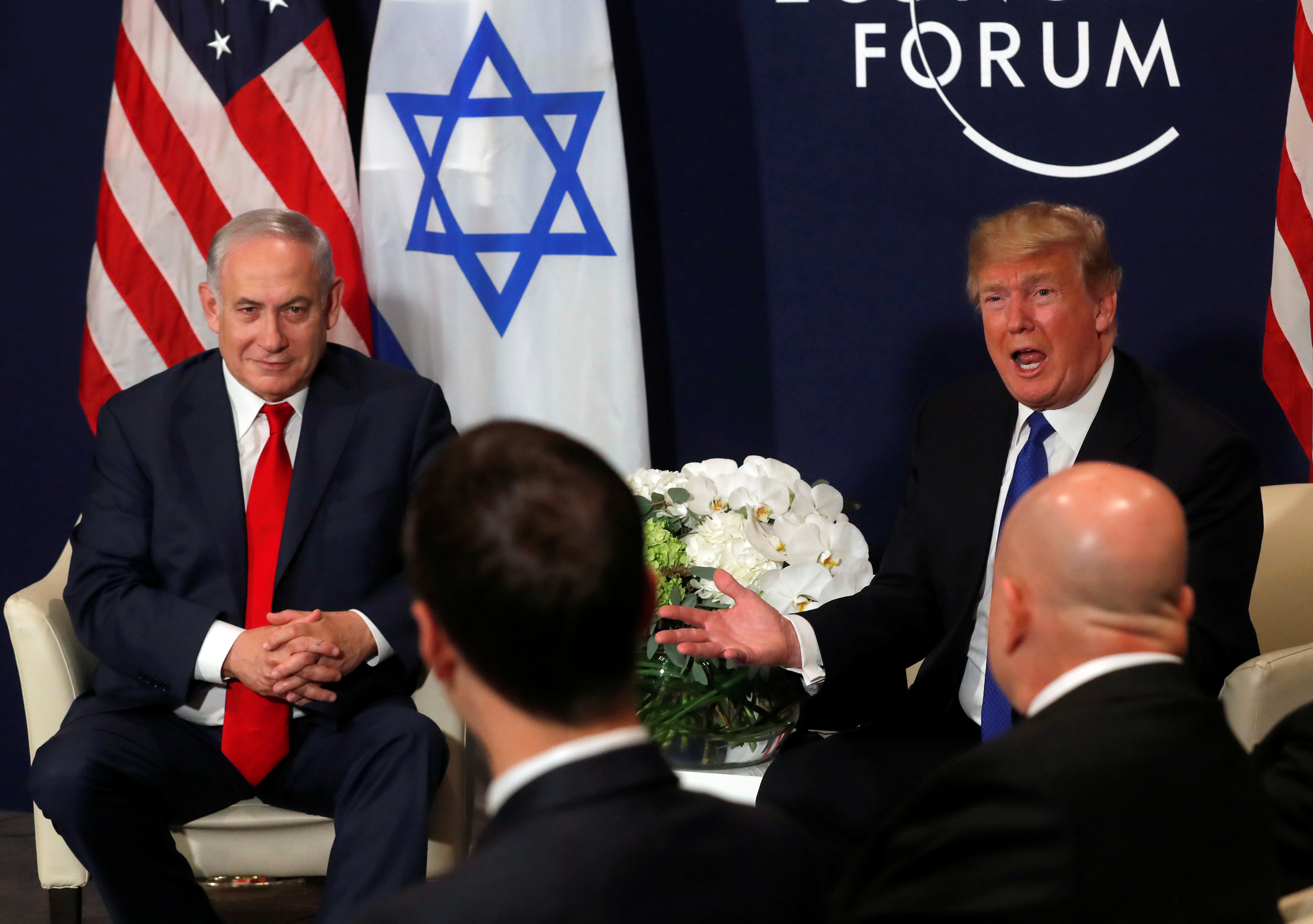
FILE PHOTO - U.S. President Donald Trump speaks with Israeli Prime Minister Benjamin Netanyahu during the World Economic Forum (WEF) annual meeting in Davos, Switzerland January 25, 2018. REUTERS/Carlos Barria

WASHINGTON (Reuters) – U.S. President Donald Trump will host Israeli Prime Minister Benjamin Netanyahu for a meeting at the White House on March 5, two U.S. officials said on Friday.

“The president has a great relationship with the prime minister and looks forward to meeting with him,” a White House official said.

The meeting comes as Netanyahu faces a political firestorm. Police have said they had found sufficient evidence for the prime minister to be charged with bribery in two corruption cases. Netanyahu has denied wrongdoing.

(Reporting by Roberta Rampton and Steve Holland)