Trump says he wants two-state solution for Mideast conflict

U.S. President Donald Trump and Israeli Prime Minister Benjamin Netanyahu hold a bilateral meeting during the 73rd session of the United Nations General Assembly at U.N. headquarters in New York, U.S., September 26, 2018. REUTERS/Carlos Barria

By Steve Holland

UNITED NATIONS (Reuters) – U.S. President Donald Trump said on Wednesday he wanted a two-state solution to resolve the Israeli-Palestinian conflict, the clearest expression yet of his administration’s support for such an outcome.

The Trump administration has in the past said it would support a two-state solution if both sides agreed to it.

Trump, in a meeting with Israeli Prime Minister Benjamin Netanyahu at the United Nations, also said he wanted to unveil a peace plan in the next two to three months.

“I like a two-state solution. That’s what I think works best … That’s my feeling,” said Trump, who is attending the annual U.N. gathering of world leaders.

Netanyahu has said that any future Palestinian state must be demilitarized and must recognize Israel as the state of the Jewish people – conditions that Palestinians say show he is not sincere about peacemaking.

The United States’ Arab allies are strong proponents of a two state solution.

“I really believe something will happen. They say it’s the toughest of all deals,” Trump said.

He added that Israel will have to do something good for the other side without elaborating.

Doubts have mounted over whether Trump’s administration can secure what he has called the “ultimate deal” since December, when the U.S. President recognized Jerusalem as Israel’s capital and then moved the U.S. Embassy there.

“It is a dream of mine to get that done prior to the end of my first term,” Trump said of an agreement on the conflict.

“I don’t want to do it in my second term. We’ll do other things in my second term,” he said. “I think a lot of progress has been made. I think that Israel wants to do something and I think that the Palestinians actually want to do something.”

Jerusalem is one of the major issues in the Israeli-Palestinian conflict. Both sides claim it as a capital. Trump’s move outraged the Palestinians, who have since boycotted Washington’s peace efforts, led by Trump’s son-in-law and adviser, Jared Kushner.

The Palestinians want to establish a state in the West Bank and the Gaza Strip and East Jerusalem. Israel captured those territories in the 1967 Middle East war and annexed East Jerusalem in a move not recognized internationally. It regards all of the city as its eternal and indivisible capital.

Asked what Israel might have to give up in return for the embassy’s move to Jerusalem, Trump replied: What will Israel have to give up after U.S. embassy move to Jerusalem? “I took probably the biggest chip off the table.

“And so obviously we have to make a fair deal, we have to do something. Deals have to be good for both parties … Israel got the first chip and it’s a big one.”

(Reporting by Steve Holland and Arshad Mohammed; Writing by Yara Bayoumy; editing by Grant McCool)

Exclusive: Turkey’s Erdogan says court will decide fate of detained U.S. pastor

Turkey's President Recep Tayyip Erdogan addresses the 73rd session of the United Nations General Assembly at U.N. headquarters in New York, U.S., September 25, 2018. REUTERS/Carlo Allegri

By Stephen Adler and Parisa Hafezi

NEW YORK (Reuters) – Turkish President Tayyip Erdogan said a Turkish court, not politicians, will decide the fate of an American pastor whose detention on terrorism charges has hit relations between Ankara and Washington.

U.S. Secretary of State Mike Pompeo said on Monday he was hopeful Turkey would release evangelical pastor Andrew Brunson this month. The preacher was moved to house arrest in July after being detained for 21 months.

In an interview with Reuters late on Tuesday while he was in New York for the United Nations General Assembly meetings, Erdogan said any decision on Brunson would be made by the court.

“This is a judiciary matter. Brunson has been detained on terrorism charges … On Oct. 12 there will be another hearing and we don’t know what the court will decide and politicians will have no say on the verdict,” Erdogan said.

If found guilty, Brunson could be jailed for up to 35 years. He denies the charges. “As the president, I don’t have the right to order his release. Our judiciary is independent. Let’s wait and see what the court will decide,” Erdogan said.

U.S. President Donald Trump, infuriated by Brunson’s detention, authorized a doubling of duties on aluminum and steel imported from Turkey in August. Turkey retaliated by increasing tariffs on U.S. cars, alcohol and tobacco imports.

The Turkish lira has lost nearly 40 percent of its value against the dollar this year on concerns over Erdogan’s grip on monetary policy and the diplomatic dispute between Ankara and Washington.

“The Brunson case is not even closely related to Turkey’s economy. The current economic challenges have been exaggerated more than necessary and Turkey will overcome these challenges with its own resources,” Erdogan said.

Turkey’s central bank raised its benchmark rate by a hefty 625 basis points this month, boosting the lira and possibly easing investor concern over Erdogan’s influence on monetary policy. Erdogan said he was against the measure.

“It shows the central bank is independent. As the president, I am against high-interest rates and I am repeating my stance here again,” he said, adding that high rates “primarily scare away investors”.

“This was a decision made by the central bank … I hope and pray that their expectations will be met because high rates lead to high inflation. I hope the other way around will happen this time.”

The lira firmed slightly on Wednesday morning after Erdogan’s assurance on the independence of the central bank was published.

IMPROVING TIES

In an effort to boost the economy and attract investors, Erdogan will travel on Sept. 28 to Germany, a country that is home to millions of Turks.

“We want to completely leave behind all the problems and to create a warm environment between Turkey and Germany just like it used to be,” Erdogan said, adding that he will meet Chancellor Angela Merkel during his visit.

The two NATO members have differed over Turkey’s crackdown on suspected opponents of Erdogan after a failed coup in 2016 and over its detention of German citizens.

On Syria, Erdogan said it was impossible for Syrian peace efforts to continue with President Bashar al-Assad in power.

Earlier this month, Turkey and Russia reached an agreement to enforce a new demilitarized zone in Syria’s Idlib region from which “radical” rebels will be required to withdraw by the middle of next month.

But Erdogan said the withdrawal of “radical groups” had already started.

“This part of Syria will be free of weapons which is the expectation of the people of Idlib … who welcomed this step,” he said. The demilitarized zone will be patrolled by Turkish and Russian forces.

Close to 3 million people live in Idlib, around half of them displaced by the war from other parts of Syria.

Erdogan said Turkey will continue to buy natural gas from Iran in line with its long-term supply contract despite Trump’s threats to punish countries doing business with Iran.

“We need to be realistic … Am I supposed to let people freeze in winter? …Nobody should be offended. How can I heat my people’s homes if we stop purchasing Iran’s natural gas?,” he said.

Trump pulled the United States out of a 2015 multinational nuclear deal with Iran and in August Washington reimposed sanctions on Tehran, lifted in 2016 under the pact. U.S. sanctions on Iran’s energy sector are set to be re-imposed in November.

(Writing by Parisa Hafezi; Editing by Raju Gopalakrishnan and Andrew Heavens)

U.S.’s Pompeo says Trump-Kim summit more likely after October: CBS

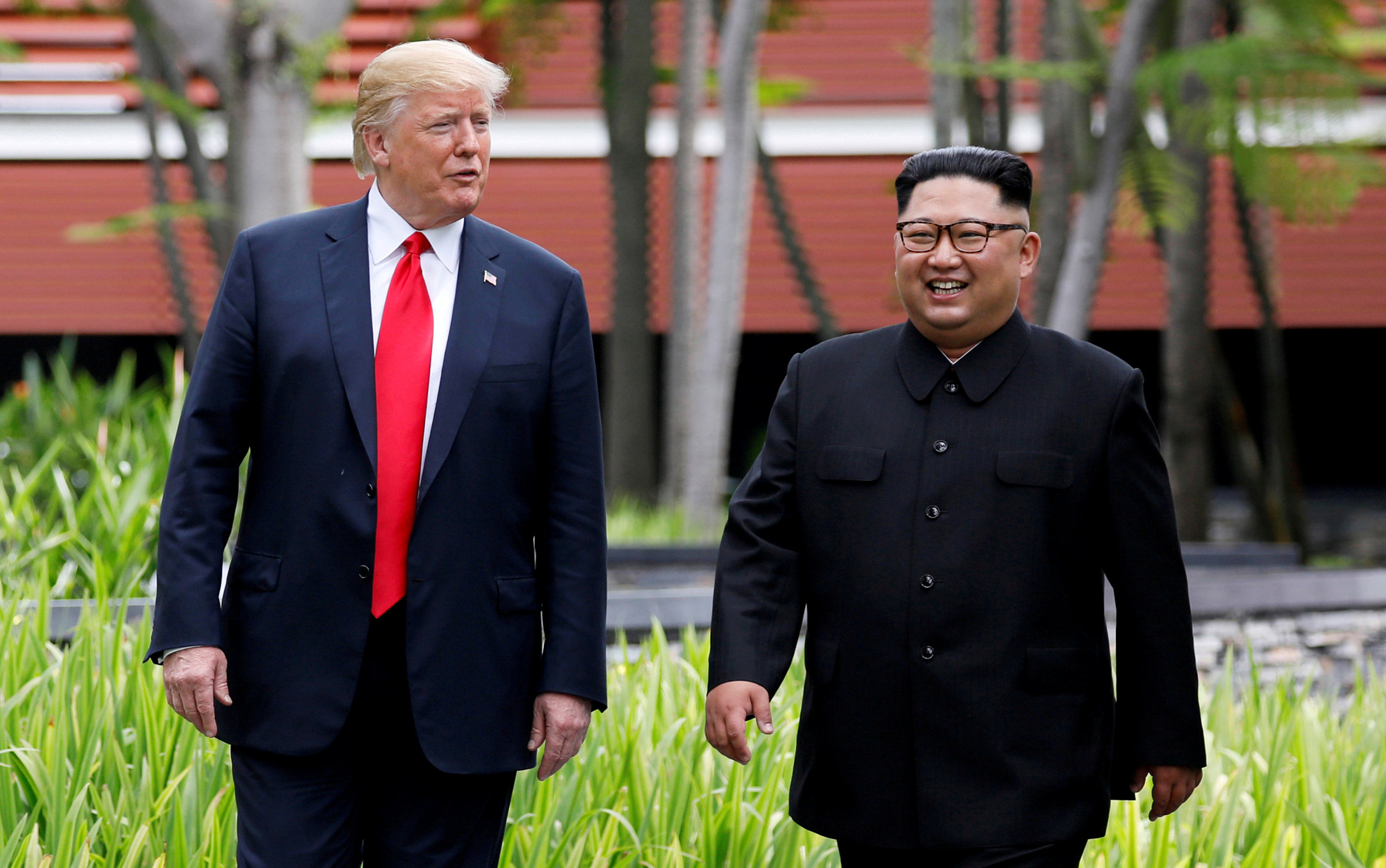
FILE PHOTO: U.S. President Donald Trump and North Korean leader Kim Jong Un walk after lunch at the Capella Hotel on Sentosa island in Singapore June 12, 2018. REUTERS/Jonathan Ernst/File Photo

WASHINGTON (Reuters) – U.S. Secretary of State Mike Pompeo said on Wednesday officials were laying the groundwork for the next summit between President Donald Trump and North Korean leader Kim Jong Un, but any meeting would likely occur after October.

“We’re working diligently to make sure we get the conditions right so that we can accomplish as much as possible during the summit. But we hope it will be soon,” Pompeo said in an interview with “CBS This Morning.”

“It may happen in October but more likely sometime after that.”

Trump held an unprecedented summit with Kim in Singapore in June that yielded a broad pledge by Kim to “work toward” denuclearization of the Korean Peninsula.

Kim’s commitments and actions, however, have fallen far short of Washington’s demands for a complete inventory of North Korea’s weapons programs and irreversible steps to give up a nuclear arsenal that potentially threatens the United States.

“It will take a while; there will be a process to this,” Pompeo said. “President Trump’s been clear about that and clear-eyed about that since the very beginning.”

Asked if Kim had agreed to allow international inspectors into nuclear sites, Pompeo said, “Yes.”

He did not, though, comment on whether any U.S. or international inspectors had been allowed into nuclear sites in the reclusive communist country but said verification was important in any nuclear agreement.

“We’ve talked about this verification from the beginning,” he told CBS. “We’re not going to buy a pig in a poke. We’re going to get this right. We’re going to deliver on this commitment (to denuclearize) that Chairman Kim has made to the world.”

Pompeo said he would be going to Pyongyang soon but did not give a date.


(Reporting by Lesley Wroughton and Doina Chiacu; Editing by Steve Orlofsky)

North Korea’s Kim wants another Trump summit to speed denuclearization: South Korea’s Moon

South Korean President Moon Jae-in and North Korean leader Kim Jong Un walk during a luncheon, in this photo released by North Korea's Korean Central News Agency (KCNA) on September 21, 2018. KCNA via REUTERS

By Hyonhee Shin and Joyce Lee

SEOUL (Reuters) – North Korea’s Kim Jong Un wants a second summit with U.S. President Donald Trump soon to hasten denuclearization, but a key goal is declaring an end this year to the 1950-53 Korean War, the South’s President Moon Jae-in said on Thursday.

Moon said he and Kim spent most of a three-day summit discussing how to break an impasse and restart nuclear talks between Pyongyang and Washington, which are at odds over which should come first, denuclearization or ending the war.

Kim, who recently proposed another summit with Trump after their unprecedented June talks in Singapore, said the North was willing to “permanently dismantle” key missile facilities in the presence of outside experts, and the Yongbyon main nuclear complex, if the United States took corresponding action.

The joint statement from the summit stipulates his commitment to a “verifiable, irreversible dismantlement” of the nuclear programs, and ending the war would be a first U.S. reciprocal step, Moon said.

“Chairman Kim expressed his wish that he wanted to complete denuclearization quickly and focus on economic development,” Moon told a news conference in Seoul, shortly after returning from the summit with Kim in Pyongyang.

“He hoped a second summit with Trump would take place in the near future, in order to move the denuclearization process along quickly.”

INSPECTIONS

Moon said Kim was also open to inspection of a nuclear test site in the northwest town of Punggye-ri, which he called the North’s sole existing facility for underground detonations.

While Pyongyang has stopped nuclear and missile tests this year, it failed to keep its pledge to allow international inspections of its dismantling of the Punggye-ri site in May, stirring criticism that the move could be reversed.

U.S. Secretary of State Mike Pompeo said on Wednesday he had invited North Korea’s foreign minister to meet in New York next week and other Pyongyang officials to Vienna for talks with nuclear envoy Stephen Biegun.

Asked on Thursday if those meetings would take place, U.S. State Department spokeswoman Heather Nauert said invitations had been sent and added: “We certainly stand ready to meet if they are able to.”

Nauert said Washington looked forward to a formal readout of the North-South talks in meetings with the South Koreans next week, which will include one between Trump and Moon on Monday on the sidelines of the U.N. General Assembly.

Asked about Pompeo’s statement on Wednesday welcoming plans for the dismantlement of all facilities at Yongbyon in the presence of U.S. and IAEA inspectors, Nauert said Moon and Kim had talked about inspectors.

“Having IAEA inspectors and United States inspectors be a part of anything is really just a shared understanding,” she said.

“Any time you have a nuclear situation like this where there is a dismantlement, the expectation is that the IAEA would be part of that, so that would be just the normal course of doing business. We have that shared understanding with the countries.”

Asked why this detail was not in the document signed by Moon and Kim, Nauert replied: “We have had conversations … with the government of North Korea and that is our mutual understanding; that is also the understanding between (South) Korea and North Korea. That was one of the things discussed, according to my understanding of it, over the past few days.”

Nauert did not respond when asked if the United States was willing to take “corresponding measures,” except to say: “Nothing can happen in the absence of denuclearization; denuclearization has to come first.”

The North Korean ambassador to the United Nations, Kim Song, did not reply when asked by reporters on Thursday if his foreign minister would meet Pompeo on the sidelines of the U.N. General Assembly next week.

ENDING WAR

Kim pledged to work toward the “complete denuclearization of the Korean peninsula” during two meetings with Moon and his encounter with Trump, but follow-up negotiations on how to implement the vague commitments have since faltered.

Washington calls for concrete action, such as a full disclosure of North Korea’s nuclear and missile facilities, before satisfying Pyongyang’s key demands, including an official end to the war and the easing of international sanctions.

The war ended in an armistice, rather than a peace treaty, meaning U.S.-led United Nations forces, including South Korea, are technically still at war with the North.

But there have been concerns in South Korea and the United States that ending the war would ultimately prompt China and Russia, if not North Korea, to demand that the United Nations Command (UNC), which overlaps with U.S. forces in South Korea, be disbanded and leave.

Seoul aims to jointly announce with the United States an end to the war within this year, a measure Moon said he would discuss with Trump when they meet next week at the United Nations General Assembly in New York.

An end-of-war declaration would not affect the presence of U.S. troops and the UNC in the South, Moon said, adding that Kim shared his view.

“It would be a political declaration that would mark a starting point for peace negotiations,” Moon said.

“A peace treaty would be sealed, as well as normalization of North Korea-U.S. relations, after the North achieves complete denuclearization.”

(Reporting by Hyonhee Shin and Joyce Lee; additional repotring by David Brunnstrom in Washington and Michelle Nichols at the United Nations; editing by Soyoung Kim, Clarence Fernandez and Lisa Shumaker)

U.S. ready to resume North Korea talks, seeks denuclearization by 2021

South Korean President Moon Jae-in and North Korean leader Kim Jong Un pose for photographs on the top of Mt. Paektu, North Korea September 20, 2018. Pyeongyang Press Corps/Pool via REUTERS

By Lesley Wroughton and Hyonhee Shin

WASHINGTON/SEOUL (Reuters) – The United States said it was ready to resume talks with North Korea after Pyongyang pledged on Wednesday to dismantle its key missile facilities and suggested it would close its main Yongbyon nuclear complex if Washington took unspecified actions.

U.S. Secretary of State Mike Pompeo said he had invited North Korea’s foreign minister to meet in New York next week, with the aim of completing its denuclearization by January 2021, after a Pyongyang summit between the leaders of the two Koreas.

The United States appeared eager to seize on commitments by North Korean leader Kim Jong Un at his talks with South Korean President Moon Jae-in even as critics said the steps did little to put Pyongyang on a course for irreversible denuclearization.

North Korea will allow experts from “concerned countries” to watch the closure of its missile engine testing site and launch pad at Tongchang-ri, Moon said at a joint news conference with Kim after their meeting in the North Korean capital.

North Korea will also take additional steps such as closing its main Yongbyon nuclear complex if the United States undertook unspecified reciprocal measures, Moon added.

The sudden revival of diplomacy followed weeks of doubts in U.S. President Donald Trump’s administration’s about whether North Korea was willing to negotiate in good faith after a June summit between Trump and Kim yielded few tangible results.

The January 2021 completion date was the most specific deadline set in what is expected to be a long process of trying to get the North to end its nuclear program, which may threaten U.S. allies South Korea and Japan as well as the U.S. homeland.

In addition to inviting North Korean Foreign Minister Ri Yong Ho to meet when both are in New York next week for the annual U.N. General Assembly gathering of world leaders, Pompeo said Washington invited Pyongyang’s representatives to meet the U.S. special representative for North Korea, Stephen Biegun, in Vienna at the “earliest opportunity.”

China, North Korea’s most important economic backer and diplomatic ally, said it warmly welcomed the agreement reached in Pyongyang and strongly supported it.

“We absolutely cannot let this hard to come by opportunity for peace slip away once again,” the Chinese government’s top diplomat, State Councillor Wang Yi, said in a statement.

SKEPTICISM

Some U.S. officials were deeply skeptical. Speaking before Pompeo’s announcement, two senior U.S. officials involved in U.S.-North Korea policy voiced fears Kim was trying to drive a wedge between Washington and Seoul.

At the summit, the two Koreas agreed on plans to resume economic cooperation, including working to reconnect rail and road links. They agreed as well to restart a joint factory park in a border city of Kaesong and tours to the North’s Mount Kumgang resort when conditions are met.

U.S. officials suggested Kim was trying to ease the economic pressure on him to curb his nuclear programs and to undercut the rationale for U.S. troops being based in South Korea by improving relations with Seoul.

The United States has some 28,500 U.S. troops in South Korea to deter North Korean attack. Pyongyang has long sought their withdrawal and Trump has questioned their rationale and cost.

“There is nothing the North has offered so far that would constitute irreversible movement toward denuclearization, however you define that, by January 2021 or any other time, or even a reduction of the military threat it poses to the South and the region,” said a U.S. intelligence official.

“Everything that’s out there now is conditional on U.S. actions that would reduce the pressure on the North to cooperate or (is) filled with loopholes and exit ramps,” added the official, who spoke on condition of anonymity.

U.S. officials said the ambiguity about what Washington was supposed to do for the North to close its nuclear complex at Yongbyon gave Kim room to argue that Washington had not done enough for North Korea to follow through on its pledges.

TRUMP: ‘HE’S CALM, I’M CALM’

Even if North Korea were to shut down Yongbyon, officials and experts believe it has other secret nuclear facilities.

South Korea’s national security adviser, Chung Eui-yong, said the reciprocal U.S. steps could include an end-of-war declaration. South Korea and the United States remain technically at war with North Korea because the 1950-53 Korean War ended in an armistice and not a peace treaty.

Though Wednesday’s inter-Korean agreement failed to stipulate the North’s commitment to declare nuclear and missile facilities for inspection and eventual decommissioning, Seoul has been in talks with both Pyongyang and Washington over the issue, a senior South Korean official said.

“What North Korea really wants and their priorities may be different from ours,” the official told reporters on Thursday on condition of anonymity.

“We’re talking about a package that would carry many elements, including the declaration of the facilities, Yongbyon and Tongchang-ri, which are of U.S. interest, and from the Northside, the issues of normalizing relations, ending the war and easing sanctions.”

Despite the doubts of U.S. officials and outside analysts, North Korea’s pledge at the summit with the South Korean president drew an enthusiastic response from Trump.

Speaking before Pompeo’s comments, Trump‏ welcomed Kim’s pledges, calling them part of “tremendous progress” with Pyongyang on a number of fronts, and hailing “very good news” from the summit between the Koreas.

“He’s calm, I’m calm – so we’ll see what happens,” Trump, who last year threatened to destroy North Korea, told reporters.

‘THEATRICAL PROMISES’

Kim pledged to work toward the “complete denuclearization of the Korean peninsula” during two meetings with Moon earlier this year and at his summit with Trump.

But discussions over how to implement the vague commitments have since faltered and North Korea has consistently refused to give up its nuclear arsenal unilaterally.

Washington has demanded concrete action, such as a full disclosure of North Korea’s nuclear and missile facilities, before agreeing to Pyongyang’s key goals, including an easing of international sanctions and an official end to the Korean War.

While North Korea has stopped nuclear and missile tests in the past year, it did not allow international inspections of its dismantling of its Punggye-ri nuclear test site in May, drawing criticism that its action was for show and could be reversed.

The day after the June 12 Trump-Kim summit, Pompeo said he hoped to achieve “major disarmament” by North Korea by the end of Trump’s first term in January 2021.

His latest statement that the process “should be completed by January 2021” may be a signal Washington will not wait forever.

“The statement clearly implies that inter-Korean summits and theatrical promises to dismantle the odd facility simply can’t substitute for a negotiating process on the nuclear issue,” said the Asia Society Policy Institute’s Daniel Russel.

“Invoking the end of Trump’s term in January 2021 is another way of saying to the North that American patience is not unlimited and that Kim Jong Un won’t be able to sidestep denuclearization indefinitely,” Russel added.

(Reporting by Lesley Wroughton in Washington and Hyonhee Shin in Seoul; Additional reporting by Joyce Lee, Soyoung Kim and Joint Press Corps, Jeongmin Kim, Haejin Choi and Ju-min Park in Seoul, Ben Blanchard and Zhang Min in Beijing, and Roberta Rampton, David Brunnstrom and John Walcott in Washington; Writing by Yara Bayoumy and Arshad Mohammed; Editing by David Gregorio, Peter Cooney and Lincoln Feast.)

North Korea’s Kim says summit with Trump stabilized region, sees more progress

South Korean President Moon Jae-in and North Korean leader Kim Jong Un wave during a car parade in Pyongyang, North Korea, September 18, 2018. Pyeongyang Press Corps/Pool via REUTERS

By Hyonhee Shin and Joyce Lee

SEOUL (Reuters) – North Korean leader Kim Jong Un said on Tuesday his “historic” summit with U.S. President Donald Trump in Singapore stabilized regional security, and that he expected further progress at an inter-Korean summit aimed at reviving stalled nuclear diplomacy.

Kim thanked South Korea’s President Moon Jae-in for bringing about the Singapore meeting in June as the two leaders began their third round of talks in Pyongyang.

“Thanks to that, the political situation in the region has stabilized and I expect more advanced results,” Kim told Moon, referring to the Singapore gathering, at the start of their talks.

The Kim-Moon summit will be a litmus test for another meeting Kim has recently proposed to Trump, with the South Korean president seeking to engineer a proposal that combines a framework for the North’s denuclearization and a joint declaration ending the 1950-53 Korean War.

Moon expressed gratitude for Kim’s “bold decision to open a new era”.

The first session of the talks, which lasted for two hours, were held at the headquarters of the North’s ruling Workers’ Party Central Committee, with party vice chairman Kim Yong Chol and Kim Jong Un’s sister Kim Yo Jong, as well as South Korea’s national security adviser Chung Eui-yong and spy chief Suh Hoon in attendance.

LIMOUSINE PARADE

Earlier, the leaders paraded down the streets of Pyongyang in Kim’s black Mercedes limousine to loud cheers from nearly 100,000 North Koreans who waved flowers and chanted “Motherland!Unification!”

Kim greeted Moon with hugs and handshakes as the South Korean leader landed in the North’s capital with a mission to rekindle momentum in faltering talks between Washington and Pyongyang over denuclearization and a formal end to the 1950-53 Korean War.

As Kim escorted Moon to the Paekhwawon State Guest House, where Moon will stay during his three-day visit, Kim said he wanted to produce a “bigger outcome at a faster pace” than the two leaders have achieved so far.

Moon, himself the offspring of a family displaced by the war, has met Kim twice this year at the border village of Panmunjom.

“You Mr. President are traveling all around the world, but our country is humble compared with developed nations,” Kim told Moon. “I’ve been waiting and waiting for today. The level of the accommodation and schedule we provide may be low, but it’s our best sincerity and heart.”

Moon said it was “time to bear fruit” and thanked Kim for his hospitality, which included a massive welcome ceremony at Pyongyang International Airport featuring a large, goose-stepping honor guard and a military band.

During their motor parade through Pyongyang’s landmark Ryomyong Street, a new residential district launched last year under Kim’s initiative to modernize the city, Kim and Moon briefly stepped out of the vehicle to greet and take flowers from members of the crowd.

“CHIEF NEGOTIATOR”

Trump has asked Moon to be “chief negotiator” between himself and Kim, according to Moon’s aides, after Trump canceled a trip to Pyongyang by his secretary of state last month.

Washington wants to see concrete action toward denuclearization by North Korea before agreeing to a key goal of Pyongyang – declaring an end to the 1950-53 Korean War.

The conflict ended with an armistice, not a peace treaty, leaving U.S.-led U.N. forces including South Korea technically still at war with the North.

South Korea is pinning high hopes on Kim’s remarks to Moon’s special envoys earlier this month that he wants to achieve denuclearization within Trump’s first term in office ending in early 2021.

“If North Korea-U.S. dialogue is restarted after this visit, it would have much significance in itself,” Moon said before his departure.

Underscoring the challenges ahead, North Korea’s official Rodong Sinmun said on Tuesday “the responsibility falls squarely on the United States” for the stalled nuclear discussions.

“It is due to its nonsensical, irrational stubbornness that other issues can only be discussed after our country has completely verifiably, irreversibly dismantled our nuclear capabilities… without showing the intention to build trust including declaring the end of war,” the newspaper said in an editorial.

On Wednesday, Moon and Kim plan to hold a second day of official talks after which they are expected to unveil a joint statement, and a separate military pact designed to defuse tensions and prevent armed clashes. Moon will return home early Thursday.

Traveling with Moon are South Korean business tycoons, including Samsung scion Jay Y. Lee and the chiefs of SK Group and LG Group. They met North Korean Deputy Prime Minister Ri Ryong Nam, who is in charge of economic affairs, although Seoul officials said they did not expect any specific joint economic projects to be agreed given extensive international sanctions.

The United States is pressing other countries to strictly observe U.N. sanctions aimed at choking off funding for Pyongyang’s nuclear and ballistic missile programs.

North Korea says it has destroyed its main nuclear and missile engine test site and has halted atomic and ballistic missile tests, but U.S. officials and analysts believe it is continuing to work on its weapons plans covertly.

U.S. Ambassador to the United Nations Nikki Haley accused Russia on Monday of “cheating” on U.N. sanctions on North Korea.

(Reporting by Hyonhee Shin, Joyce Lee, Soyoung Kim and Pyongyang Press Corps; Editing by Lincoln Feast and Alex Richardson)

Trump pays tribute to 9/11 ‘true heroes’ in Pennsylvania memorial visit

U.S. President Donald Trump and first lady Melania Trump stand together at the Flight 93 National Memorial during the 17th annual September 11 observance at the memorial near Shanksville, Pennsylvania, U.S., September 11, 2018. REUTERS/Kevin Lamarque

By Roberta Rampton

SHANKSVILLE, Pa. (Reuters) – President Donald Trump on Tuesday lauded the men and women of United Flight 93 for saving countless lives when they struggled with hijackers on Sept. 11, 2001 and called the field where the plane went down a monument to “American defiance.”

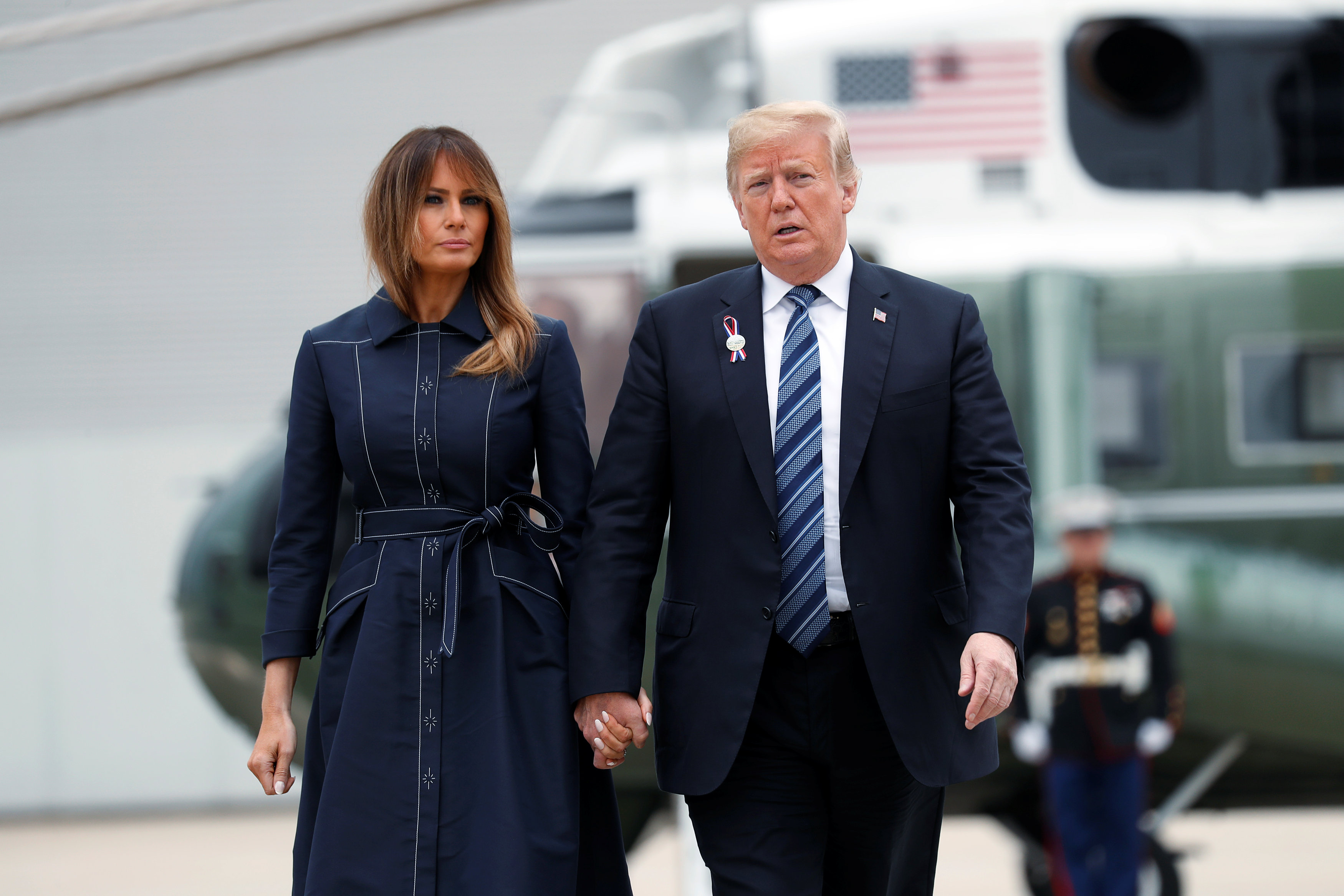
U.S. President Donald Trump and first lady Melania Trump hold hands and talk as they walk from the Marine One helicopter to Air Force One at John Murtha Johnstown-Cambria County Airport prior to departing Johnstown, Pennsylvania, U.S., September 11, 2018. REUTERS/Kevin Lamarque

U.S. President Donald Trump and first lady Melania Trump hold hands and talk as they walk from the Marine One helicopter to Air Force One at John Murtha Johnstown-Cambria County Airport prior to departing Johnstown, Pennsylvania, U.S., September 11, 2018. REUTERS/Kevin Lamarque

Commemorating the 17th anniversary of the attacks that struck the World Trade Center in New York and the Pentagon in Washington, Trump said the nation shared the grief of the family members whose loved ones were lost that day.

“We grieve together for every mother and father, sister and brother, son and daughter, who was stolen from us at the Twin Towers, the Pentagon and here in this Pennsylvania field,” Trump said.

“We honor their sacrifice by pledging to never flinch in the face of evil and to do whatever it takes to keep America safe.”

Flight 93 was heading to San Francisco from Newark, New Jersey, when passengers stormed the plane’s cockpit and sought to take control from the hijackers, crashing in a field and preventing what was thought to be another planned target in Washington.

Family members of Flight 93, some of their voices breaking, read aloud the names of the 40 passengers and crew members who died. Memorial bells tolled.

Trump and his wife, Melania, traveled to the Flight 93 National Memorial from Washington and paused for a moment of reflection while overlooking the field where the plane crashed.

U.S. President Donald Trump andfirst lady Melania Trump walk at the Flight 93 National Memorial during the 17th annual September 11 observance at the memorial near Shanksville, Pennsylvania, U.S., September 11, 2018. REUTERS/Kevin Lamarque

U.S. President Donald Trump andfirst lady Melania Trump walk at the Flight 93 National Memorial during the 17th annual September 11 observance at the memorial near Shanksville, Pennsylvania, U.S., September 11, 2018. REUTERS/Kevin Lamarque

“They boarded the plane as strangers and they entered eternity linked forever as true heroes,” Trump said of the passengers and crew.

“This field is now a monument to American defiance. This memorial is now a message to the world: America will never, ever submit to tyranny.”

Commemorations also took place in New York and Washington to mark the anniversary of the 9/11 attacks by al Qaeda, in which nearly 3,000 people were killed.

(Reporting by Roberta Rampton,; Writing by Jeff Mason; Editing by Alistair Bell)

North Korea military parade features floats and flowers, not missiles

People carry flags in front of statues of North Korea founder Kim Il Sung (L) and late leader Kim Jong Il during a military parade marking the 70th anniversary of North Korea's foundation in Pyongyang, North Korea, September 9, 2018. REUTERS/Danish Siddiqui

By Josh Smith

PYONGYANG (Reuters) – With no long-range missiles on display, North Korea staged a military parade on Sunday focused on conventional arms, peace and economic development as it marked the 70th anniversary of the country’s founding.

The reduced display compared to past years earned a thank you note from U.S. President Donald Trump, who hailed it as a “big and very positive statement from North Korea.”

Trump on Twitter quoted a Fox News description of the event without long-range nuclear missiles as a sign of North Korea’s “commitment to denuclearize.”

“Thank you To Chairman Kim. We will both prove everyone wrong! There is nothing like good dialogue from two people that like each other! Much better than before I took office,” Trump tweeted.

In Pyongyang, line upon line of goose-stepping soldiers and columns of tanks shook the ground before giving way to chanting crowds waving flags and flowers as they passed a review stand where North Korean leader Kim Jong Un sat with a special envoy from China, as well as other visiting foreigners.

Kim told the envoy, Chinese parliament chief Li Zhanshu, that North Korea was focusing on economic development and hopes to learn from China’s experience in this regard, Chinese state television reported.

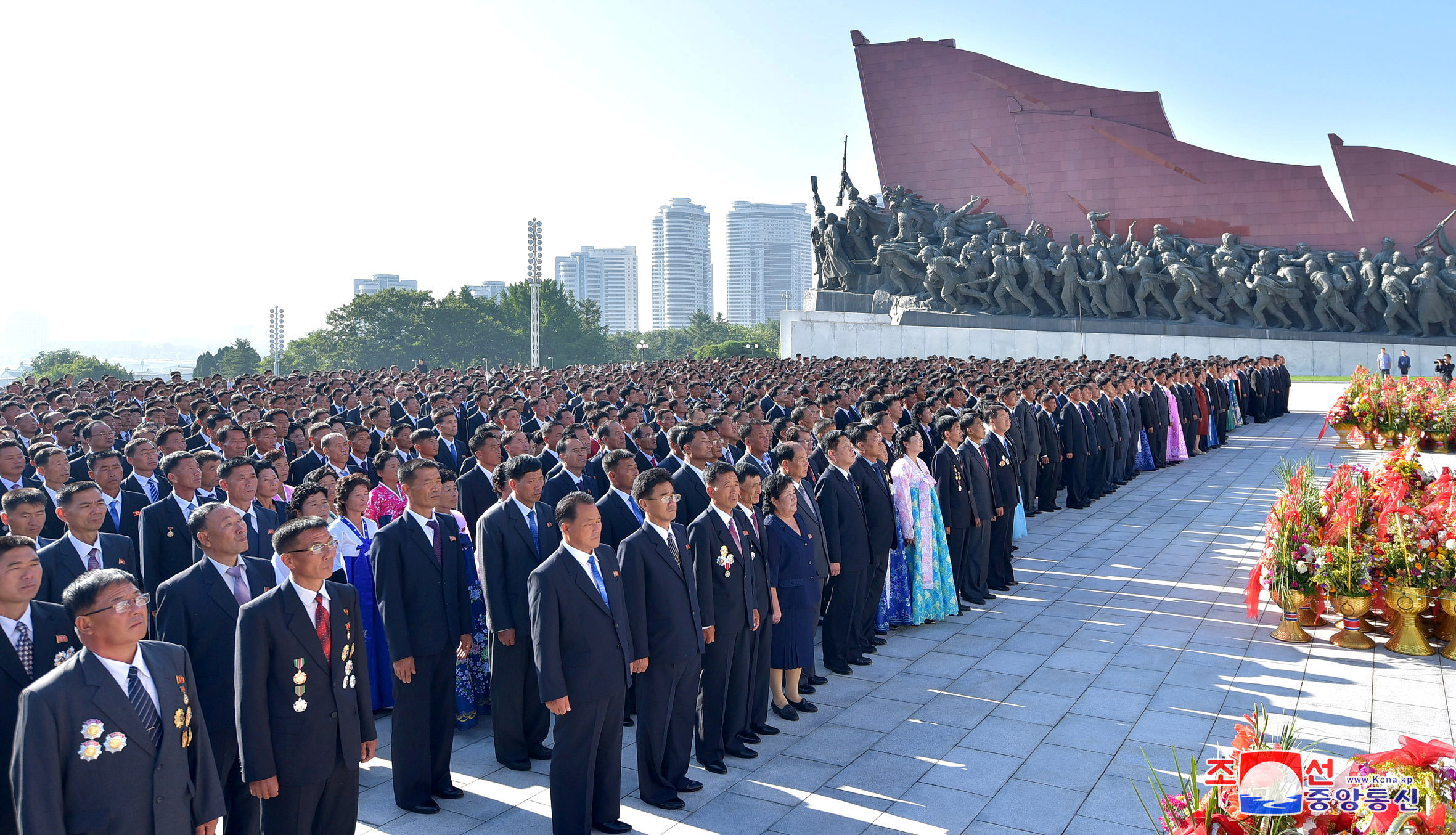
Attendees during the 70th anniversary of North Korea's foundation, in this undated photo released on September 9, 2018 by North Korea's Korean Central News Agency (KCNA). KCNA/via REUTERS

Attendees during the 70th anniversary of North Korea’s foundation, in this undated photo released on September 9, 2018 by North Korea’s Korean Central News Agency (KCNA). KCNA/via REUTERS

“North Korea upholds the consensus of the Singapore meeting between the leaders of North Korea and the United States and has taken steps for it and hopes the United States takes corresponding steps, to jointly promote the political resolution process for the peninsula issue,” the report paraphrased Kim as saying.

The parade highlight themes of military accomplishment, national development, and international engagement at a time when doubts are arising over Kim’s commitment to abandoning nuclear weapons.

Unlike in previous years, there were no inter-continental missiles on display. And there were no nuclear tests to mark the holiday, as has happened in each of the last two years.

North Korea routinely uses major holidays to showcase its military capabilities and the latest developments in missile technology.

But that has lessened this year, underlining Kim’s stated aim for denuclearizing the Korean peninsula and his recent meetings with South Korean President Moon Jae-in and summits with Trump in Singapore and Chinese President Xi Jinping in Beijing and Dalian.

The theme for the celebrations this year was economic development and unifying the Korean peninsula, divided since World War Two.

A huge float was decorated with a modern train, solar panels, wind power plants and dams, under a slogan of “All our might to build economy!”, as North Korean men in construction work wear marched.

Kim Yong Nam, North Korea’s titular head of state, gave a speech at the parade in which he said the country had achieved status as a military power, and would now pursue efforts to strengthen its economy.

Floats on unification also passed by a throng of North Koreans waving unified Korea flags.

“All Koreans should join forces to accomplish unification in our generation. Unification is the only way Koreans can survive,” said an editorial in North Korea’s party newspaper Rodong Sinmun.

Kim Jong Un and his South Korean counterpart Moon will meet in Pyongyang on Sept. 18-20 for the third time this year and discuss “practical measures” toward denuclearization, officials in Seoul have said.

KIM’S LETTER

Despite stalled progress on talks with Washington, the North Korean leader wants to denuclearize the peninsula within Trump’s first term, according to South Korean officials.

Trump said on Friday that Kim has sent a letter to him, which he believes will be positive.

Melissa Hanham, a senior research associate at the James Martin Center for Nonproliferation Studies, said the military component of the parade appeared to be scaled down this year.

“I am very curious to hear what is in the letter to Trump, because this parade could have been more provocative,” Hanham said, adding satellite evidence showed North Korea continued missile-related activities such as testing solid fuel motors.

Kim was seen laughing and holding hands up with China’s Li as he oversaw the festivities at Pyongyang’s main Kim Il Sung square on a clear autumn day. Kim waved to the crowd before leaving but did not make any public remarks.

North Korea has invited a large group of foreign journalists to cover a military parade and other events to mark the 70th anniversary of its founding.

That includes iconic mass games that Pyongyang is organizing for the first time in five years, a huge, nationalist pageant performed by up to 100,000 people in one of the world’s largest stadiums.

Both the Mass Games and the military parade have been criticized by human rights advocates and North Korean defectors for the pressure placed on performers and for painting a distorted picture of the country through stage-managed displays.

But thousands of jovial North Koreans clapped in unison and rallied support for their leader Kim.

A concert on Saturday night attended by Kim Yong Nam and foreign delegations featured little in the way of martial messaging or images, with only a few shadowy American bombers shown briefly in footage of the 1950-1953 Korean War.

(Reporting by Josh Smith; Additional reporting by Pei Li and Ben Blanchard in Beijing and David Lawder in Washington; writing by Ju-min Park; Editing by Raju Gopalakrishnan and Lisa Shumaker)

Ducking queries on Trump, Supreme Court nominee resumes U.S. Senate test

Supreme Court nominee Brett Kavanaugh testifies during the second day of his confirmation hearing before the Senate Judiciary Committee on Capitol Hill in Washington, U.S., September 5, 2018. REUTERS/Joshua Roberts

By Lawrence Hurley

WASHINGTON (Reuters) – Supreme Court nominee Brett Kavanaugh will face a final barrage of questions on Thursday in a multi-day U.S. Senate confirmation hearing, as Democrats press him on his independence from the man who nominated him, President Donald Trump.

A conservative appeals court judge and former Republican White House aide, Kavanaugh has stressed his independence. But in a more than 12-hour session on Wednesday, he sidestepped questions about the scope of presidential power.

The hearing’s focus on that issue came amid a widening probe into Russian meddling in U.S. politics and turmoil within the White House, clouding the presidency of Trump, who is working to get more conservative judges appointed to the federal courts.

If confirmed to a lifetime appointment, Kavanaugh is seen as likely to tilt the nation’s highest court even further to the right. That prospect worries Democrats and heartens Republicans on volatile issues ranging from abortion to guns to business regulation.

Kavanaugh has been an appeals court judge for 12 years and earlier worked for former Republican President George W. Bush.

After more questions from senators on Thursday, his hearing is set to wrap up on Friday with testimony from outside witnesses. Republicans hope Kavanaugh will be confirmed by the Senate before the start of the next Supreme Court term on Oct 1.

Senate Democrats have vowed a fierce fight to block him. But Trump’s fellow Republicans hold a slim Senate majority and there are no clear signs of defections in their ranks. As a result, it is likely that Kavanaugh will be confirmed.

‘HYPOTHETICAL QUESTION’

On presidential power, Kavanaugh declined on Wednesday to pledge he would step aside from any cases that might come before the court involving Trump’s conduct.

Trump has often criticized the judiciary. Some liberals have expressed concern Kavanaugh could be a rubber stamp for Trump and protect him from lawsuits and investigations.

Asked if he would have any trouble ruling against Trump or the executive branch, Kavanaugh replied: “No one is above the law in our constitutional system.”

He dodged a question about whether a president must respond to a subpoena, an issue that could come into play as Special Counsel Robert Mueller investigates possible collusion between Trump’s 2016 presidential campaign and Moscow.

“I can’t give you an answer on that hypothetical question,” Kavanaugh said.

He also avoided clearly answering a question about whether a president could pardon himself or someone else in exchange for a promise not to testify against him.

On abortion, Kavanaugh signaled respect for the landmark 1973 Roe v. Wade Supreme Court ruling legalizing the procedure nationwide. He called it an important legal precedent reaffirmed by the justices over the decades.

Liberals are concerned Kavanaugh could provide a decisive fifth vote on the nine-justice court to overturn the 1973 abortion ruling.

Kavanaugh called the Roe decision “an important precedent of the Supreme Court that has been reaffirmed many times.” He highlighted the 1992 Planned Parenthood v. Casey ruling that reaffirmed Roe, calling it a “precedent on precedent.”

Trump picked Kavanaugh, 53, to replace Justice Anthony Kennedy, who announced his retirement in June.

(Reporting by Lawrence Hurley; Editing by Kevin Drawbaugh and Peter Cooney)

North Korea’s Kim sets denuclearization time line, prompting thanks from Trump

Chief of the national security office at Seoul's presidential Blue House Chung Eui-yong meets with North Korean leader Kim Jong Un in Pyongyang, North Korea September 5, 2018. Picture taken September 5, 2018. The Presidential Blue House/Handout via REUTERS 


By Hyonhee Shin and Susan Heavey

SEOUL/WASHINGTON (Reuters) – North Korea’s Kim Jong Un has given his first timeline for denuclearization, aiming for the end of U.S. President Donald Trump’s first term, Seoul officials said on Thursday, prompting thanks from Trump who said they would “get it done together”.

Kim and South Korean President Moon Jae-in will also meet in Pyongyang on Sept. 18-20 for a third summit and discuss “practical measures” toward denuclearization, Moon’s national security adviser, Chung Eui-yong, said a day after meeting Kim.

The summit could provide renewed momentum to talks over denuclearization between North Korea and the United States, after Trump canceled a visit to Pyongyang by Secretary of State Mike Pompeo last month citing lack of progress.

Kim told South Korean officials his faith in Trump was “unchanged” and that he wanted denuclearization and an end to hostile relations with the United States before Trump’s first term in office ends in early 2021, Chung said.

“He particularly emphasized that he has never said anything negative about President Trump,” Chung said.

Trump welcomed Kim’s remarks in a trademark Tweet.

“Kim Jong Un of North Korea proclaims ‘unwavering faith in President Trump.’ Thank you to Chairman Kim. We will get it done together!” Trump wrote.

In previous, failed talks, North Korea has said it could consider giving up its nuclear program if the United States provided security guarantees by removing troops from South Korea and withdrawing its so-called nuclear umbrella of deterrence from the South and Japan.

U.S. officials involved in the latest negotiations have said North Korea has refused to even start discussions about defining denuclearization or other key terms such as “verifiable” and “irreversible”, and has insisted the United States must first agree to simultaneous steps to reduce economic pressure.

Pompeo, visiting New Delhi, declined to discuss the next steps but said there was a long road ahead in the denuclearization process.

Pompeo visited Pyongyang in July, after which North Korea accused him of making “unilateral and gangster-like demands for denuclearization” while showing little interest in ending the war.

“It is the case that there is still an enormous amount of work to do,” Pompeo told a news conference on Thursday.

Asked about U.S. intelligence that North Korea was still advancing its weapons programs, Pompeo noted that Pyongyang had ceased its nuclear tests and test-firing missiles, “which we consider a good thing.

“But the work of convincing Chairman Kim to make this strategic shift that we’ve talked about for a brighter future for the people of North Korea continues,” Pompeo said.

Moon’s national security adviser Chung said Kim had stressed the need for the United States to reciprocate North Korea’s initial moves, which have included dismantling a nuclear test site and a missile engine facility.

The U.S. embassy in Seoul said it had no information to share on the matter.

FRUSTRATION

North Korea’s official KCNA news agency said Kim told the South’s envoys that his “fixed stand” was to turn the Korean peninsula into “a cradle of peace without nuclear weapons, free from nuclear threat”.

Chung said Kim showed “frustration over the doubt raised by some parts of the international community about his willingness to denuclearize, and asked us to convey his message to the United States”.

“He said he would appreciate that such good faith is accepted with good faith,” Chung said. “He expressed his strong will to carry out more proactive measures toward denuclearization if action is taken in response to the North’s preemptive steps.”

U.S. officials have previously said they have already made concessions, such as halting joint military exercises with South Korea.

During his meeting with Kim, Chung delivered a message from Trump and will relay comments from Kim to U.S. National Security Advisor John Bolton, Moon’s spokesman, Kim Eui-kyeom, told reporters.

Trump spoke to Moon on the evening before Chung’s trip and asked Moon to act as “chief negotiator” between Washington and Pyongyang, the spokesman said.

WHAT HAPPENS FIRST?

Kim and Trump held a landmark summit in Singapore in June, in which they agreed to work toward complete denuclearization. But negotiations have made little progress, while signs North Korea has maintained work on its weapons have emerged.

Under discussion is whether denuclearization or declaring an end to the 1950-53 Korean War should come first.

The war ended with an armistice, not a peace treaty, meaning U.S.-led U.N. forces, including South Korea, are technically still at war with the North.

“The United States shouldn’t delay any further an end-of-war declaration, which the U.S. president promised at the Singapore summit,” the North’s official Rodong Sinmun newspaper said in an editorial.

U.S. officials have said such a declaration could weaken North Korea’s incentive for denuclearization, and create uncertainty about the purpose of 28,500 U.S. troops stationed in South Korea, a legacy of the three-year war.

“Looks like Kim is trying to wash away worries that talks could stall or fail, knowing well that Washington is losing patience,” said Koh Yu-hwan, a professor of North Korean Studies at Dongguk University in Seoul.

“Kim also made it clear that he needs some kind of proof Trump has abandoned the U.S.’s hostile policy before moving toward denuclearization. Kim is trying to prove his sincerity.”

(Additional reporting by Cynthia Kim Joyce Lee in SEOUL John Walcott and Susan Heavey in WASHINGTON and Phil Stewart in NEW DELHI; Writing by Soyoung Kim; Editing by Chris Cushing and Nick Macfie)