As North Korea threat looms, Trump to address world leaders at U.N.

U.S. President Donald Trump participates in a session on reforming the United Nations at UN Headquarters in New York, U.S., September 18, 2017. REUTERS/Kevin

By Michelle Nichols

UNITED NATIONS (Reuters) – North Korea’s nuclear threat looms large this week over the annual gathering of world leaders at the United Nations in New York, where diplomats are eager to hear U.S. President Donald Trump address the 193-member body for the first time.

North Korean diplomats will have a front-row seat in the U.N. General Assembly for Trump’s speech on Tuesday morning, which will touch on the escalating crisis that has seen Trump and Pyongyang trade threats of military action.

Despite his skepticism about the value of international organizations and the United Nations in particular, Trump will seek support for tough measures against North Korea, while pressing his “America First” message to the world body.

“This is not an issue between the United States and North Korea. This is an issue between the world and North Korea,” Trump’s national security adviser, H.R. McMaster, said on Friday.

U.N. Secretary-General Antonio Guterres – who, like Trump, took office in January – plans to meet separately with “concerned parties,” including North Korean Foreign Minister Ri Yong-ho, on the sidelines of the 72nd General Assembly.

“The solution can only be political. Military action could cause devastation on a scale that would take generations to overcome,” Guterres warned on Wednesday.

A week ago, the 15-member U.N. Security Council unanimously adopted its ninth sanctions resolution since 2006 over North Korea’s nuclear and ballistic missile programs.

U.S. Ambassador to the United Nations Nikki Haley said U.N. sanctions had banned 90 percent of the Asian state’s publicly reported exports, saying of Pyongyang on Friday: “This is totally in their hands on how they respond.”

Haley told CNN’s “State of the Union” program on Sunday that Washington had “pretty much exhausted” its options on North Korea at the Security Council.

Ri is due to address the General Assembly on Friday.


IRAN

Some leaders will also push Trump not to give up on a 2015 deal curbing Iran’s nuclear ambitions in return for a lifting of U.N., U.S. and European sanctions, while Israeli Prime Minister Benjamin Netanyahu said it was time to “fix it – or cancel it.”

The foreign ministers of Iran, the United States, Britain, Germany, Russia, China and France – the parties to the agreement – are due to meet on Wednesday ahead of an October deadline for Trump to tell Congress if he believes Tehran is sticking to what he has described as “the worst deal ever negotiated.”

When asked on Friday what Moscow’s message would be for Washington, Russia’s U.N. ambassador, Vassily Nebenzia, said: “Stay in the JCPOA (the nuclear deal).”

A senior U.N. Security Council diplomat, speaking on condition of anonymity, said: “We are faced with real uncertainties with respect to North Korea and it’s a bit dangerous … to add another source of uncertainty with respect to Iran.”

Iran’s Supreme Leader Ayatollah Ali Khamenei said on Sunday his country would not be bullied by the United States and would react strongly to any “wrong move” by Washington on the nuclear deal.

Iran and North Korea will also feature heavily during a ministerial Security Council meeting on Thursday, at the request of the United States, to discuss the proliferation of weapons of mass destruction.


MYANMAR, CLIMATE, U.N. REFORM

While leaders and diplomats are also due to meet on longer-running crises including Libya, Syria, South Sudan, Mali, Central African Republic, Yemen and Iraq, a last-minute addition has been Myanmar, where the United Nations has branded violence against Rohingya Muslims as “ethnic cleansing.”

Britain is due to host a ministerial meeting on Monday to seek a way to get Myanmar authorities to end a military offensive in the country’s Rakhine state that has sent more than 400,000 minority Rohingya Muslims fleeing to Bangladesh.

Following Trump’s announcement that the United States would withdraw from a landmark 2015 global agreement to fight climate change, several high-level gatherings are planned on the sidelines of the General Assembly to bolster the deal.

“Climate change is a serious threat,” Guterres told reporters. “Hurricanes and floods around the world remind us that extreme weather events are expected to become more frequent and severe, due to climate change.”

U.S. Secretary of State Rex Tillerson appeared to hold the door open for the United States to remain in the Paris climate accord “under the right conditions.”

“The president said he is open to finding those conditions where we can remain engaged with others on what we all agree is still a challenging issue,” Tillerson said on CBS’ “Face The Nation” program on Sunday.

Trump will seek to boost support for reforming the United Nations, which he once called “a club for people to get together, talk and have a good time.”

The United States is the largest U.N. contributor and Trump has complained that Washington pays too much.

“The United Nations, of course, holds tremendous potential to realize its founding ideals, but only if it’s run more efficiently and effectively,” McMaster said on Friday.


(Reporting by Michelle Nichols at the United Nations; Editing by Yara Bayoumy and Peter Cooney)
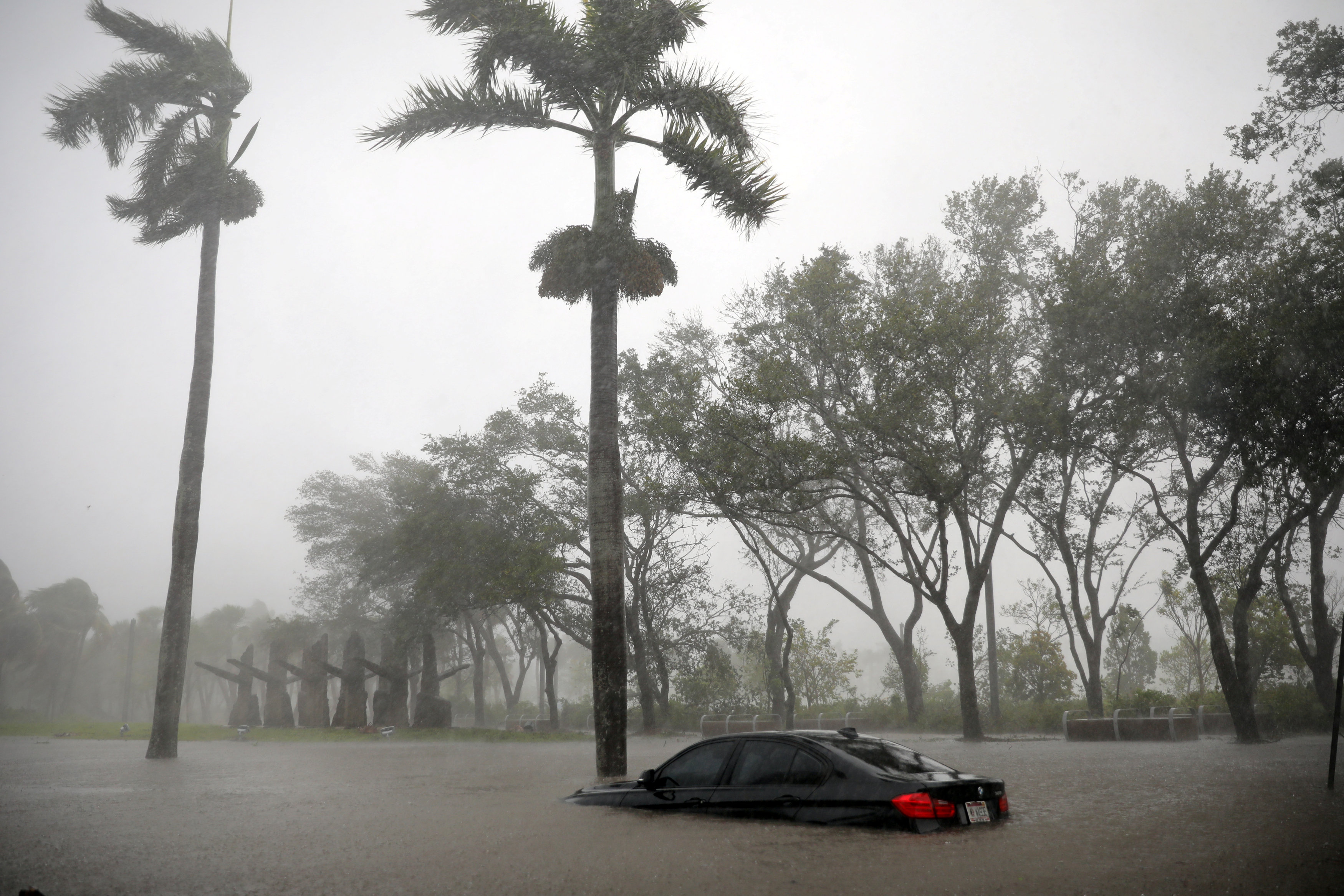
 

Tropical Storm Irma floods northern Florida cities after hammering south

A partially submerged car is seen at a flooded area in Coconut Grove as Hurricane Irma arrives at south Florida, in Miami, Florida, U.S., September 10, 2017.

By Zachary Fagenson and Daniel Trotta

MIAMI/KISSIMMEE, Fla. (Reuters) – Downgraded from a hurricane to a tropical storm, Irma flooded several northern Florida cities with heavy rain and a high storm surge on Monday as it headed out of the state after cutting power to millions and ripping roofs off homes.

Irma, once ranked as one of the most powerful hurricanes recorded in the Atlantic, hit a wide swath of Florida over the past day, first making landfall on the Florida Keys archipelago and then coming ashore south of Naples before heading up the west coast.

Now a tropical storm with sustained winds of up to 70 miles per hour (110 km per hour), Irma was located about 35 miles (56 km) west of Gainesville and headed up the Gulf Coast, the National Hurricane Center said at 8 a.m. ET (1200 GMT).

The Cuban government reported on Monday that 10 people had been killed after Irma battered the island’s north coast with ferocious winds and 36-foot (11-meter) waves over the weekend. This raised the overall death toll from Irma’s powerful rampage through the Caribbean to 38.

Northeastern Florida cities including Jacksonville were facing flash flooding, with the city’s sheriff’s office pulling residents from waist-deep water.

“Stay inside. Go up. Not out,” Jacksonville’s website warned residents. “There is flooding throughout the city and more rain is expected.”


HEART-POUNDING NIGHT

After what she called a terrifying night bunkered in her house in St. Petersburg, on Florida’s Gulf Coast, with her children and extended family, Julie Hally emerged with relief on Monday. The winds had toppled some large tree branches and part of a fence, but her house was undamaged.

“My heart just pounded out of my chest the whole time,” said Hally, 37. “You hear stuff hitting your roof. It honestly sounds like somebody is just whistling at your window the whole night. It’s really scary.”

Governor Rick Scott said he would travel later on Monday to the Florida Keys. Irma first came ashore at Cudjoe Key as a Category 4 hurricane with sustained winds of up to 130 mph (215 kph.)

U.S. President Donald Trump in a ceremony at the Pentagon to remember the victims of the Sept. 11, 2001, attacks vowed a full response to Irma, as well as continued federal support for victims of Hurricane Harvey, which flooded Texas.

“These are storms of catastrophic severity and we are marshalling the full resources of the federal government to help our fellow Americans,” Trump said. “When Americans are in need, Americans pull together and we are one country.”

The state’s largest city, Miami, was spared the brunt of the storm but still saw heavy flooding. Utility crews were already on the streets there clearing downed trees and utility lines. All causeways leading to Miami Beach were closed by police.

As it traveled through the center of the state early on Monday, Irma brought gusts of up to 100 mph (160 kph) and torrential rain to areas around Orlando, one of the most popular areas for tourism in Florida because of its cluster of theme parks, the National Weather Service said.

A piece of a McDonald’s “golden arch” sign hung in a tree near the fast-food restaurant in the central Florida city of Kissimmee on Monday morning. Valerie Gilleece, 55, had ridden out the storm in the city because her wheelchair-bound husband insisted on it, she said.

“I’m just thanking God to be alive,” Gilleece said. “I wanted to go from the start but he’s stubborn as hell.”

Over the weekend, Irma claimed its first U.S. fatality – a man found dead in a pickup truck that had crashed into a tree in high winds in the town of Marathon, in the Florida Keys, local officials said.

During its passage through the Caribbean en route to Florida, Irma was ranked at the rare top end of the scale of hurricane intensity, a Category 5, for days. It carried maximum sustained winds of up to 185 mph (295 kph) when it crashed into the island of Barbuda on Wednesday.

Ahead of Irma’s arrival, some 6.5 million people in southern Florida, about a third of the state’s population, were ordered to evacuate their homes. Some 200,000 were housed in shelters during the storm, according to federal officials.


DAMAGE ESTIMATES

The storm did some $20 billion to $40 billion in damage to insured property as it tore through Florida, catastrophe modeling firm AIR Worldwide estimated.

That estimate, lower than earlier forecasts of up to $50 billion in insured losses, drove insurance company shares higher on Monday. Florida-based insurers Federated National, HCI Group and Universal Insurance were all up more than 12 percent. Meanwhile, Europe’s insurance index was the biggest sectoral gainer, up 2 percent and set for its best day in more than four months.

High winds snapped power lines and left about 5.8 million Florida homes and businesses without power, state data showed.

Miami International Airport, one of the busiest in the country, halted passenger flights through at least Monday. According to the FlightAware.com tracking site, a total of 3,582 U.S. flights were canceled on Monday, mostly as a result of the storm.

Irma was forecast to cross the eastern Florida Panhandle and move into southern Georgia later in the day, dumping as much as 16 inches (41 cm) of rain, government forecasters said.

Police in Miami-Dade County said they had made 29 arrests for looting and burglary.


(Additional reporting by Bernie Woodall, Ben Gruber and Andy Sullivan in Miami, Letitia Stein in Detroit, Colleen Jenkins in Winston-Salem, N.C., Doina Chiacu and Jeff Mason in Washington, Scott DiSavino in New York and Marc Frank in Havana; Writing by Scott Malone and Jon Herskovitz; Editing by Frances Kerry and Paul Simao)


Trump scraps ‘Dreamer’ immigration program

Demonstrators protest in front of the White House after the Trump administration today scrapped the Deferred Action for Childhood Arrivals (DACA), a program that protects from deportation almost 800,000 young men and women who were brought into the U.S. illegally as children, in Washington, U.S., September 5, 2017. REUTERS/Kevin Lamarque

By Steve Holland

WASHINGTON (Reuters) – President Donald Trump on Tuesday scrapped a program that protects from deportation almost 800,000 young men and women who were brought into the United States illegally as children, giving a gridlocked Congress six months to decide their fate.

Trump’s action, announced by Attorney General Jeff Sessions, rescinds a program called Deferred Action for Childhood Arrivals (DACA). The program, created by Democratic former President Barack Obama, is supported by Democrats and many business leaders. The Trump administration said no current beneficiaries of the program would be affected before March 5.

Sessions said the action does not mean the DACA recipients are “bad people.”

“To have a lawful system of immigration that serves the national interest, we cannot admit everyone who would like to come here. It’s just that simple. That would be an open-border policy and the American people have rightly rejected that,” Sessions said.

The move marked the latest action by Trump that is sure to alienate Hispanic Americans, a growing segment of the U.S. population and an increasingly important voting bloc. Most of the immigrants protected by DACA, dubbed “Dreamers,” came from Mexico and other Latin American countries.

Trump’s action, deferring the actual end of the program, effectively kicks responsibility for the fate of the Dreamers to his fellow Republicans who control Congress. But Congress has been unable since the president took office in January to pass any major legislation and has been bitterly divided over immigration in the past.

Obama bypassed Congress and created DACA through an executive order.

Trump appeared determined to pressure U.S. lawmakers to act. “Congress, get ready to do your job – DACA!” the president wrote on Twitter on Tuesday morning before the policy announcement was made.

There were some signs that Congress might be willing to act, with a number of senior Republican lawmakers coming forward to express an interest in protecting the Dreamers.

The president’s decision may have been forced by nine Republican state attorneys general, led by Texas, who had threatened a legal challenge in federal court if Trump did not act to end DACA. A number of Democratic state attorneys general have threatened legal action to defend the program.

(Reporting by Steve Holland; Additional reporting by Makini Brice; Editing by Tim Ahmann, Leslie Adler and Frances Kerry)

Thousands flee Texas towns flooded by Harvey; gas prices spike

Lorenzo Salina helps a neighbor to clean a house damaged by Tropical Storm Harvey in East Houston, Texas, U.S. September 1, 2017.

By Emily Flitter and Peter Henderson

ORANGE, Texas/HOUSTON (Reuters) – Rescuers searched flooded sections of southeastern Texas for people trapped by Hurricane Harvey’s deluge on Friday, and Houston’s mayor warned residents of the city’s west that their neighborhoods may remain underwater for two weeks.

The storm, one of the costliest to hit the United States, has displaced more than 1 million people, with up to 44 feared dead from flooding that paralyzed Houston, swelled river levels to record highs and knocked out the drinking water supply in Beaumont, Texas, a city of about 120,000 people.

Houston Mayor Sylvester Turner called for voluntary evacuations of flooded homes, which he said may remain waterlogged as the Army Corps of Engineers continues to release water into the Buffalo Bayou to prevent dam and levee failures.

About 80 miles (130 km) east of the city, the Neches River, which flows into Beaumont and nearby Port Arthur, was forecast to crest on Friday.

Rescue officials were still working to determine the scope of flooding caused by releases from Orange County dams, said Rodney Smith, deputy chief of the Cedar Hill, Texas, Fire Department.

“A lot of what gives us a snapshot of what’s on the ground are 911 (emergency) calls,” Smith said, adding that about 80 rescue crews were rotating through the county. “If the water starts to recede, we’ll start doing searches door-to-door, block-to-block to see if anyone is still in their homes.”

Tiana Kelly, 22, was waiting in a shelter in Orange, Texas, after being rescued from her flooded street by National Guard troops in a special high-water truck at 2 a.m. Friday.

“I was checking on my neighbor’s dogs and I saw their flashlights, so I flashed my flashlight and they came and got us,” Kelly said as she sat with her 11-month old son, Kalameet, in her arms. “They told us there was an eight-foot flash (flood) that was supposed to come.”

Chemical maker Arkema SA said a fire started on Thursday in a truck storing chemicals at a flooded plant 25 miles (40 km) east of Houston had burned itself out by Friday, but that more blasts were likely in eight other trucks storing the same chemicals in the coming days. Police were enforcing 1.5-mile (2.4-km) exclusion zone around the Crosby, Texas facility.

With three months remaining in the official Atlantic hurricane season, a new storm, Irma, had strengthened into a Category 3 storm on the five-step Saffir-Simpson scale, on Friday. It remained hundreds of miles from land but was forecast to possibly hit the U.S. territory of Puerto Rico, the Dominican Republic and neighboring Haiti by the middle of next week.

Harvey shut about a quarter of U.S. refinery capacity, much of which is clustered along the Gulf Coast, and caused gasoline prices to spike to a two-year high ahead of the long Labor Day holiday weekend.

Harvey roared ashore a week ago as a Category 4 storm and the most powerful hurricane to hit Texas in half a century. It dumped unprecedented amounts of rain and left devastation across more than 300 miles (480 km) of the state’s coast.


OIL RELEASED FROM FEDERAL SUPPLY

The national average for a gallon of regular gasoline has risen 17 cents since the storm hit, hitting $2.519 as of Friday morning, the highest since August 2015, according to motorists group AAA.

Supply concerns prompted the U.S. Energy Department to authorize the release of up to 4.5 million barrels of oil from the Strategic Petroleum Reserve.

Several East Coast refineries have run out of gasoline, raising fears that travelers will face fuel shortages during the three-day holiday.

In major Texas cities including Dallas, there were long lines at gas stations.

The storm came on the 12th anniversary of Hurricane Katrina, which killed about 1,800 around New Orleans. Then-U.S. President George W. Bush’s administration was roundly criticized for its botched early response to the storm.

Signaling that he did not want to be seen as repeating those mistakes, President Donald Trump plans a second visit to the region on Saturday.

“The people of Texas and Louisiana were hit very hard by a historic flood and their response taught us all a lesson, a very, very powerful lesson,” Trump said after meeting with charity organizations in the Oval Office. “There was no outbreak in crime. There was an outbreak of compassion only … and it really inspired us as a nation.”

U.S. first lady Melania Trump, Vice President Mike Pence and U.S. President Donald Trump receive an update on Hurricane Harvey recovery efforts at the White House in Washington, U.S., September 1, 2017.

U.S. first lady Melania Trump, Vice President Mike Pence and U.S. President Donald Trump receive an update on Hurricane Harvey recovery efforts at the White House in Washington, U.S., September 1, 2017. REUTERS/Kevin Lamarque

Lawmakers will replenish a federal disaster relief fund to keep aid flowing, but full assistance will come from Congress in installments, U.S. House of Representatives Speaker Paul Ryan said.

“The cash drain is fast. And so we’re going to have to do some quick responses,” Ryan said in an interview with radio station WCLO in his hometown Janesville, Wisconsin.

Moody’s Analytics estimated the economic cost from Harvey for southeastern Texas at $51 billion to $75 billion.


(Additional reporting by Richard Valdmanis, Marianna Parraga, Ernest Scheyder, Ruthy Munoz, Peter Henderson and Andy Sullivan in Houston, David Gaffen in New York, Jon Herskovitz in Austin, Texas, and Brendan O’Brien in Milwaukee; Writing by Scott Malone Jon Herskovitz; Editing by Bill Trott and Jonathan Oatis)


France says powers must impose transition on Syrians, no role for Assad

French Foreign Minister Jean-Yves Le Drian attends a conference of Italian ambassadors in Rome, Italy July 24, 2017.

By John Irish

PARIS (Reuters) – France’s foreign minister said on Friday he wanted major powers to agree on a transition plan that would be imposed on Syrians, but ruled out any role for President Bashar al-Assad, who he said had “murdered” part of his population.

Jean-Yves Le Drian’s comments come despite what has appeared to be a softening in Paris’ position since the arrival of President Emmanuel Macron.

Macron’s election victory gave Paris, which is a key backer of the Syrian opposition and the second-largest contributor to the U.S.-led coalition fighting Islamic State, a chance to re-examine its Syria policy.

Macron proposed dropping demands Assad step down as a pre-condition for talks, although French officials still insist he cannot be the long-term future for Syria.

Le Drian, defence minister under former president Francois Hollande, said the anticipated defeat of Islamic State militants meant there was an opportunity for a compromise. More than 300,000 people have died in six years of fighting and millions more have fled Syria.

“He (Assad) cannot be part of the solution. The solution is to find with all the actors a calendar with a political transition that will enable a new constitution and elections,” Le Drian told RTL radio.

“This transition cannot be done with Bashar al-Assad who murdered part of his population and who has led millions of Syrians to leave” their homeland, he said.

Critics accused the Hollande administration of intransigence over Assad’s future, although it later said Assad would have to leave only once a transition process was complete.


CONTACT GROUP

That position has put France at odds with Russia and Iran, who back Assad and say the Syrian people should decide their own future.

While Britain has said Assad must go, diplomats say the administration of U.S. President Donald Trump has yet to outline a vision for a political process in Syria and is focusing primarily on defeating Islamic State and countering Iran.

Syria's President Bashar al-Assad speaks during an interview with AFP news agency in Damascus, Syria in this handout picture provided by SANA on April 13, 2017.

FILE PHOTO: Syria’s President Bashar al-Assad speaks during an interview with AFP news agency in Damascus, Syria in this handout picture provided by SANA on April 13, 2017. SANA/Handout via REUTERS

The U.N. Security Council has already adopted a Syria transition roadmap and two diplomats said the latest French idea was to get the five permanent members of the council – Britain, China, France, Russia and the United States – to agree first how to move forward.

The Security Council would then bring into fold the main regional powers, although diplomats said it was pointless without Iran’s involvement. There were also questions on how to win U.S. support given the Trump administration’s staunch anti-Iranian position.

“That’s what we want to do now even before Assad leaves. We do that independently because if we wait for the Syrians to agree we will wait a long time and there will be thousands more dead,” Le Drian said.

Macron has said the initiative would begin to see light during the U.N. General Assembly in mid-September.

Le Drian has previously said the contact group would aim to help U.N.-brokered peace talks in Geneva. They have stalled in large part due to the weakness of opposition groups and the Assad government’s refusal to enter substantive negotiations, given its strong position on the ground.

The last major international attempt to resolve the crisis ended in failure when the International Syria Support Group, which included Iran, was disbanded after Syrian government forces retook the rebel stronghold of Aleppo in 2015.


(Reporting by John Irish; Editing by Jon Boyle)


Russia pledges ‘harsh response’ to U.S. tit-for-tat measures

A sign outside the entrance to the building of the Consulate General of Russia is shown in San Francisco, California, U.S., August 31, 2017.

By Andrew Osborn

MOSCOW (Reuters) – Russia said on Friday it would respond harshly to any U.S. measures designed to hurt it, a day after the United States told Moscow to close its San Francisco consulate and buildings in Washington and New York.

The warning, from Foreign Minister Sergei Lavrov, came as Russia said it was weighing a response to the U.S. move that will force it to shutter two trade missions in the United States as well as the San Francisco consulate by Sept. 2.

“We’ll react as soon as we finish our analysis,” Lavrov told students in Moscow. “We will respond harshly to things that damage us.”

Separately, a top Kremlin aide complained the U.S. demarche pushed bilateral ties further into a blind alley and fuelled a spiral of tit-for-tat retaliatory measures.

U.S. President Donald Trump took office in January, saying he wanted to improve U.S.-Russia ties which were at a post-Cold War low. But since then, ties have frayed further after U.S. intelligence officials said Russia had meddled in the presidential election, something Moscow denies.

Trump, himself battling allegations his associates colluded with Russia, grudgingly signed new sanctions on Moscow into law this month which had been drawn up by Congress.

When it became clear those measures would become law, Moscow ordered the United States to cut its diplomatic and technical staff in Russia by more than half, to 455 people.

Lavrov hinted on Friday that Russia might look at ordering further reductions in U.S. embassy staff, suggesting Moscow had been generous last time by allowing Washington to keep “more than 150” extra people.

He said Russia had cut the U.S. numbers to tally with the number of Russian diplomats in the United States, but that Moscow had generously included more than 150 Russian staff who work at Russia’s representation office at the United Nations.

Lavrov said Moscow still hoped for better relations and blamed Trump’s political foes for the deteriorating situation.

“I want to say that this whole story with exchanging tit-for-tat sanctions was not started by us,” Lavrov said.

“It was started by the Obama administration to undermine U.S.-Russia relations and to not allow Trump to advance constructive ideas or fulfil his pre-election pledges.”

Barack Obama, then outgoing president, expelled 35 suspected Russian spies in December and seized two Russian diplomatic compounds. President Vladimir Putin paused before responding, saying he would wait to see how Trump handled Russia.

“We thought this administration could exercise common sense, but unfortunately the Russophobes in Congress are not allowing it to,” said Lavrov, who complained that the United States had only given Moscow 48 hours to comply with its latest demands.


(Additional reporting by Denis Pinchuk; Editing by Robin Pomeroy)


Trump to present vision for U.S. strategy in Afghanistan war

FILE PHOTO: U.S. Army soldiers from the 2nd Platoon, B battery 2-8 field artillery, fire a howitzer artillery piece at Seprwan Ghar forward fire base in Panjwai district, Kandahar province southern Afghanistan, June 12, 2011.

By Steve Holland and John Walcott

WASHINGTON (Reuters) – It will be President Donald Trump’s turn on Monday to address a problem that vexed his two predecessors when he details his strategy for the war in Afghanistan, America’s longest military conflict.

In a prime-time speech to the nation, Trump may announce a modest increase in U.S. troops, as recommended by his senior advisers.

Trump has long been skeptical of the U.S. approach in the region, where the Afghan war is in its 16th year.

He announced a strategic review soon after taking office in January and has privately questioned whether sending more troops was wise, U.S. officials said.

“We’re not winning,” he told advisers in a mid-July meeting, questioning whether Army General John Nicholson, the top U.S. commander in Afghanistan, should be fired, an official said.

Trump, who on Sunday ended a two-week working vacation at his Bedminster, New Jersey, golf club, reached his decision on Afghanistan after lengthy talks with his top military and national security aides at Camp David, Maryland, on Friday.

A White House statement on Sunday said Trump would “provide an update on the path forward for America’s engagement in Afghanistan and South Asia.”

A senior administration official said the likeliest outcome was that Trump would agree to a modest increase in U.S. troops. Current U.S. troop numbers are about 8,400.

The United States invaded Afghanistan in October 2001 after the Sept. 11 attacks on New York and Washington, and overthrew the Islamist Taliban government. But U.S. forces have remained bogged down there through the presidencies of George W. Bush, Barack Obama and now Trump.

“I took over a mess, and we’re going to make it a lot less messy,” Trump said when asked about Afghanistan earlier this month.


TALIBAN THREAT

Defense Secretary Jim Mattis has argued that a U.S. military presence is needed to protect against the ongoing threat from Islamist militants.

Afghan security forces have struggled to prevent advances by Taliban insurgents. The war stymied the Obama administration, which committed an increase of tens of thousands of U.S. troops to reverse Taliban gains, then committed to a troop drawdown, which ultimately had to be halted.

Earlier this year, Trump gave Mattis the authority to set troop levels in Afghanistan, opening the door for future troop increases requested by Nicholson. The general, who leads U.S. and international forces in Afghanistan, said in February he needed “a few thousand” additional forces, some potentially drawn from U.S. allies.

U.S. military and intelligence officials are concerned that a Taliban victory would allow al Qaeda and Islamic State’s regional affiliate to establish bases in Afghanistan from which to plot attacks against the United States and its allies.

One reason the White House decision has taken so long, two officials who participated in the discussions said on Sunday, is that it was difficult to get Trump to accept the need for a broader regional strategy that included U.S. policy toward Pakistan before making a decision on whether to send additional forces to Afghanistan.

Both officials, speaking on condition of anonymity, declined to disclose Trump’s decisions on troop levels and Pakistan policy before he does.

The difficulty in reaching a decision was compounded, the two officials said, by the wide range of conflicting options Trump received.

White House national security adviser H.R. McMaster and other advisers favored accepting Nicholson’s request for some 4,000 additional U.S. forces.

But recently ousted White House strategic adviser Steve Bannon had argued for the withdrawal of all U.S. forces, saying that after 16 years, the war was still not winnable, U.S. officials said. Bannon, fired on Friday by Trump, was not at the Camp David meeting.

The officials said that another option examined was shrinking the U.S. force by some 3,000 troops and leaving a smaller counterterrorism and intelligence-gathering contingent to carry out special operations and direct drone strikes against the Taliban.

Proponents argued that option was less costly in lives and money and would add less to the damage already inflicted on U.S. special operations forces by the long-running battles in Afghanistan, Iraq, Somalia and Syria.


(Additional reporting by Idrees Ali traveling with Mattis in Amman; Writing by James Oliphant; Editing Peter Cooney.)


Korea tensions ease slightly as U.S. officials play down war risks

A South Korean soldier stands guard at a guard post near the demilitarized zone separating the two Koreas in Paju, South Korea, August 14, 2017.

By Christine Kim and Ben Blanchard

SEOUL/BEIJING (Reuters) – Tension on the Korean peninsula eased slightly on Monday as South Korea’s president said resolving North Korea’s nuclear ambitions must be done peacefully and U.S. officials played down the risk of an imminent war.

Concern that North Korea is close to achieving its goal of putting the mainland United States within range of a nuclear weapon has caused tension to spike in recent months.

U.S. President Donald Trump warned last week that the U.S. military was “locked and loaded” if North Korea acted unwisely after threatening to land missiles in the sea near the U.S. Pacific territory of Guam.

“There must be no more war on the Korean peninsula. Whatever ups and downs we face, the North Korean nuclear situation must be resolved peacefully,” South Korean President Moon Jae-in told a meeting with senior aides and advisers.

“I am certain the United States will respond to the current situation calmly and responsibly in a stance that is equal to ours,” he said.

U.S. Defense Secretary Jim Mattis and Secretary of State Rex Tillerson sent a conciliatory message to North Korea in an op-ed piece in the Wall Street Journal on Sunday.

“The U.S. has no interest in regime change or accelerated reunification of Korea. We do not seek an excuse to garrison U.S. troops north of the Demilitarized Zone,” the officials said, addressing some of Pyongyang’s fears that Washington ultimately intends to replace the reclusive country’s leadership.

The article took a softer tone on North Korea than the president, who warned Pyongyang last week of “fire and fury” if it launched an attack.

Mattis and Tillerson underlined that the United States aims “to achieve the complete, verifiable and irreversible denuclearization of the Korean Peninsula and a dismantling of the regime’s ballistic-missile programs.”

“While diplomacy is our preferred means of changing North Korea’s course of action, it is backed by military options,” they said.

The United States is adopting a policy of “strategic accountability” towards North Korea, the officials wrote, but it is not clear how this significantly differs from the “strategic patience” Korea policy of former President Barack Obama.

A global index of stocks rose, after fears of a U.S.-North Korea nuclear standoff had driven it to the biggest weekly losses of 2017, while the dollar also strengthened.

U.S. Central Intelligence Agency Director Mike Pompeo said North Korean leader Kim Jong Un might conduct another missile test but talk of being on the cusp of a nuclear war was overstating the risk.

“I’ve seen no intelligence that would indicate that we’re in that place today,” Pompeo told “Fox News Sunday”.

However, North Korea reiterated its threats, with its official KCNA news agency saying “war cannot be blocked by any power if sparks fly due to a small, random incident that was unintentional”.

“Any second Korean War would have no choice but to spread into a nuclear war,” it said in a commentary.

The United States and South Korea remain technically still at war with North Korea after the 1950-53 Korean conflict ended with a truce, not a peace treaty.

MISSILE DOUBTS

South Korean Vice Defence Minister Suh Choo-suk agreed North Korea was likely to continue provocations, including nuclear tests, but did not see a big risk of the North engaging in actual military conflict.

Suh again highlighted doubts about North Korea’s claims about its military capability.

“Both the United States and South Korea do not believe North Korea has yet completely gained re-entry technology in material engineering terms,” Suh said in remarks televised on Sunday for a Korea Broadcasting System show.

Ukraine denied on Monday that it had supplied defense technology to North Korea, responding to an article in the New York Times that said North Korea may have purchased rocket engines from Ukrainian factory Yuzhmash.

Tension in the region has risen since North Korea carried out two nuclear bomb tests last year and two intercontinental ballistic missile tests in July, tests it often conducts to coincide with important national dates.

Tuesday marks the anniversary of Japan’s expulsion from the Korean peninsula, a rare holiday celebrated by both the North and the South. Moon and Kim, who has not been seen publicly for several days, are both expected to make addresses on their respective sides of the heavily militarised border.

Trump has urged China, the North’s main ally and trading partner, to do more to rein in its neighbor, often linking Beijing’s efforts to comments around U.S.-China trade. China strenuously rejects linking the two issues.

Trump will issue an order later on Monday to determine whether to investigate Chinese trade practices that force U.S. firms operating in China to turn over intellectual property, senior administration officials said on Saturday.

Chinese Foreign Ministry spokeswoman Hua Chunying said that Beijing has said many times the essence of China-U.S. trade and business ties is mutual benefit and that there is no future in any trade war between China and the United States.

“The (Korean) peninsula issue and trade and business issues are in a different category from each other,” Hua added. “On these two issues, China and the United States should respect each other and increase cooperation. Using one issue as a tool for exerting pressure on another is clearly inappropriate.”

China’s Commerce Ministry issued an order on Monday banning imports of coal, iron ore, lead concentrates and ore, lead and sea food from North Korea, effective from Tuesday.

The move followed the announcement of U.N. sanctions against North Korea this month which have to be enforced within 30 days by member states.

U.S. Joint Chiefs of Staff Chairman Joseph Dunford told South Korea’s Moon in a meeting on Monday that U.S. military options being prepared against North Korea would be for when diplomatic and economic sanctions failed, according to Moon’s office.

(Writing by Lincoln Feast and Alistair Bell; Editing by Raju Gopalakrishnan and James Dalgleish)


White House says Trump condemns Ku Klux Klan, neo-Nazis

People gather for a vigil in response to the death of a counter-demonstrator at the "Unite the Right" rally in Charlottesville, outside the White House in Washington,

By Ian Simpson

CHARLOTTESVILLE, Va. (Reuters) – President Donald Trump’s remarks condemning violence at a white nationalist rally were meant to include the Ku Klux Klan and neo-Nazi groups, the White House said on Sunday, a day after he was criticized across the political spectrum for not explicitly denouncing white supremacists.

U.S. authorities opened an investigation into the deadly violence in Virginia, which put renewed pressure on the Trump administration to take an unequivocal stand against right-wing extremists occupying a loyal segment of the Republican president’s political base.

A 32-year-old woman was killed and 19 people were injured, five critically, on Saturday when a man plowed a car into a crowd of people protesting the white nationalist rally in the Southern college town of Charlottesville. Another 15 people were injured in bloody street brawls between white nationalists and counter-demonstrators who fought each other with fists, rocks and pepper spray.

Two Virginia state police officers died in the crash of their helicopter after assisting in efforts to quell the unrest, which Mayor Mike Signer said was met by the presence of nearly 1,000 law enforcement officers.

Former U.S. Army enlistee James Alex Fields Jr., 20, a white Ohio man described by a former high school teacher as having been “infatuated” with Nazi ideology as a teenager, was due to be appear in court on murder and other charges stemming from the deadly car crash.

The federal “hate crime” investigation of the incident “is not limited to the driver,” a U.S. Justice Department official told Reuters. “We will investigate whether others may have been involved in planning the attack.”

Democrats and Republicans criticized Trump for waiting too long to address the violence – his first major crisis on the domestic front that he has faced as president – and for failing when he did speak out to explicitly condemn white-supremacist marchers who ignited the melee.

Trump on Saturday initially denounced what he called “this egregious display of hatred, bigotry and violence on many sides.”

On Sunday, however, the White House added: “The president said very strongly in his statement yesterday that he condemns all forms of violence, bigotry, and hatred, and of course that includes white supremacists, KKK, neo-Nazi, and all extremist groups. He called for national unity and bringing all Americans together.”

The statement was emailed to reporters covering Trump at his golf resort in New Jersey and attributed to an unidentified “White House spokesperson.”


SOLIDARITY WITH CHARLOTTESVILLE

Memorial vigils and other events showing solidarity with Charlottesville’s victims were planned across the country on Sunday to “honor all those under attack by congregating against hate,” a loose coalition of civil society groups said in postings on social media.

Virginia police have not yet provided a motive for the man accused of ramming his car into the crowd. But U.S. prosecutors and the Federal Bureau of Investigation have opened a civil rights investigation, FBI and Justice Department officials said.

Derek Weimer, a history teacher at Fields’ high school, told Cincinnati television station WCPO-TV that he remembered Fields harboring “some very radical views on race” as a student and was “very infatuated with the Nazis, with Adolf Hitler.”

“I developed a good rapport with him and I used that rapport to constantly try to steer him away from those beliefs,” Weimer recounted, adding that he recalled Fields being “gung-ho” about joining the Army when he graduated.

The Army confirmed that Fields reported for basic military training in August 2015 but was “released from active duty due to a failure to meet training standards in December of 2015.” The Army statement did not explain in what way he failed to measure up.

Fields is being held on suspicion of second-degree murder, three counts of malicious wounding and a single count of leaving the scene of a fatal accident, authorities said.

Two people stop to comfort Joseph Culver (C) of Charlottesville as he kneels at a late night vigil to pay his respect for a friend injured in a car attack on counter protesters after the "Unite the Right" rally organized by white nationalists in Charlottesville, Virginia, U.S., August 12, 2017. REUTERS/Jim Bourg

Two people stop to comfort Joseph Culver (C) of Charlottesville as he kneels at a late night vigil to pay his respect for a friend injured in a car attack on counter protesters after the “Unite the Right” rally organized by white nationalists in Charlottesville, Virginia, U.S., August 12, 2017. REUTERS/Jim Bourg

REPUBLICAN SENATORS CRITICIZE RESPONSE

On Sunday before the White House statement, U.S. Senator Cory Gardner of Colorado, who chairs the Republican Party’s Senate election effort, urged the president to condemn “white supremacists” and to use that term. He was one of several Republican senators who squarely criticized Trump on Twitter on Saturday.

“Calling out people for their acts of evil – let’s do it today – white nationalist, white supremacist,” Gardner said on CNN’s “State of the Union” program on Sunday. “We will not stand for their hate.”

Sunday’s White House statement elaborating on Trump’s initial comment on the Charlottesville clashes was followed hours later by even tougher rhetoric against white nationalists from Vice President Mike Pence, on a visit to Colombia.

“We have no tolerance for hate and violence from white supremacists, neo Nazis or the KKK,” Pence said. “These dangerous fringe groups have no place in American public life and in the American debate, and we condemn them in the strongest possible terms.”

Mayor Signer, a Democrat, blamed Trump for helping foment an atmosphere conducive to violence, starting with rhetoric as a candidate for president in 2016.

“Look at the campaign he ran, Signer said on CNN’s State of the Nation.” “There are two words that need to be said over and over again – domestic terrorism and white supremacy. That is exactly what we saw on display this weekend.”

Jason Kessler, an organizer of Saturday’s “Unite the Right” rally, which was staged to protest the planned removal of a statue of Confederate army commander General Robert E. Lee from a park, said supporters of the event would not back down. The rally stemmed from a long debate over various public memorials and symbols honoring the pro-slavery Confederacy of the U.S. Civil War, considered an affront by African-Americans.

Kessler attempted to hold a press conference outside city hall in Charlottesville on Sunday but was quickly shouted down by counter-protesters.


(Additional reporting by Lucia Mutikani and Mike Stone in Washington, James Oliphant in New Jersey, Bernie Woodall in Fort Lauderdale, Fla. and Julia Cobb in Bogota; Writing by Grant McCool and Steve Gorman; Editing by Andrew Hay and Mary Milliken)


Trump praises new chief of staff for avoiding controversy

U.S. President Donald Trump shakes hands with John Kelly after he was sworn in as White House Chief of Staff in the Oval Office of the White House in Washington, U.S., July 31, 2017.

By Roberta Rampton

WASHINGTON (Reuters) – U.S. President Donald Trump swore in his new chief of staff John Kelly on Monday, a retired Marine Corps general who he praised for averting controversy during his tenure overseeing border security issues at the Department of Homeland Security.

Kelly is expected to bring a more disciplined approach to running Trump’s White House. He replaced Reince Priebus, who failed to mesh with the president’s freewheeling and untraditional management style and grappled with infighting during his six months in the job.

Trump praised Kelly for his work at the DHS, crediting him with reducing the number of people illegally crossing the southern U.S. border, and implementing a travel ban for refugees and people from a group of Muslim majority countries.

“He will do a spectacular job, I have no doubt, as chief of staff,” the Republican president said in brief remarks to reporters in the Oval Office, surrounded by his senior advisers, after Kelly was sworn in.

“With a very controversial situation, there’s been very little controversy, which is really amazing by itself,” Trump said.

Trump announced last Friday that Kelly would replace Priebus, at the end of a particularly chaotic week that saw his first legislative effort – healthcare reform – fail in Congress.

The last week heightened concerns in Trump’s party that the distractions and West Wing dysfunction would derail other legislative priorities, including tax reform and debt ceiling negotiations.

Trump pointed to the buoyant stock market and low unemployment rate as signs that his White House was working well. “No WH chaos!” he tweeted on Monday.

Asked by reporters what Kelly would do differently, Trump brushed aside concerns.

“We’re doing very well, we have a tremendous base, we have a tremendous group of support. The country is optimistic, and I think the general will just add to it,” he said.


(Reporting by Roberta Rampton; Editing by Frances Kerry)