Iran naval drills underway amid tensions with U.S.

A staff member removes the Iranian flag from the stage after a group picture with foreign ministers and representatives of the U.S., Iran, China, Russia, Britain, Germany, France and the European Union during the Iran nuclear talks at the Vienna International Center in Vienna, Austria July 14, 2015. To match Analysis USA-ELECTION/IRAN

By Phil Stewart

WASHINGTON (Reuters) – The United States believes Iran has started carrying out naval exercises in the Gulf, apparently moving up the timing of annual drills amid heightened tensions with Washington, U.S. officials told Reuters on Thursday.

One U.S. official, speaking on condition of anonymity, said possibly more than 100 vessels were involved in the drills, including small boats. A second official expected the drill could be wrapped up this week.

Iran has been furious over U.S. President Donald Trump’s decision to pull out of an international nuclear deal and reimpose sanctions on Tehran. Senior Iranian officials have warned the country would not easily yield to a renewed U.S. campaign to strangle Iran’s vital oil exports.

The U.S. military’s Central Command on Wednesday confirmed it has seen an increase in Iranian naval activity, including in the Strait of Hormuz, a strategic waterway for oil shipments that Iran’s Revolutionary Guards have threatened to block.

“We are monitoring it closely, and will continue to work with our partners to ensure freedom of navigation and free flow of commerce in international waterways,” said Navy Captain Bill Urban, the chief spokesman at Central Command, which oversees U.S. forces in the Middle East.

Central Command did not update its guidance on Thursday.

A third official said the Iranian naval operations did not appear to be affecting commercial maritime activity.

U.S. officials, speaking to Reuters on condition of anonymity, said the drills appeared designed to send a message to Washington, which is intensifying its economic and diplomatic pressure on Tehran but so far stopping short of using the U.S. military to more aggressively counter Iran and its proxies.

But Iran did not appear interested in drawing attention to them. Iranian authorities have yet to comment on them and several officials contacted by Reuters declined to comment.

Trump’s policies are already putting significant pressure on the Iranian economy, although U.S. intelligence suggests they may ultimately rally Iranians against the United States and strengthen Iran’s hardline rulers, officials say.

Iran’s currency plumbed new depths this week ahead of Aug. 7, when Washington is due to reimpose a first lot of sanctions following Trump’s withdrawal from the 2015 nuclear deal.

Protests have broken out in Iran since the beginning of the year over high prices, water shortage, power cuts and alleged corruption.

On Tuesday, hundreds of people rallied in cities including Isfahan, Karaj, Shiraz and Ahvaz to protest high inflation caused in part by the weak rial.

(Reporting by Phil Stewart in Washington; additional reporting by Parisa Hafezi in Ankara; Editing by James Dalgleish)

U.S. detects new activity at North Korea factory that built ICBMs

A satellite image shows the Sanumdong missile production site in North Korea on July 29, 2018. Planet Labs Inc/Handout via REUTERS

By David Brunnstrom

WASHINGTON (Reuters) – U.S. spy satellites have detected renewed activity at the North Korean factory that produced the country’s first intercontinental ballistic missiles capable of reaching the United States, a senior U.S. official said on Monday, in the midst of talks to compel Pyongyang to give up its nuclear arms.

Photos and infrared imaging indicate vehicles moving in and out of the facility at Sanumdong, but do not show how advanced any missile construction might be, the official told Reuters on condition of anonymity because the intelligence is classified.

The Washington Post reported on Monday that North Korea appeared to be building one or two new liquid-fueled intercontinental ballistic missiles at the large research facility on the outskirts of Pyongyang, citing unidentified officials familiar with intelligence reporting.

According to the U.S. official who spoke to Reuters, one photo showed a truck and covered trailer similar to those the North has used to move its ICBMs. Since the trailer was covered, it was not possible to know what, if anything, it was carrying.

The White House said it did not comment on intelligence. A senior official at South Korea’s presidential office said U.S. and South Korean intelligence agencies are closely looking into various North Korean movements, declining specific comment.

The evidence obtained this month is the latest to suggest ongoing activity in North Korea’s nuclear and missile facilities despite talks with the United States and a June summit between North Korean leader Kim Jong Un and U.S. President Donald Trump.

Trump declared soon afterward that North Korea no longer posed a nuclear threat. Kim committed in a broad summit statement to work toward denuclearization, but Pyongyang has offered no details as to how it might go about that and subsequent talks have not gone smoothly.

It was not the first time U.S. intelligence clashed with the president’s optimism.

In late June, U.S. officials told U.S. media outlets that intelligence agencies believed North Korea had increased production of fuel for nuclear weapons and that it did not intend to fully give up its nuclear arsenal.

U.S. Secretary of State Mike Pompeo told the U.S. Senate Foreign Relations Committee last week that North Korea was continuing to produce fuel for nuclear bombs despite its pledge to denuclearize. But he insisted the Trump administration was still making progress in its talks with Pyongyang.

Joel Wit, a former State Department negotiator and founder of 38 North, a North Korea monitoring project, said it was unrealistic to expect North Korea to stop its programs “until the ink is dry on an agreement.”

That was the case with U.S. negotiations with the Soviet Union during the Cold War, and more recently with Iran, “which continued to build more centrifuges capable of producing nuclear material even as it negotiated with the United States to limit those capabilities,” Wit said.

The Sanumdong factory produced two Hwasong-15 ICBMs, North Korea’s longest-range missiles, but the U.S. official noted that Pyongyang still had not tested a reliable re-entry vehicle capable of surviving a high-velocity trip through the Earth’s atmosphere and delivering a nuclear warhead.

It is possible, the official said, that any new missiles the North is building may be for further testing of such vehicles and of more accurate guidance systems.

“They seem to have figured out the engines, but not all the higher-tech stuff, and that might be what this is about,” the official said.

“What’s more, a liquid-fueled ICBM doesn’t pose nearly the threat that a solid-fueled one would because they take so long to fuel, and that’s something we almost certainly could see in time to abort a launch, given our assets in the vicinity.”

(Additional reporting by David Alexander and Joyce Lee; Writing by Mary Milliken; Editing by Peter Cooney)

Trump threatens U.S. government shutdown over border wall

FILE PHOTO: U.S. President Donald Trump at the Rose Garden of the White House in Washington, U.S., July 25, 2018. REUTERS/Joshua Roberts/File Photo

By Doina Chiacu

WASHINGTON (Reuters) – U.S. President Donald Trump said on Sunday he would allow the federal government to shut down if Democrats do not fund his border wall and back immigration law changes, betting that maintaining a hard line will work in Republicans’ favor in November congressional elections.

However, a disruption in federal government operations could backfire on Trump if voters blame Republicans, who control Congress, for the interruption in services.

“I would be willing to ‘shut down’ government if the Democrats do not give us the votes for Border Security, which includes the Wall! Must get rid of Lottery, Catch & Release etc. and finally go to system of Immigration based on MERIT! We need great people coming into our Country!” Trump said on Twitter.

Americans are divided along party lines on immigration, and 81 percent of Republicans approved Trump’s handling of the issue, according to a Reuters/Ipsos poll released this month.

The Republican president has threatened a shutdown several times since taking office in 2017 in a bid to get immigration priorities in congressional spending bills, especially funding for a wall along the southern U.S. border. Trump has asked for $25 billion to build the wall.

“I don’t think it would be helpful, so let’s try to avoid it,” Republican Senator Ron Johnson, chairman of the Senate Homeland Security Committee, said on CBS’ “Face the Nation.”

Congress must agree on a spending measure to fund the government by a Sept. 30 deadline.

Although Republicans control both the U.S. Senate and House of Representatives, disagreements between moderates and conservatives in the party have impeded a speedy legislative fix.

Standoffs over spending levels and immigration led to a three-day government shutdown, mostly over a weekend, in January and an hours-long shutdown in February.

The House in June rejected an immigration bill favored by conservative Republicans.

The Republican president has made tougher immigration laws a centerpiece of his administration, from the first ill-fated travel ban on people from predominantly Muslim nations to the current battle raging over the separation of illegal immigrant children from their parents at the U.S.-Mexico border.

A federal judge on Friday urged the U.S. government to focus on finding deported immigrant parents whose children remain in the United States.

(Reporting by Doina Chiacu; Additional reporting by Sarah N. Lynch; Editing by Lisa Shumaker)

Trump thanks Kim as North Korea transfers remains of missing U.S. soldiers

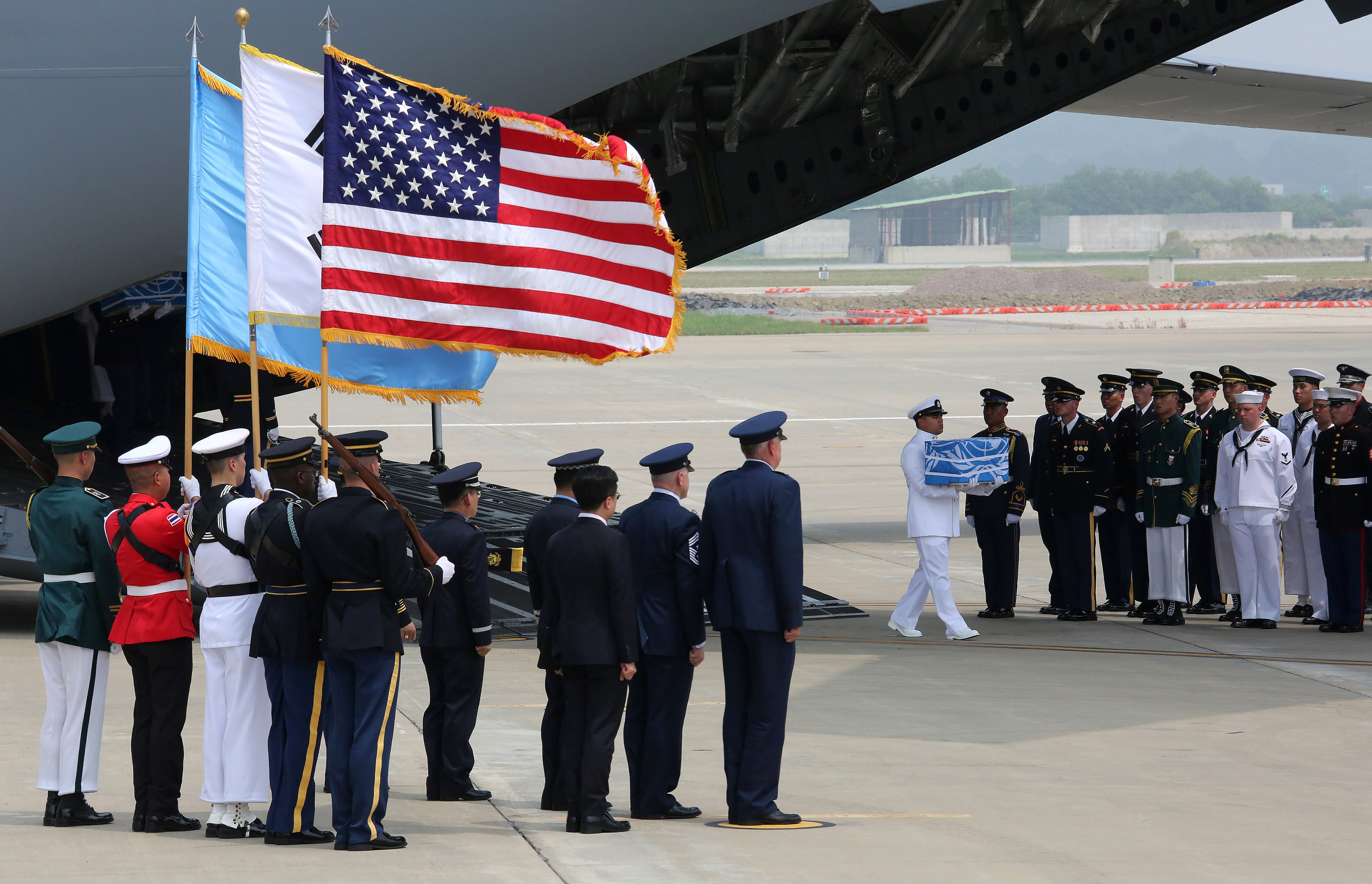
A soldier carries a casket containing the remains of a U.S. soldier who was killed in the Korean War during a ceremony at Osan Air Base in Pyeongtaek, South Korea, July 27, 2018. REUTERS/Kim Hong-Ji/Pool

By Joyce Lee and Eric Beech

SEOUL/WASHINGTON (Reuters) – North Korea transferred 55 small, flag-draped cases carrying the suspected remains of U.S. soldiers killed in the Korean War on Friday, officials said, a first step in implementing an agreement reached in a landmark summit in June.

The repatriation of the remains missing in the 1950-53 conflict is seen as a modest diplomatic coup for U.S. President Donald Trump as it was one of the agreements reached during his meeting with North Korean leader Kim Jong Un in Singapore aimed primarily at securing the denuclearization of the North.

“After so many years, this will be a great moment for so many families. Thank you to Kim Jong Un,” Trump wrote on Twitter.

A White House statement earlier said: “We are encouraged by North Korea’s actions and the momentum for positive change.”

A U.S. military transport plane flew to an airfield in North Korea’s northeastern city of Wonsan to bring the remains to Osan air base in South Korea, the White House statement said.

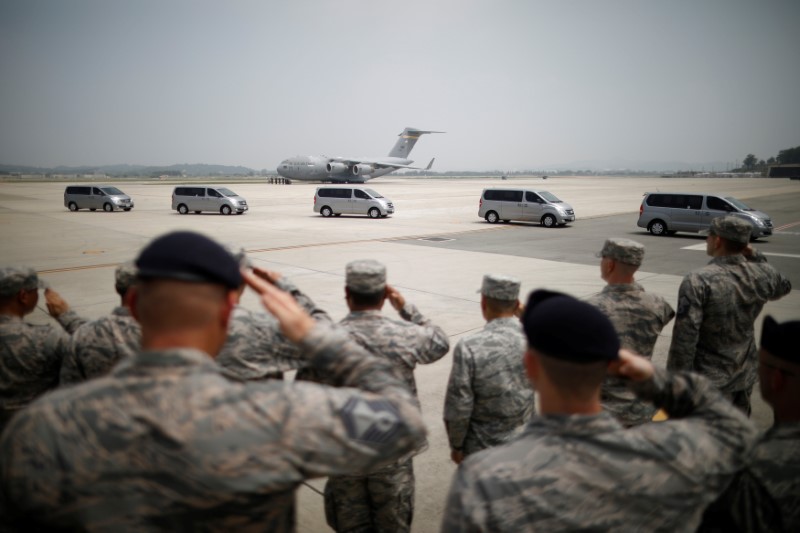
Soldiers in dress uniforms with white gloves were seen slowly carrying 55 small cases covered with the blue-and-white U.N. insignia, placing them one by one into silver vans waiting on the tarmac in Osan.

A U.N. honor guard carries a box containing remains believed to be from American servicemen killed during the 1950-53 Korean War after it arrived from North Korea, at Osan Air Base in Pyeongtaek, South Korea, Friday, July 27, 2018. Ahn Young-joon/Pool via Reuter

A U.N. honor guard carries a box containing remains believed to be from American servicemen killed during the 1950-53 Korean War after it arrived from North Korea, at Osan Air Base in Pyeongtaek, South Korea, Friday, July 27, 2018. Ahn Young-joon/Pool via Reuters

Straight-backed officers looked on next to the flags of the United States, South Korea and the United Nations.

A formal repatriation ceremony would be held at Osan on Wednesday, the White House said.

The remains would then be flown to Hawaii for further processing under the U.S. Defense POW/MIA Accounting Agency, the U.N. Command said in a statement.

The transfer of the remains coincided with the 65th anniversary of the 1953 armistice that ended fighting between North Korean and Chinese forces on one side and South Korean and U.S.-led forces under the U.N. Command on the other. The two Koreas are technically still at war because a peace treaty was never signed.

Kim paid tribute to the North’s Korean War “martyrs” and to Chinese soldiers killed in the conflict, state media said.

More than 7,700 U.S. troops who fought in the Korean War remain unaccounted for, with about 5,300 of those lost in what is now North Korea.

U.S. soldiers salute to vehicles transporting the remains of 55 U.S. soldiers who were killed in the Korean War at Osan Air Base in Pyeongtaek, South Korea, July 27, 2018. REUTERS/Kim Hong-Ji/Pool

U.S. soldiers salute to vehicles transporting the remains of 55 U.S. soldiers who were killed in the Korean War at Osan Air Base in Pyeongtaek, South Korea, July 27, 2018. REUTERS/Kim Hong-Ji/Pool

GOODWILL GESTURE

The pledge to transfer war remains was seen as a goodwill gesture by Kim at the June summit and, while it has taken longer than some U.S. officials had hoped, the handover will rekindle hopes for progress in nuclear talks.

Kim committed in a broad summit statement to work toward denuclearization but Pyongyang has offered no details.

South Korea welcomed the return of the remains, calling it “meaningful progress that could contribute to fostering trust” between Pyongyang and Washington.

The two Koreas agreed to hold general-level military talks on Tuesday to discuss ways to implement their own summit in April in which they vowed to defuse tensions, Seoul’s defense ministry said on Friday.

South Korea also said it plans to cut the number of troops from 618,000 to 500,000 by 2020 and the number of generals from 436 to 360 as part of military reforms.

The plan comes amid a thaw in relations between the two Koreas and days after the South pledged to reduce guard posts and equipment along the demilitarized zone on its border with the North.

It would spend 270.7 trillion won ($241.8 billion) on the reforms from 2019-23, which translates into a 7.5 percent rise in its annual defense budget, the ministry said in a statement.

Pyongyang has renewed calls for a declaration of the end of the Korean War, calling it the “first process for peace” and an important way Washington can add heft to security guarantees it has pledged in return for North Korea giving up its nuclear weapons.

The U.S. State Department says Washington is committed to building a peace mechanism to replace the armistice when North Korea has denuclearised.

U.S. Secretary of State Mike Pompeo told a Senate hearing on Wednesday North Korea was continuing to produce fuel for nuclear bombs despite of its pledge to denuclearize, even as he argued that the United States was making progress in talks with Pyongyang.

Pompeo said North Korea had begun to dismantle a missile test site, something Kim also promised in Singapore, and called it “a good thing, steps forward”. However, he said Kim needed to follow through on his summit commitments to denuclearize.

The U.N. Security Council has unanimously boosted sanctions on North Korea since 2006 in a bid to choke off funding for Pyongyang’s nuclear and ballistic missile programs, banning luxury goods said to include recreational sports equipment.

The United States has blocked a request by the International Olympic Committee to transfer sports equipment to North Korea so its athletes can participate in the Olympic Games, United Nations diplomats said on Thursday.

Before Friday’s transfer of remains, the United States and North Korea had worked on so-called joint field activities to recover Korean War remains from 1996-2005. Washington halted those operations, citing concerns about the safety of its personnel as Pyongyang stepped up its nuclear program.

More than 400 caskets of remains found in North Korea were returned to the United States between the 1990s and 2005, with the bodies of some 330 other Americans also accounted for, according to the Defense POW/MIA Accounting Agency.

Pentagon officials have said discussions with North Korea have included resuming field operations in the North to recover remains.

The program helped bring in vital hard currency to North Korea, which has been under U.S.-led sanctions for decades. However, reviving it could complicate U.S. efforts to persuade countries around the world to maintain economic pressure on Pyongyang over its ballistic and nuclear programs.

(Reporting by Eric Beech and David Brunnstrom in WASHINGTON and Joyce Lee in SEOUL; Additional reporting by Hyonhee Shin in SEOUL; Editing by Mohammad Zargham, Paul Tait and Nick Macfie)

U.S. Christian pastor leaves Turkish prison after court ruling

U.S. pastor Andrew Brunson reacts as he arrives at his home after being released from the prison in Izmir, Turkey July 25, 2018. Demiroren News Agency, DHA via

By Ezgi Erkoyun and Daren Butler

ISTANBUL (Reuters) – A U.S. Christian pastor on trial in Turkey on terrorism charges left prison on Wednesday after a court ruled he should be transferred to house arrest, a step that could help reduce tension between the NATO allies.

Andrew Brunson, who has worked in Turkey for more than 20 years and has been detained for the last 21 months, was escorted out of prison by officials in the coastal city of Izmir, live television footage showed. He departed in a convoy of cars.

Brunson, who is from North Carolina, was detained in October 2016 and charged with helping the group which Ankara says was behind a failed military coup earlier that year.

His lawyer Ismail Cem Halavurt said Brunson has to wear an electronic ankle bracelet and is banned from leaving the country.

The same court rejected a week ago a call by Brunson’s defense for his release. The state-owned Anadolu news agency said the court had decided, after re-evaluating the case, that he could leave prison on health grounds and because he would be under effective judicial control.

Brunson’s detention deepened a rift between NATO allies Washington and Ankara, who are also at odds over the Syrian war and Turkey’s plan to buy missile defenses from Russia.

A source in the United States familiar with the developments said the sudden shift came a day before U.S. Vice President Mike Pence had been set to unveil a harsh new policy on Turkey.

The source, who was not authorized to speak publicly about the matter, said U.S. and Turkish officials had been working on a deal that would lead to Brunson’s release, with Washington expecting him to be freed at the trial last week.

U.S. officials had been under the impression that the deal was in place, the source said, adding that when Brunson was not released, Pence spoke with President Donald Trump and the two agreed harsh new policy measures were needed to force the issue.

Pence spoke by phone on Wednesday with Brunson, who expressed gratitude for the help from Trump and his top officials in securing his move from prison, the source said.

“LONG OVERDUE NEWS

Brunson was accused of helping supporters of Fethullah Gulen, the U.S.-based cleric who Turkish authorities say masterminded the coup attempt against President Tayyip Erdogan in which 250 people were killed. He was also charged with supporting outlawed PKK Kurdish militants.

The pastor, who denies the charges, faces up to 35 years in jail if found guilty.

U.S. Secretary of State Mike Pompeo welcomed what he said was the “long overdue news” of Brunson’s transfer, but said it was not enough. “We have seen no credible evidence against Mr. Brunson, and call on Turkish authorities to resolve his case immediately in a transparent and fair manner,” he said on Twitter.

Financial markets took the transfer order as a positive, seeing in it the potential for improvement in ties between Ankara and Washington.

The Turkish lira strengthened to 4.8325 against the dollar from 4.8599 before the report. Shares of Halkbank, whose former deputy general manager was convicted in January of evading U.S. sanctions on Iran, jumped 12 percent.

Erdogan has previously linked Brunson’s fate to that of the Muslim cleric Gulen, whose extradition from the United States has been a long-held demand of Turkish authorities. Gulen denies any involvement in the coup bid.

Trump said in a tweet last week that Brunson was being held hostage and that Erdogan should “do something to free this wonderful Christian husband & father”.

The U.S. Senate passed a bill last month including a measure that prohibits Turkey from buying F-35 Joint Strike Fighter jets because of Brunson’s imprisonment and Turkey’s purchase of Russia’s S-400 air defence system.

(Additional reporting by Omer Berberoglu in Istanbul; Tuvan Gumrukcu in Ankara; Roberta Rampton and Doina Chiacu in Washington; Writing by Dominic Evans and David Dolan; editing by David Stamp and Mark Heinrich)

Trump tells Iran ‘never, ever threaten’ U.S. or suffer consequences

FILE PHOTO: U.S. President Donald Trump speaks about his summit meeting with Russian President Vladimir Putin as he begins a meeting with members of the U.S. Congress at the White House in Washington, July 17, 2018. REUTERS/Leah Millis/File Photo

By Warren Strobel and Parisa Hafezi

WASHINGTON/ANKARA (Reuters) – U.S. President Donald Trump told Iran it risked dire consequences “the like of which few throughout history have suffered before” if the Islamic Republic made more threats against the United States.

His words, spelled out in capital letters in a late night Twitter message, came hours after Iranian President Hassan Rouhani told Trump that hostile policies toward Tehran could lead to “the mother of all wars.”

Despite the heightened rhetoric, both sides have reasons to want to avoid starting a conflict that could easily escalate.

Trump’s comments come in the context of a barrage of speeches and online communications meant to foment unrest and pressure Iran to end its nuclear program and its support of militant groups, according to U.S. officials.

Iran has faced increased U.S. pressure and possible sanctions since Trump’s decision in May to withdraw the United States from a 2015 international agreement over Iran’s nuclear program.

In his message directed at Rouhani, Trump wrote: “Never, ever threaten the United States again or you will suffer consequences the likes of which few throughout history have ever suffered before. We are no longer a country that will stand for your demented words of violence and death. Be cautious!”.

Earlier on Sunday, Rouhani had told a gathering of Iranian diplomats: “Mr Trump, don’t play with the lion’s tail, this would only lead to regret.”

“America should know that peace with Iran is the mother of all peace, and war with Iran is the mother of all wars,” said Rouhani, quoted by the state news agency IRNA.

Rouhani left open the possibility of peace between the two countries, at odds since the 1979 Islamic Revolution. But Iran’s most powerful authority Supreme Leader Ayatollah Ali Khamenei said on Saturday negotiations with the United States would be an “obvious mistake”.

Rouhani also scoffed at Trump’s threat to halt Iranian oil exports and said Iran has a dominant position in the Gulf and the Strait of Hormuz, a major oil shipping waterway.

A senior commander of Iran’s elite Revolutionary Guards reacted angrily to Trump’s threats by saying Tehran would continue to resist its enemies, Iran’s Students news Agency ISNA reported.

“We will never abandon our revolutionary beliefs … we will resist pressure from enemies … America wants nothing less than (to) destroy Iran … (but) Trump cannot do a damn thing against Iran,” Brigadier General Gholamhossein Gheybparvar said.

“WAR OF WORDS”

Trump’s warning to Iran came hours after a speech by U.S. Secretary of State Mike Pompeo who denounced Iran’s clerical leadership as a “mafia” and promised unspecified backing for Iranians unhappy with their government.

Tehran reacted to Pompeo’s speech as an interference in Tehran’s affairs, the semi-official Tasnim news agency reported.

“Such policies will unite Iranians who will overcome plots against their country,” Iranian Foreign Ministry spokesman Bahram Qasemi said.

Israeli Prime Minister Benjamin Netanyahu praised Trump’s “strong stance” on Iran.

At the same time, Germany said threats of war were “never helpful”.

There is limited appetite in Washington for a conflict with Iran, not least because of the difficulties the U.S. military faced in Iraq after its 2003 invasion but also because of the impact on the global economy if conflict raised oil prices.

Many ordinary Iranians are worried that the war of words might lead to a military confrontation but insiders in Tehran told Reuters that the U.S. administration would not drag the country into another quagmire in the Middle East.

With popular discontent over Iran’s faltering economy and sliding currency, and the prospect of tough new U.S. sanctions, Iran’s leaders have called for unity.

Many ordinary Iranians are largely skeptical of the Trump administration’s support for Iranian citizens because of the harsh U.S. sanctions on the country and a visa ban imposed on Iranians barring them from entering the United States.

Iran’s faction-ridden religious and political elites have closed ranks against Trump’s hawkish approach to Tehran.

However, growing strains with the U.S. will eventually boost Rouhani’s anti-Western hardline rivals who fear losing power if the nuclear deal, championed by Rouhani, ended the country’s political and economic isolation.

Rouhani’s apparent threat earlier this month to disrupt oil shipments from neighboring countries came in reaction to efforts by Washington to force all countries to stop buying Iranian oil.

Washington initially planned to shut Iran out of global oil markets completely after Trump abandoned the deal that limited Iran’s nuclear ambitions, demanding all other countries stop buying Iranian crude by November.

But the United States has somewhat eased its stance, saying it may grant sanction waivers to some allies that are particularly reliant on Iranian supplies.

(Additional reporting by Brendan O’Brien in Washington, Dubai newsroom, Dan Williams in Jerusalem; Writing by Daniel Wallis and Parisa Hafezi; Editing by Matthew Mpoke Bigg)

Trump says Putin summit ‘even better’ than NATO meeting

FILE PHOTO: U.S. President Donald Trump waves after a joint news conference with Russian President Vladimir Putin (not pictured) in Helsinki, Finland July 16, 2018. REUTERS/Grigory Dukor

WASHINGTON (Reuters) – President Donald Trump on Tuesday morning cast his Monday meeting with Russian President Vladimir Putin in a glowing light and attempted to discredit the widely held perception that the day he spent with Putin in Helsinki, Finland, was detrimental to the United States.

“While I had a great meeting with NATO, raising vast amounts of money, I had an even better meeting with Vladimir Putin of Russia,” Trump wrote in a tweet. “Sadly, it is not being reported that way – the Fake News is going Crazy!”

Trump’s news conference alongside Putin, where he discounted U.S. intelligence assessments that Russia meddled with the 2016 election, drew fire from members of both political parties, who said he put Russia above U.S. interests.

Last week, Trump met with fellow NATO members, pushing them to increase their spending on defense. In another tweet on Tuesday, he took personal credit for the strength of the North Atlantic Treaty Organization, saying it is better funded “only because of me.”

“I had a great meeting with NATO,” he said in the same tweet. “NATO was weak, but now it is strong again (bad for Russia). The media only says I was rude to leaders, never mentions the money!”

(Reporting by Lisa Lambert and Susan Heavey)

UK PM May doing ‘fantastic’ job on Brexit, says Trump, promising trade deal

British Prime Minster Theresa May and her husband Philip stand together with U.S. President Donald Trump and First Lady Melania Trump at the entrance to Blenheim Palace, where they are attending a dinner with specially invited guests and business leaders, near Oxford, Britain, July 12, 2018. REUTERS/Hannah McKay

By Jeff Mason and William James

CHEQUERS, England (Reuters) – U.S. President Donald Trump said on Friday he looked forward to finalizing a post-Brexit trade deal with Britain, marking an abrupt change from a newspaper interview when he said Prime Minister Theresa May’s strategy would kill such an agreement.

In an interview published just hours before the two leaders held talks, Trump chided the “very unfortunate” results of the prime minister’s proposals for Brexit and her negotiating tactics as Britain prepares to leaves the European Union in March next year.

However, Trump later said May was doing a “fantastic job”.

“Once the Brexit process is concluded and perhaps the UK has left the EU, I don’t know what they’re going to do but whatever you do is OK with me, that’s your decision,” Trump told a press conference with May in the garden of her official country residence Chequers.

“Whatever you do is OK with us, just make sure we can trade together, that’s all that matters. This is an incredible opportunity for our two countries and we will seize it fully.”

Last week at the same location, May finally won agreement for her Brexit plans from her cabinet but within days two senior ministers had quit, departures which Trump said earlier in the week had left Britain in turmoil.

Hours after those proposals were formally published, Trump cast further doubt on the strategy, delivering a withering verdict in an interview with the Sun newspaper.

“If they do a deal like that, we would be dealing with the European Union instead of dealing with the UK, so it will probably kill the deal,” Trump said. “I would have done it much differently. I actually told Theresa May how to do it, but she didn’t listen to me.”

Asked about that interview, Trump said he did not criticize the prime minister and was gushing in his praise of his host, saying she was tough and capable.

“This incredible woman right here is doing a fantastic job, a great job,” he said. “Unfortunately, there was a story that was done which was generally fine but it didn’t put in what I said about the prime minister and I said a tremendous thing. It’s called fake news.”

“HIGHEST LEVEL OF SPECIAL”

May, likewise, glossed over the comments.

“We agreed today that as the UK leaves the European Union we will pursue an ambitious U.S.-UK free trade agreement,” she said. “The Chequers agreement reached last week provides the platform for Donald and me to pursue an ambitious deal that works for both countries right across our economies.”

May and Trump both spoke of the importance of the “special relationship” between their two countries, something that Brexit supporters hope will reap benefits when Britain leaves the EU, allowing it to forge closer trade ties with the world’s biggest economy.

“I would say I would give our relationship in terms of grade the highest level of special,” Trump said.

However, many have cast May’s “business-friendly” plan as a betrayal that would leave Britain too close to the EU, including lawmakers in her deeply divided Conservative Party who have warned that she might face a leadership challenge.

During the press conference, May also thanked Trump for his support over Russia which Britain has blamed for a nerve agent attack on a former Russian spy in southwest England in March.

Trump is due to meet Putin, who has rejected the nerve agent claims, at a summit when he finishes his four-day visit to Britain, and said he would raise the issue of reducing nuclear weapons.

“It will certainly be something that we bring up and talk about,” the U.S. president said.

As Trump and May spoke, thousands of protesters marched against the president through central London, one of more than 100 demonstrations planned against the president during his stay.

While Trump’s trip was not a full state visit, he has been given red carpet treatment and is scheduled to have tea later with Queen Elizabeth at Windsor Castle, where her grandson Prince Harry married U.S. actress Meghan Markle in May.

(Writing by Guy Faulconbridge and Michael Holden, editing by Larry King, Kevin Liffey and David Stamp)

Trump to talk to Russia’s Putin about substantially reducing nuclear weapons

Britain's Prime Minister Theresa May and U.S. President Donald Trump hold a joint news conference at Chequers, the official country residence of the Prime Minister, near Aylesbury, Britain, July 13, 2018. REUTERS/Hannah McKay

CHEQUERS, England (Reuters) – U.S. President Donald Trump said he would discuss substantial reductions to nuclear weapons when he meets Russian President Vladimir Putin in Helsinki on Monday.

“The proliferation is a tremendous, I mean to me, it’s the biggest problem in the world, nuclear weapons, biggest problem in the world,” Trump said alongside British Prime Minister Theresa May at her Chequers country residence.

“If we can do something to substantially reduce them, I mean, ideally get rid of them, maybe that’s a dream, but certainly it’s a subject that I’ll be bringing up with him,” Trump said of his upcoming meeting with Putin.

Trump added: “It’s also a very expensive thing but that’s the least important.”

The United States and Russia are by far the world’s biggest nuclear powers.

Trump cautioned that it was hard to do substantive deals with Russia because his opponents would say that he was too pro-Russian.

“We have this stupidity going on, pure stupidity, but it makes it very hard to do something with Russia because, anything you do, it’s like: ‘Russia, oh he loves Russia’,” Trump said. “I love the United States but I love getting along with Russia and China and other countries.”

Though Trump has not so far given specific details about what nuclear arms control treaties they would like to talk about, he and Putin are likely to discuss the possibility of extending the “New Start” treaty – a pillar of arms control.

They are also likely to discuss what to do about another pact known as the Intermediate-Range Nuclear Forces Treaty (INF) to try to dampen a high-risk nuclear rivalry between the two former Cold War foes.

Ahead of the summit, Russian diplomats have stressed the need for strategic stability talks, saying existing arms control treaties are fraying at the edges and they fear Washington will withdraw from the INF treaty. Both sides accuse one another of violating the treaty.

New Start, signed in 2010, requires both nations to cut their deployed strategic nuclear warheads to no more than 1,550, the lowest level in decades.

The treaty, which also limits deployed land- and submarine-based missiles and nuclear-capable bombers, expires in February 2021, but can be extended by five years if both sides agree.

A U.S. official said Trump would be ready to talk about New Start if Putin raised it, but it was not a big U.S. priority.

The INF Treaty, signed in 1987, required both sides to eliminate their ground-launched ballistic and cruise missiles with ranges between 500 and 5,500 km (310 and 3,420 miles).

(Reporting by Jeff Mason, additional reporting by Sarah Young; Editing by Guy Faulconbridge and Peter Graff)

Trump claims NATO victory after ‘go it alone’ ultimatum

U.S. President Donald Trump looks on as he holds a news conference after participating in the NATO Summit in Brussels, Belgium July 12, 2018. REUTERS/Reinhard Krause

By Jeff Mason and Sabine Siebold

BRUSSELS (Reuters) – Donald Trump claimed a personal victory at a NATO summit on Thursday after telling European allies to increase spending or lose Washington’s support, an ultimatum that forced leaders to huddle in a crisis session with the U.S. president.

Trump emerged declaring continued commitment to a Western alliance built on U.S. military might that has stood up to Moscow since World War Two.

People present said he had earlier warned he would “go it alone” if allies, notably Germany, did not make vast increases in their defense budgets for next year.

“I let them know that I was extremely unhappy,” he said, but added that the talks ended on the best of terms: “It all came together at the end. It was a little tough for a little while.”

German Chancellor Angela Merkel, who called the summit “very intense”, and other leaders including French President Emmanuel Macron, played down the extent to which they had pledged to accelerate spending plans as fast as Trump wanted.

“He said they must raise spending by January 2019 or the United States would go it alone,” one person said of the clash at NATO headquarters when Trump spoke in a debate that was meant to move to other matters after rows over spending on Wednesday.

Macron and others said they did not interpret Trump’s words as a direct threat to quit the alliance Washington founded in 1949 to contain Soviet expansion. Trump, asked if he thought he could withdraw from NATO without backing from Congress, said he believed he could but it was “unnecessary”.

Others say Congressional approval would be required — and would be unlikely to be forthcoming.

Trump hailed a personal victory for his own strategy in complaining loudly that NATO budgets were unfair to U.S. taxpayers, and the emergence of what he said was a warm consensus around him.

Several diplomats and officials said, however, that his undiplomatic intervention — including pointing at other leaders and addressing Merkel as “you, Angela” — had irritated many.

As the drama unfolded, a day after Trump launched a virulent public attack on German policy, NATO Secretary General Jens Stoltenberg cleared the room of many officials and the invited leaders of non-members Georgia and Afghanistan so that the other 28 leaders could hold a closed session with the president.

SPENDING TARGETS

NATO members have committed to spending at least two percent of their national income on defense by 2024, though the terms allow for stretching that in some cases to 2030. The United States, far the biggest economy, spent 3.6 percent last year, while Germany, the second biggest, paid out just 1.2 percent and only a handful of countries met the 2 percent target.

Trump told leaders he wanted them all to hit that target by January, prompting consternation. Many have already settled their 2019 budgets and the sums involved are immense — even if they wanted to, many would struggle to make useful purchases.

Merkel told reporters there followed a discussion with assurances to Trump that spending was increasing — something he later acknowledged was happening at an unprecedented rate.

“The American president demanded what has been discussed for months, that there is a change in the burden sharing,” Merkel said. “I made clear that we are on this path. And that this is in our own interests and that it will make us stronger.”

Asked when exactly the allies would now reach their two percent of GDP target, Trump said it would over the coming years. Macron said France, which last year spent 1.8 percent on defense, would meet the target by the 2024 deadline.

Spanish Prime Minister Pedro Sanchez, who like the summit host, Belgian Prime Minister Charles Michel, was singled out in the room by Trump for spending less that 1 percent of GDP on defense, said Madrid would also meet the target by 2024.

“We have a very powerful, very strong NATO, much stronger than it was two days ago,” Trump said. “Secretary Stoltenberg gives us total credit, meaning me, I guess, in this case, total credit. Because I said it was unfair.”

(Additional reporting by Robin Emmott, Alissa de Carbonnel and Humeyra Pamuk in Brussels, John Walcott in Washington, Writing by Robin Emmott; Editing by Janet Lawrence and Jon Boyle)